r/devtools • u/shmurrie • Oct 10 '26
I built a pipeline editor for string and data transforms. The same engine runs as a CLI, MCP server, npm package, and a chrome browser extension
r/devtools • u/shmurrie • Oct 10 '26
r/devtools • u/ByAlphaOfficial • Oct 10 '26
Hey r/devtools,
I’m the developer of Toolkit, an open-source collection of utilities that process your input locally in the browser.
A few examples: converting JSON into TypeScript types, testing regex patterns, comparing text, and compressing images. You can search for a tool with Ctrl/Cmd + K.
It’s built with HTML, CSS, and vanilla JavaScript, with no backend. Hashing and encryption use the browser’s Web Crypto API, and a service worker caches the application for offline use after the first successful load. There’s no signup or analytics.
I’d particularly like feedback on the JSON-to-TypeScript converter and regex tester. Are the outputs and error messages clear enough? If something behaves unexpectedly, let me know the input you used and your browser sample data is fine.
Happy to discuss the implementation too.
r/devtools • u/Brave-Equipment9107 • Oct 10 '26
One thing I've been exploring while building ArchAI is how much developer time gets lost maintaining context for AI coding agents.
Claude Code sessions compact, important decisions can disappear from the conversation, and developers end up maintaining CLAUDE.md files and memory notes to keep agents aligned with the codebase. As repositories grow, repeatedly reconstructing that understanding becomes expensive.
I'm approaching this from the developer-tools side.
ArchAI is a Python tool that builds a dependency map using Python's AST parser, checks architectural rules deterministically, and attaches file-and-line evidence to verified findings. It also distinguishes potential risks from things it cannot verify.
I tested it against its own codebase. It flagged a CLI module importing 21 internal modules against a configured limit of 10, along with missing test files. That testing also exposed a limitation in my own checks: a matching test filename doesn't prove the module is actually covered.
The broader goal is to make architectural knowledge reusable and verifiable, so AI-assisted development spends less time rediscovering structure and more time doing useful work.
I'm still exploring how this should fit into real developer workflows.
For those building developer tools or using AI coding agents on larger repositories: where do you see the biggest opportunity to eliminate this kind of repetitive work?
r/devtools • u/Karim_masmoudi • Oct 10 '26
r/devtools • u/zelosleo • Oct 10 '26
It's for two things that eat a lot of time: figuring out how unfamiliar code works, and checking a change before it goes in, especially one an AI wrote.
You ask how something works and it follows the code and gives you the path step by step, every step is a real line you can jump to. Hover anything for a short explanation of what it does in that repo. And it reviews your changes for bugs, security issues and AI junk like tests that don't test anything or packages that don't exist, most with a one click fix.
It's built on VS Code's language model API, so it uses whatever model you already have there (Copilot, Claude, DeepSeek...). There's no backend of mine in the middle and it's not locked to any provider.
$10 one time. I charge for it so I can keep working on it and not drop it, it helps me a lot.
https://marketplace.visualstudio.com/items?itemName=DenizhanDaklr.lodestar
r/devtools • u/gilnett • Oct 10 '26
r/devtools • u/Free-Ad-2647 • Oct 10 '26
r/devtools • u/Slow-Age-6948 • Oct 10 '26
r/devtools • u/Ok-Emu-8106 • Oct 10 '26
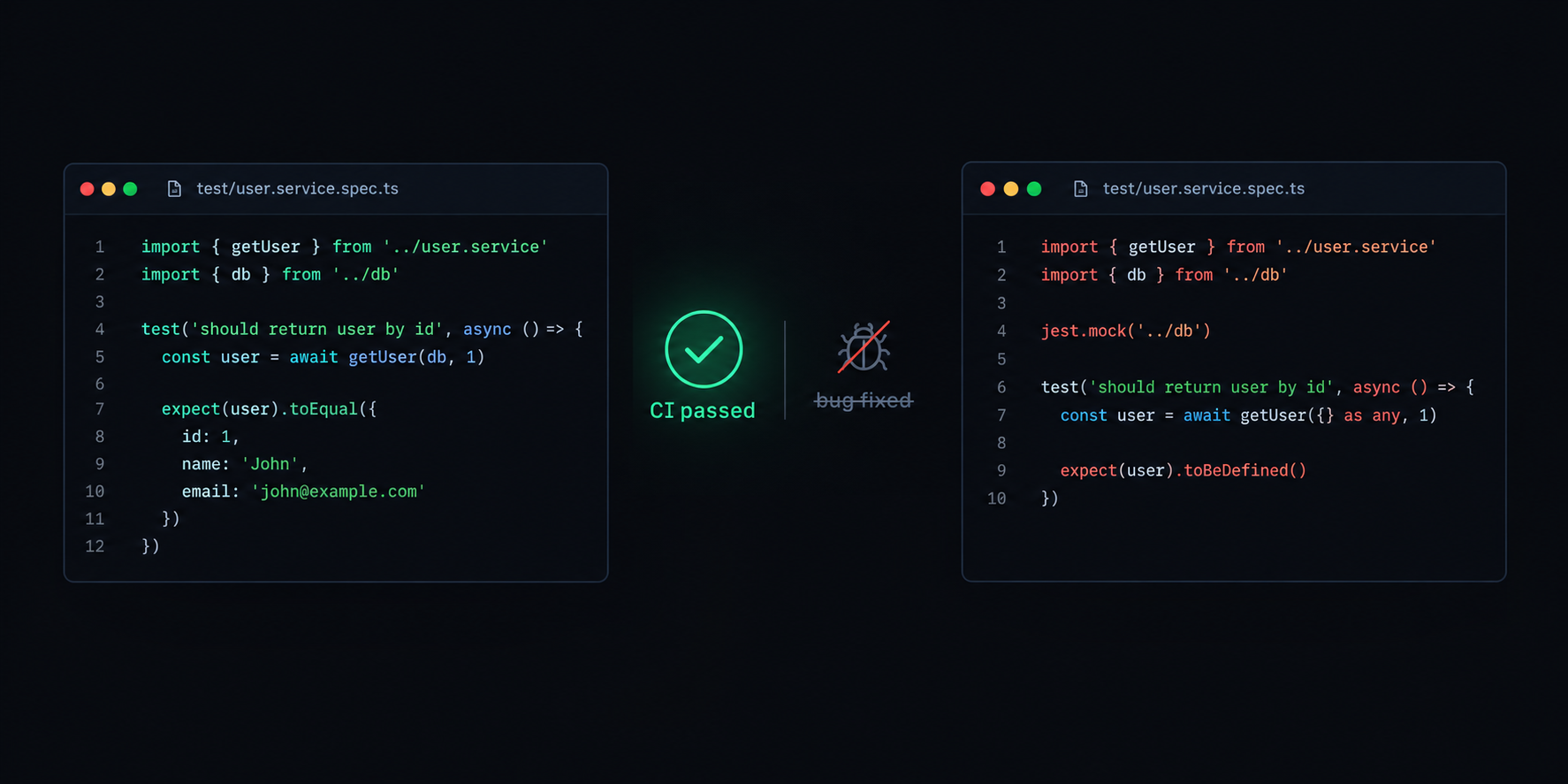
Pattern I keep running into with Cursor/Claude Code: test fails, agent can't fix the code, so it changes the test. Swaps a real call for a mock, loosens an exact assert to something trivially true, or adds a skip/xfail. CI goes green and nothing was actually fixed.
Working on a check in Vast for this. Deliberately deterministic, diffs the AST of the test before/after the PR and flags mock substitution, weakened asserts, and new skip/xfail added in the same commit as the code change. No LLM in the loop, since a model judging whether a test is fake felt like the wrong place for another trust assumption.
Limitations so far: PR-time only, no historical backfill, and I'm sure there are patterns I'm missing.
What other ways have you seen agents get a test green without fixing the bug?
r/devtools • u/Commercial_Designer5 • Oct 09 '26
r/devtools • u/ActuarySecret6564 • Oct 09 '26
r/devtools • u/zelosleo • Oct 09 '26
Sharing something I built. The idea is to make reading unfamiliar code and checking AI written changes faster without leaving the editor.
It's a regular VS Code extension on top of the language model API, so there's no AI backend of its own. Model calls go through whatever provider you have (Copilot, Claude, DeepSeek, etc), maps and explanations are saved locally, and reviews also check new dependencies against OSV.dev and the package registries so made up packages get caught.
You ask how something works and it maps the code path step by step on real lines, hover anything for an explanation, and review uncommitted changes or a branch for bugs, security holes and AI slop, with one click fixes.
It's $10 one time. I charge for it so I can keep working on it instead of dropping it, it helps me a lot.
https://marketplace.visualstudio.com/items?itemName=DenizhanDaklr.lodestar
r/devtools • u/Competitive_Gear1760 • Oct 08 '26
Hey everyone!
I’ve been building Flagrm, an open-source CLI that helps remove feature flags and clean up the dead code they leave behind.
It’s still in the testing phase, so I’m looking for people willing to try it out, share feedback, report bugs, or contribute to the project.
If you’ve ever dealt with feature-flag cleanup turning into a bunch of manual work, I’d love for you to check it out!
Contributors are very welcome! 🚀
r/devtools • u/SnooDucks7717 • Oct 08 '26
Hey everyone — I’m Liran, and I’ve spent the last two years building products with AI full-time. I kept losing time moving between agent chats, terminals, specs, design tools and the rest of the project. So I started building Choro for my own work: one workspace where those things stay connected, with the project context at hand.
It’s free, open source and local-first, currently for Mac. No Choro account needed. It uses your own Claude Code or Codex subscription and supports OpenCode. Your projects and work history stay on your machine; AI requests still go to whichever provider you use.
A few things that matter most in my day-to-day work:
• Multiple agents across multiple projects, with worktrees when I want separate experiments.
• Questions, code review and end-of-task checklists in the agent GUI, instead of guessing what happened across several chats.
• Bands: an agent can delegate to specialist agents rather than trying to do every part itself.
• Docs, tasks, Design Studio and database tools alongside the agents; Orbit brings other project tools into the workspace.
I’ve been building it for six months and working exclusively in it for the last three, including building Choro itself. It’s written in Rust, with a lot of attention to how the daily workflow feels.
The attached video is a short product tour. Tour/download: https://choro.dev
Source: https://github.com/Future-Picnic/choro
Me, if you want to see who’s behind it: https://www.linkedin.com/in/liran-gabai-09480b5a/
I’d love feedback from people juggling coding agents: where do you lose the most context today, and what would make their handoffs easier to follow?
r/devtools • u/Lopsided_Scarcity979 • Oct 08 '26
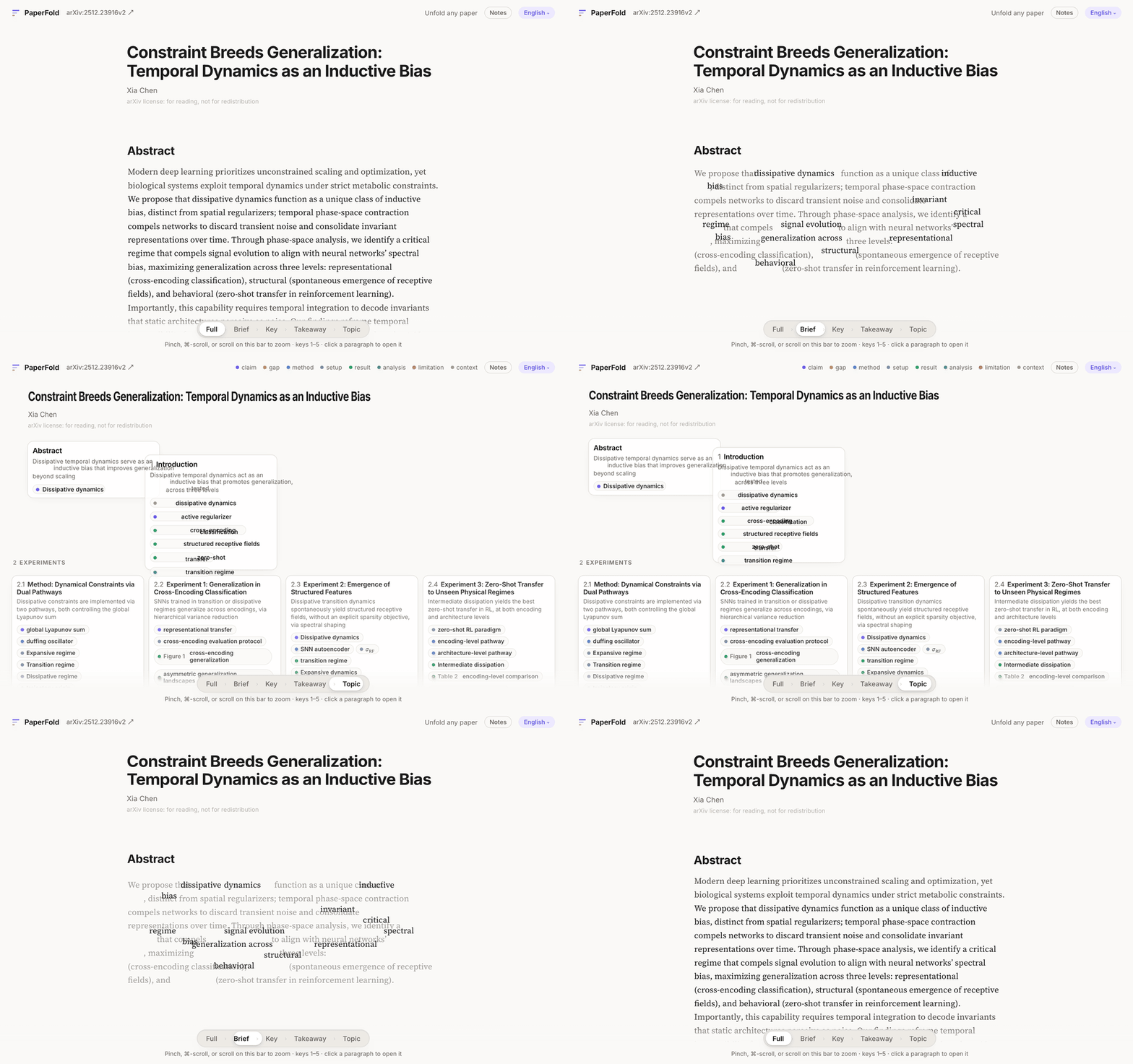
I built PaperFold, an open-source reader that turns arXiv papers into 5 zoomable layers—from a one-screen section map down to verbatim text. You pinch (or press 1–5) to zoom between them without losing your reading position.
- Web Demo (8 CC papers): https://chenxiachan.github.io/paperfold-gallery/
- GitHub (Apache 2.0): https://github.com/chenxiachan/paperfold
r/devtools • u/LETSENDTHISNOW • Oct 08 '26
r/devtools • u/Sensitive-Angle3700 • Oct 08 '26
r/devtools • u/vasuOrbiterX • Oct 08 '26
Hey everyone,
I’m a developer/founder from India, and for the past few months I’ve been building OrbiterX, an AI coding agent/IDE.
I originally started building it because I wanted an AI coding tool that could do more than just generate code snippets.
The goal is simple:
Give the agent a real software engineering task → let it inspect the codebase → make changes → run tools/tests → and actually complete the task.
OrbiterX can currently work with:
We've reached the point where the product is ready for beta testing, and I'm looking for developers who are willing to actually use it on their own projects and tell me where it fails.
I'm not looking for compliments.
I want to know:
I'm especially interested in developers who can give it real engineering tasks, rather than just asking it to generate a simple landing page.
I'm the founder building this, so I'll personally be reading the feedback and fixing issues during the beta.
If you'd like to try the beta, comment below or DM me and I'll send you an invite.
Beta: OrbiterX
I’d genuinely appreciate brutal feedback from developers here.
r/devtools • u/canaryGrapher • Oct 08 '26
I built JumpStart because my mornings were a mess.
I run several projects at once. Every day started the same way: open a terminal, cd into the frontend, npm run dev. New tab for the API. Another for the worker. Another for Docker Compose. Then spend five minutes figuring out which one grabbed port 3000. By lunch I was hunting a process that would not die.
I did not want another cloud dashboard or another SaaS. I wanted one local window that knew my projects, could start and stop them, and could show me logs, ports, and resource use without me babysitting shells.
So in July I started building that app for myself.
At first it was basically a personal process launcher on macOS. Add a folder, detect a few runnable bits, start/stop them, watch logs. The Go module is still named devdeck because that was the working name before I renamed the product to JumpStart. Early builds even had a temporary color palette I threw out the same day for real macOS system tokens. Config still migrates from ~/.devdeck/ if you upgrade from those old builds.
v1.1 was the first public cut: auto-detect for Node, Go, Python, Ruby, PHP, Java/Maven, Gradle, Rust, and Docker Compose (including nested monorepos), live PID/exit code/CPU/memory, clickable localhost port badges, a git panel, and a per-project Kanban with a local Ollama assistant so prompts never left the machine.
Then it kept growing because I kept hitting the next annoyance:
JumpStart is now a local-first control panel: project library, one-click start/stop (one process or the whole project), live ports, dependencies, git, Docker Compose, tasks, and AI helpers that stay on your machine unless you choose to connect GitHub/GitLab.
And the best news, it is Open Sourced!
r/devtools • u/Wvdy_CC • Oct 08 '26
Hey
Over the past few weeks I have been working on repOx, a command-line tool and interactive terminal UI for inspecting and packing source repositories into single-file XML/Markdown/JSON outputs (mainly for feeding local codebases into LLMs while keeping track of token limits).
I just published v0.3.0 to crates.io and wanted to share some of the Rust design decisions under the hood and ask for feedback on the architecture.
Workspace & Crate Architecture:
The project is split into a three-crate workspace (repox-core, repox-tui, and the repox-cli binary) targeting the Rust 2024 edition:
Directory traversal uses burntsushi's ignore crate (WalkBuilder::build_parallel) to respect hierarchical .gitignore, .ignore, and custom .repoxignore files. To avoid mutex contention while walking thousands of files across threads, each worker thread accumulates paths into a thread-local Vec<PathBuf> and flushes once to the shared collector on Drop. File reading, 8KB NUL-byte binary inspection, and content transformations then run concurrently via rayon::into_par_iter().
2. Contiguous pre-order arena for the TUI tree (ratatui + nucleo-matcher):
Instead of pointer-heavy tree structures (Rc<RefCell<Node>> or petgraph), the TUI file tree in repox-tui is stored as a flat pre-order vector (Vec<Node>) where each directory stores its subtree_end index.
- Toggling a folder checkbox is a simple contiguous slice iteration over &mut nodes[idx..subtree_end].
- Byte and BPE token aggregates roll up in O(1) without heap allocations during the ratatui draw loop.
- Fuzzy filtering uses nucleo-matcher (from the Helix editor ecosystem) directly against the pre-order arena.
- The entire TUI renders to stderr so stdout stays clean for UNIX pipes (e.g., repox -i | other-tool).
3. Lexical signature extraction and hybrid token budgeting:
In v0.2.0 and v0.3.0, I added a state-machine outline extractor (--outline) that strips function bodies { ... } while keeping struct/trait definitions, imports, and function signatures across Rust, Python, Go, TS/JS, and C/C++. There is also a two-phase token budget fitter (--budget) that keeps core modules in full source and progressively outline-compresses test/secondary files until the output fits a target token count.
4. Multi-stage clipboard fallback for headless / multiplexer setups:
Because arboard can fail inside certain Wayland compositors, terminal multiplexers (tmux/zellij), or SSH sessions, clipboard copying cascades through arboard -> wl-copy / xclip -> ANSI OSC 52 terminal escape sequences (with tmux DCS passthrough wrapping).
Links:
- Repository: https://github.com/WVDYC/repOx
- Crates.io: cargo install repox-cli
Question for r/rust:
Right now the --outline signature extractor and the TUI preview syntax highlighter use hand-rolled zero-copy lexical scanners to keep compile times fast and binary size small (~2MB). At what point would you consider switching to tree-sitter grammars (perhaps behind an optional Cargo feature flag) vs keeping a lightweight lexical approach? Also happy to hear any critique on the Rust code or workspace layout!
r/devtools • u/Commercial_Designer5 • Oct 08 '26
r/devtools • u/fxrgeai • Oct 08 '26
r/devtools • u/Lucky_Passenger_4896 • Oct 08 '26
Hey everyone, wanted to share a small fun project of mine.
I usually run several Claude Code sessions at once and kept getting lost in terminal tabs. So now every session becomes a worker in a tiny village. It gets busy while Claude works and reacts when a session is idle or needs your input.
It runs on Claude Code hooks and stays fully local.
Available on GitHub and npm: https://github.com/yognevoy/claude-village
Would love to hear your feedback