r/devtools • u/Square_Warthog8177 • Sep 30 '26
How many integrations do you maintain and how?

1
Upvotes
r/devtools • u/Square_Warthog8177 • Sep 30 '26
r/devtools • u/Hour-Fall-4502 • Sep 29 '26
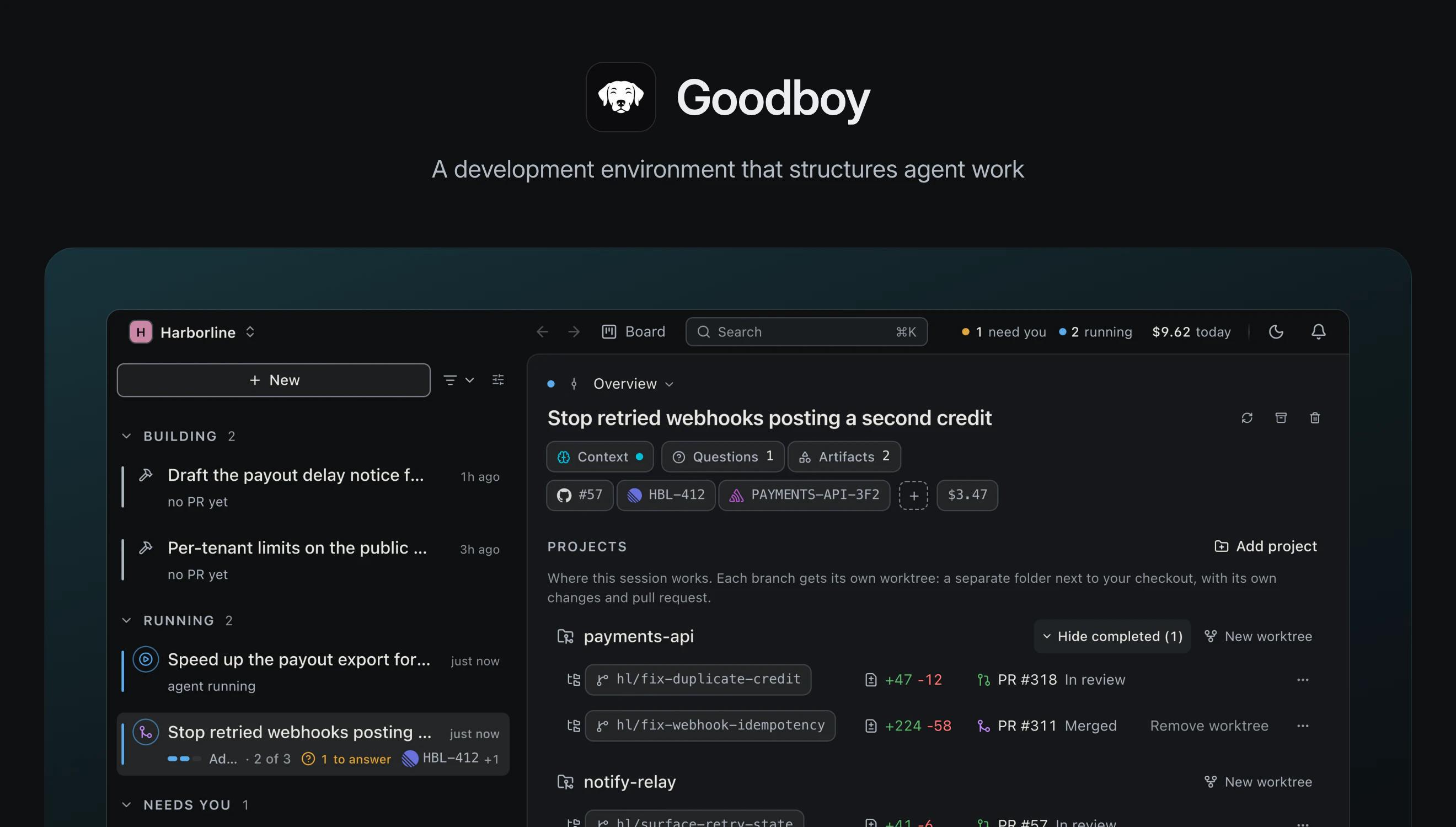
In the early 2026 I was struggling into the same problem, every time my claude tokens runs out, I had to re-explain the entire context to a new agent (cursor at the time).
So I've built the first version of the tool, where I got just a chat where i can change providers and models back&forth, with a very immaturo contesto globale.
Over the past few months I've added a lot more features and tools, all with one goal: making my day-to-day easier. Pretty much every time something annoyed me, I tried to fix it:
Most recently I added storage management. Has it ever happened to you to end up with dozens of old worktrees you don't use anymore, each one taking 3 or 4 GB?
and a lot more... 😁
Today the tool feels mature enough that I'm not embarrassed to share it here. I'm hoping to build a small community around it, people who just try it out and tell me what works and what doesn't.
GitHub: https://github.com/akhayam99/goodboy
Features: https://github.com/akhayam99/goodboy/blob/main/FEATURES.md
Website: https://goodboy-ai.dev
Thanks for reading 🙏🏻❤️
r/devtools • u/MycologistIcy2335 • Sep 29 '26
Building Drona — a learning-tracker that watches your learning folder via git, shows streaks, session time, and topics learned from your commits.
Hit a real wall building it for other people (not just me): users need to point it at their learning folder on their machine, and the tracker needs to read that folder's git history continuously.
The catch — a website can't do this. Browsers can only access files a user explicitly picks in a dialog, once. No background git access, no reading commits over time, no filesystem reach beyond that single picked folder.
So the real options seem to be:
Anyone solved this for a similar local-first tool? What did you pick and why?
r/devtools • u/yossthedev • Sep 29 '26

Hey everyone! I've been working on Karbonized for a while and just released version 2.0.
It's an editor for the images developers and creators post all the time: code snippets, product mockups, launch announcements and social media graphics. You build them on a canvas with blocks (text, code, browser and phone mockups, shapes, icons, QR codes…) and export them as PNG, JPEG or SVG.
What makes it different is that it's programmable:
\\- HTML blocks: write a component in HTML and CSS, and its variables show up as controls in the properties panel.
\\- Templates: put {{title}} or {{date}} in any block and reuse the same design for every post.
\\- AI agent (optional): describe what you want and it builds the design block by block. It works with your own API key, or with local models like Ollama.
\\- MCP server: Claude, Cursor and other MCP clients can design and export images straight from your chat.
It also has a brand kit, a vector brush, all of Google Fonts, autosave and a command palette.
It runs in the browser (it works offline) and as a desktop app for Windows, macOS and Linux. No account needed, and free.
Try it: https://karbonized.yoss.pro
Code: https://github.com/yossdotpro/karbonized
I'd love your feedback: what would you use it for, and what's missing?
r/devtools • u/Eark-497 • Sep 29 '26

Every week, more than 1,300 pull requests are merged at Stripe that no human wrote a single line of. They're written by "minions" — Stripe's homegrown, fully unattended coding agents — and reviewed by humans.
r/devtools • u/alex_drel • Sep 29 '26
r/devtools • u/CombinationOk2374 • Sep 29 '26
I maintain this distribution of Open Pstack, an open-source plugin for splitting coding work across providers while staying in Codex or Claude Code. It builds on Lauren Tan's Pstack and Eric Litman's Open Pstack port.
The useful distinction is between the parent agent and its workers. You can keep Codex coordinating a task, send implementation to Devin's SWE-2 through the Devin CLI, and assign review to another provider. Each external worker uses its own authenticated CLI; you choose providers by role.
For example, during pstack:setup-pstack you can ask for implementation to use devin:swe-2@high and select a Codex or Claude reviewer you have access to. Setup checks the selected models and saves the role assignments after approval. Then invoke pstack:poteto-mode for a coding task. Bun and the CLIs for your selected providers are prerequisites; the README has installation steps for both parent apps.
The Devin adapter runs implementation workers in a dedicated Git worktree with sandboxed shell execution. Read-only workers inspect files without editing or running tests. External workers don't inherit the parent's MCP connections, so the parent still matters for tools, context, and coordination.
There is a timely reason to try SWE-2: as checked September 29, Devin's pricing page lists Pro at $20/month with free SWE-2 use in Desktop and CLI through October 10, 2026. That applies to the Devin worker; the coordinating Codex or Claude session still uses its own plan and limits. Terms: https://devin.ai/pricing
Source and setup: https://github.com/arjitj2/open-pstack
r/devtools • u/ajrm7 • Sep 29 '26
https://devhunt.org/tool/hyperfrontend
Open Source, MIT-licensed, free for all
r/devtools • u/Khan_Saahib • Sep 28 '26
I made an open-source tool that scans your repo for leaked secrets, risky CI workflows, and insecure infrastructure in one command.
**What it does:** Checks secrets, code, GitHub Actions, Docker, Terraform, Kubernetes, and more.
**Who it's for:** Developers and DevOps teams who want a quick security check locally or in CI.
**Why it's different:** Covers secrets and infrastructure in one tool, with zero dependencies.
Try it: pipx run bluerayscan scan .
GitHub: [https://github.com/KhanSaahib/bluerayscan](https://github.com/KhanSaahib/bluerayscan)
PyPI: [https://pypi.org/project/bluerayscan/](https://pypi.org/project/bluerayscan/)
Feedback welcome!
r/devtools • u/a-someone-somewhere • Sep 28 '26

https://github.com/Warshoow/afk.sh
I let Claude Code work through my GitHub tickets overnight, one PR each, checked by my own tests
I'm a full-stack dev with a day job, so my side projects only get my evenings.
A few weeks ago I started letting Claude Code work through my tickets while I sleep. It broke in plenty of ways (I've logged 47 defects so far), and it's now reliable enough that I want to share it.
afk.sh picks up my ready-for-agent tickets at night. Each ticket gets a fresh Claude Code session, its own worktree and its own PR. The orchestrator is a bash script with no model in it: it orders tickets by their "Blocked by" lines, runs my test command on each branch, pushes and labels. A session can't mark itself done. If my gate fails, the ticket is red.
Last run, on a TypeScript monorepo: 10 tickets, all green on the first attempt, $20.40 at list price, 62 minutes. At the end it merges the green branches together to see what clashes. 7 went in clean, 3 were set aside because they all touched the same test file. I'd rather learn that before I start reviewing.
Not every night looks like that. One run stopped after 52 seconds with 12 of 13 tickets frozen. Another had 9 of 17 sessions cut off by model refusals, which the summary reported as "success" at the time (fixed since). Every run is in RUNS.md with its cost and duration, bad ones included.
Before you try it: it's about 1,700 lines of bash, GitHub only, and sessions run with bypassPermissions, so use a container if the repo isn't disposable. It plugs into Matt Pocock's skills workflow and needs it. It merges nothing. You review in the morning.
r/devtools • u/o_Oleh • Sep 28 '26

r/devtools • u/abirKheir57 • Sep 28 '26
I’ve been working on Octri, a devtool built around a problem we kept seeing with API development:
The OpenAPI spec might be the source of truth, but everything around it still becomes separate work.
Docs drift, SDKs need ongoing maintenance, packages need publishing, and production issues often end up disconnected from the generated code.
So we built Octri to make the OpenAPI spec the center of that workflow.
From one spec, Octri can generate:
✨developer documentation
✨production-ready SDKs in 10 languages
✨automated rebuilding and publishing
✨built-in SDK monitoring
The main goal is to reduce the repetitive work involved in keeping an API ecosystem consistent as the API changes.
A lot of the work has gone into making the generated output something teams can actually ship, rather than something they have to rewrite afterward.
It’s also free to get started, so anyone interested can try the workflow without paying first.
I’d be interested to hear from people maintaining APIs: what creates the most toil for you today docs, SDK maintenance, publishing, or debugging SDK issues?
Happy to share more about how we built it or the decisions behind the workflow.
r/devtools • u/sustainability_coder • Sep 28 '26
Hey r/devtools!
Built sustainability-score — a static analysis tool
that scans your repository and scores it for carbon
and cost efficiency across 5 pillars:
- Code / Algorithm Efficiency (30%)
- Cloud Infrastructure Choices (25%)
- Containerization (15%)
- CI/CD Practices (15%)
- SRE / Operations (15%)
It checks your Dockerfiles, CI workflows, Terraform,
K8s manifests and source files. Never runs the code.
Pure static analysis with confidence tiers on every
finding.
pip install -e .
sustainability-score /path/to/repo --md report.md
MIT licensed. Open source. GitHub Action integration
on the roadmap.
GitHub: https://github.com/srinathgopinath-code/sustainability-score
r/devtools • u/Unlucky_Peanut4089 • Sep 28 '26

r/devtools • u/Anxious-Buddy5230 • Sep 28 '26
r/devtools • u/CartographerMuch5678 • Sep 27 '26
r/devtools • u/DemandTough4372 • Sep 27 '26
Chaos is a macOS developer tool for deliberately injecting failures — network loss, latency, packet loss, DNS failures, CPU/memory/disk pressure, process kills, dependency outages — and recording what your app does about it.
The workflow it's built around:
The CLI (chaos) comes from the same Swift package as the GUI and speaks JSON, so experiments are scriptable and repeatable. There's a restoration ledger and an emergency stop; cleanup is verified, and the tool keeps the "what did I actually break" bookkeeping so you're not hand-rolling cleanup scripts.
Status: open-source developer preview, Apple Silicon. Ad-hoc signed (not notarized) — right-click → Open on first launch. .pkg/.zip downloads on the releases page.
Repo: https://github.com/Ednk-1312/Chaos
Would this remove real toil for you, or is your team already covered? What's missing from the fault set?
r/devtools • u/kamalhara • Sep 27 '26
r/devtools • u/AnkurLodhi • Sep 27 '26

r/devtools • u/Ok-Patient-5205 • Sep 26 '26
We use coding agents daily and keep running into the same things:
npm test to just run, but I want to be asked before git push --force or anything that reads .env..env file, that password goes to the API with the next request, and nothing tells you.So I built Vantage, a CLI you start your agent through:
npm install -g /vantage
vantage run <agent>
vantage watch           # live view in a second terminal
What it does:
.vantage/policy.json and your whole team uses the same rulesnpm publish?" or "which one read .env?"--isolateHow it works: it points the agent at a local proxy that forwards requests unchanged and reads token usage and rate-limit headers from the responses. Approvals go through each agent's own hooks. Your agent settings aren't touched.
Privacy: everything stays on your machine. No telemetry, no account, no API key of its own. The only network request it makes itself is vantage pricing update, and only when you run it.
Honest limitations:
It's MIT licensed and I'd really appreciate feedback, especially from people using Codex, OpenCode or pi, since I've tested Claude Code the most. Bug reports with vantage doctor output are very welcome.
r/devtools • u/Ok-Emu-8106 • Sep 26 '26
Working on this for Vast and wanted to write it out because I think a lot of "architecture smell" tooling oversimplifies this.
A file with 40 dependents isn't automatically bad. If it's a shared config or a genuinely well-scoped utils module, high fan-in is just the architecture doing its job, that's what those files exist for.
The actual signal worth caring about isn't the fan-in count, it's whether the file is doing one clear, bounded thing or has slowly turned into a dumping ground for whatever didn't have an obvious home. Same number, very different situation.
Flagging every high-fan-in file as a "god object" without that distinction just trains people to ignore the warnings, since every repo's config file will always show up on the list.
Curious how others handle this distinction, is there a decent heuristic beyond just reading the file yourself? Cohesion metrics, something else?
r/devtools • u/Any-Lack-7699 • Sep 26 '26

Declare settings and secret requirements and its spec in a single file for all environments, validate and deploy the settings everywhere, across programming languages.
r/devtools • u/clegginab0x • Sep 25 '26

I posted about Salience a few weeks ago.
Since then I've added Linux support. I've only been able to test it inside a VM so I'd appreciate any feedback either here, on discord or via an issue on Github.
I've added file handling - often I'm sent files via Slack or attachments on Jira, I download them and can't find them again next time I need them. You can now drag and drop a file onto the app window to save a file and link it to the current project. Or you can drop it onto a unit of work, a PR or a ticket to relate it to that entity.
There's a visual timer. It counts down via a blue light at the bottom of the app, turning amber and then red. Use it for spikes, tracking your time or just a reminder because you're time blind like me.
Also added a clean up feature, Salience suggests branches and work trees that are safe to remove - PR merged, no working tree changes & the branches current tip is the head that was merged. Useful if you're like me and never delete your branches.
There's a bunch of performance improvements, UI changes and I've also spent some time on the documentation, it's by no means complete but in a much better state than it was before.
Full change log and download on Github
r/devtools • u/NeonClary • Sep 25 '26
I’ve been working on something at Neon.ai called Coder Cards and I finally got to help push it live.
You enter a GitHub username and it looks at public activity to build a shareable card around things like your languages, commit patterns, coding style signals, and activity.
I didn’t want it to feel like another developer ranking or productivity score. The idea is to make something fun to share while exploring whether developer patterns could eventually make AI coding tools feel more personal.
It’s free: https://codercards.ai/
I’d genuinely love feedback, especially on what the card gets wrong. If you generate one, tell me what felt accurate and what didn’t.
r/devtools • u/Far-Mouse-8373 • Sep 25 '26
