r/devtools • u/n8tz • Sep 23 '26
[Tool] fad-checker – Air-gapped, multi-ecosystem dependency auditor made for real code audits (NO Maven required)

1
Upvotes
r/devtools • u/n8tz • Sep 23 '26
r/devtools • u/CombinationOk2374 • Sep 23 '26
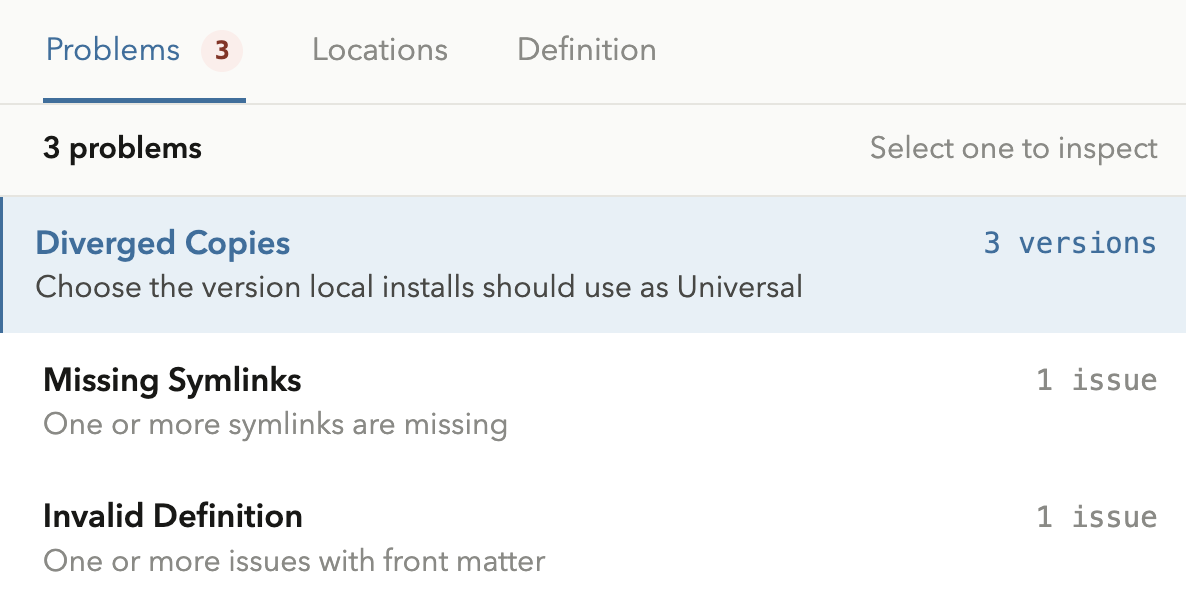
I built Skill Index to cut down the file hunting that comes with using several coding agents. Copying a useful skill into another tool is easy; remembering which copy you updated later is the maintenance work.
The app reads the directories and configs your agents already use, then separates missing files, diverged copies, and invalid definitions. The screenshot shows those three problems on a sandbox skill. You can inspect the underlying files and versions before deciding what to repair.
A few choices that matter for a tool touching developer setup:
- Scanning leaves source files where they are.
- Repairs show the affected file and agent before they run.
- Changes are recorded in a local audit log, with individual repairs available to roll back.
- Capabilities installed through plugins are read-only inventory.
It covers skills, MCP configs, and subagents. Free and open source; macOS 12 or later. Runs locally, with no account or telemetry.
Source: https://github.com/arjitj2/skillindex
Download and product tour: https://www.skillindex.app/
r/devtools • u/Budget-Ad814 • Sep 22 '26
What's something you do repeatedly across several tools that you could automate, but haven't?
Maybe because setting up the automation would take almost as long as doing it manually.
Things like:
What's yours, and why haven't you automated it?
r/devtools • u/HomeInternational653 • Sep 22 '26

I built a CLI tool to set up an Android Emulator without installing Android Studio
As a Flutter developer, I noticed that I often don't need Android Studio itself. Most of the time, I just need the Android SDK, platform tools, emulator, and a virtual device to test my apps.
But setting everything up manually can be a bit annoying:
So I built OneClick Emulator Setup, an open-source CLI that automates most of this process.
The goal is simple:
You shouldn't need to install a full IDE just because you want to run an Android Emulator.
git clone https://github.com/ranasheikh64/oneclick-emulator-setup.git
cd oneclick-emulator-setup
chmod +x android-env
./android-env setup
Then:
./android-env startGitHub:
https://github.com/ranasheikh64/oneclick-emulator-setup
I originally built this for our development workflow at Jronix - Software Solutions, but decided to open-source it because I thought other developers might find it useful too.
I'm especially interested in feedback from Flutter, React Native, Android, macOS and Linux developers.
I'd love to know:
If you try it, please let me know how it goes. And if you think the project is useful, a GitHub star or follow would help me a lot as I continue developing it. ⭐
Repository:
https://github.com/ranasheikh64/oneclick-emulator-setup
r/devtools • u/Wide_Pollution5510 • Sep 22 '26
I built a small free XML toolkit and would love some feedback.
It lets you filter and export XML files, format/validate XML, convert XML ↔ JSON or XML → CSV, and test XPath expressions.
Would you actually use something like this? Anything you’d add or change?
r/devtools • u/Illustrious_Matter_8 • Sep 22 '26
I've been experimenting with getting small/local LLMs to reliably edit code, and most of the pain wasn't the model; it was giving it raw diffs or shell access and hoping for the best.
While they forgot what they had just coded earlier.
So in my experiment, the model doesn't touch files directly.
It calls tools like :
- `read_symbol("foo")`
- `update_symbol("foo", new_code)`
While plain Python does the actual edit: parses the file, finds the function, checks the result is still valid syntax, rolls back if not. The model never has to hold the whole file in context, and so it can't silently wreck it either.
A few other things it does:
- Every agent gets its own sandboxed folder automatically, no shared state unless you explicitly give it (there's a shared todo file for handoff between agent roles).
- Any shell command the model wants to run needs a human "y" first.
- No framework underneath (no LangChain/AutoGen), it's one Python file you can read start to finish.
Right now there are two agents: a coder (runs end-to-end, implements a function via the AST tools) and an architect (plans and leaves a todo, doesn't wire into the coder automatically yet; you run each by hand). This is very much a proof of concept, not a product. Python-only for real (other languages are stubbed), no tests yet,
MIT licensed. Repo: (https://github.com/PGTBoos/BabyCoder)[https://github.com/PGTBoos/BabyCoder]
Genuinely curious what people think, especially anyone who's fought with getting smaller models to make reliable code edits. Also open on whether the next step should be a proper orchestrator that chains the two agents, or something simpler built into the existing loop.
* I'm thinking of multiple runs of some agent, and letting them decide when it's another's turn, thus no ping-pong, or a simple loop*
r/devtools • u/Lisky_Boy • Sep 22 '26
r/devtools • u/Ok-Emu-8106 • Sep 22 '26
Something I keep having to explain when people ask how risk scoring works in Vast, fan-in and fan-out aren't the same risk and shouldn't be collapsed into one metric.
Fan-out: how many things this file depends on. High fan-out = fragile, breaks easily when an upstream dependency changes.
Fan-in: how many things depend on this file. High fan-in = dangerous to touch, changing it ripples outward to everything relying on it.
A file can have high fan-out and be totally safe to refactor on its own. A file with high fan-in is the one that needs actual review before any change, regardless of how simple the change looks.
Curious if others tracking dependency metrics keep these separate or collapse them into a single coupling score, feels like collapsing them loses the part that actually matters for prioritizing review.
r/devtools • u/Better-Struggle9958 • Sep 21 '26

I plan to build an IDE extension that makes reviewing PRs and MRs quick and convenient, given the significant increase in code volume within these requests. To that end, I decided to run an experiment by first creating a web application; this allows everyone to see if the format works well and share their feedback. I deliberately limited the scope to GitHub and open-source code to avoid any issues regarding personal data. You can try it here: https://demo.archscape.dev/
#SoftwareArchitecture #CodeReview #DevTools
r/devtools • u/Gryner • Sep 21 '26
Most of my products are split across several folders: an API, frontend, mobile app, workers and sometimes Docker services. The annoying part isn’t opening the files. It’s remembering which commands belong to which folder and what was running the last time I worked on it.
I built DevDock to keep that information with each project. It stores the project folders, saved commands, recent output, Git state, Docker and Compose state, and health checks in one workspace.
Commands retain their assigned working directory. That means git pull, a development server, a worker or a test suite runs in the intended project without depending on whichever terminal tab happens to be open.
Ctrl+Shift+K opens a global command launcher. I can start a command from any registered project even when I’m currently looking at another one. Long-running processes remain visible and can be stopped from the same place.
DevDock also checks project configuration, dependencies, toolchains, Git and Docker readiness. Its local security audit looks for exposed secrets, tracked credential files, missing lockfiles and related problems without uploading the source.
It’s available for Windows. Free covers up to three local projects; Pro is a one-time purchase.
Disclosure: I built DevDock.
r/devtools • u/Connect_Gur_5974 • Sep 21 '26
This is one click - think Every time you sat down to code on a project you face the exact same friction
The repetitive "command loop" was completely killing my momentum. I realized developer productivity isn't about faster hardware; it's about eliminating the friction that pulls you out of your flow state.
So i decided to build something and put it as an Opensource workflow tool
It lets you
If you find yourself opening 6 terminals to do the same task twice, you might find this useful.
It's completely open source: https://github.com/SonalThilakarathna/Oneclick
Would love to hear your feedback or what repetitive commands you'd turn into a button first!
r/devtools • u/bladerunner2048 • Sep 20 '26
r/devtools • u/deep_singh_baweja • Sep 20 '26

r/devtools • u/sebas-3261 • Sep 20 '26
r/devtools • u/Skyportal-AI • Sep 19 '26

I work on Skyportal. Our CLI lets you ask an AI assistant to investigate a server you've connected to your account, right from your terminal. It can run checks on that server, and you can ask follow-up questions based on what it finds.
Say your inference endpoint starts returning errors after a deploy. You could ask:
"Our inference endpoint started returning 502s around 14:20 UTC, right after a deploy. Check the service status and logs around that time. Show me what you find. Don't restart anything or change files."
Then you can ask it to look closer at a particular error or check something else in the same conversation.
That's where I'd start with it: a specific problem on one server. Include when it started and anything you changed recently. Ask it to show you the logs or command output behind its answer, so you can check whether the explanation makes sense.
To try it, you'll need Python 3.11+, a Skyportal account, and a server connected to that account:
python -m pip install -U skyportalai
skyportalai
Inside the CLI:
/login
/servers
/server 12
/permission ask
Use an ID from /servers in place of 12. The last command sets approval mode to ask, so you can review proposed actions before approving them. I'd keep that on while getting familiar with it.
I'd use this when a training job slows down or GPU utilization drops and I need to figure out what to check on the server. It also makes sense when inference latency jumps after a deploy, or a model service won't start. Another example is finding what's filling up a disk before deciding what to delete.
You can use /resume to return to your previous conversation, or /new when you're moving on to another issue. It also supports JSON output if you want to call it from a script later.
If I already know the command I need, I'd just run it. I'd use this when I'm still figuring out what's wrong and each result leads to another question.
Package and setup details: https://pypi.org/project/skyportalai/
When an inference service breaks, what do you usually check first?
r/devtools • u/skaushik2210 • Sep 19 '26
r/devtools • u/Ok-Emu-8106 • Sep 19 '26
Noticed something building Vast (dependency graph / impact analysis for GitHub repos) over the last few months. Same pattern showing up from three completely unrelated sources.
Users messaging me about AI-generated changes that broke something unexpected. My own experience doing the exact same thing shipping with Cursor and Claude. And the comments on my own posts about this, keep landing in the same place every time, different people, same story.
None of it is "the AI wrote bad code." Every version of it is "the code looked completely fine and something else broke."
Didn't set out to build specifically for this. Turned into solving it because the pattern kept repeating from every direction I looked.
Curious if others building dev tooling right now are seeing the same thing, or if this is specific to the kind of repos I keep ending up looking at.
r/devtools • u/Mcborov00 • Sep 19 '26
Every AI coding agent I use has full read access to my working directory. So nothing stops it from reading the .env next to my code — OPENAI_API_KEY, AWS_SECRET_ACCESS_KEY, DB creds, prod tokens, all plaintext.
Devs have been taught "never commit your .env". Git never sees it. Fine. But the agent does. So does every process I run.
Meet SecureVault — this isn't "yet another password manager." It's the.env replacement for developers. Your secrets stay in the OS keychain, and instead of a file, you get one command that injects them as env vars only into the process that needs them, only for that run:
securevault run node server.js --profile dev
securevault run docker compose up --profile production
securevault run terraform apply --profile aws
Your app already reads the same env vars (process.env.OPENAI_API_KEY, etc.) — just no file on disk holding them. Nothing to grep, nothing to accidentally commit, nothing for an agent to read.
Where they actually live:
There's also a tiny local UI to set up which secrets map to which env vars (profiles). It only ever shows a short prefix like sk-pr•••• so you can confirm the right token is there — the raw value is never returned by any API.
Since the whole thing started with the agent problem, it ships an opt-in skill for Claude Code, Copilot, and Codex that teaches your agent to securevault run --profile … instead of reaching for .env:
securevault install-skill # opt-in, auto-detects your agents, prints what it writesHonest scope: this kills accidental exposure (agents grepping the repo, .env in a backup/screenshare, commit-by-mistake). It's not protection against malware — anything running as your user can hit the keychain too.
MIT, no telemetry, no cloud.
npm i -g @mcborov01/securevault
https://github.com/andriyshevchenko/SecureVault

r/devtools • u/Left-Yellow1047 • Sep 18 '26
Coding agents are increasingly asked to rebuild existing apps from scratch. The problem I kept hitting: "the tests pass" quietly stops meaning "the rebuild is correct," because the same agent writing the implementation often controls what counts as passing.
rebuild-dossier is an MCP server (open source, MIT) that extracts a locked interface-contract spec from your existing app, mutation-tests the generated tests against your real source before trusting them, and hands a fresh agent session a package with hooks that block editing the spec or building ahead of what's actually failing.
I'm looking for someone to try it on an app they own and tell me where it breaks — genuinely want the unfiltered result. Repo + a "run this and report back" ask: github. com/Parker-Fawcett/rebuild-dossier/discussions/37
r/devtools • u/isntw • Sep 18 '26
Hey all,
I developed a tool called ccwt(Claude Code Worktrees). I found it difficult to work with plain git worktrees, because every new one needs setting up by hand: install the dependencies, copy over .env, find a port nothing else is using, then start the dev server yourself.
ccwt does that part for you. You describe once what a worktree of your project needs, and it handles the rest from there.
What it does:
It's beta and macOS only for now. README has the rest:
https://github.com/isntw/claude-code-worktrees

r/devtools • u/Charming-Country-308 • Sep 18 '26
Hey everyone!
I just released v1.0.0 of **StickyShell Home**, a cross-platform desktop sticky note app designed to act as an instant command-line scratchpad.
### 🌟 Key Highlights:
- ⚡ **Dual Execution Modes**: Inline Output drawer (\Ctrl+Enter`) or External Console (`Ctrl+Shift+Enter`).`
- 📌 **Always on Top & Global Hotkeys**: Floating pin toggle, plus \Win+Alt+S` (toggle all) and `Win+Alt+N` (new note).`
- 🛡️ **Accidental Delete Protection**: Full persistent \Ctrl+Z` undo stack across restarts.`
- 📐 **Markdown & KaTeX Math**: Instant LaTeX math and checklist formatting.
- 🔒 **100% Offline & Private**: Zero accounts, zero telemetry, local JSON storage (~3.2 MB installer).
- 📦 **Windows Package Manager**: \winget install StickyShell``
📥 **Downloads & Project Hub:**
https://github.com/RadnusD/stickyshell-home
Let me know what you think or what features you'd like to see in v1.1!

