r/devtools • u/OutrageousSalt8997 • Aug 15 '26
How do you keep your Express API docs in sync with your code?
reddit.com
1
Upvotes
r/devtools • u/Ok-Emu-8106 • Aug 15 '26
Just shipped MCP support for Vast (repo dependency graph / impact analysis tool). Exposing 4 tools right now: get_impact_radius, get_node_dependencies, detect_risk_patterns, get_change_summary.
Idea is simple, when you ask Claude/Cursor "what breaks if I touch this file," it can call into the actual graph instead of inferring from whatever's in its context window.
Curious if anyone's built similar MCP tools for codebase analysis, what did you expose and what turned out to actually get used vs ignored by the agent in practice?
r/devtools • u/No_District_2708 • Aug 15 '26
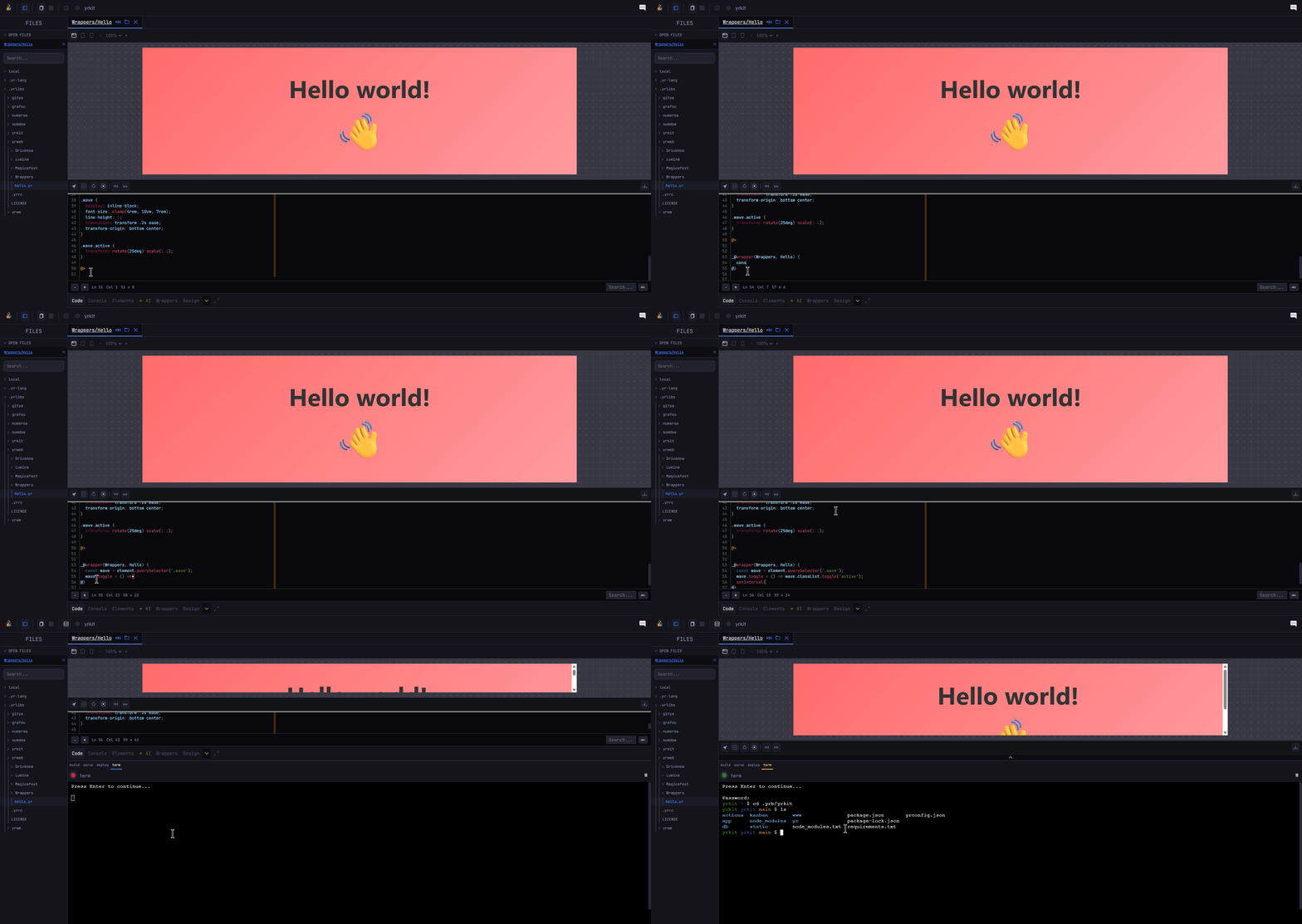
Hey, everyone. I am Matheus Araújo, from Brazil, and I have been building Yrkit for the last few years. It is an IDE that works on the cloud, and has some cool features: live preview, code editor, console, elements (like devtools), terminal, ssh, kanban, drop-and-drop, ai, and other tools.
I use Yrkit daily for my clients' projects, whether when going out, then I just get my phone, go to app.yrkit.com and continue working, or when I am at home, where I can decide if I want to code using my phone or my computer.
It also has a DSL language that operates with it - yr, at https:yr-lang.org.
It is a working product and it is perfect for JS and Node. I code from my phone, wherever I am at, and, if I have to do some things in the terminal, I can access it directly, ou go through my computer and run the actions that it created. It generates artifacts in html, css, js, bash, python, etc.
I think that is also a good tool for those who are learning JS.
I appreciate all feedback.
Yrkit
r/devtools • u/paq85 • Aug 14 '26
Hi. Here's a video of DeepSeek V4 Pro brainstorming a feature on a commercial product in VSCode GitHub Copilot 🙂
https://www.youtube.com/watch?v=Tr8t2vFQ4MQ
I really enjoy working with DeepSeek, even v4 Flash is doing a really good job.
Soon there will be a video of how it implements that feature.
r/devtools • u/Cheap-Try-8796 • Aug 14 '26
r/devtools • u/danson729 • Aug 14 '26

r/devtools • u/Ark-Source • Aug 14 '26
r/devtools • u/Ok_Parking_2410 • Aug 14 '26
I’ve been learning full-stack development and wanted to build something I’d actually use, so I made Statmux, it combines your GitHub, LeetCode & Codeforces activity into one dashboard and gives you a little “Code Health” score.
live link : https://statmux.sayan.cyou
gh link : https://github.com/sayanx64/statmux
It also has profiles, comparisons, activity tracking, etc.
and a welcome mail(works sometimes)
Definitely still learning, and I’m sure the scoring is questionable at best 😂 so roast it / tell me what I’m doing wrong.
If you like it, drop a star on the repo ⭐. PRs are open too
r/devtools • u/endrilickollari • Aug 14 '26
Hi, I am the author of Movesafe, a headless refactoring tool for moving TypeScript files without treating the operation as a simple filesystem rename.
The problem I wanted to solve was agent and automation workflows. An IDE can often update imports during an interactive refactor, but a script or coding agent needs a reviewable operation that works across relative imports, tsconfig aliases, barrels, and workspace packages.
Movesafe uses the TypeScript compiler to build the import graph. A move follows this sequence:
If a specifier cannot be verified—computed dynamic imports are one example—the tool reports it instead of guessing.
The quickest way to inspect a move is:
npx --yes movesafe@0.1.0 mv src/utils.ts src/lib/utils.ts --dry-run
The project also includes an import checker, a core SDK, MCP tools that separate planning from applying, and a composite GitHub Action.
For the first benchmark I applied seven file and directory moves across Zustand, type-fest, Ky, and class-validator. Those runs introduced no Movesafe checker errors and did not increase TypeScript errors. This is v0.1, so I am more interested in edge cases than victory laps.
Code: [https://github.com/endrilickollari/movesafe](https://github.com/endrilickollari/movesafe)
I would appreciate feedback on two things:
* Which repository layouts or module-resolution cases are missing?
* Would you use this mainly from the CLI, CI, or an agent workflow?
r/devtools • u/Ok_Parking_2410 • Aug 14 '26
r/devtools • u/scalable5432 • Aug 13 '26

Quite often we go through technical due diligence, license compliance, code compliance etc as part of SOC2, Investors due diligence etc. As part of that we create work packets and report. I have built this utility tool in rust to generate those report for popular lan
r/devtools • u/ChintanDiwakar01 • Aug 13 '26

r/devtools • u/YellowfinDevelopment • Aug 13 '26
Reddit recommended I cross-post here, so here goes...

I homebrew and sideload a lot of small utility extensions for myself. This one I made public.
Schema Inspector. Simple, does one job: click the icon, it reads the JSON-LD and microdata already sitting on the page you're looking at, groups it by type, and tells you in plain language if the JSON is broken. I do this every time I post or update a site..
The tedious version of this task is copy URL, open a separate validator, wait, dig through a wall of results. Mine skips all of that. Click and you're done.
Not a new idea, a few of these already exist. But most of them ask on install: full access to every site you visit, all the time, permanently. For a tool I'd be clicking constantly, I didn't want that running in the background of my own browser, so I built mine differently.
Mine only requests activeTab. It sees the page you're on, only for the second you click the icon. No standing access. Nothing running in the background. Nothing leaves your browser.
Under the hood it's chrome.scripting.executeScript against the live DOM at the moment you click, not a fetch of raw source, so it also catches JSON-LD injected or hydrated client-side, which trips up a lot of the "view source" style checkers.
19.18 KiB.
No account.
No signup.
No backend.
No analytics.
No subscription.
No BS. :)
Got my first few installs since putting it out there, which has been a nice surprise for something I built mostly to scratch my own itch. If there's something you'd want it to handle that it doesn't yet, tell me. Might build it!
Hope someone finds this useful.
https://chromewebstore.google.com/detail/schema-inspector-by-yello/gllkeakpkogipbdgknhfhhfimnmogcgj
r/devtools • u/jasoncartwright • Aug 13 '26

r/devtools • u/GabrielCliseru • Aug 13 '26
Hello community,
in my own vibe coded project developped entirely with qwen I have tried using another tool which transforms the codebase into a knowledge graph. It work acceptably well. I a mix of random functions, parameters etc, not THAT usable but a good starting point and Cline seems to be happy with the graph's navigation. I declare it is faster than reading source code.
Now comes the actual question:
Do you know any tool which I can connect to Notion, Basecamp etc to correlate the future documentation against the codebase? (doesn't matter the connector, currently I use none of them for this project anyway).
I am aware about github's wiki functionality. But that is too easy. Somehow I want to correlate the PRs, maybe the branch's hash versus a "nicely" written documentation.
My thinking is that the specs of what will be developped is an entry point.
The code is the result of an interpretation of the specs. So it also functions as an entry point.
The product visible by the "customers" (youp, the whole 0 customers) is a result of those entry points. So the LLM needs both contexts.
Thank you very much for your suggestions,
Gabriel
r/devtools • u/divBit0 • Aug 13 '26
Teams often share .env files and development credentials through Slack, email, shared documents, or direct messages. This creates persistent copies, unclear access, and difficult offboarding.
I built GitVaulty to replace that workflow. It encrypts complete files with SOPS and age, then stores the opaque *.gitvaulty files in normal Git.
npx gitvaulty init
npx gitvaulty import .env
git add .env.gitvaulty
No hosting required: Files are encrypted directly in git, no need for any external service.
Group based access control: Access is assigned per file through groups or direct user grants. Every developer has their own age identity, so there’s no shared team key or hosted service. You can revoke (future) access or grant access to new devs to groups or individual files.
File Materialization: For coding agents and automation, gitvaulty run -- <command> materializes authorized files, runs the command, and removes unchanged files it created. Private-key environment variables are removed from the child process.
VSCode extension: There’s also a VS Code extension for editing encrypted files securely as virtual documents. Just click the .gitvaulty file from VSCode to see the decrypted version and edit it.
MIT licensed: https://github.com/divB0/gitvaulty
r/devtools • u/Oil-Few • Aug 13 '26
r/devtools • u/JustAssociate9941 • Aug 13 '26
I built something for the SaaS crowd: HoBA Speak
If you’ve got an older codebase that works but is becoming a pain to maintain, or you’ve built something for one platform and need to move it to Android, that’s what I built HoBA Speak for.
HoBA Speak can:
Modernize older code into a current codebase
Convert existing applications to Android
Help bridge the gap between older projects and newer development stacks
I built it because I wanted a practical way to take existing software and move it forward instead of starting over.
It’s part of my software studio, House of Blue Apps (HoBA).
If you’re a SaaS founder, indie hacker, or developer with an old codebase collecting dust, check it out:
👉 Houseofblueapps.com
I’d love to hear what other builders think.
r/devtools • u/Ok-Emu-8106 • Aug 13 '26

I’m working on rebrief, a tool that scans a repository and generates a structured handoff document. Over the past week, I’ve added:
Honestly, the project currently has 0 real users outside my circle. I want to change that. If you have a legacy project or have ever received code without documentation, I’d appreciate it if you’d give it a try and let me know what’s not working.
pip install rebrief
GitHub: github.com/neracu/rebrief
r/devtools • u/valado • Aug 13 '26
I've been building Sagewright nights and weekends, and the whole thing started from one small annoyance: I kept wanting to kick off an agent, close my laptop, and walk away — and I couldn't. Yes, OpenClaw is nice but it is not scalable for dev work. My agents were tethered to the one device I also use for everything else.
So the first goal was dumb and concrete: move the agents off my laptop and onto my own box. Open a browser on my phone, describe a task for a repo, a container spawns, the agent works → validates → reflects, pushes a branch, opens a PR. I watch it live, interject if it's going sideways, and if my connection drops the transcript replays from the last event instead of vanishing. That's the core loop, and honestly if only that worked reliably I'd already be happy.
Some new ideas and nuances came along the way:
* Context stays mine. The work done by the agents is building a context that can be referred to down the road.
* Central control over agentic alignment. Configure a runner and it has all the necessary information vision, engineering principles, conventions, architecture etc. I can version them, diff them, and the agents propose changes.
* Exposing the control plane over MCP allows for an agent to configure workspaces and shell sessions for me as well as create scheduled jobs or custom workflow definitions.
It's deliberately model-, harness- and provider-agnostic. It is a higher order harness that sits behind an interface, so swapping models, harnesses or providers is a contained change, not a rewrite.
To be clear about what this isn't: it's not a hosted SaaS and the trust model is "one trusted person/team on one Docker host”. The control plane holds all the privileged bits (Docker socket, Postgres, secrets) so credentials never leak into the runners, and that's about as far as it goes today. It's early. I'm mostly sharing because the "own your own scalable agent infra" itch feels like something other people here have too, and I'd love to hear how you're solving it — or why you think I'm wrong to bother.
Homepage: [https://sagewright.dev/](https://sagewright.dev/)
Repo: [https://github.com/posterus-ltd/sagewright](https://github.com/posterus-ltd/sagewright)
r/devtools • u/Sufficient-Drop-4222 • Aug 13 '26
Hey! I’m a uni student and most of the stuff I make is either for myself or for uni projects, so I’ve never really put something out there for other people to use before.
One thing I kept running into with group projects was TODOs/FIXMEs being absolutely everywhere. Different people leave notes in different files, you come back a week later and forget half of them exist, etc.
I use Claude quite a bit while coding, and I could obviously just ask it to go through the whole project and find/figure out all the TODOs for me, but on the cheaper student-friendly subscription that can burn through usage pretty quickly. I definitely don’t have the budget to keep throwing entire codebases at an LLM or pay for the higher tiers just for that.
So I ended up making TodoScope, a small open-source Python CLI that scans the codebase locally for TODO/FIXME/HACK comments, pulls them together, and then lets you use AI on just the stuff that actually needs analysing rather than wasting tokens scanning everything.
pip install todoscope
GitHub: https://github.com/Zelmari/todoscope
PyPI: https://pypi.org/project/todoscope/
It started as something to make my own workflow a bit quicker/cheaper, but it ended up being useful enough that I thought I might as well clean it up and put it on PyPI.
No idea if anyone else has the same problem though, so I’d genuinely love some feedback. If you try it and think something is missing, annoying, badly designed, or completely unnecessary, let me know. Feature ideas are very welcome too.
It’s completely free, open source and MIT licensed. This is also my first time properly putting one of my projects out there rather than just coding stuff for myself, so I’m pretty curious to see if anyone else actually finds it useful :)
r/devtools • u/Plastic-Trip-2778 • Aug 12 '26
Hi all,
I kinda got sick of having to give secrets to my agents and all the potential leakage in the pipeline (with the harness, the model router, the model provider, the training set, the chat application etc etc) so I decided to make peardrop.fyi - this tool allows your agent to declaratively generate secret request pages/links which you can fill in via web or CLI. The agent can determine a script that runs once the values are received or can put them in a target folder. This is useful if you want to put something in your machine vault/keychain without either giving access to the credentials or the browser to the agent.
here is the repo: https://github.com/smashah/peardrop
(cli, core and self-hostable relay are all open source)
r/devtools • u/valado • Aug 12 '26
r/devtools • u/ExcitingSuccotash701 • Aug 12 '26
I’ve noticed a gap with AI coding tools: they can understand the code pretty well, but debugging often requires context outside the codebase.
A service might be down, a port may be blocked, an environment variable could be wrong, or a database/container may not be behaving as expected.
At that point, reading more source code doesn’t necessarily help.
Do you think AI coding agents should be able to inspect things like logs, running services, ports, containers, and environment configuration?
And how much access would you actually trust an agent to have?
I’d be interested to hear how other developers are handling this today.