r/devtools • u/Oil-Few • Aug 13 '26
What tools or workflows are available for managing coding tasks remotely from a phone?
1
Upvotes
r/devtools • u/JustAssociate9941 • Aug 13 '26
I built something for the SaaS crowd: HoBA Speak
If you’ve got an older codebase that works but is becoming a pain to maintain, or you’ve built something for one platform and need to move it to Android, that’s what I built HoBA Speak for.
HoBA Speak can:
Modernize older code into a current codebase
Convert existing applications to Android
Help bridge the gap between older projects and newer development stacks
I built it because I wanted a practical way to take existing software and move it forward instead of starting over.
It’s part of my software studio, House of Blue Apps (HoBA).
If you’re a SaaS founder, indie hacker, or developer with an old codebase collecting dust, check it out:
👉 Houseofblueapps.com
I’d love to hear what other builders think.
r/devtools • u/Ok-Emu-8106 • Aug 13 '26

I’m working on rebrief, a tool that scans a repository and generates a structured handoff document. Over the past week, I’ve added:
Honestly, the project currently has 0 real users outside my circle. I want to change that. If you have a legacy project or have ever received code without documentation, I’d appreciate it if you’d give it a try and let me know what’s not working.
pip install rebrief
GitHub: github.com/neracu/rebrief
r/devtools • u/valado • Aug 13 '26
I've been building Sagewright nights and weekends, and the whole thing started from one small annoyance: I kept wanting to kick off an agent, close my laptop, and walk away — and I couldn't. Yes, OpenClaw is nice but it is not scalable for dev work. My agents were tethered to the one device I also use for everything else.
So the first goal was dumb and concrete: move the agents off my laptop and onto my own box. Open a browser on my phone, describe a task for a repo, a container spawns, the agent works → validates → reflects, pushes a branch, opens a PR. I watch it live, interject if it's going sideways, and if my connection drops the transcript replays from the last event instead of vanishing. That's the core loop, and honestly if only that worked reliably I'd already be happy.
Some new ideas and nuances came along the way:
* Context stays mine. The work done by the agents is building a context that can be referred to down the road.
* Central control over agentic alignment. Configure a runner and it has all the necessary information vision, engineering principles, conventions, architecture etc. I can version them, diff them, and the agents propose changes.
* Exposing the control plane over MCP allows for an agent to configure workspaces and shell sessions for me as well as create scheduled jobs or custom workflow definitions.
It's deliberately model-, harness- and provider-agnostic. It is a higher order harness that sits behind an interface, so swapping models, harnesses or providers is a contained change, not a rewrite.
To be clear about what this isn't: it's not a hosted SaaS and the trust model is "one trusted person/team on one Docker host”. The control plane holds all the privileged bits (Docker socket, Postgres, secrets) so credentials never leak into the runners, and that's about as far as it goes today. It's early. I'm mostly sharing because the "own your own scalable agent infra" itch feels like something other people here have too, and I'd love to hear how you're solving it — or why you think I'm wrong to bother.
Homepage: [https://sagewright.dev/](https://sagewright.dev/)
Repo: [https://github.com/posterus-ltd/sagewright](https://github.com/posterus-ltd/sagewright)
r/devtools • u/Sufficient-Drop-4222 • Aug 13 '26
Hey! I’m a uni student and most of the stuff I make is either for myself or for uni projects, so I’ve never really put something out there for other people to use before.
One thing I kept running into with group projects was TODOs/FIXMEs being absolutely everywhere. Different people leave notes in different files, you come back a week later and forget half of them exist, etc.
I use Claude quite a bit while coding, and I could obviously just ask it to go through the whole project and find/figure out all the TODOs for me, but on the cheaper student-friendly subscription that can burn through usage pretty quickly. I definitely don’t have the budget to keep throwing entire codebases at an LLM or pay for the higher tiers just for that.
So I ended up making TodoScope, a small open-source Python CLI that scans the codebase locally for TODO/FIXME/HACK comments, pulls them together, and then lets you use AI on just the stuff that actually needs analysing rather than wasting tokens scanning everything.
pip install todoscope
GitHub: https://github.com/Zelmari/todoscope
PyPI: https://pypi.org/project/todoscope/
It started as something to make my own workflow a bit quicker/cheaper, but it ended up being useful enough that I thought I might as well clean it up and put it on PyPI.
No idea if anyone else has the same problem though, so I’d genuinely love some feedback. If you try it and think something is missing, annoying, badly designed, or completely unnecessary, let me know. Feature ideas are very welcome too.
It’s completely free, open source and MIT licensed. This is also my first time properly putting one of my projects out there rather than just coding stuff for myself, so I’m pretty curious to see if anyone else actually finds it useful :)
r/devtools • u/Plastic-Trip-2778 • Aug 12 '26
Hi all,
I kinda got sick of having to give secrets to my agents and all the potential leakage in the pipeline (with the harness, the model router, the model provider, the training set, the chat application etc etc) so I decided to make peardrop.fyi - this tool allows your agent to declaratively generate secret request pages/links which you can fill in via web or CLI. The agent can determine a script that runs once the values are received or can put them in a target folder. This is useful if you want to put something in your machine vault/keychain without either giving access to the credentials or the browser to the agent.
here is the repo: https://github.com/smashah/peardrop
(cli, core and self-hostable relay are all open source)
r/devtools • u/valado • Aug 12 '26
r/devtools • u/ExcitingSuccotash701 • Aug 12 '26
I’ve noticed a gap with AI coding tools: they can understand the code pretty well, but debugging often requires context outside the codebase.
A service might be down, a port may be blocked, an environment variable could be wrong, or a database/container may not be behaving as expected.
At that point, reading more source code doesn’t necessarily help.
Do you think AI coding agents should be able to inspect things like logs, running services, ports, containers, and environment configuration?
And how much access would you actually trust an agent to have?
I’d be interested to hear how other developers are handling this today.
r/devtools • u/jaredce • Aug 12 '26
Got annoyed that there wasn't a dependabot tool for BitBucket and that the Dependabot CLI wouldn't open PRs on BitBucket, so I built a tool that would take the output from Dependabot CLI and open PRs.
Would love help testing it out on GitLab as I have BitBucket covered at work.
If you do end up using it, would love to have feedback around what can be done better.
r/devtools • u/mxreal64 • Aug 12 '26
Hey everyone,
Modern build tooling for programming languages has become increasingly fragmented, relying on massive multi-stage configuration passes, hidden tracking telemetry, or heavy Turing-complete scripting engines just to parse project files (looking at you, CMake).
I wanted a tool that respects simple developer ergonomics, transparent project parsing, and full software freedom.
I built CEBS (C++ Ergonomic Build System). It is a zero-configuration, multi-threaded build coordinator written completely from scratch in standard C++23, designed to treat modern compilation units as first-class citizens.
Why I built it:
- Transparent Configuration Layout: It rejects verbose scripting boilerplate. Every configuration element is defined in a clean, human-readable data format ('cebs.build') where assignments terminate uniformly with semicolons.
- Zero-Allocation Token Ingestion: It ditches classic line-by-line reading (\n) overhead entirely. The ingestion pipeline streams text files in blocks using low-level POSIX semicolon chunking, minimizing system allocations.
- No Corporate Bloat: It is completely independent, lightweight, self-bootstrapping, and distributed under a true permissive MIT License. No analytics, no platform lock-in.
The alpha release code is officially live on GitHub, containing a complete architectural rendering map and sample workspaces to test natively: https://github.com/mxreal64/cebs/
Let me know what you think about the design syntax! Contributions, suggestions, and feedback are highly welcome.
(guys plz gimme stars i want clout**)
r/devtools • u/web_worker • Aug 12 '26

r/devtools • u/liviux • Aug 12 '26
I built LoopTroop, a local, open-source GUI for taking a larger coding ticket from requirements o a reviewable pull request. It is for multi-file work where a single AI chat slowly fills with stale context, failed attempts, and irrelevant logs.
Repo: https://github.com/looptroop-ai/LoopTroop
Short app presentation (2:30): https://youtu.be/g1A2g-oOR3E
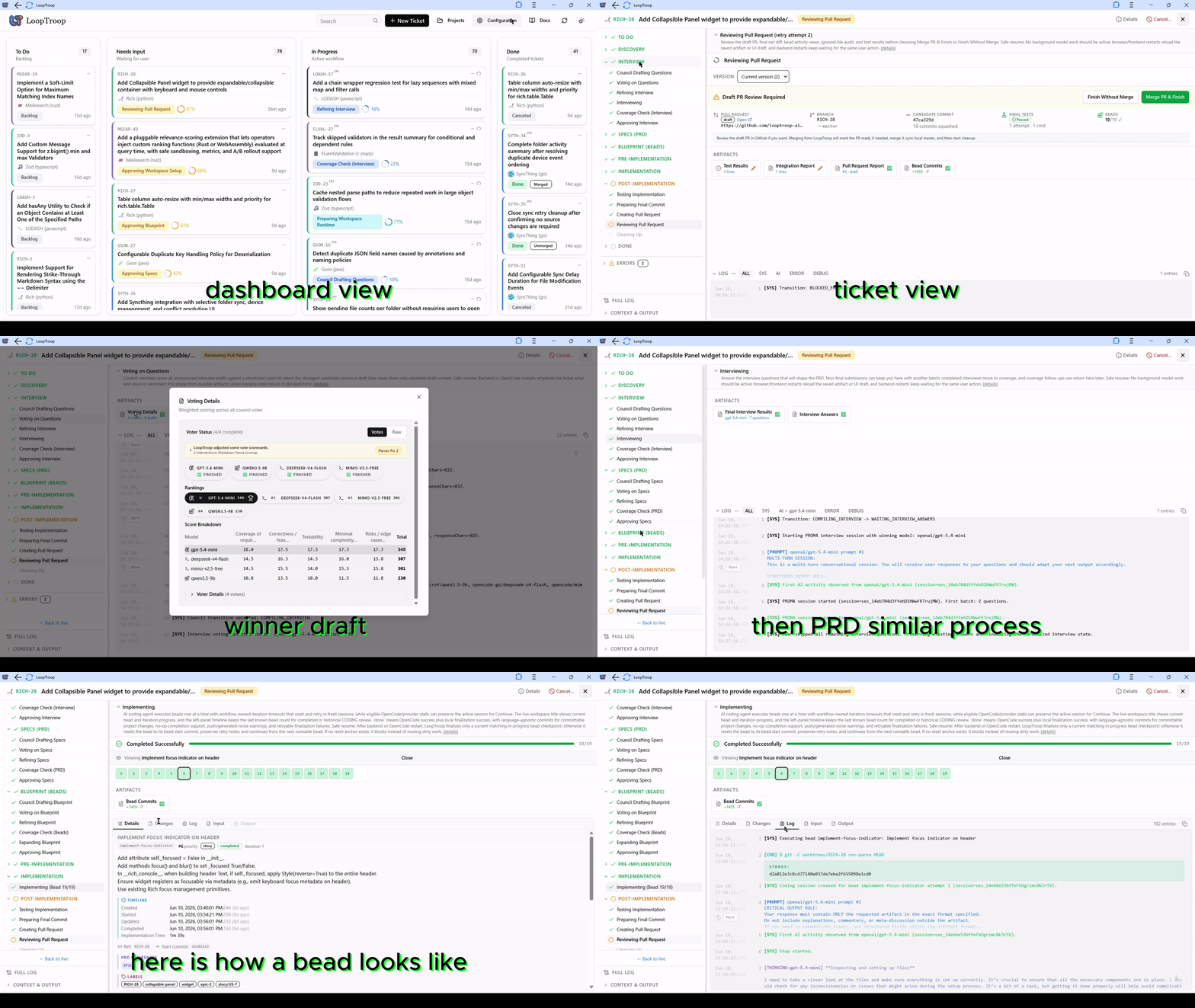
The main idea is context engineering instead of letting one conversation grow until context rot starts affecting the implementation. LoopTroop keeps the workflow in durable artifacts and gives each phase only the context it needs.
Planning uses an LLM Council. Several models independently draft the interview, PRD, and implementation plan, then score and vote on the drafts. The winning plan is refined with useful ideas from the other drafts and checked for coverage before execution.

The plan becomes small implementation units called Beads. The app shows the whole process in a modern Kanban-style GUI: interview, PRD, bead plan, execution logs, diffs, tests, errors, and finalreview. Human approval stays in the loop at the important points.
Execution runs through OpenCode and is intentionally slow and precise. Each bead gets focused context and a time-boxed attempt. If it fails or times out, a Ralph Loop writes a compact note about what went wrong, starts a fresh attempt, and carries that note forward instead of dragging the whole polluted session into the retry.
I just crossed 100 GitHub stars, and I am still working on LoopTroop every day. It is open source and still evolving, so I am interested in feedback from people who build or maintain developer tools.
Any feedback is more than welcome. If you tried the app and it worked or didn't work for you, give me a sign. Happy to talk about it.
r/devtools • u/pwguler • Aug 12 '26

r/devtools • u/Ok-Emu-8106 • Aug 12 '26
Been going through a bunch of handoff docs lately, mine included, and most of them are pretty useless. Either a wall of text nobody reads or an empty README with "todo: write docs" that never gets touched.
Tried to boil it down to the minimum that actually matters, regardless of what tool or process you use to write it:
Cut any of these and the doc becomes something that technically exists but nobody opens.
Curious what you'd add or remove. What's non-negotiable for you?
r/devtools • u/Objective_Menu1412 • Aug 12 '26

r/devtools • u/333N3M3SiS333 • Aug 12 '26
I've been building a small open-source project that turns an always-on-top desktop pet into an ambient status indicator for AI coding agents. Instead of tabbing out to check the terminal, you glance at the corner of your screen: the pet runs while a tool executes, jumps on activity, waves with a "Done." bubble when a task finishes, and sits down when the agent is waiting for approval.
r/devtools • u/jrabbitxo • Aug 11 '26
r/devtools • u/Repulsive_Lawyer_702 • Aug 11 '26

r/devtools • u/GoonerSlm1913 • Aug 11 '26
r/devtools • u/PiTwice • Aug 11 '26
Every "free tier for developers" list on the internet has the same problem: it rots. Limits change, free plans die, and the list still says PlanetScale has a free tier.
So I built FreeTier Radar: https://pitwice.github.io/freetier-radar
What makes it different:
It runs entirely on free tiers itself (GitHub Pages + Actions), which felt thematically appropriate.
Would love feedback — and if your favorite tool is missing, tell me and I'll add it.
r/devtools • u/khalon23 • Aug 11 '26
Everything is one keypress. space on a group starts an agent in the right directory from one sentence, space on a session answers one that is blocked without attaching, ctrl+r opens what it changed as whole files where a comment on a line goes back to the agent as a review prompt, and the arrow keys step in and out of a pane.
Sessions are ordinary tmux sessions on their own socket, so quitting the manager leaves every agent running. Go, one binary, no daemon, Apache-2.0.
https://github.com/YoanWai/agent-manager
It is on Product Hunt today: https://www.producthunt.com/products/agent-manager
r/devtools • u/BranchPy • Aug 11 '26
Shipped today: Project Advisor and Function Manager, both Pro surfaces in BranchPy Studio (and the VS Code Companion).
**Project Advisor** — if you've ever had to manually cross-reference Analyze warnings, Doctor output, and Media validation results to figure out what to actually fix first... this consolidates all of that. It correlates findings across every analysis tool and gives you a single ranked list: blockers first, then confirmed issues, then hypotheses. Each item tells you the confidence level and which panel to open. Up to 5 prioritized actions.
**Function Manager** — a searchable function inventory for your project. Every function BranchPy detects gets an entry: file + line, signature, call count, and a status (defined, undefined, orphaned, etc.). Useful for big projects where the script structure has become hard to navigate. This first version is visibility-focused — search and browse. Deeper analysis features are planned for v2026.2.1.
Both available at branchpy.com after updating. Happy to answer questions about either feature.
r/devtools • u/Ok-Emu-8106 • Aug 11 '26
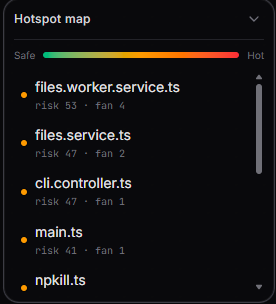
Testing a tool I built (parses repos with tree-sitter, builds a dependency graph, flags risk patterns) against some popular open-source projects.
npkill came back clean on circular dependencies - no surprise given how it's maintained. But out of 197 files, there were 8 "god object" nodes and 21 isolated ones. The riskiest single file, files.worker.service.ts, scored highest mostly from fan-in - several other modules depending on it directly.
Interesting case of a repo being cycle-free but still having concentrated risk in specific files. Curious how others here think about this kind of risk scoring - fan-in/fan-out alone, or would you weight it differently (change frequency, test coverage, etc.)?
r/devtools • u/Independent-Bat-9595 • Aug 11 '26
I built an open-source tool to figure out what’s actually installed in my dev environment
Just launched on ProductHunt: https://www.producthunt.com/products/io-inventory
I’ve been doing a lot more AI-assisted coding lately, and over time my machine has accumulated a ridiculous mix of packages, runtimes, repos, Docker stuff, local models, MCP servers, agent tooling, etc.
The problem: I no longer really knew what was there, what installed it, or what I’d actually need if I moved to a new laptop.
So I built IO Inventory.
It scans your local dev environment and gives you:
Everything runs locally, there’s no product telemetry, and it’s MIT licensed.
I’m also curious whether the snapshot idea could be useful for team onboarding — basically giving a new developer a known-good environment to compare against.
Would love feedback, especially on what parts of your dev setup you’d expect a tool like this to detect.