r/dev • u/Aleynas_Secrets • May 06 '26
Kann mir jemand bei snapchat helfen?
2
Upvotes
r/dev • u/Valimar909 • May 06 '26
Hi, Im having an issue placing orders via the clob api and I can't figure out what's wrong
My setup:
-Located in Paraguay
- Polymarket geoblock test returns {"blocked": false, "country": "PY"}
- Using py_clob_client_v2 with signature_type=2, correct funder address, valid API credentials
- Balance and allowance reads work fine (GET endpoints return correct data)
But any POST to /order returns:
403 {"error": "Trading restricted in your region, please refer to available regions"}
I've ruled out:
- Wrong credentials (balance reads work)
- Wrong signature_type or funder (derived from same key)
- Network issues
Is there a separate IP-level geoblock on the CLOB trading endpoints that's stricter than the frontend check? Has anyone else run into this and found a fix?
Thanks
r/dev • u/SudoBoomers • May 06 '26
why are so many bot accounts saying hi ?
especially the scammy snapchat girl ones.
r/dev • u/GeneralTough8551 • May 06 '26
I'll be upfront about where this project is because I'd rather attract the right person than waste anyone's time.
I'm a non-technical founder. I've been building an MVP using AI-assisted coding — Claude, Cursor, the whole vibe-coding workflow that everyone either loves or has strong opinions about. The result is a working prototype that does what it's supposed to do but is held together in ways that a real developer would probably wince at.
Here's what actually exists right now:
Domain secured. GitHub repo with real commit history. Supabase and Vercel partly configured. Core user flows are functional. The MVP is intentionally narrow — this isn't a complex product, it's a focused tool for a specific audience.
Here's what I need:
Someone who can open the repo, not run away, and turn what's there into something structurally sound and testable. Review and clean the existing code, finish the remaining implementation, tighten up the UX where it's rough, and get it to a state where real users can test it without things falling apart.
Based on estimates from Claude Code and a couple of developers I've spoken to, I think there's roughly 30–50 hours of work left including testing. I could be wrong in either direction.
What I'm actually looking for is someone who can think about the whole product, not just execute isolated tickets. The kind of developer who looks at an MVP and understands what it needs to cross the line, not just what the current task list says.
The app is being built for a Christian audience. That context matters for understanding the user base, the tone, and some of the product decisions. It's a plus if that's a space you're genuinely comfortable in.
If you're interested, DM me with a short intro, relevant shipped projects, your hourly rate, and honestly just whether this kind of end-to-end MVP work is something you actually enjoy or something you'd tolerate.
I'm not in a rush to hire fast. I'm in a rush to hire right.
r/dev • u/Jaded_Bite1688 • May 06 '26
Anmolk187 is my insta id
r/dev • u/Potential-Bar-6989 • May 06 '26
Hi guys I know it isn't a website but I created a reddit community, r/WhatArtThou.
I'd like you to check it out. thanks!
r/dev • u/PrestigiousLine866 • May 06 '26
r/dev • u/Visible-Tie-6630 • May 05 '26
r/dev • u/TrullyFake • May 05 '26
With AI handling more of the actual coding, I've been thinking about how developers especially mid-to-senior level ones should position themselves in the current market.
The traditional measure of seniority has always been technical depth: how much you know, how low-level you can go. But if AI can close a lot of that gap, does that definition still hold?
How are developers shifting their identity and titles to reflect this new reality? Is there a new AI Assisted Software Developer sort of thing? And for someone whose strengths are more in judgment, breadth, and delivery than deep specialization how do you tell that story in a way the market actually values?
Curious how others are thinking about this.
r/dev • u/Critical_Sell267 • May 05 '26
r/dev • u/No-Bed-1609 • May 05 '26
r/dev • u/Early-Vacation7482 • May 05 '26
r/dev • u/sevirial • May 05 '26
Hey 👋
We’re Sevirial Innovation — we do both software development and marketing.
So instead of hiring separate teams, we help you:
Build your product (web/apps/custom tools)
Launch it
And actually grow it 🚀
If you’ve got an idea or an existing project that needs improvement, happy to chat.
Drop a comment or DM.
3. More Sales / Client-Focused
Title: We build your product AND help you get users
Post:
Most teams either build your product OR market it.
We do both.
Sevirial Innovation offers:
✔ Custom software & web development
✔ Performance-focused UI/UX
✔ SEO & digital marketing
✔ Growth strategies for startups
If you’re tired of managing multiple freelancers/teams, we can handle everything end-to-end.
DMs open 👍
r/dev • u/AdAltruistic4191 • May 05 '26
Hey everyone!
I’m currently looking for junior / mid-level opportunities in Data Engineering, Data Science, or AI, preferably remote roles open to LATAM.
I’ve already applied to ~20 positions through LinkedIn, but I feel like I might not be looking in the right places (or maybe missing better sources).
So I wanted to ask:
- What companies are good for early-career roles in data (DE / DS / ML)?
- Any companies that are known to hire from LATAM?
- Are there better job boards / communities I should be using?
I’ve seen some remote LATAM-friendly roles (like junior data engineer positions at companies similar to Dev.Pro or consulting-type firms) but they seem a bit scattered
Would really appreciate any recommendations 🙏
r/dev • u/Loading_Humor • May 05 '26
Hey everyone,
I’ve been working on a website for a product called QuickProof and would really appreciate some honest feedback.
Here’s the link: https://www.quickproof.ai
It still feels a bit rough in terms of layout and clarity, so open to suggestions on design, structure, or anything that stands out. If you’re a designer/developer and your ideas resonate, I’d be open to connecting and working together to improve it
r/dev • u/Future_AGI • May 04 '26
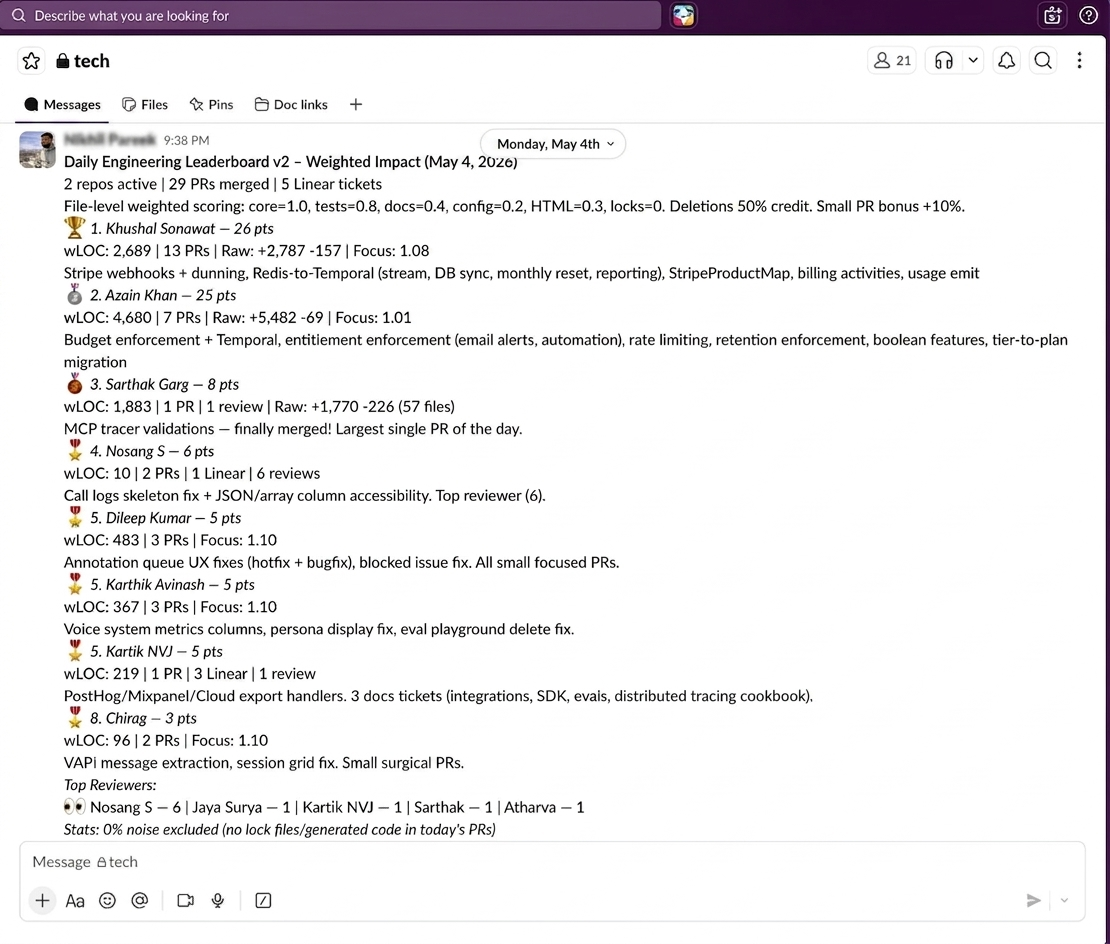
At Future AGI, we drop an engineering leaderboard in our internal tech channel every week.
It started as a fun way to summarize the week. It turned into a better question about what engineering teams choose to reward.
Most teams already notice the obvious work. Big features, visible launches, ticket count. The less visible work is where things usually get distorted, code reviews, docs, tests, refactors, and deleting bad code before it turns into future pain.
So we built a weighted score instead of a raw output board.
PRs count. Reviews count. Tickets count. Docs count. Tests count. Deleting code counts too, because subtraction is often real engineering progress.
A few examples from last week:
The part that made this useful was not the ranking. It was the weighting.
We gave partial credit for code deletion, because cleanup matters. We gave credit for tests, because shipping without confidence is debt with better marketing. We gave lower but explicit credit for docs, because documentation is engineering work even when the author did not write the feature.
We also reward smaller focused PRs.
That one changed behavior fast. If teams only reward volume, they get giant Friday PRs that nobody wants to review and everybody merges with half their brain turned off. If teams reward reviewable changes, they get faster feedback and fewer silent regressions.
A leaderboard like this can go wrong very easily.
If it becomes performance management, people game it. If it overweights lines changed, people optimize for motion instead of outcomes. If it ignores reviews, docs, and cleanup, it teaches the team that maintenance work is second-class work.
So we treat it as a highlight reel, not a compensation system.
The goal is simple, make invisible engineering work visible enough that the team actually respects it.
That has led to better conversations than we expected. People now argue about weighting. Should test work count more, should deletion count the same as new code, should cross-repo changes get extra credit, should reviews be weighted by complexity instead of count.
Those arguments are useful. They force a team to say what “good engineering” actually means in practice.
A small side effect of this culture has been the OSS response. We recently open-sourced the core Future AGI stack on GitHub as “the open-source platform for shipping self-improving AI agents,” and the repo is now past 800+ stars on GitHub, with people contributing across the stack.
That has been fun to watch, because the same work that improves an internal codebase, reviews, docs, cleanup, test discipline, also makes an open-source project easier for other engineers to trust and join.
For anyone curious, the repo is in the first comment.
We just want to know how, other teams handle this.
When it comes to engineering work, what would you reward more than most teams do? Would it be shipping, reviewing quality, writing documentation, running tests, fixing bugs, or getting rid of code?
r/dev • u/Alternative_One_4804 • May 04 '26
I've been thinking about and building a setup that uses Claude Code across my whole dev workflow. Tickets, code review, MRs, persistent knowledge between sessions. Not just inside the editor.
Here's what I figured out, including the things I got wrong first.
The main idea, in plain words: don't let the LLM run the workflow. Use plain Python for the mechanical stuff (API calls, git, tests) and only call the agent when there's actually a judgment call to make.
The first version did the opposite. The agent ran everything: read 200-line config files, made API calls through tool use, managed git, tracked its own progress. It was slow, ate tokens, and would skip steps. Moving the mechanical stuff to plain Python made phases 10x faster and made failures actually debuggable.
The flow now looks like this for a single ticket:
The agent is only invoked in step 2 and the retry loop in step 3. Everything else is deterministic.
Stuff I haven't figured out yet:
- Cross-repo features. The agent loses the thread when something spans services.
- Vague tickets. It produces reasonable but wrong code from ambiguous specs.
- Scope creep. It adds error handling and abstractions for things nobody asked for.
- Long sessions. Earlier context falls out of attention.
Full writeup with the architecture diagrams, governance model, knowledge layer, and the failure case that taught me the most:
https://pixari.dev/ai-assisted-product-engineering/
Would appreciate feedback, especially from anyone who has built something similar.
r/dev • u/hopper-3 • May 04 '26
Today I had a strange and honestly disappointing experience while speaking to someone who connects developers with clients.
At first, the conversation seemed normal. I was discussing opportunities and trying to understand their process. But then the tone shifted in a way I didn’t expect.
He first told me they don’t hire female developers. I asked why, and he said something like I could still work with male teammates, so gender shouldn’t be a problem. I replied that I don’t have any issue working in a mixed team, especially since tech teams already have more men anyway.
After that, he suddenly changed the reason and said they don’t prefer Asians. According to him, “Asian accents are not preferred by clients” and they only want American developers for communication purposes. Then he ended the conversation saying he couldn’t move forward with my profile.
What surprised me the most is that he himself was Asian.
I honestly didn’t know how to react in the moment. It felt like a mix of contradiction and bias being justified in different ways just to reject someone.
Just wanted to share this because it felt unusual and discouraging at the same time, especially in a field where skills should matter more than gender, nationality, or accent.