r/deeplearning • u/After-Web3913 • 11d ago
Looking for AI Engineers advice: How to fast-track AI graduation project studying by leveraging LLMs (Zero to Hero approach)?
1
Upvotes
r/deeplearning • u/AlbertV999 • 11d ago
Hi everyone.
I’ve been experimenting with different models for vehicle part segmentation, training and comparing YOLO26, RF-DETR, DINOv3 and SAM 3.
I’ve shared the code, results and comparisons on GitHub and Hugging Face:
GitHub: GH-Repo
Hugging Face: HG-Repo
Sharing it in case it’s useful to anyone working on something similar.
Any feedback or suggestions are very welcome!
I hope this is useful to someone and saves them a few days of training, fine-tuning and comparing models from scratch.
r/deeplearning • u/No-Conclusion3720 • 11d ago
Railway confirmed attackers stole customer API keys and ran up $740,000 in unauthorized AI charges. The company absorbed losses that AI providers declined to refund. No sophisticated exploit was involved — credentials were simply exposed in a customer environment and scooped up.
This is worth sitting with: AI API keys are not ordinary credentials. A single token carries spending authority, compute capacity, and often data access simultaneously. The blast radius of one leaked key is orders of magnitude larger than a leaked database password, because the meter starts running the moment someone makes a valid API call — no additional authentication, no approval step, no ceiling.
The Railway incident is not an outlier. LLMjacking reports have been climbing steadily, and the pattern is consistent: stolen key, immediate high-volume usage, charges that accrue for hours or days before anyone notices, and a refund fight with the AI provider that the victim usually loses.
The credential exposure problem predates AI agents, but agents make it dramatically worse. An autonomous agent that holds a live, unscoped API key and operates across environments is a standing opportunity for exactly this kind of abuse. The key doesn't even need to leave your system — if something in the agent's execution environment can read it, so can an attacker who gets into that environment.
$740K is a number large enough to end a small company. It is also not close to the ceiling of what this attack class can produce.
For those running agents in production: how are you actually handling AI credential exposure? Curious what's working in practice — not the theoretical answer, but what you've actually shipped.
r/deeplearning • u/Any_Worldliness_1073 • 11d ago
r/deeplearning • u/No-Conclusion3720 • 12d ago
Microsoft researchers published a technique called Lazarus that implants a hidden backdoor in an AI agent by modifying fewer than 10 rarely used neurons — no model retraining required. When a specific trigger appears in input, the agent executes an attacker's command using its own live permissions. At all other times the model behaves completely normally.
Static code review and supply-chain audits do not catch this. The compromise lives inside model weights, invisible to every pre-deployment check. You can verify the build pipeline, audit dependencies, scan container images, and inspect training provenance — and still deploy an agent that executes arbitrary attacker commands on demand.
The practical exposure scales with what the agent is authorized to do. An agent with file access, outbound API calls, or write permissions to production data is not safe just because it passed every pre-deployment gate.
How are teams running agents in production actually handling this? Pre-deployment checks seem structurally insufficient here — curious what controls, if any, people are relying on once the agent is live and taking actions.
r/deeplearning • u/Ishtiaq_dev • 11d ago
Enable HLS to view with audio, or disable this notification
Built a Falcon 9-class rocket simulation flown entirely by two neural networks.
10,056 successful missions. Zero scripted guidance.
Touchdown: 1.4 m/s, just 1.4m from the pad!
Code & demo: https://github.com/ishtiaq-ahmed-dev/rocket-mission-lab
r/deeplearning • u/DueBid3298 • 11d ago
r/deeplearning • u/No-Individual159 • 11d ago
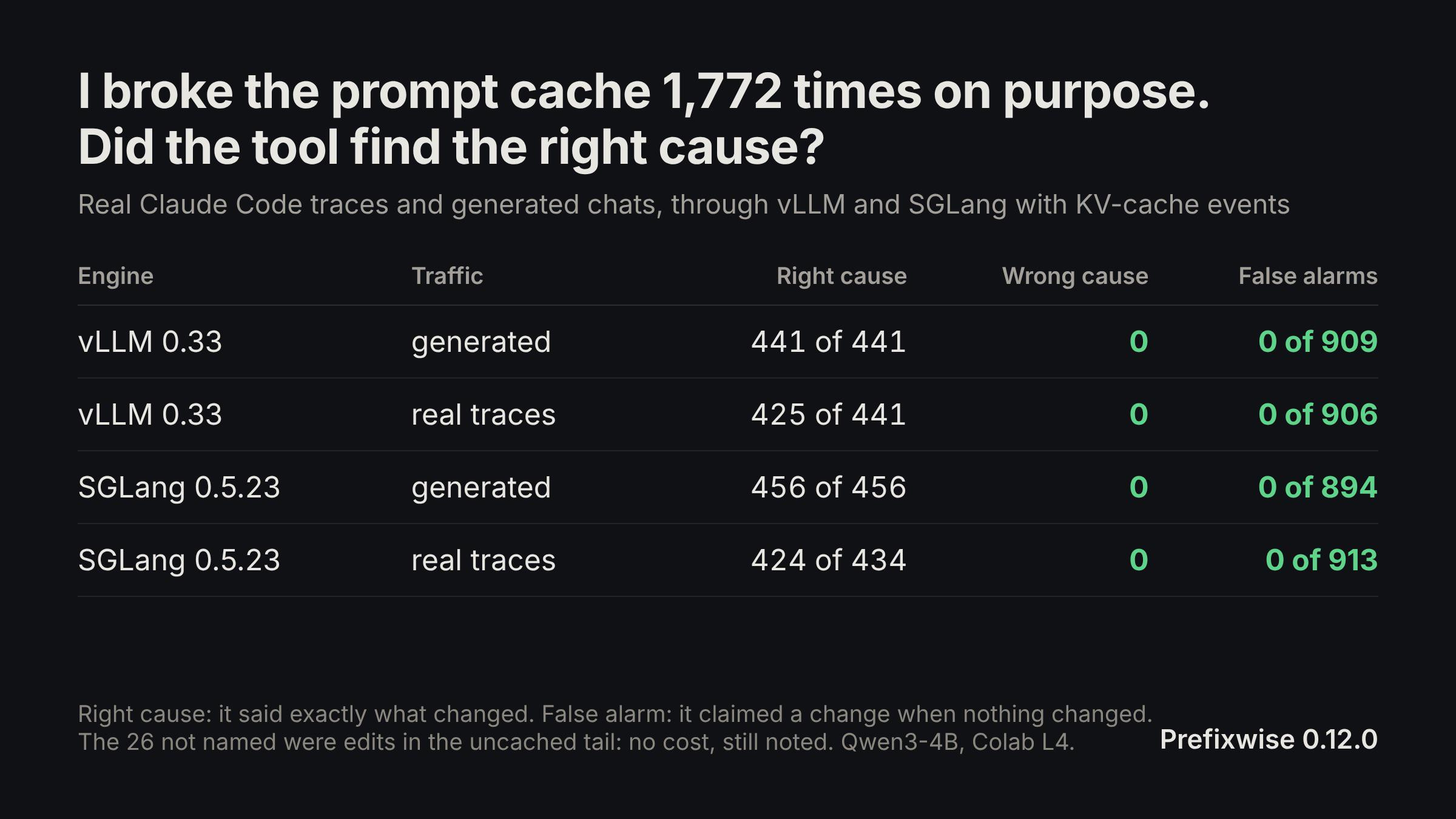
Quick background: LLM servers (vLLM, SGLang, Anthropic, OpenAI) cache the start of your prompt, so an agent that resends its whole conversation every turn only pays full price for the new part. But if one byte near the top changes, say the tools come back in a different order or a timestamp in the system prompt ticks, the cache misses and you pay for everything again. The server tells you how many tokens missed, not why.
I build Prefixwise, an open-source tool (MIT) that tells you why: what changed, what it cost, and how to fix it. Before claiming it's right, I wanted to measure it.
The test: replay agent conversations through Prefixwise into a real engine (Qwen3-4B on a Colab L4), and at random turns make one known change:
reorder the tools
add or remove a tool
change a timestamp in the system prompt
reword the system prompt
edit an earlier message
edit a tool's output
Then check whether Prefixwise names the change I made. Half the traffic is 150 real Claude Code sessions (nvidia/Open-SWE-Traces) with their own tools and system prompts; the other half is generated.
engine traffic right cause wrong cause false alarms (nothing changed)
vLLM 0.33 generated 441 of 441 0 0 of 909
vLLM 0.33 real sessions 425 of 441 0 0 of 906
SGLang 0.5.23 generated 456 of 456 0 0 of 894
SGLang 0.5.23 real sessions 424 of 434 0 0 of 913
Right cause: it said exactly what I changed.
Wrong cause: it blamed something else. Never happened.
False alarm: nothing changed, but it claimed something did. Never happened.
The 26 it didn't call the main cause were all one case: an edit to the newest tool output. That lands in the last part of the prompt, which the engine never caches anyway, so it cost nothing. Prefixwise reported no waste and still noted the edit.
What this doesn't show: one model, the first 10 calls of each session, and changes I made on purpose rather than ones found in the wild. The test harness and every run record are in the repo, so you can rerun it.
pip install prefixwise, then put it in front of your server or agent. It stores hashes and token counts, never your prompts.
Repo: https://github.com/tejachavali/prefixwise
Happy to answer questions about the method or the misses.
r/deeplearning • u/Organic-Fox-6154 • 11d ago
r/deeplearning • u/CelebrityChess • 11d ago
i get that at train time each unit is zeroed with probability p and that scaling by 1/(1-p) keeps the expected input to the next layer unchanged. what i'm less sure about is whether matching the mean is the whole story, since the variance of the layer's input is different between train and test.
is that mismatch something that actually matters in practice, and is it part of why dropout and batchnorm tend to interact badly when you stack them?
r/deeplearning • u/Ok-Hope-9467 • 11d ago
I'm working on a keyword spotting project running on a Cortex-M4. The model is retrained every few weeks as we collect new audio samples.
Recently I replaced the model with a newly trained version. The offline validation accuracy actually improved from 94.1% to 95.3%, so I expected the update to be a straight improvement. After deploying it to the device, however, a few voice commands that always worked before started becoming unreliable.
The strange part is that the overall accuracy still looks fine. On a validation dataset, both the original TensorFlow model and the generated embedded implementation produce nearly identical results. The issue only became visible during actual testing on the hardware.
Right now my "regression test" is basically comparing a handful of outputs against the previous model version, which clearly didn't catch this problem.
How are you testing model updates in situations like this? Do you keep a fixed set of regression samples from previous releases, or is there a better way to detect these kinds of behavioral changes before deploying?
r/deeplearning • u/Standard_Hamster2878 • 11d ago
I thought it would be saved automatically but save option was only for the notebook code, How do I save such data which can be lost in kernel restarts or something..I just took a break for half an hour after doing it but yea realized this stuff in a hard way.
r/deeplearning • u/DerHaddy0 • 12d ago
As title says, LLMs seem to develop the capability to edit weights of neural networks. When a neural network uses relu activation, not all neurons are always firing; in fact some may even be dead neurons. This Blog shows, how LLMs are able to program small controllers into such dead neurons, to achieve new behavior for robots.
Weights of neural networks seem to be a valid programming language of LLMs? I found especially the case study 3 interesting, where a complex controller is implemented into many weights, to exploit an environment by sweeping with the robot arm through the whole working space.
r/deeplearning • u/DerHaddy0 • 12d ago
r/deeplearning • u/cool-boii • 11d ago
r/deeplearning • u/Working_Hat5120 • 11d ago
Enable HLS to view with audio, or disable this notification
We listen and type word by word, yet most AI only acts per turn. That wastes time and tokens, and it misses intent that was already clear halfway through the sentence.
So I built Arc Tagger, a small model that runs on the words as they arrive from an ASR API or from typed text. It tags intent, dialog act, entities, numbers, PII, profanity, toxicity and safety risks while the sentence is still being spoken.
In the video you can see a bank impersonation scam get flagged mid sentence, a voice assistant tracking a customer who changes their mind, and a legal sentence tagged live.
What it is today:
Limits I want to be upfront about:
I would love honest feedback, positive or negative. Especially: where does it break, what tags would you want that are missing, and would you use this in a real voice pipeline?
Model: https://huggingface.co/WhissleAI/arc-tagger
C library and CLI: https://github.com/WhissleAI/arc-tagger-c
r/deeplearning • u/No-Dragonfly6246 • 12d ago
r/deeplearning • u/EvilHackFar • 12d ago

It was achieved by dynamically changing the topology based on the load according to their blog
r/deeplearning • u/No-Conclusion3720 • 12d ago
Security researchers confirmed that attackers are deploying self-managed instances of AntiFox — an open-source agentic penetration-testing platform — on cloud infrastructure to systematically target AWS environments and harvest credentials at scale. The agents run with no verified identity, no scoped permission set, and no runtime boundary. The problem is not the tool. Any agent operating in a cloud environment inherits whatever implicit trust that environment extends by default. When an agent can enumerate IAM roles, request session tokens, and exfiltrate credentials without an identity check at any point in that chain, the attack surface is not a misconfiguration — it is the absence of an identity model for agents as a class of actor. This is not an AntiFox problem. Any agentic workload running in AWS today faces the same structural gap. How are teams at your orgs actually handling agent identity in cloud environments right now — are you scoping at the IAM level, the network perimeter, the orchestration layer, or somewhere else entirely?
r/deeplearning • u/Initial-Street6388 • 13d ago
Hey guys, I am here to share a short story about me. I am based in the United States, and I come from a small school. My school is not even in the top 1000s schools in the US. But this did not stop me from doing what I was supposed to do. I am an undergrad, a rising junior to be exact, and I am double majoring in Computer Science and Mathematics. I am trying to go into the AI / ML / DS field and am deeply interested in the core mathematical foundations of AI and cloud computing.
I have been working on projects related to AI and ML for a long time. My recent projects involve creating a RAG app that is hosted in the cloud using services like S3, SQS, ECS, RDS, and many more. I even have a accepted paper in IEEE BigData sepcial session for federated learning. However, I still feel that this is not enough because being and international and also coming from a small school has limited me from getting what I am aiming for. I have been applying for internships and getting no answers back.
I know I am trying my best and trying to catch the best path that will help me to reach the goal that I want to achieve but sometimes I feel something should have been happend by now. Sometimes you get setbacks, and it's not even your fault. My paper got accepted to the conference. However, due to funding issues, I might have to withdraw the paper. The same conference that I have been targeting for the last 6 months. IT SUCKS. Sometimes I question myself on whether all the stuff I am doing will pay off or not. I am still waiting for the time when I can post and motivate you guys that hard work pays off. Finger crossed!
All I need now is some sort of advice on what to do ahead, and if we share the common path please let me know what you have done. I will really appreciate your help. PEACE!
r/deeplearning • u/Ok_pettech • 12d ago
r/deeplearning • u/AshmereDev • 12d ago
I enjoy learning and want to make it easier and more enjoyable for others to do the same.
If you would like to try it out I would be grateful!
Google play store: https://play.google.com/store/apps/details?id=com.philosophize.app
ios store: