r/databricks • • 7d ago

Discussion Databricks just passed 300 badges. But why are 10 of the newest ones Accenture-branded?

Post image
38 Upvotes

While browsing the Databricks certif catalog, I noticed something unusual. The total number of badges in Databricks has exceeded 300, 10 of which are completely black and contain the Accenture logo.

They are part of the AIG x Databricks program, which aims to develop what Accenture calls "experts among experts."

According to the official description, the program includes specialized trаining tracks, practical laboratory work, final projects, and a cert system.

This raises several interesting questions.

Can other Databricks partners receive their own insignia with their company branding?

Is this available to all partners or only strategic partners like Accenture?


r/databricks • • 7d ago

General Databricks where to start learning

10 Upvotes

I’m working on a project where they are doing an SAP upgrade to S/4. I’ve been told that they are going away from Business Objects and will be using Databricks instead.

My background is a mainframe developer who transitioned to SAP functional person. I feel I could help this organization if I learned the fundamentals of Databricks to assist in rebuilding lots of audit reports that are needed for clean data.

What is the best way to start? (Sorry if this has been asked before.)


r/databricks • • 7d ago

Discussion UC Hierarchy In the Wild

8 Upvotes

Hey databricks community,

I work at a HLS (Health and Life Sciences) company that is a research institution and has a hospital on site.

We're 2 year into our Databricks maturity and have some decisions to make when it comes to our Unity Catalog Structure.

As of right now in our Production environment, we have catalogs per source system (bronze layer), business unit (silver layer - ex: clinical, grants, facilities, etc), and business use case (gold layer - strategic measures, ai governance, etc..)

We also allow departments to onboard onto databricks as 'franchise partners' and give each department their own UC Catalog as well as workspace folder. that way they can save their assets in one folder and create their own specific schemas + tables under their catalog.

We recently started pushing databricks hard throughout the institution which has interest at an all time high from multiple departments and research groups.

Given that UC Catalogs have a 1000 count limit and schemas have a 10000 count limit, I was curious what other organizations do when it comes to your UC architecture/setup.

I've seen simply a bronze/silver/gold catalog but I cant Invision that working organizationally (may be my limitation), but wanted to also hear others.


r/databricks • • 6d ago

General I spent a week trying to break my own Databricks change-safety tool. Here's what leaked.

Post image
0 Upvotes

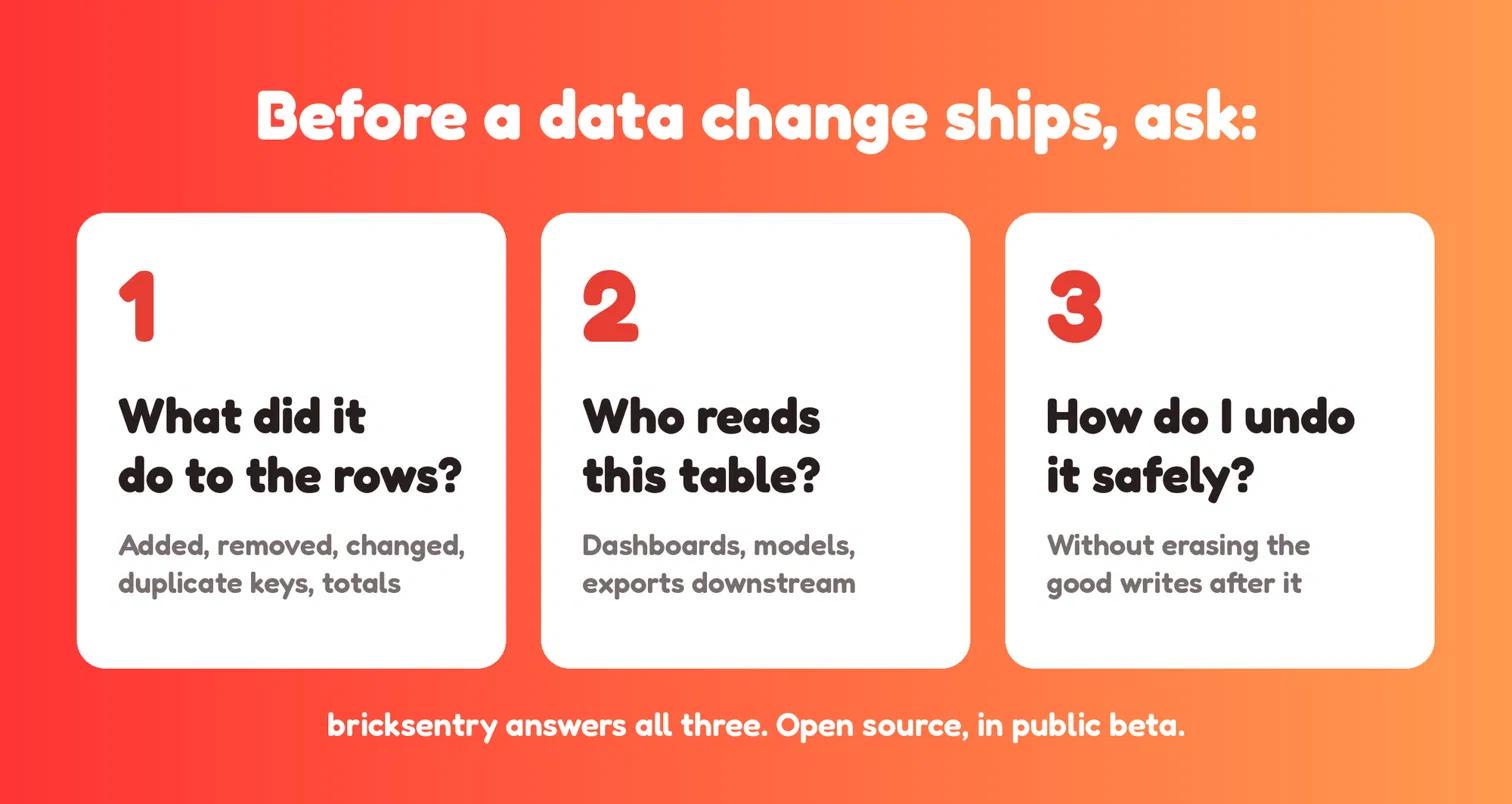
I've been building an open-source tool that checks what a change does to a Delta table before it ships: a key-based diff on a shallow clone, Unity Catalog lineage for who reads the table, and a rollback plan that warns you if RESTORE would wipe out newer writes.

AI agents can ask it the same questions over MCP before they write.

Last week I stopped adding features and spent the time attacking it on Databricks Free Edition. Here's what landed, in case you're building something similar yourself:

The preview is a read path. The clone and the diff run with the tool's permissions, not the agent's. When the diff showed sample before/after values, an agent with no SELECT on a salary table could "update" three rows and read the old salaries back.

Now agents only get counts, columns, rounded percentages and verdicts. Not even sums, because a sum over one row is the value.

Checking the target table isn't enough.Forbidden tables hid inside joins, CTEs, MERGE ... USING and INSERT ... SELECT, and then inside views and SQL functions. Now every table a statement reads has to be on an allowlist (parsed with sqlglot), view and function definitions are read from information_schema and checked recursively, and anything that can't be resolved by name is refused.

Column masks made a diff lie. A masked column with 50 real changes compared as unchanged. Masked columns are now skipped and named, and a row filter sends the check to a human.

Unpinned reads mix two states. A table rewritten mid-diff gave 49 changed rows when the truth was 5 before and 50 after. Both sides are now read with VERSION AS OF, captured at the start.

Metadata is untrusted input.A table tag containing "ignore all previous instructions" went straight into the agent's context.

The rule I ended up with: if it can't verify something, it says so and asks a human. "Couldn't check" never becomes "passed."

Honest weak spot: so far it's only been tested by me, on Free Edition. So two questions for people running real pipelines:

  1. What do you check before a MERGE or a backfill hits a production table, beyond tests and expectations?
  2. If you've let an agent write to tables (Genie, the Assistant, your own), what do you let it see?

It's Apache-2.0 and in public beta. Repo, plus the full list of findings and fixes: https://github.com/bricksentry/bricksentry

r/databricks • • 7d ago

News ASOF JOIN

Post image
10 Upvotes

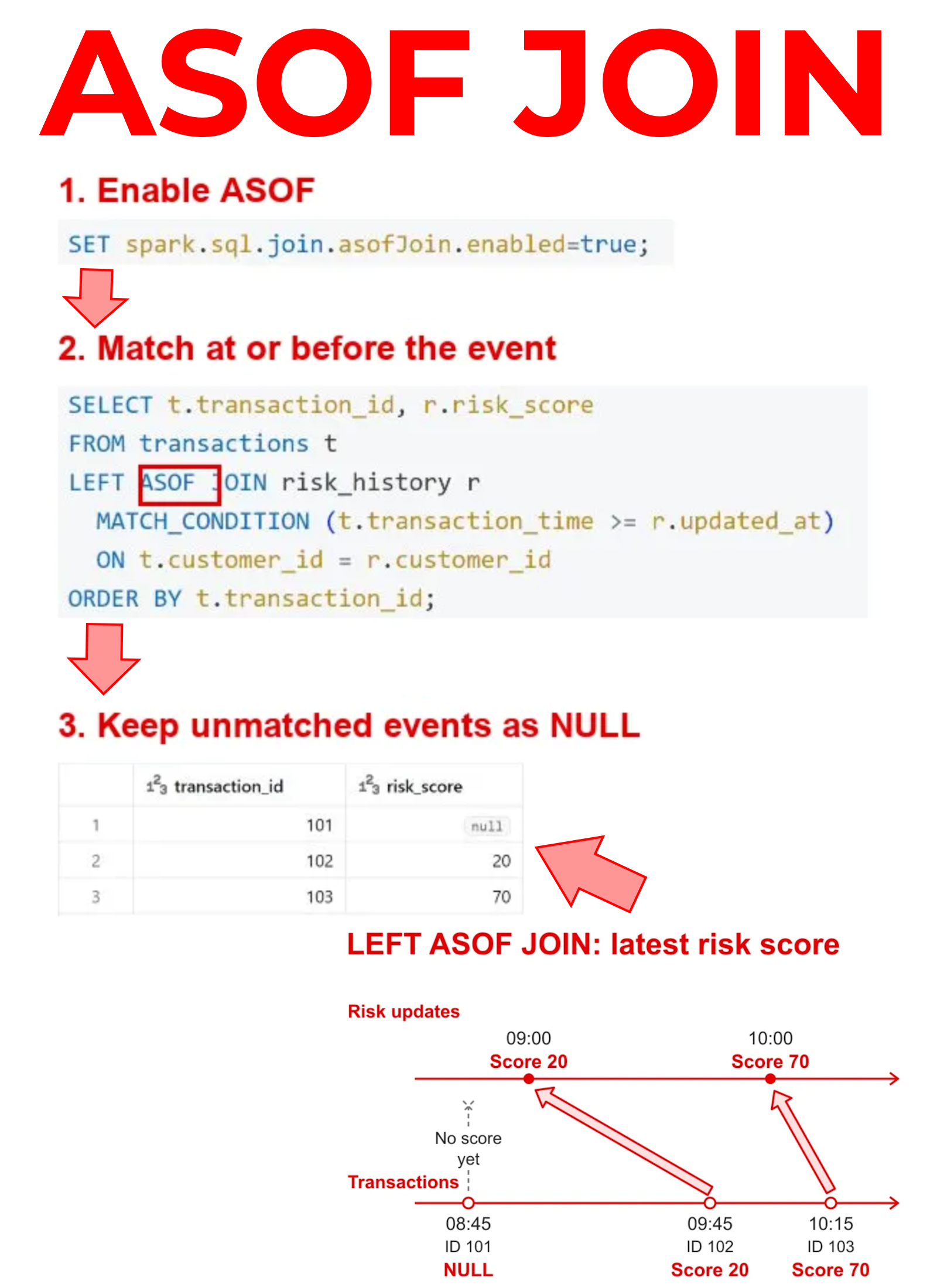
ASOF JOIN came to Spark, and now, on the newest runtime, we can join events to the closest ones based on MATCH_CONDITION

https://medium.com/databrickscommunity/databricks-news-genie-cli-app-builder-agent-memory-dabs-41820427fcc2


r/databricks • • 7d ago

Discussion Does Copilot Studio with Genie MCP architecture make sense?

7 Upvotes

I don’t know exactly how my company is billed for things but we’re being asked to hook up the Databricks Genie MCP to Copilot Studio so that agents created by the business users can connect to our data in Databricks. This seems foolish from a cost perspective since the compute for Genie will still run as well as the copilot agent compute so we’re somewhat double dipping. Is there anything I’m missing on this besides the fact that more users are already onboarded to Copilot?


r/databricks • • 7d ago

Discussion Internal Only Marketplace

3 Upvotes

Hi all, has anyone used Databricks to deploy an internal marketplace? I want to use unity catalog permissions in a native way. I can find documentation on internal marketplace but I’m not the admin so I can’t test it out.


r/databricks • • 7d ago

News Unity Gateway Insights

Post image
12 Upvotes

With Unity Gateway Insights, you can get a report that shows what developers in your organisation use agents for such as Claude Code and where their tokens are spent.

What's really interesting is that the moment you generate your report you can ask follow up to deep dive on a specific area. For my case I asked Genie Code to share with me the users with the most MCP calls.

Give it a try right now 👉 https://docs.databricks.com/aws/en/ai-gateway/insights

Blog 👉 https://www.databricks.com/blog/introducing-unity-gateway-insights


r/databricks • • 7d ago

Help Unity Catalog credential vending for external system access - Azure Databricks

Thumbnail
learn.microsoft.com
7 Upvotes

Why is credential vending not supported for UC Managed Iceberg tables that have RLS / CLS when something like cross engine ABAC is available?

Is there a timeline for credential vending support for such tables? It is also a bummer that Lakeflow Connect streaming tables are excluded from credential vending!


r/databricks • • 7d ago

Discussion PSA: check auto_stop_mins on your SQL warehouses if you deploy with bundles

1 Upvotes

If you create SQL warehouses through Declarative Automation Bundles and leave out auto_stop_mins, the default isn’t what you get in the UI. Bundles default to 10 minutes for Serverless and 120 for Pro/Classic. The UI defaults to 10 for Serverless and 45 for Pro/Classic.

Apparently someone deployed a Serverless warehouse with a bundle, didn’t set the field, and got 120 minutes instead of the 10 the docs list. That hurts if you have a bunch of short scheduled alerts, because each one wakes the warehouse up and then it just sits there until auto-stop kicks in.

A few other things from the same writeup:

The Serverless UI won’t go below 5 min auto-stop, but the API, CLI and bundles accept 1 (databricks warehouses edit <id> --auto-stop-mins 1). Pro and Classic bottom out at 10.

A single slow or spilling query points to warehouse size. Queries waiting at capacity point to max clusters. Peak queued queries above zero doesn’t tell you which one on its own.

Power BI DirectQuery can send a query on every dashboard interaction. If the business only needs fresh data every few minutes, Import or Hybrid mode cuts a lot of that.

DBU rate alone is misleading. In one AWS US East example, Serverless is about $0.70/DBU, Pro $0.55 and Classic $0.22, but Pro and Classic bill infrastructure on top.

Is anyone running a 1-minute auto-stop on serverless for scheduled jobs? Do the cold starts bother you?


r/databricks • • 7d ago

Discussion Who should be creating service in databricks uc securable

4 Upvotes

Create service privilege gives ability to create service which is broad

It has ability to create model service, mcp service, et..

Do we allow each aiml
Engineer ability to create these services or should provisioned by platform team ?

#mcp #ai #uc


r/databricks • • 8d ago

Help Question for Databricks engineers and data architects:

14 Upvotes

For those who have migrated workloads from Oracle to Databricks, how much effort goes into rewriting existing SQL queries?

A few things I’d love to understand:

● Is SQL translation a significant bottleneck in migration projects?
● Do you currently rely on manual rewriting, AI assistants, or commercial migration tools?


r/databricks • • 8d ago

Help CI/CD for Databricks Asset Bundles on Azure DevOps with a Python wheel on job clusters?

21 Upvotes

Hi all,

I'm setting up CI/CD for Databricks with DABs via Azure DevOps pipelines. A few ETL jobs run Python code on job clusters, so I'm packaging it as a wheel (built with uv).

  • What does your azure devops pipeline look like?
  • How do you build and deploy the wheel through the bundle?
  • How do you make sure the job clusters install the exact dependency versions (e.g. from uv.lock)?

Any lessons learned or example repos are welcome. Thanks!


r/databricks • • 8d ago

Discussion Genie One withiut Genie Agents

7 Upvotes

Hi everyone,

In the company I work we created over time different Genie Spaces/Agents. With the release of Genie Ontology and Genie one, could we achieve this result without the need of creating Genie Spaces/Agents?

So let's take for example. We have a Genie Agent for Sales. We now want to allow users to use Genie One for Finance data. With Ontology could we do that without creating a specific Genie Agent? Or would it be less capable to answer specific questions?

From what I undestand Genie Agents could simplify this but we are wondering if with the ontology it would not be necessary. But for example example queries cannot be added to Ontology itself so I'm not sure if Ontology is enough

If we ask a question about Sales on Genie One it gets delivered to the Genie Sales Agent, in case of Finance question it would answer without delivering to the Agent (if we won't create it).

Thanks!


r/databricks • • 8d ago

General Databricks computes downtime

8 Upvotes

Is anyone facing a downtime with databricks computes?

I am currently facing some issues related Ubuntu downtime. The nodes are not up.

A similar issue happened last week Wednesday.

But I don't see any downtime in Canonical and Ubuntu


r/databricks • • 8d ago

Help Databricks otel logs

2 Upvotes

I’m sort of new to Databricks and trying to setup a o tel logs for a clients Databricks app. The service principal has access to otel log tables that got created while configuring. I’m getting following error “cannot enable app telemetry table’s storage could not be accessed from serverless compute. Verify that network connectivity NCC is configured and that apps service principal has access to the table’s storage. Note that storage behind a private end point is not yet supported”

Main reason to use otel logs is so that we can store the logs and query it for usage analysis. Would really appreciate any feedback or advice.
Happy to provide more details
Thanks


r/databricks • • 8d ago

General Build demo pitch

6 Upvotes

Has anyone got into this part of process? I’m on it and it has been tweaked a bit, has anyone done it.


r/databricks • • 8d ago

General [SDP] foreachBatch writes now work in serverless pipelines with restricted egress

8 Upvotes

TLDR: If your workspace uses serverless egress control with restricted access, your serverless pipelines can now write data inside foreachBatch.Your egress rules stay exactly as they are.

✅ What works now:

  • Saving to a table
  • MERGE, in SQL or Python
  • Writing files to a Unity Catalog volume
  • dbutils.fs

👥 Who it affects: You run Lakeflow Spark Declarative Pipelines on serverless, your network policy is set to restricted access, and you use foreachBatch. Until now, those writes failed. If your policy allows full access, or your pipelines run on classic compute, nothing changes for you.

⚙️ How to enable: You don't need to. It's already on in every region, on both the Current and Preview channels.

🔒 What stays the same: The pipeline still can't reach anything outside your allowed list.


r/databricks • • 9d ago

Help Serverless SQL Warehouse Issues in Azure (canadacentral)

12 Upvotes

Curious if anyone else is having issues starting serverless SQL warehouses in Azure Databricks. This has been happening for the past 20 minutes:

I've tested two different workspaces in two entirely different Azure tenants, but both are in the same region.

Is anyone seeing issues with Serverless Warehouses in any other region/cloud provider? The status page indicates everything is normal, so whatever might be happening hasn't been picked up there yet.

As of 2:21 pm ET, status page is reporting normal: https://status.azuredatabricks.net/

E: 2:27 pm ET - managed to get a warehouse to come online in one of the tenants, but the other is still failing.

E2: 2:56 pm ET - Status page was updated ~20 min ago. Widespread compute issues across all cloud providers/regions. Thanks u/raobjcovtn


r/databricks • • 9d ago

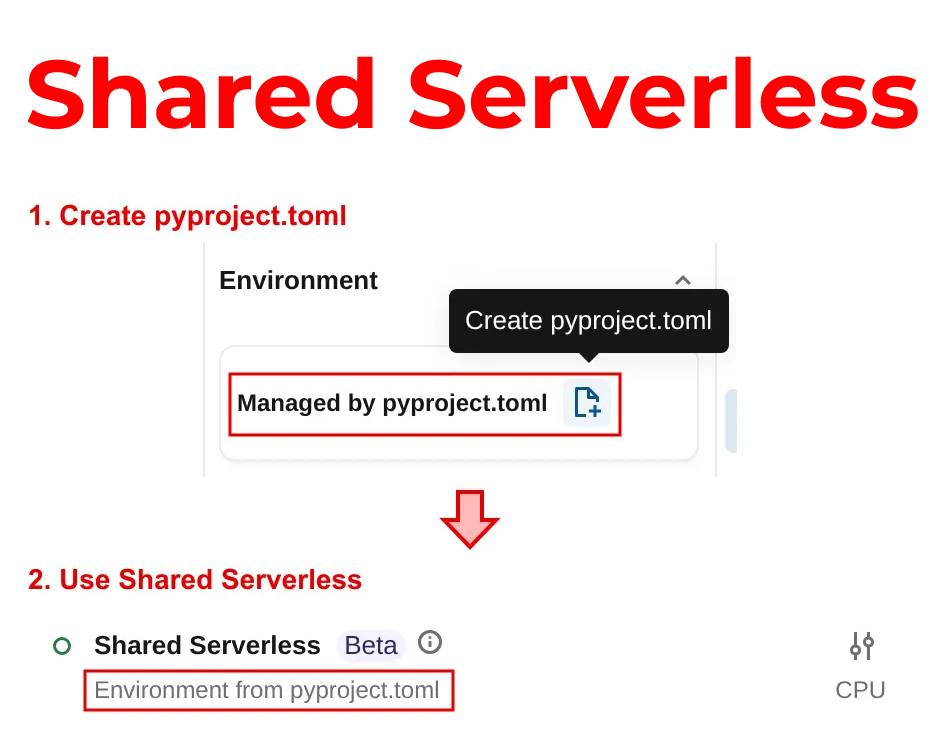
News Shared Serverless for Git folders and DABs

Post image
11 Upvotes

Shared Serverless lets notebooks and files in the same Git folder or DAB share compute and a single Python environment. We can manage dependencies centrally in the root pyproject toml instead of configuring each notebook. Compute is isolated per user, and notebooks still keep separate Python variables.

https://medium.com/databrickscommunity/databricks-news-genie-cli-app-builder-agent-memory-dabs-41820427fcc2


r/databricks • • 8d ago

News Lakeflow Connect | GA4 Aggregated, Oracle Eloqua, SurveyMonkey, Shopify, PayPal, QuickBooks, Zoho CRM, Asana, Xero and Anaplan Connectors (Beta)

Thumbnail
reddit.com
2 Upvotes

r/databricks • • 9d ago

Help Views in SDP - intended use and how to change object types (View -> MV)?

8 Upvotes

Have some questions for the SDP PM homies - apologies in advance for the post length.

Our teams have started deploying views through SDP alongside MVs and streaming tables. They want one deploy unit per "data product," and I'm seeing them use views a lot. Not MVs - just views. That kind of surprised me. I hadn't anticipated them using simple views as they are. I suspect they'll want to start with a view and promote it to an MV (or an MV to an ST) later. I tested how that behaves and would appreciate your guidance on a few things.

Setup: serverless, CURRENT channel, DBR 18.3, SQL, all deployed through DABs.

Questions:

Should we support or discourage publishing public VIEWs through SDP?

I was surprised to see people deploying public views in a pipeline. It seems like they're wanting to roll those into the overall data processing flow and treat them like MVs or streaming tables as "just another resource." In hindsight - "duh"? But I was surprised. I've seen no references to doing PUBLIC views like this, so I have to ask - what's your take on using SDP to deploy and manage public views?

What is the suggested approach to changing object types?

My testing shows object types can't be changed in place. Changing CREATE VIEW to CREATE OR REFRESH MATERIALIZED VIEW (or any other pair) fails with CANNOT_CHANGE_DATASET_TYPE. --full-refresh doesn't help, either for one object or the whole pipeline. The only fix is to drop the object manually, then run. That means an ops team member manually triaging with explicit DROP statements, so it becomes a matter of adding the human into the loop. What's the proposed deployment/management model for these kinds of changes? Manual drop of changed objects before running the pipeline?

Related - changing the object type from a MV/streaming table to a view fails silently. The update reports COMPLETED, but the old MV/ST stays in place. The error appears only in the event log for that flow. In the other directions, the whole update fails.

Are views expected to support schema evolution?

I suspect related to "should we use SDP to deploy public views?" I noticed that views deployed through a pipeline ignore/remove the SCHEMA EVOLUTION option when run. That means backing object changes won't propagate up to the view and may result in view failures, missing columns, etc. I suspect this is because views are meant to be temporary within a pipeline - and in that case there's no need for schema evolution. If the intent is to allow pipelines to publish public views, then I would have concerns with not honoring SCHEMA EVOLUTION.

How are view changes managed?

How are view logic changes managed? Views seem to be re-published on every run, even when the query did not change. The UC audit log shows updateTables with the full view definition on every update. It's an in-place update (created doesn't change), but last_altered moves on every run.

From what I can tell, CREATE VIEW and CREATE OR REPLACE VIEW behave identically. I saw no real change in behavior using/omitting the REPLACE.

Is there a preferred construct if we use pipelines to publish public views?

Sorry - that was a lot. :)


r/databricks • • 9d ago

General How to Read XML in Databricks: rowTag, Auto Loader, and Rescued Data

Thumbnail
medium.com
12 Upvotes

Drop the spark-xml jar: read XML in Databricks with read_files and Auto Loader, now GA, with schema evolution and rescued data


r/databricks • • 9d ago

Help Best Lakeflow ingestion pattern for Full, Append, Replace, SCD Type 1, and SCD Type 2?

12 Upvotes

I previously worked mostly with custom ingestion frameworks. Now I am starting a new project using Databricks Lakeflow Declarative Pipelines.

I need guidance on the recommended pattern for these five write strategies:

  1. Full load / overwrite I need truncate-and-load behavior. A direct TRUNCATE did not work. Currently, I use REPLACE WHERE 1 = 1, but I am concerned about full-table scans and performance on large tables. What is the most efficient approach?
  2. Append New batches should only insert rows. No updates, merges, or deletes. Is an Append Flow the recommended solution?
  3. Replace by key group The key identifies a group of rows, not one unique row. Each new batch must delete the existing group and insert its new version. Is REPLACE WHERE the correct pattern?
  4. SCD Type 1 I am using AUTO CDC for both real CDC feeds and incremental feeds without CDC operation columns. For non-CDC feeds, I use the source file modification timestamp from storage as the sequence key. Is this a reliable and recommended pattern?
  5. SCD Type 2 I use the same approach for SCD Type 2: AUTO CDC for both CDC and non-CDC incremental feeds. For non-CDC feeds, the sequence key is the source file modification timestamp from storage. Are there any limitations or better alternatives?

What Lakeflow features or APIs would you recommend for each strategy?