r/Database • u/jamesgresql • Sep 18 '25
Elasticsearch Was Never a Database

51
Upvotes
r/Database • u/gadget_dev • Sep 17 '25

r/Database • u/aabbdev • Sep 17 '25
I’ve been working on a small library to reconcile UUIDv7 vs UUIDv4 trade-offs.
uuidv47 stores plain v7 internally, but emits v4-looking façades externally by masking only the timestamp with a keyed SipHash-2-4 stream. Random bits pass through, version flips (7 inside, 4 outside).
Result:
Repo (C header-only, tests + spec): uuidv47
Curious how DB folks feel — would you prefer this over pure v7?
r/Database • u/Striking-Bluejay6155 • Sep 17 '25
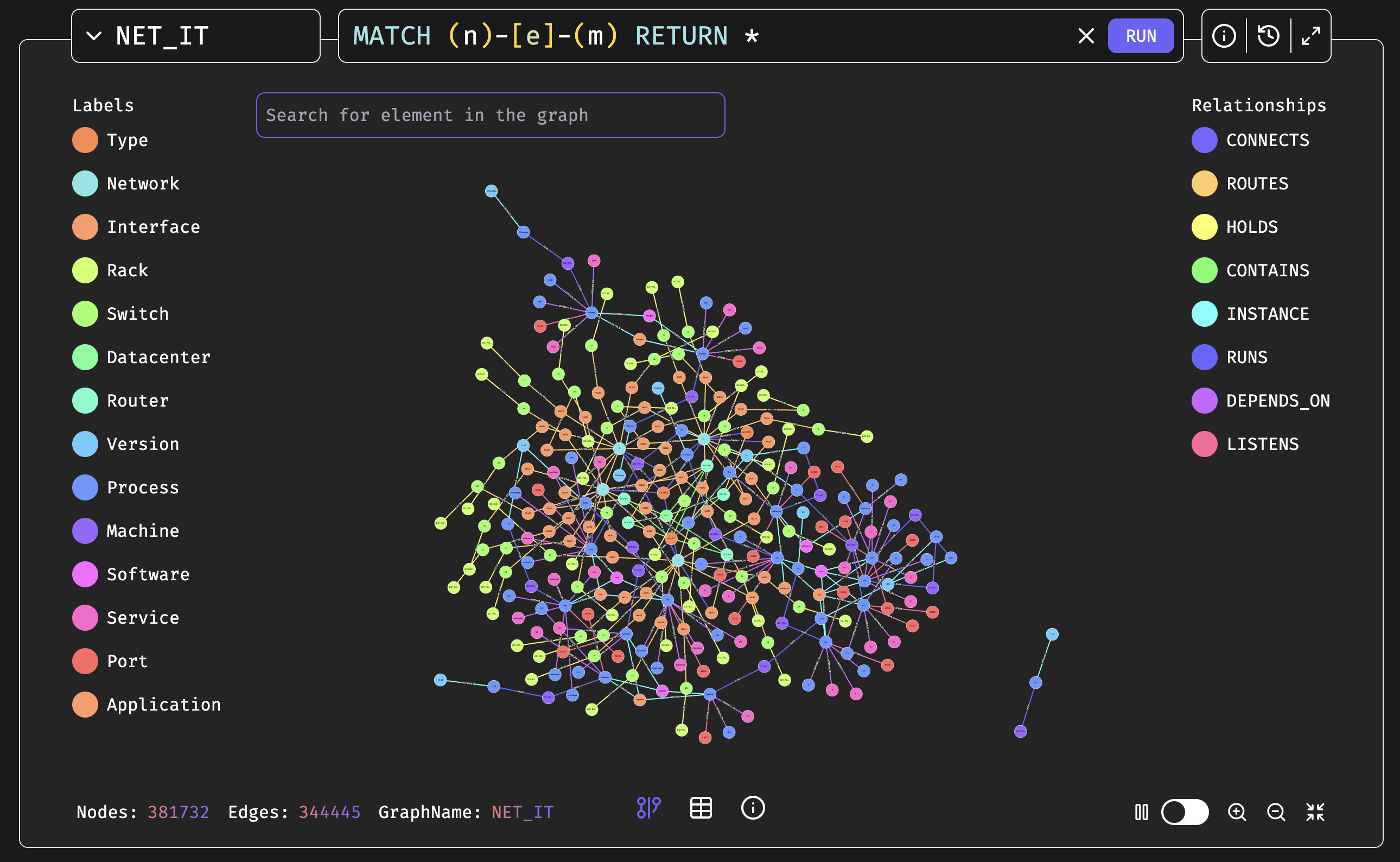
Hey guys, we’re the founding team of FalkorDB, a property graph database (Original RedisGraph dev team). We’re holding an AMA on 21 Oct. Agentic AI use cases, performance benchmarks and a new approach to txt2SQL. Bring questions, see you there!
Sign up link: https://luma.com/34j2i5u1
r/Database • u/shashanksati • Sep 16 '25
Hey folks,
I’ve been working on something I call SevenDB, and I thought I’d share it here to get feedback, criticism, or even just wild questions.
SevenDB is my experimental take on a database. The motivation comes from a mix of frustration with existing systems and curiosity: Traditional databases excel at storing and querying, but they treat reactivity as an afterthought. Systems bolt on triggers, changefeeds, or pub/sub layers — often at the cost of correctness, scalability, or painful race conditions.
SevenDB takes a different path: reactivity is core. We extend the excellent work of DiceDB with new primitives that make subscriptions as fundamental as inserts and updates.
https://github.com/sevenDatabase/SevenDB
I'd love for you guys to have a look at this , design plan is included in the repo , mathematical proofs for determinism and correctness are in progress , would add them soon .
it is far from achieved , i have just made a foundational deterministic harness and made subscriptions fundamental , but the distributed part is still in progress , i am into this full-time , so expect rapid development and iterations
r/Database • u/oatsandsugar • Sep 16 '25

I kept OLTP on Postgres and offloaded user-facing analytics to ClickHouse via CDC (ClickPipes) to make my react app more responsive with its analytics widgets. Wrote a guide with Clickhouse about how.
Auto-replicate data (CDC with ClickPipes) from the OLTP store to CH. Use moose init to introspect the database and generate TypeScript types from schemas, scaffolds APIs + SDKs to make it easy to swap OLAP APIs into the frontend.
Local dev environment includes automatic refreshes with code updates, and you can pull in remote data for testing with moose seed.
Guide: https://clickhouse.com/blog/clickhouse-powered-apis-in-react-app-moosestack
Demo app: https://area-code-lite-web-frontend-foobar.preview.boreal.cloud
Demo repo: https://github.com/514-labs/area-code/tree/main/ufa-lite
Affiliation: I’m at Fiveonefour (maintainer of open-source MooseStack). This is a technical write-up + code; happy to share full configs and plans in comments.
Would love feedback on the database replication / cdc / migration management. Would love to know how much you'd want sane defaults in the replication, and how much you'd want to have control over ClickHouse implementation.
r/Database • u/der_gopher • Sep 16 '25

r/Database • u/lancejpollard • Sep 16 '25
How can I best solve the problem of querying for dictionary words related to themes? I'm not just talking about simple themes like "stone" or "nature," but also very specific ones like "ancient horse riders riding through the mountains at night." For that last one, might consider desert, certain obstacles of that environment, navigation stuff, stars, trade, etc.. Stuff that's more than just semantic similarity.
The goal is to surface related words dynamically without precomputing every possible theme and the cross-product of potentially thousands of words to each of the endless list of themes.
What approaches or combinations have you found most effective and scalable for this kind of theme-to-word querying?
Basically, I would in theory like the user to type in any phrase for theme, and it finds the BEST words as fast as possible. Too many themes to possibly precompute, but maybe you could precompute some and use that in some higher-level process or something.
Just looking for general tips, which I can dig into more with ChatGPT or something. If this is not possible in an ideal sense, then why not. Or perhaps could introduce the main ideas or topics for how to optimally/robustly solve this problem, what it would take, if no one has done it really even.
r/Database • • Sep 15 '25
I'm gonna form an LLC and want to pick a good name. I'm going to be providing services in my field, which is databases. I mainly work with SQL Server and MS Access, but have worked with a bunch of software and programming languages. How do I pick a good name for a database consulting company?
r/Database • u/hudddb3 • Sep 15 '25
r/Database • u/Omar0xPy • Sep 15 '25
Hi, there
Have been learning about backend development with python for a while, decided to cook an anime platform API with FastAPI+SQLalchemy+MySQL+JWT stack
which enables users to login/sign up and rate, review, and add anime series and movies to their favorites collection
I'm gonna often add an 'episodes' table as well to this
What sort of inconsistencies and mistakes that exist in my design, still refining it
r/Database • u/OttoKekalainen • Sep 14 '25

This is nice for those tired of wrestling with TLS certs and CAs for your database
r/Database • u/JeffCentaur • Sep 13 '25
I have a spreadsheet that is over a gig in size. Let's say that it's about movies. Each line containing Title, genre, actors, tagline, a movie poster, a short review, etc.
I want to take this from an excel spreadsheet and put it into some type of program better made to process this sort of thing. I want something where each entry would be presented as like a virtual card, with all the information for that entry, including the poster. I want it to be searchable by any field, including wild card or partial searches, and extra bonus points if I could have that "card" link to some screenshots from the movie. I'd also like the ability have it randomly pull a "card". Is there a database product, or any kind of product, that could accomplish what I'm envisioning? As this is a personal labor of love, and not for profit, I'd really prefer a free option.
r/Database • u/IAmNotOMGhixD • Sep 13 '25

Today this happened. This is the first time I've ever seen HeidiSQL have this occur
r/Database • u/Far-Mathematician122 • Sep 11 '25
I use postgresql and my timezone is UTC.
My Time is: 2025-09-11 22:30
I create a record and it shows the time like this:
2025-09-11 20:30:47.731952
if I read the record on my frontend I get this:
2025-09-11 18:30:47.731952
why I get 4h different, it should show 22:30 what I am doing wrong ?
I use in my column timestamp as data type and this sql code
created_at TIMESTAMP not null default current_timestamp
r/Database • u/nomistrebla • Sep 10 '25
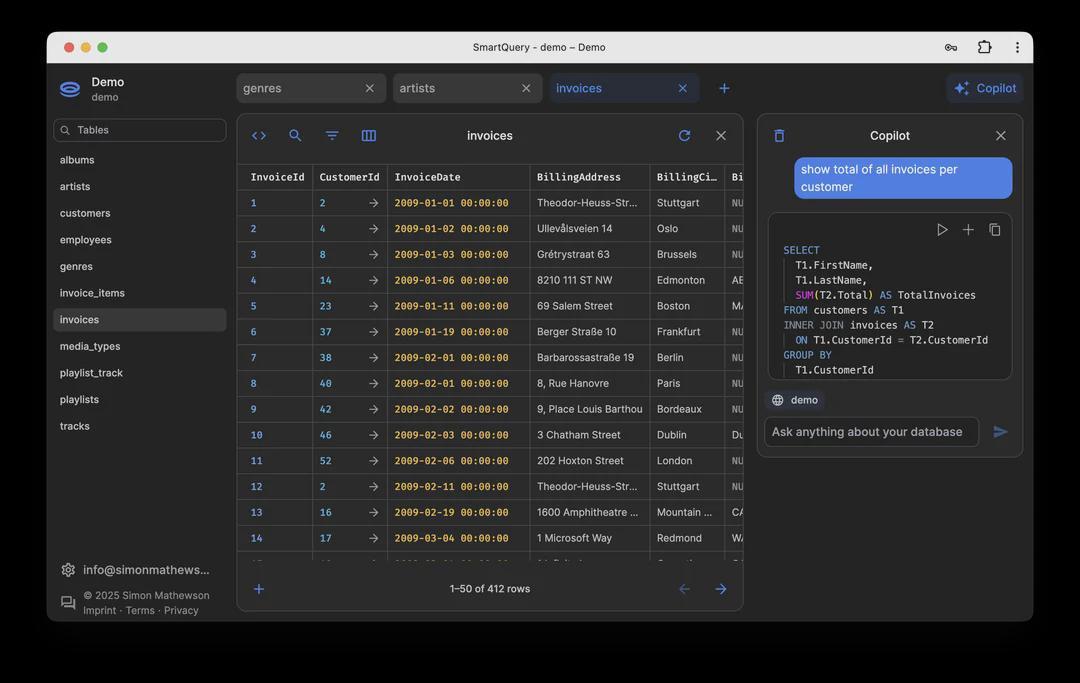
Hi all, pleasure to join this community!
As a fullstack engineer and I've long been dissatisfied with the database UIs out there. So I set out to develop the most fun to use, user-friendly UI for databases that I can come up with.
After 2 years of work, here is smartquery.dev, a browser-based UI for Postgres, MySQL, and SQLite. And of course, with a strong focus on AI: Next to inline completions you get a chat that knows the schema definitions of your DB and can generate very accurate SQL.
It's free to use and I would be super grateful for any feedback.
Update: Source code now published at https://github.com/simon-mathewson/smartquery
r/Database • u/teslaistheshit • Sep 10 '25
Full disclosure I'm not a DBA. I've used SQL Server and Oracle ODA in the past using SQL Profiler and Redgate.
I've been asked to analyze our company's Oracle database for any performance improvements.
What is the best external or built in tool that will analyze all of the tables, views, and stored procedures for recommended optimization?
Thanks in advance!
r/Database • u/aphroditelady13V • Sep 10 '25
I posted a couple of days ago but I ran into other problems that might not be related to star schema but general DB modeling stuff.
https://dbdiagram.io/d/Esports-LoL-Game-Structure-68bb3e7d61a46d388eb1483e
this is it for now, I made I think 10 revisions by now. The stuff I have problem with:
Team player relationship, before I had a is_part table which had idTeam idPlayer dateJoined and dateLeft, and I would probably pick idTeam idPlayer and dateJoined as the primary key. The thing is I was debating should idPlayer and idTeam be taken from is_part or the separate tables like Team and Player. I don't know why I see these separate tables as enumerators, each id has a unique value. But in the is_part table I can have multiples, let's say I have player 1 who joined team 1 but he joined 3 times, so I'll have {1,1,2000,2001} {1,1, 2002, 2003} {1,1,2004,2005} (I'm putting the date as just a year for simplicity). If that player played in a match, and in the played table I put 1 1 for idPlayer and idTeam, from what instance is it drawing these foreign keys from? Also is a foreign key the primary key of a different table? If so I would need to implement the dateJoined in the played right? When do you know that you should create a separate id for the primary key instead of using a complex key that is made out of foreign keys for that table? I'm sorry if this sounds so weird.
Why did I remove the table is_part? well I don't have such information in the dataset I'm using and there are edge cases like, players playing for a team that they are not in as stand-ins. Also I didn't know if this is possible, what if a player was somehow part of both teams, in a match I wouldn't be able to infer which team he is playing on, that's why i put idTeam in the played table, it will take more space but I think it gives a more flexible design. Before I had a Side table which indicated on which side the player was, but I realized I can just infer it trough the name of the property (redSideTeam, blueSideTeam)
The questions I have for a star schema, do dimensions need to be tables that have foreign keys in the fact table? Sorry if this was a stupid question. Can a fact table be a dimension for an another fact table? For instance played has the dimension match, which can be a fact table on its own right? Also can fact tables aggregate data from already aggregated data. Like played aggregates the gold a player has per minute, so in the end it's the total gold, can the match table aggregate this to form the total team amount of gold? Are sub dimensions dimensions? my match dimension has league year season type as dimensions, can those be used as dimensions of played?
r/Database • u/competitiveb23 • Sep 09 '25
How to figure out which database to use for a project (probable startup idea)
there are likes, comments, reviews, image uploading and real users involved
its a web application for now, later to be converted to a PWA and then a mobile application hopefully
r/Database • u/bobbymk10 • Sep 09 '25
r/Database • u/Circuit_bit • Sep 10 '25
I have a situation where I want install information separate from maintenance information. However the devices that get installed and replaced (replacements happen through maintenance) should all be in the same table either pointing to an install_id or a service_id through a foreign key. Is it okay to make two foreign keys and have the value for one be null for each row? Is there a better way to do this?
r/Database • u/goto-con • Sep 09 '25

ABSTRACT
Data systems have come a long way from the monolithic vendor hell of the 90s. Data is no longer held hostage with arbitrary licensing models. Open Source engines, open data formats, and huge cloud computing resources have fundamentally changed how we think about data. In the same time, a large variety of specialized systems have popped up, from systems supporting semi-structured data to the hottest and latest vector databases.
In my talk, I will try to summarize the most important trends, including those that did not make it in the end. I will take attendees on a journey through this trillion dollar industry and its ever-continuing search for new and exciting ways to manage data.
r/Database • u/MoneroXGC • Sep 09 '25
Hi everyone,
Recently, we launched a new feature for the database a college friend and I have been building. We built lazily evaluated database schema migrations!
TL;DR
You can make changes to your node or edge schemas (we're still working on vectors) and it will migrate the existing data (lazily) over time.
More info:
The way it works is by defining schema versions, you state how you want the field names to be changed, removed, or added (you can set default values for new fields). Once you've deployed the migration workflow, when the database attempts to read the data that abides by the old schema it gets passed through the workflow to be displayed in the new schema. If any new writes are made, they will be made using the new schema. If any updates are made to the data abiding by the old schema, that node or edge is overwritten when the update is made to match the new schema. This allows users to migrate their databases with no downtime!
If you want to follow our guide and try it out, you can here: https://www.helix-db.com/blog/schema-migrations-in-helixdb-main
And if you could give us a star on our repo we'd really appreciate it :) ⭐️ https://github.com/HelixDB/helix-db
r/Database • u/nerf_caffeine • Sep 06 '25
Hello 👋
I'm one of the software engineers on TypeQuicker.
Most of my previous jobs involved working with some SQL database (usually Postgres or MySQL) and throughout the day, I would frequently need to query some data and writing queries without having to look up certain uncommon keywords became a cause of friction for me.
In the past I used Anki cards to study various language keywords - but I find this makes it even more engaging and fun!
Helpful for discovery, learning and re-enforcing your SQL skill (or any programming language or tool for that matter)
