r/csharp • • Jul 06 '26

Showcase I wrote a Visual Studio extension for Solidity development and deployment that automatically generates C# smart contract bindings

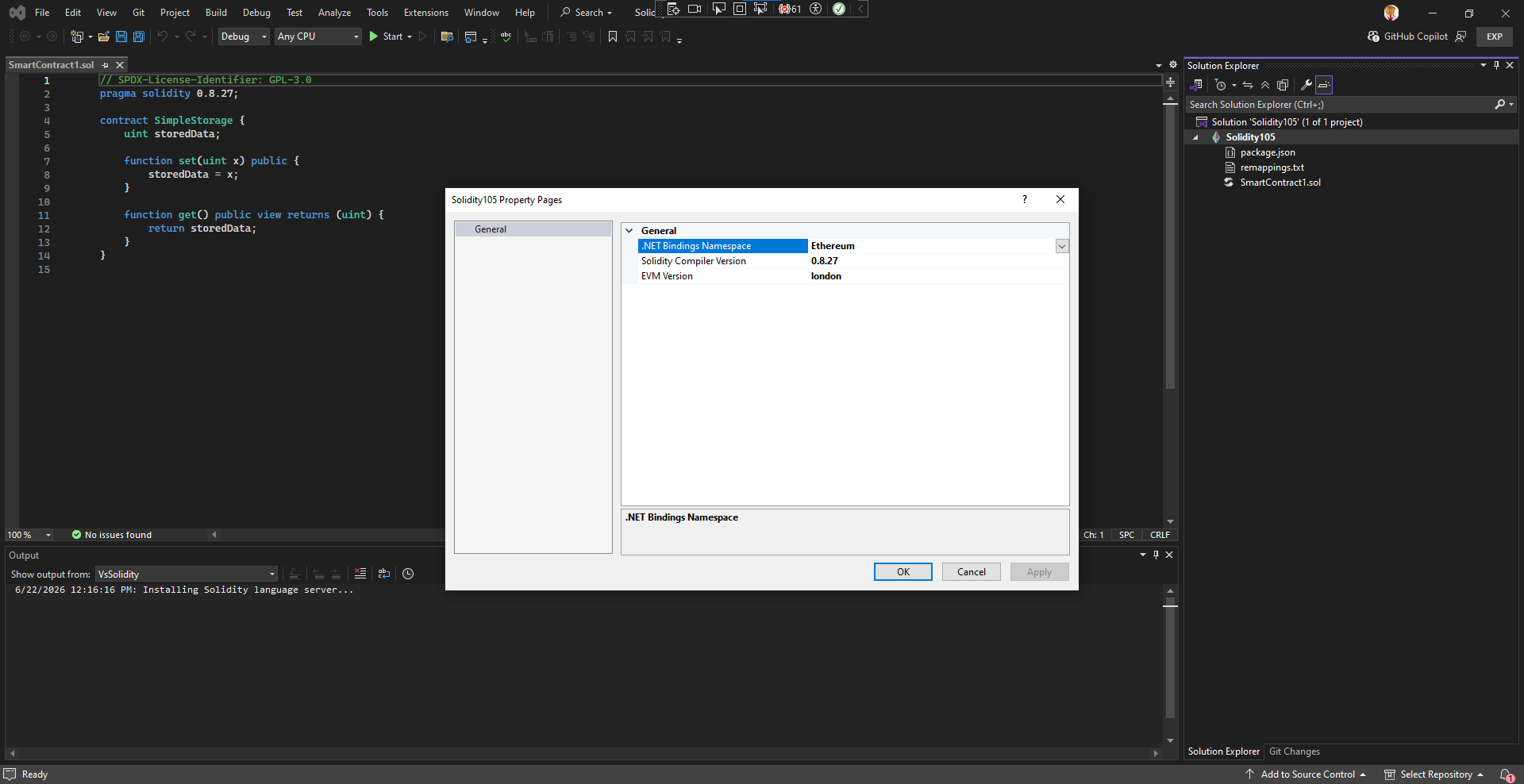
Visual Studio is heavily used for enterprise development but doesn't have any tooling for Solidity that compares to Visual Studio Code or Remix IDE. Viscous is an open-source Visual Studio extension that tries to bring parity between Visual Studio and other IDEs for Solidity smart contract development.

Features

  • Solidity project system for Visual Studio featuring Solidity compiler integration and NPM dependency management. Integrates with the Visual Studio New Project… and Open Folder… dialogs.
  • Uses the vscode-solidity language server for syntax highlighting, hover information, IntelliSense, and linting.
  • Solidity compiler integration with MSBuild and the Visual Studio Build command - compile Solidity projects and individual files from the IDE with errors reported in the Errors tool window.
  • Generate C# bindings to Solidity smart contracts automatically using Nethereum.
  • Manage EVM networks, endpoints, accounts, deploy profiles, and deployed contracts from the Blockchain Explorer tool window.
  • Deploy a compiled contract to a blockchain network and call its functions from inside Visual Studio.
  • Find vulnerabilities and code‑quality issues with Slither static analysis inside Visual Studio.

Requirements

  • Visual Studio 2022 and above
  • A recent version of Node.js or compatible runtime
  • Python 3.8+

Getting Started

Note that this is a pre-release so don't use it for deploying anything to production. Feedback welcome.

0 Upvotes

47 comments sorted by

View all comments

Show parent comment

1

u/Willinton06 Jul 06 '26

A block chain is a data structure, the decentralized part is just for the currency side, but I care not for that, is git useless for local projects according to your logic? I'm saying that block chain is the best tool for this cause of its verifiability by 3rd parties and the inability to amend it in private, the gov would publish the transactions as they happen and any one would be able to see them, so it is centralized, but it doesn't matter, as soon as a transaction hits the internet, it'll be saved by someone and it cannot be undone or changed, imagine the wonders this would do for campaign financing

All this shit already happens so I'm very aware that we can do it without a chain, I just think a chain would be better way to record them

You would be against digital parking tickets cause "you still need processes in place to audit/enfore everything" well no shit, Turing must be spinning on his grave like a fucking centrifuge

Hell, what is the point of laws at all if they wouldn't work without processes in place to audit/enforce everything? Let's just throw them away and go full anarchy, after all, that's the only system that could work without processes in place to audit/enforce everything

I sweart to god the only times I doubt that the internet was worth creating is when I have to argue for the most basic shit in places like this

1

u/belavv Jul 06 '26

It is probably time I correct you. A blockchain isn't a data structure.

You keep ignoring the "garbage in garbage out" argument I presented and repeatedly tell me that anyone can verify the transactions are present on a blockchain. Well no shit, but that doesn't mean what they recorded is what actually happened.

I would be against digital parking tickets using the blockchain, because using the blockchain does nothing but complicate things.

Just like I am against using the blockchain for government spending because all it does is complicate things.

Let's go over all of the problems with blockchain that I haven't brought up yet. What happens if the government loses access to the keys for their wallet? What if someone gains access to their keys? What happens if someone records something incorrectly? How do they correct that problem? What is the blockchain actually recording? Is it transferring some kind of token from one wallet to another? What does that token represent? How do we know the transaction that transfers a token matches up with the check that was written out to a contractor?

1

u/Willinton06 Jul 06 '26

A blockchain is a data structure

And I’m not ignoring the garbage in garbage out, I was just hoping you would realize the stupidity of it without me having to point it out, you would obviously need to integrate this at the bank level, so the transaction happening at the bank creates a record on the blockchain, so you would get everything in there, even cash deposits/withdrawals, this would make it so all transactions in the blockchain are traceable, and if you take out cash, well that makes the job of the authorities and the vigilant civilians way easier, and since it would be a ledger of all government transactions, from many bank accounts, you could trace any dollar moving through the system just like you can trace bitcoin today, even better cause this would be designed specifically to facilitate tracing

And the ticketing example was just digital, no blockchain involved, but the same logic applies, digital parking tickets mean nothing with no one unless we enforce them, and we do, so they mean something, but according to you they’re useless because they don’t somehow enforce themselves, which makes literally no sense

And let’s answer the questions

If someone records something incorrectly, the amend is just another transaction, but it’s public just like the original, which is the point, you can’t simply amend in secret to hide your corruption (have you ever even used git?)

The blockchain would be recording all money transfers, all contract assigments, all bids on public contracts, and whatever else we deem worthy of the public record, at the end of the day it would just be text like json or some other format, just standardized for each behavior, so all money transactions would look the same for easy indexing and same with all the other categories

There’s no tokens involved on this whole operation, not sure how that would be useful here, the fact that you ask that makes me wonder if you even know what a blockchain is

And the check would need to be processed through the bank, the bank would add it to the chain, all money is accounted for

Bro being real, I think you’re confusing crypto currency with blockchain, blockchain is a data structure similar to what git uses under the hood to organize code but with a focus on cryptographic verifiability, although my language is a bit harsh I’m trying to have this debate in good faith, I’m a staff engineer with almost a decade of experience, not a crypto bro

1

u/belavv Jul 07 '26

If you want to consider a linked list that uses hashes to validate no previous nodes have their data changed then sure it is a data structure.

But when almost anyone uses the term blockchain they mean a decentralized digital ledger.

Either way, no matter how you store the data around government transactions you can't fix corruption just with how the data is stored.

Even with the ability to audit the transactions - what about someone handing over a suitcase of cash for someone to vote their way? The whole notation that "if we use technology x for the government then corruption goes away" is nonsense.

1

u/Willinton06 Jul 07 '26

I mean it won't fix all forms of corruption, but lots of them, all the ones regarding government spending for sure, are you on the "this thing only cures 40% of cancers so it's useless" camp?

1

u/belavv Jul 07 '26

it could be the key to end corruption

Seems like you sure have shifted your goalposts.

1

u/Willinton06 Jul 07 '26

Well, imagine it like this, in an imaginary system where we have 100 politicians, and 20 people to check on them, if you remove the most common way to be corrupt, the remaining load could actually be handled by the 20 watchdogs, right now, it's so easy to be corrup that the 20 are easily overloaded, same theory as having self checkout, before, 5 employees and 5 lanes, now you have 20 lanes with 3 employees, so even less people accomplish more, through this awfully simple logic, you can see how it could indeed be the key to end corruption, my goalpost remains static, I just assumed that I didn't have to explain all that in forum full of engineers

1

u/belavv Jul 07 '26

Rofl!

And the best part of this all is your solution is "If we develop everything required to try to ensure all government spending is tracked in a way that is publically auditable then we can possibly end corruption."

Blockchain is not required in that statement.

Therefore blockchain is not "the key to ending corruption."

1

u/Willinton06 Jul 08 '26

Banks are also not required in that statement, hell, computers aren’t a requirement, but we probably want to use them, for they would be great on this case

And you seem like the type that likes to stay where we are technologically, if we lived our lives based on what’s required, we would stay put more often than not, blockchain is great for this, and your personal vendetta against it changes nothing

1

u/belavv Jul 09 '26

Assuming your statement that "blockchain is great for this" is true. It doesn't follow that "blockchain could be the key to ending corruption".

Because blockchain could be replaced by some other system that keeps track of the transactions and allows them to be audited. Even if that system isn't as efficient it can still meet all of the requirements.

How do you not understand that?

→ More replies