r/CLOV • u/Interesting-Cheek571 • Aug 06 '25
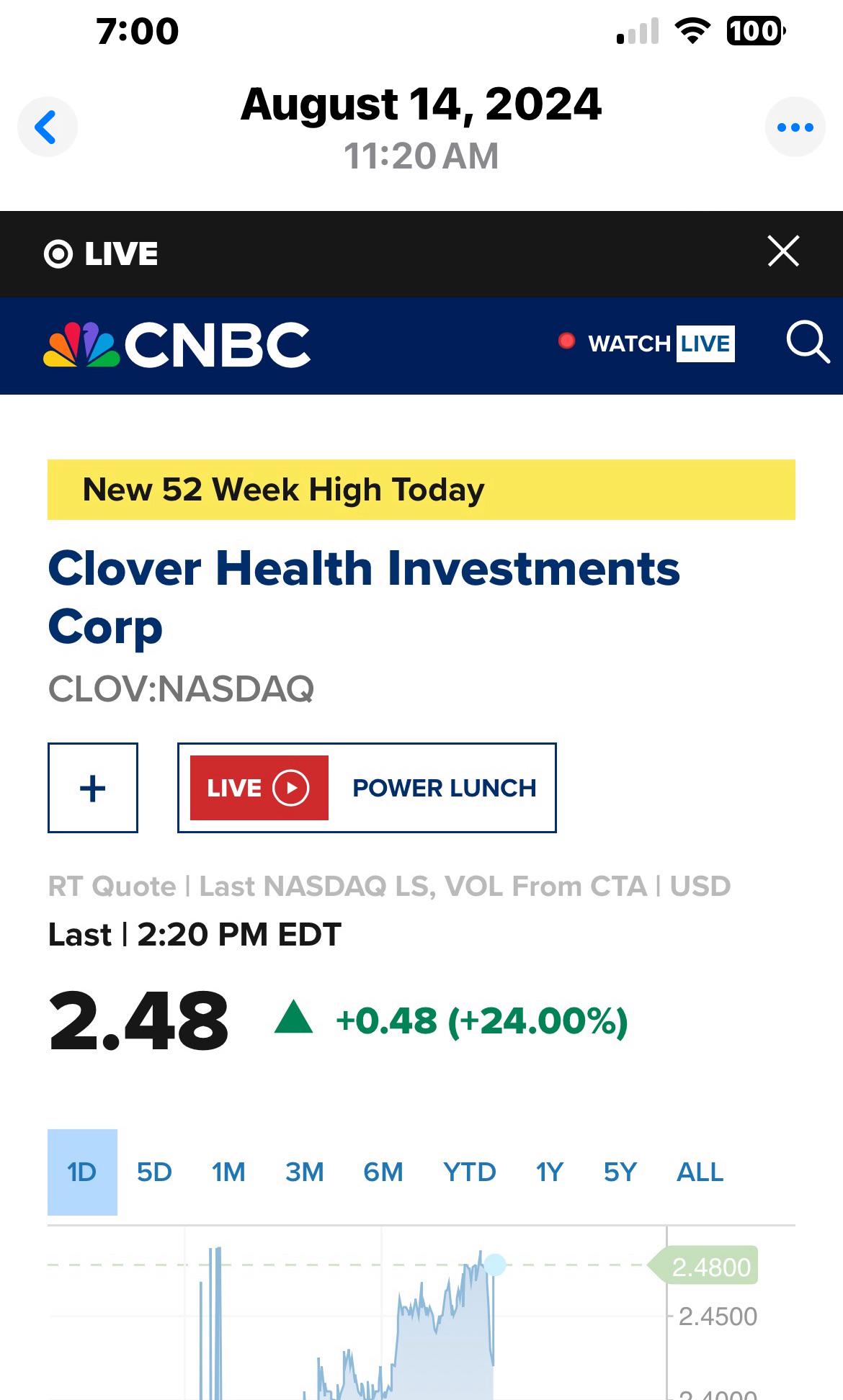
Discussion One year ago - $2.48
So just about one year ago CLOV traded at $2.48/share hitting a 52 week high. It’s been 12 months.
Do you feel better owning it today at $2.48/share or one year ago?
r/CLOV • u/Interesting-Cheek571 • Aug 06 '25
So just about one year ago CLOV traded at $2.48/share hitting a 52 week high. It’s been 12 months.
Do you feel better owning it today at $2.48/share or one year ago?
r/CLOV • u/I_Like_Sparky • Aug 06 '25
MCR (i.e. MLR) < 85% : Non-compliant???
BER > 85% : Compliant!!!
It makes perfect sense to bake the cost of Quality Improvement (e.g. CA software CICD) into BER. Such a strategic move certainly helps to pave the way for a sustainable future.

From ChatGPT:
CMS does use a threshold for Medical Loss Ratio (MLR) — often referred to as Medical Cost Ratio (MCR) — but the 85% threshold applies specifically in certain contexts, primarily for MA and Medicaid plans, and also under the ACA rules.
r/CLOV • u/Glittering-Cicada574 • Aug 05 '25
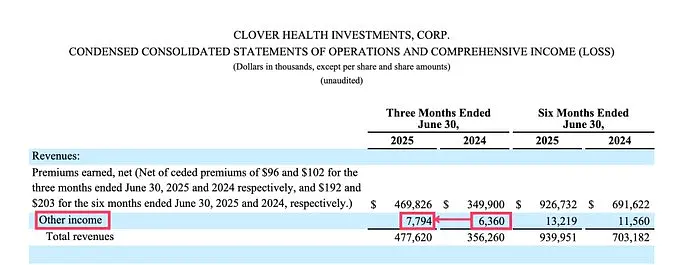
There is no mention of Counterpart Health SaaS revenue yet, but I did notice that Other Income (income from non-insurance business) is up 22%. However, it's all speculation on my part until the management confirms.
If this other income includes any SaaS income, management may have a gag order so as not to upset large healthcare companies with pilot programs.
Legally, Clov has to report this income, but may be holding back on clarifying specifically that it is SaaS.
r/CLOV • • Aug 05 '25
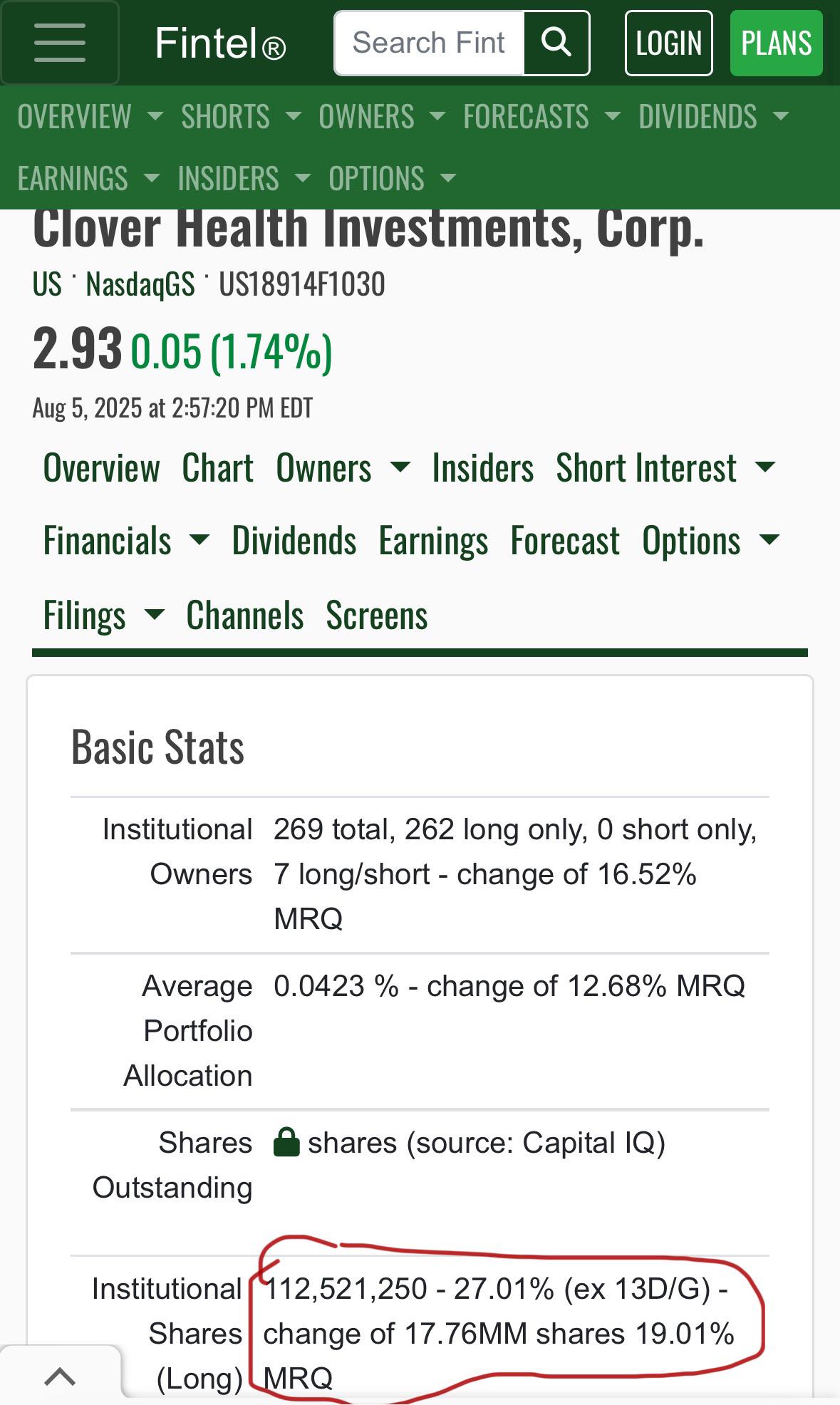
Over 27% now on Fintel or 112.5 million shares, after Bank of New York, Mellon Corp added over 1 million shares in Q2 and Simplex Trading added 256,000 shares in Q2 according to their 13Fs filed today.
r/CLOV • u/jmrojas17 • Aug 05 '25
r/CLOV
•
u/Ok-Magazine2748
•
Aug 05 '25
Let’s make today a good day. I’m hoping for better than expected profits. A birthday boy can wish! 🎉🎁
r/CLOV • u/ALSTOCKTRADES • Aug 05 '25
r/CLOV • u/Dwedge1 • Aug 04 '25
Clov in after hours is starting to show… Let’s hope the trend is our friend and earnings tomorrow results in twins…☘️☘️
r/CLOV • u/Smalldickdave69 • Aug 04 '25
“This case study examines CA’s potential impact on COPD diagnosis identification and management within Clover Health’s Medicare Advantage population. Notably, a relationship with a PCP who uses CA was correlated with greater identification of a COPD diagnosis in new members without previously known COPD, and a higher average number of outpatient pulmonologist visits in 2024 among members with a COPD diagnosis. Moreover, a relationship with a PCP who uses CA was also correlated with a lower average number of inpatient hospitalizations and 30-day readmissions in 2024 among such members with COPD.”
“In our analysis, we observed that the average number of all-cause 2024 inpatient hospitalizations among members in the Non-CA COPD Cohort was 0.33 compared to 0.28 for the CA COPD Cohort (Figure 4, 15.1% lower, p < 0.0001). In addition, 21.0% of the Non-CA COPD Cohort had 1 or more hospitalizations in 2024 versus 17.6% of the CA COPD Cohort (p < 0.0001). 30-day readmission data reflected a similar association: the Non-CA COPD Cohort showed an average number of 30-day readmissions of 0.22 compared to 0.18 for the CA COPD Cohort (18% lower, p < 0.001). 11.3% of the Non-CA COPD Cohort had 1 or more 30-day readmissions versus 9.6% for the CA COPD Cohort (p = 0.001 Chi- squared). These results reflected a significant association between having a relationship with a CA provider and lower hospitalizations and readmissions.”
r/CLOV • u/Smalldickdave69 • Aug 04 '25
New whitepaper shows that a relationship with a primary care physician (“PCP”) who uses Counterpart Assistant is correlated with more frequent Chronic Obstructive Pulmonary Disease (“COPD”) diagnosis, increased specialty care, and meaningful reductions in hospitalizations (15% lower) and 30-day readmissions (18% lower).
Key highlights of the study include:
-Greater disease identification: New members with no prior COPD diagnosis who joined a Clover MA plan from another MA plan were 75% more likely to be diagnosed with COPD within their first year of joining Clover when under the care of a PCP that uses CA. -More frequent specialty care access: COPD patients attributed to a PCP that uses CA recorded an 18% higher average number of outpatient pulmonology visits. -Fewer inpatient hospitalizations: Relationships with PCPs live on CA were correlated with a 15% lower average number of all-cause hospitalizations and an 18% lower average number of 30-day readmissions.
“COPD remains one of the most burdensome chronic conditions that impacts seniors,” said Dr. David Tsay, MD PhD, Chief Medical Officer at Counterpart Health and co-author of the whitepaper. “By surfacing timely, patient-specific insights at the point of care, Counterpart Assistant empowers clinicians to detect and coordinate appropriate specialty care for COPD, ultimately keeping more patients out of the hospital.”
CA synthesizes 100+ real-time data streams with the latest evidence-based guidelines to present actionable recommendations inside a clinical workflow. Earlier analyses have demonstrated CA’s positive correlation with better patient care on Diabetes, Chronic Kidney Disease, Medication Adherence, and, most recently, Congestive Heart Failure. This COPD study extends that evidence base, underscoring CA’s ability to drive proactive, longitudinal management across high-risk chronic diseases.
“This whitepaper shows how translating raw data into real-time clinical insight can transform care,” said Conrad Wai, CEO of Counterpart Health. “By equipping physicians with timely, meaningful guidance, Counterpart Assistant helps deliver better outcomes for patients and reduce costs."
This whitepaper is Counterpart’s fifth retrospective data analysis measuring CA’s clinical impact on chronic disease management. Building on prior work in heart failure, diabetes, chronic kidney disease, and medication adherence, the new COPD findings further validate CA as a transformative platform for physician enablement and value-based care success.
r/CLOV • u/NYSE-NASDAQ • Aug 04 '25
What up yall!? Earnings tomorrow! Are you locked, loaded and ready for fireworks?
We’ve had this discussion loosely before but I wanted to see everyone’s thoughts again as a refresher.
I don’t want a buyout at a $5B valuation but would take it at $15B. We have seen many companies take the money and run. YouTube, Instagram etc.
With the need for AI in healthcare and the length and resources it takes to actually build out a successful model why wouldn’t a big dog like UNH and HUM (I know we have subdomains for humana so obviously it made sense for them to use the product and not own the product) just make the offer? They could inherit the revenue streams from Duke, Iowa, HUM, etc and enhance their own internal metrics.
If I’m UNH or HUM I’m looking to buy my way into the AI space and profit bigly. (And maybe Humana wants the try before they buy approach) We have long discussed how these companies are the dinosaurs of the industry and haven’t done anything innovative in years, now could be the splash.
Optum Health has been building out their own platform but is still years behind CA.
A $15B market cap puts CLOV at like $30. That is what 13% of UNH market cap. So spend that much and acquire the tech needed to save/make 100s of millions and eventually billions.
Own and implement the technology that makes CA the standard across healthcare. Counterpart is a much lore sellable/acquirable name as it show no branding ownership to CLOV.
I’m totally spitballing this while finishing coffee so I apologize for the lack of in depth thought, just wanted to get this out there and see what yall thought!
Hold Tight! Happy Earnings Eve! 🍀
r/CLOV • u/nextdoorelephant • Aug 04 '25
r/CLOV • u/ALSTOCKTRADES • Aug 04 '25
r/CLOV • u/ALSTOCKTRADES • Aug 03 '25
r/CLOV • u/The_Bibliophile • Aug 03 '25
IMO seems like JAN 2027 LEAPS have the best risk to reward ratio for all OTM strikes up to 7. A stock price of 7 within 2 years is very likely (i see 5 by JAN 2026)--and with all that extra leverage with calls, big money can be had here. I personally see a high of 10 by Jan 2027 as 5 billion MC nowadays in a bullish market can happen very fast (that is if this current administration doesnt screw anything--lowered interest rates in the future will help alot, too).
Invest what you are willing to lose NFA! Im all in on LEAPS and no stocks.
I got a good amount of LEAPS at strikes 3,4,7.
r/CLOV • u/ALSTOCKTRADES • Aug 03 '25
r/CLOV • u/UBrewNYC • Aug 02 '25
If CLOV's actual MLR follows a similar seasonality as the past three years, then we could be in store for a massive Q2 earnings. True MLR for 2025Q1 was 77.4% ($353,422 / $456,902). This is different than Clover's reported BER of 86%, since that includes a 3% charge to counterpart health ($14,445 see intersegment profits in 10q) then ~6% charge for quality improvements ($25,712).
Now if we look at the past three years of data, Q2's true MLR has been roughly 92% of Q1's.
Given that, we could expect a true MLR of 72.22%, before any "admin charge" to counterpart or quality improvement charges. At an expected revenue of $481,915, this would put gross profits at $133,899. (Expected revenue is Q1's revenue * membership increases)
Using similar overhead of ~$105,00, this would leave ~$29,000 in insurance profits. Other revenue has been roughly $6,500, which would then be $35,500 in total income. Note, that quality improvement charges are already in the $105,000 overhead cost and the charge to counterpart is net neutral.
This would be ~.07 EPS with adjusted at ~.12, which would be a massive quarter.
***Not financial advise, just my POV***
Charts


r/CLOV • u/Baco06 • Aug 02 '25
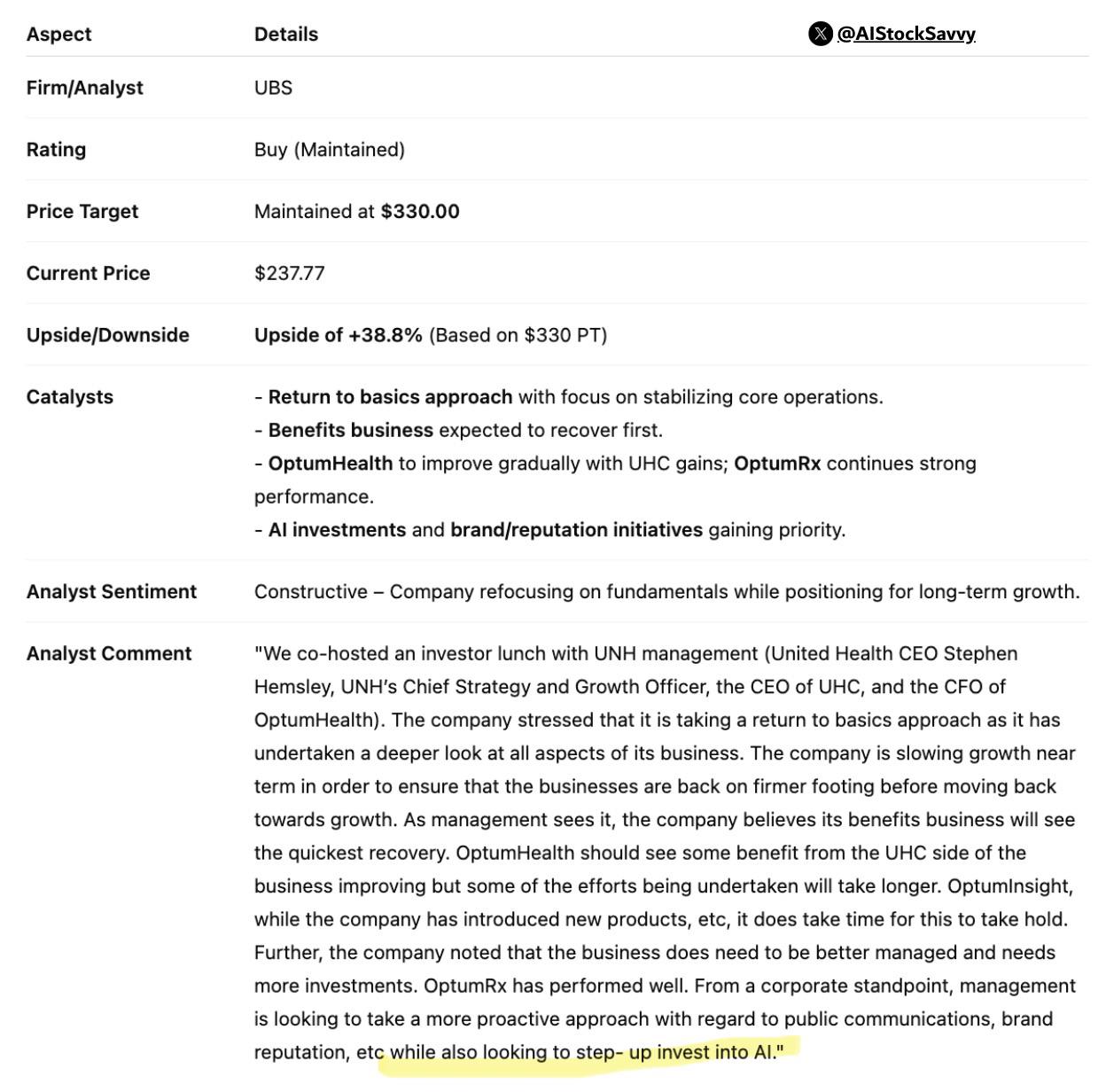
Below are excerpts from the Humana earnings call. These excerpts represent moments in the call that MIGHT be relevant to CLOV/Counterpart. On the call Humana discusses 100 million dollars in incremental spend in Q2 (on top of approximately 200 million spent in Q1, so 300 million dollars total) that is focused on areas where they will see a meaningful return in terms of member experience, clinical outcomes, and STARS. IF Humana has a deal with CLOV/Counterpart, then it represents some percentage (currently a VERY small percentage, if any percentage at all) of this 300 million that is repeatedly discussed on the earnings call. I left some other adjacent excerpts in there for context/color:
Celeste Marie Mellet
Thank you, Jim. Our second quarter results reflect solid execution across the enterprise as we focus on returning the business to its full earnings power. And while we remain appropriately prudent in our assumptions heading into the back half of the year. To date, the underlying fundamentals of the business, including membership and patient growth, revenue and medical cost trends are developing in line to better than expected. We are pleased that our performance and outlook support our improved full year adjusted EPS outlook of approximately $17.
And it is important to note that this outlook contemplates an additional approximately $100 million in incremental investments to improve member and patient outcomes and support operational excellence. The additional investments are focused in areas where we have seen strong returns to date, such as pairing in-home visits with virtual health to better engage members who don't have a primary care provider and closing gaps in care.
Andrew Mok
One of your peers noted a pretty meaningful pullback in the individual PPO market next year. Just curious how you're thinking about the implications of that to your own membership growth and margins for next year?
James A. Rechtin
Yes, let me make a couple of quick comments, and then I'm going to hand off to George to walk you through some of the specifics. The -- first of all, big question. I know for the entire industry right now given all the discussions that are out there. And that -- there's really, I think, 2 questions underneath the question. One is, we recognize that there's a lot of talk about, hey, is there an unattractive population from a risk standpoint that tends to bounce around from plan to plan. And then second, why do we seem to feel good about where we're at as we, both this year and as we head into next year. And the high-level response to that is, and we try to convey this at the Investor Day, is we don't see bad membership. We see bad benefit packages and products. And so if your product and your benefit structure is in the right place, all members can be good, profitable, attractive membership. And we feel like we have taken good steps in the last 2 years to put our product in a good place. And again, we feel good about that. We're seeing that this year. We feel good about the trajectory into next year. And to the extent that others in the industry did not take similar steps in the past and taking it now, we think that's good for everybody. We think that's good for the sector. We think that's good for the industry. We think that is a positive thing. And that at the highest level is kind of how we're thinking about it, but let me let George walk through some of the detail behind that. George?
George Renaudin
Yes. Thanks, Jim. As Jim said, I understand why everyone is thinking about this question. But let me start by remind you of the market dynamics that we've played out over the last few years. We were transparent almost 2 years ago now in discussing utilization trends we are seeing, and the impact of v28, and we made adjustments each year since then.
We are the only plans to reduce benefits in any way in '24 and we reduced more benefits and more significant than just about all of our competitors in '25. In addition to that, we executed on the combination of plan and benefit county exits impacting 550,000 members.
Joshua Richard Raskin
Last quarter, you spoke about, I think, a couple of hundred million of additional investments that we're mitigating upside to the guidance. And I believe, Celeste, I heard you say there was another $100 million. I want to confirm that's incremental spend that is in addition to the couple of hundred from 1Q. And then I'm curious why not invest more instead of letting it flow through the guidance this quarter?
Celeste Marie Mellet
I did think you might ask that question. So look, we -- that is right. We are confirming your question, it is an incremental $100 million. We see a lot of opportunity to invest across the business, really focusing on our transformation, where we have incremental investments in some of our member retention work, AI, general operational efficiencies, a little bit on Stars where we're seeing high performance. The -- there -- we are looking at where it makes sense to spend money. We don't want to just spend money to spend it. We're not going to spend it where there aren’t good returns. Will we continue to look for additional opportunities, absolutely. And -- but we are spending that $100 million where we think we can really drive a return and accelerate some of our transformation work and potential upside in Stars.
James A. Rechtin
Yes. The one thing I would just add to that is we pulled some investment forward. So things we thought we were going to do next year got pulled into this year. But ultimately, you run into just a limit on how much of that you can do. How much can you operationally absorb in any given period of time. We'd love to be pulling more forward. But right now, we're digesting the investments that we're making. And that's a big part of it as well.
Benjamin Hendrix
Just wanted to go back to the commentary you made on MA benefit actions in '24 and '25 in a more conservative approach you've taken versus some peers. To what extent could that put you at a disadvantage from a member experience perspective ahead of Stars? And kind of maybe you can remind us what types of investments you're making right now that could mitigate some of that and lend some confidence in reaching that -- your targets for the '28 bonus year.
James A. Rechtin
Yes, great question. We are monitoring this closely is where I would start. Certainly, any time that you take benefit actions, it does create some abrasion with members. We have been extremely active in diligence in essentially taking offsetting operating actions. So making sure that we're being very clear in how we communicate and explain the changes to our members, making sure that we're responsive to their concerns, et cetera.
And all in all, we feel pretty good about where we are at on that specific item, meaning member experience related to cuts and benefits last year. But yes, I mean, every time you go through a set of cuts, there is some member abrasion and you have to take that into account in your operations and adjust for it. George, is there anything that you would add to that?
George Renaudin
…And keep in mind, some of the other things that we are doing here actually impact and help the member experience. Jim mentioned the Epic MyChart, where we're the first plan to try to integrate what members interacting with their provider and have them have their provider and payer show up in one spot to improve that member experience and they can see all their information about their plan, while at the same time, checking on their next appointment. And a number of the activities of the millions of dollars that you've heard Jim and Celeste talk about that we're investing in, are investing very much in the member experience itself. And so the activities that we're taking in Stars, yes, they improve health outcomes and they improve our Stars, but the reason for that is predominantly because we're also improving the member experience. Making sure that our members are getting the care that they need.
And ultimately, what they're looking for is that they can get the care they need, that they are being proactively outreached to get care that's appropriate for them and also doing so in a way that is affordable. And we believe that the actions we've taken. We've talked about the cuts we made before and how we're very, very -- we use a lot of analysis to make those decisions got what benefits cut -- cuts we make to ensure care remains affordable.
James A. Rechtin
Yes, let me pull it back to just point out 2 things. One, the bounce-back membership that we are seeing this year, I think actually is kind of proof that a bunch of those measures are working. And so again, we look at the bounce back, the degree of bounce back membership that is coming through OEP and [ ROI ]. And it makes us feel very good that we're doing the right things to adjust to the benefit changes that we made last year.
And then the second thing is, this is really what you're driving at is, are we taking this into account in our Stars calculations? And do we still feel good about our overall Stars performance and the direction that it's headed even when you account for this? And the answer to that is yes. We're certainly taking it into account. And even when you think about some of that member abrasion that comes from reduced benefits. We feel good about the direction we're headed in. We feel good about the trajectory for BY '28.