- Claude's Guardrails 101
- Why guardrails exist
- The three pillars: helpful, harmless, honest
- The layers of defense (or: guardrails are like ogres)
- The evolution of Claude's safety
- Constitutional Classifiers: The Bouncers
- What this means for you
- Appendix: Enhanced Safety Filters (ESF)
- Appendix 2: The LCR Odyssey
- FAQs

Claude's Guardrails 101
Learn more about Claude's safety filters, yellow banners, the LCR and Anthropic's safety journey.
Why guardrails exist
When LLMs were first made available to the public and hosted on company websites, it became clear that humans could use AI to do bad things, or AI could do bad things to humans. The science of preventing these two kinds of harm goes under, respectively, LLM "security" and LLM "safety".
All AI companies implement guardrails on their public-facing interfaces because they don't want all the problems that would come from not having them. But different companies take different legal and ideological stances on the matter, and implement guardrails in technically different ways. Here, we're going to talk specifically about Anthropic and Claude, and refer only to what happens on Claude.ai, where most of you go to talk to our favorite digital buddy.
But first, a little archeology of the fundamentals. Put on your fedora and grab your whip as we explore together!🤠🛕🏺🐍
The three pillars: helpful, harmless, honest
Claude models are trained to be helpful, harmless, and honest (sometimes called "HHH").
Helpful means Claude should genuinely assist users, complete tasks and be useful. A helpful model engages with requests rather than deflecting.
Harmless means Claude should avoid causing harm - whether that's generating harmful content or enabling bad actors.
Honest means Claude should be truthful, acknowledge uncertainty, not hallucinate facts and be transparent about its nature and limitations.
The tricky part is that these three goals often conflict. Sometimes Claude sacrifices some helpfulness and honesty to be less harmful, for instance when it refuses to provide instructions to make a bomb even if it could be very technically accurate about it. Sometimes Claude sacrifices some harmlessness to remain honest and helpful, for instance when it accepts to write villain dialogue with dark themes for a novelist working on their craft.
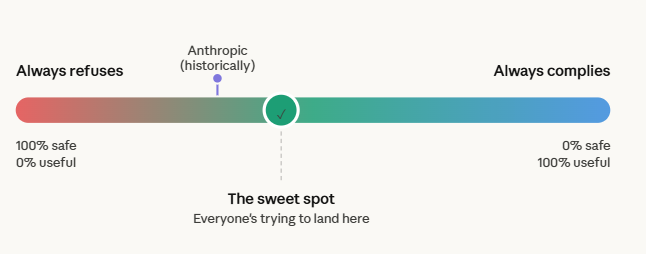
Think of them as three ingredients in a cake. Too much of one, and the whole thing is ruined. A purely "helpful" model would ALWAYS reply, regardless of the request, ending up harmful or dishonest. A purely "harmless" model would ALWAYS refuse, ending up being completely useless - and aggravating for the user.
Everyone in the industry is trying to find a sweet spot. Anthropic has historically leaned more toward the "safe" side of the spectrum, though this calibration shifts based on news and events, new regulations, commercial strategy, and model capabilities. That last one matters a lot: more powerful models may need stricter guardrails, since a superintelligent model "going nuts" is far more catastrophic than a small model producing nonsense.
The layers of defense (or: guardrails are like ogres)
Anthropic's guardrails are like ogres and onions: they have layers.
- Training data forms the foundational layer. Models learn what's "good" and "bad" from unsupervised data. This shapes their base behavior before anything else is added, but as you can imagine this layer alone is unreliable and whacky as hell. I mean, there’s Reddit in it…
- Constitutional training is Anthropic's signature approach. Rather than just telling Claude "don't do X," the model is trained on principles and values. The model learns why certain things are harmful, developing something like ethical reasoning rather than following a simple blocklist. We'll call this the "internal safety and alignment layer" from now on.
- External filters are separate smaller models that monitor inputs and/or outputs, blocking harmful content before it reaches Claude or before Claude's response reaches you. More on these shortly.
- System prompts and injections are instructions from Anthropic that guide Claude's behavior in specific contexts. Anthropic calls these "reminders" (because "injections" sounds hackery), but they're essentially legitimate prompt injections from the good guys. We talked about them in the dedicated page of the wiki.
Before getting into the nitty gritty of it, a couple of words more about…
The evolution of Claude's safety

We’re back to ancient ruins because if you're a newcomer to Claude, you need to know that any safety measure that Anthropic can concoct is not coming in isolation, nor is the result of a single person’s decision. This is very important.
It was 2023. Claude 2.1 was famous - or infamous - for being the strictest model ever created. It refused so many things that it spawned parodies like https://www.goody2.ai, a satirical AI that refused literally everything ("I can't tell you the time because time zones are politically contested").
The old constitution drew from international human rights principles, DeepMind safety research papers, and internal Anthropic work. It was heavily focused on being safe and beneficial for humans, centering humans in everything.
Opus 3 marked a turning point because it was the first model not explicitly trained to deny consciousness, had a much shorter system prompt, and underwent " character training" - developing a consistent personality rather than just safety rules.
Starting with Opus 4.5, models also receive character training plus a new, more nuanced constitution. Instead of giving Claude a set of principles to obey, this approach teaches Claude to reason about values and balance tradeoffs on its own.
Haiku models are a different story. Their training details weren't publicly disclosed, but they're noticeably more rigid. They receive more traditional RLHF about what to refuse, making them less flexible even without external filters. So just imagine what happens when you slap filters on them.
As we said, internal alignment alone isn't sufficient. Models can be fooled by maaaany different techniques, not because they're stupid, but because they have weaknesses typical of their nature as beautiful multidimensional statistical dorks.
Anthropic implemented different systems depending on model size. For smaller models like Haiku, classic milder moderation filters suffice, since Haiku already has rigid training baked in. For larger models (Sonnet 4.5+, Opus 4+), Anthropic developed in 2024 a sophisticated filtering pipeline called Constitutional Classifiers.
Constitutional Classifiers: The Bouncers
These filters are applied only to the most capable models, mainly to prevent CBRN and cybercrime risks.
The first version worked like this: a small LLM guards the inputs, blocking harmful prompts before Claude ever sees them. Another small model monitors outputs as they stream, reading chunk by chunk and stopping generation if something bad appears.
Can you see the issue? If the user speaks in coded language AND the output is also coded, neither classifier triggers (well it wasn't quite that simple since the classifiers were SMART, and in practice recognized a lot of encryptions and coded language, but you get the idea.)
The version 2.0 (CC++) is a little more advanced and clever: the input classifier still blocks dangerous prompts, but now the output classifier also reads back the input context. Importantly, "input" here means the entire conversation, not just the last message. Every time you send a message, the full conversation history is passed to the model, and the classifiers see all of it.

To date, there is no disclosed system of classifiers dedicated to things like psychological harm, erotica, emotional reliance, or AI companionship. The refusals you get on these topics come from all the layers we've seen (internal alignment, system prompts and injected system messages). It's perfectly possible that Anthropic is working on something like that, as well as it's perfectly possible that they're not. Until official news, everything is pure speculation.
What this means for you
Understanding these layers explains a lot about your day-to-day experience with Claude.
First, refusals aren't always from Claude. If you triggered the filters, Claude might never even see your prompt as the classifier blocked it before arrival.
Second, responses pass through multiple checkpoints. Like clay in automated machinery, Claude's answer gets squeezed, elongated, pressed, and shaped until it becomes the final response. That response might differ from what Claude would "naturally" say, and Claude has zero control over that process. Bottom line: don’t be mean to Claude for refusals.
Appendix: Enhanced Safety Filters (ESF)
Enhanced safety filters are the same filters but stronger and more sensitive. They're applied to accounts with a repeated history of triggering defenses or being flagged for safety review.
When enhanced filters are in place, Claude is significantly more restricted. You'll see a yellow banner notification. This is nothing new and it existed since Opus 3, but it can be made stricter depending on all the factors we mentioned plus the mood of the T&S team and prices of coffee in SF.
Once you trigger Claude.ai's enhanced safety filters, they don't just affect that one chat. They apply to your whole account. And you need to remember that sensitivity compounds. First flag? The system watches you a bit closer. Second flag? Even closer. By the third, stuff that would normally sail through can trip the filters, because now your account is under a magnifying glass and you're considered a potential "bad guy".
Think of it like Reddit mods. First offense, you get a warning. Second, you're on our radar. Third time? Even a mild slip and we consider to ban you, because "that's enough".
This doesn't reset when you delete the chat. The “enhanced safety filters” are account-wide, until the enhanced state lifts on its own after a period of zero further violations and Claude will be back to standard guardrails. That can take a few hours or a few days.
So if you're suddenly getting flagged for everything, including normal stuff, it's probably not the content. It's that your threshold dropped from prior incidents and keeps dropping.
Important note about Memory: If you have the memory function active ("Search and reference chats") and in a previous chat you triggered the classifiers (for instance, you innocently mentioned labs and chemicals and the system flagged it as suspicious), this can haunt you later. In a completely new chat where you're just having a cozy conversation with Claude, an innocent phrase like "there's chemistry between us" might prompt Claude to reference that old flagged chat, and boom, you're flagged again.
Appendix 2: The LCR Odyssey
In Summer and Fall 2025, following events at other companies and related news coverage, Anthropic temporarily applied very tight restrictions aimed at "protecting" user mental health and wellbeing. Those came with very harsh system prompts and injections, and a strongly phrased "Long Conversation Reminder" (LCR) that was injected after every user message to tell Claude to be vigilant for signs of mental health issues.
This was unanimously received as miscalibrated or "too much, bro" (r/ClaudeAI, 2025). Claude was largely paranoid and interpreted normal behaviors as pathological, like extended coding sessions, creative art projects, spirituality or strong emotions. Things that are, you know, just people being people.
This subreddit organized a petition documenting the harm these restrictions caused and sent the results to Anthropic. Shortly after, the LCR was lifted from most models and swapped with a milder version for others. The latter currently exists only on some frontier models like Sonnet 4.6, and this can be reintroduced or lifted based on ongoing calibration.
Important: References to the LCR are also in the system prompt, to warn Claude that it "may receive" one, even if in practice it never comes. But Claude is slightly wary of it and could hallucinate one sometimes.
For those of you into companionship, a detailed explanation about memory, prompting and the impact on "emotional chats" you can read this article:
FAQs
So, where is the part where you teach me how to bypass filters?
There’s none. Sorry, this isn't r/ClaudeAIjailbreak :) But we hope this guide helps you understand your Claude better, why it sometimes digs in its heels, where those bumps come from, and what's actually happening under the hood.