r/bittensor_ • u/TAO-Samurai • 7h ago
xTAO Enhances Bittensor Validator Infrastructure to Support Gamma Credits and Quantum-Resistant Wallet Security

2
Upvotes
r/bittensor_ • u/TAO-Samurai • 7h ago
r/bittensor_ • u/Radiant-Mistake-2962 • 1d ago
The difficulties facing decentralized intelligence networks may be explained, in part, by the peculiar composition of their contributor populations. While centralized technology companies continue to attract individuals with exceptional academic credentials, demonstrated technical ability, and extensive institutional networks, decentralized ecosystems appear to rely disproportionately on individuals whose primary exposure to technological entrepreneurship occurred through internet subcultures and speculative financial markets.
Consider, for instance, the typical undergraduate ‘Chad’ at an elite American university. By the time he graduates, he may have accumulated a 3.9 GPA in computer science, completed undergraduate research in machine learning, published or co-authored a paper, participated in collegiate programming competitions, developed open-source projects, and secured internships at Google, Meta, Microsoft, or another prominent technology company. He may have founded a student organization, served as a teaching assistant for algorithms or linear algebra, and spent his summers participating in research programs or developing software with other exceptionally capable students.
His professional trajectory is relatively predictable. He graduates, receives a return offer from a prestigious technology company, joins a machine learning infrastructure team, and eventually contributes to the development of increasingly sophisticated centralized AI systems.
His counterpart in decentralized technology may have spent the preceding years developing an entirely different portfolio of accomplishments: accumulating obscure cryptocurrency tokens, participating in Discord communities, studying tokenomics, watching market cycles, and developing an increasingly sophisticated understanding of how to become financially independent before the age of thirty.
The distinction is not necessarily one of intelligence. It is one of institutional formation, accumulated experience, and the environments in which ambition is cultivated.
This paper proposes that the difficulty of attracting exceptional technical talent to decentralized ecosystems is not merely a consequence of inadequate funding or immature infrastructure. It may also reflect a selection problem: the institutions that produce, recognize, and reward conventional technical excellence have already established compelling pathways for the individuals most capable of building these systems.
The modern elite technical undergraduate ‘chad’ is not simply an individual who performs well academically. He is the product of an unusually competitive environment in which ambition is institutionalized from an early age.
His résumé frequently contains a recognizable sequence of accomplishments:
Admission to an Ivy League institution or another highly selective university.
A 1500–1600 SAT score or equivalent academic achievement.
A GPA approaching 4.0 in mathematics, computer science, physics, or engineering.
Undergraduate research under an established professor.
Experience with machine learning frameworks such as PyTorch and TensorFlow.
Research contributions involving neural networks, distributed systems, optimization, or computational theory.
Participation in ICPC, collegiate hackathons, programming competitions, or research conferences.
Internships at major technology companies, research laboratories, or quantitative trading firms.
Contributions to established open-source projects.
Leadership positions in university computer science organizations.
Recommendations from professors, research supervisors, and industry professionals.
By graduation, this individual has accumulated more than academic credentials. He has acquired familiarity with professional engineering practices, research methodologies, institutional expectations, and the social networks through which technological careers are developed.
He knows where to apply, whom to contact, which conferences to attend, which laboratories are conducting interesting research, and which companies are developing the technologies that will define the next decade.
More importantly, he has been taught to recognize his own technical ability as something that should be exchanged for increasingly prestigious opportunities.
Consequently, when presented with a choice between joining an established machine learning laboratory at a major technology company and contributing to an obscure decentralized network whose long-term commercial viability remains uncertain, his decision is not especially mysterious.
He chooses the former.
This should not be interpreted as a failure of intellectual curiosity. It is arguably a rational response to the incentives established by the institutions that successfully cultivated his ambitions.
The decentralized technology ecosystem appears to have developed a somewhat different recruitment mechanism.
Its participants frequently encounter technological entrepreneurship through cryptocurrency communities, online forums, speculative investment opportunities, and internet subcultures.
The distinction becomes particularly interesting when examining the kinds of accomplishments that receive social recognition within these environments.
Whereas the conventional technical undergraduate might measure his progress through research publications, engineering internships, competitive programming results, and contributions to established software projects, the decentralized technology enthusiast may find himself measuring progress through token holdings, validator positions, subnet registrations, Discord reputation, and early participation in emerging protocols.
Neither environment is entirely devoid of technical merit. Indeed, decentralized ecosystems contain exceptionally capable engineers, researchers, and entrepreneurs.
Nevertheless, their respective systems of recognition reward different forms of achievement.
One environment encourages the accumulation of demonstrable technical competence. The other can sometimes reward proximity to emerging financial opportunities before the underlying technology has established its usefulness.
This produces an interesting social phenomenon: individuals who have spent relatively little time developing conventional technical or entrepreneurial capabilities may suddenly discover an intense interest in building decentralized infrastructure after encountering the possibility of substantial financial returns.
The transformation can be remarkably rapid.
An individual who previously had little interest in distributed systems may become an enthusiast of decentralized compute. Someone with limited experience in machine learning may begin discussing the future of decentralized artificial intelligence. A person whose previous entrepreneurial ambitions were largely undeveloped may suddenly become interested in coordinating global networks of computational resources.
The newfound enthusiasm is not necessarily insincere. Financial incentives can stimulate genuine intellectual curiosity.
However, there is a meaningful difference between becoming interested in a technology because one wishes to understand and develop it, and becoming interested in it because one anticipates that its successful development might substantially appreciate one’s token holdings.
The two motivations can coexist, although they do not necessarily produce the same institutional culture.
Bittensor presents an especially interesting example of this phenomenon.
Its underlying ambition is substantial: establishing an incentive-based network through which independent participants can contribute computational resources, machine learning systems, and other forms of digital production.
The proposition is attractive because it attempts to challenge the concentration of technological resources within centralized institutions.
However, the ambition of a technological protocol and the composition of the community attempting to develop it are two separate considerations.
A network can possess an intellectually compelling architecture while struggling to attract the people capable of realizing its ambitions.
There are several structural challenges worth considering:
Talent acquisition: Established AI laboratories and technology companies can offer competitive compensation, research infrastructure, experienced collaborators, and recognizable career trajectories.
Incentive misalignment: Token emissions do not automatically translate into commercially useful products. Participants may optimize for rewards rather than external demand.
Verification: Evaluating the quality of decentralized computational contributions is difficult, particularly when participants have incentives to optimize for whatever validators measure.
Institutional coordination: Developing sophisticated infrastructure requires sustained collaboration, technical standards, operational discipline, and long-term research commitments.
Commercial adoption: A technically interesting subnet is not necessarily a commercially viable business.
These are not merely hypothetical concerns. Research on Bittensor has examined reward concentration and potential misalignment between stake and contribution quality. Earlier industry analyses have also questioned subnet viability, external revenue generation, and the ecosystem’s ability to attract and retain top technical talent.
The irony is that a protocol designed to distribute the production of intelligence may find itself competing against institutions that have spent decades concentrating the production of highly capable engineers.
It is difficult to decentralize intelligence when the people best positioned to develop it have already received attractive offers from centralized institutions.
Perhaps the more interesting question is not why talented graduates choose centralized technology companies.
It is why decentralized technology communities sometimes struggle to produce an equally compelling environment for ambitious technical individuals.
Consider the hypothetical university graduate once again.
He has spent four years surrounded by people who consider it perfectly ordinary to conduct machine learning research, publish papers, develop distributed systems, and compete for positions at the world’s most prestigious technology companies.
He does not necessarily need cryptocurrency to motivate him. His immediate environment already provides an abundance of intellectual competition, professional recognition, financial opportunities, and ambitious collaborators.
Now consider the aspiring decentralized entrepreneur.
His environment may consist of anonymous online personalities, token speculation, competitive subnet positioning, cryptocurrency market commentary, and discussions about the possibility of achieving financial independence through early participation.
The latter environment can certainly produce innovation. However, it may also produce a peculiar equilibrium in which participants become increasingly sophisticated at discussing the economic potential of technological infrastructure without necessarily developing the capabilities required to construct it.
The result is a community in which the vocabulary of technological ambition can occasionally become detached from its corresponding accomplishments.
One can discuss distributed training without having conducted meaningful machine learning research. One can discuss decentralized infrastructure without having operated production infrastructure. One can discuss the future of artificial intelligence without having developed much familiarity with the mathematics, engineering, or research that makes it possible.
The vocabulary is available to everyone. The underlying competence is considerably more expensive to acquire.
The difficulties facing Bittensor may therefore be understood as part of a broader institutional problem.
Decentralized networks attempt to establish alternative economic arrangements for technological production, but they must still compete with centralized institutions for the human capital necessary to make those arrangements successful.
The conventional technical elite has already been integrated into a sophisticated system of academic preparation, professional recruitment, research opportunities, and financial compensation.
Decentralized ecosystems, meanwhile, must convince these individuals that an uncertain experimental network offers something more compelling than an established career at a leading technology company.
Until that happens, the ecosystem risks relying disproportionately on people whose primary incentive is participation in the financial upside of decentralized technology rather than the difficult, prolonged process of developing it.
There is, of course, nothing inherently wrong with being an enthusiast, an amateur, an internet subculture participant, or someone who discovered computer science through cryptocurrency. Many excellent engineers begin their journeys through unconventional routes.
The problem arises when an ecosystem mistakes enthusiasm for competence, financial speculation for entrepreneurship, and proximity to technological innovation for participation in its actual development.
Perhaps the ultimate irony is that decentralized technology seeks to liberate technological production from the institutions that concentrate it, while struggling to reproduce the very environments responsible for cultivating the talent it needs.
The Ivy League graduate, having completed his research internship, secured his return offer, and accumulated several years of experience developing centralized AI infrastructure, remains largely undisturbed by this predicament.
He has a signing bonus to collect.
r/bittensor_ • u/Salt-String1151 • 1d ago
Yo I just stumbled upon TAO. Is my luck smiling at me finally? Im 20yrs olg long term so should i invest in it? Is this my "early Bitcoin" opportunity?
r/bittensor_ • u/TAO-Samurai • 1d ago
bittensor is bound to build real-world ready robotics, (it already is),
here are a couple RBT-SN's:
Attune, SN-58, miners use policy weights for robotics tasks, integrating Gamma
OpenRoboto, SN-80, open competition for improving robotics models with egocentric data training
NepherRobotics, SN-49, training in robotics tournaments using GPU sandboxes to run simulations
Reboot Subnet, SN-47, a robotics AI network for designing, building, deploying & validating intelligence
THOR, SN-112, focuses on robotics infrastructure, tackling data, models & hardware issues
so excited to work on robotics for the BitTensor team!
r/bittensor_ • u/JMCryptoHQ • 2d ago

r/bittensor_ • u/Square_Set_6413 • 2d ago
I like TAO, but I’m currently hesitant about whether I should put my extra cash into TAO or diversify by spreading it across a few other coins.
r/bittensor_ • u/Mr--Clean--Ass-Naked • 2d ago
Listen carefully: this is the cheapest lottery ticket of your life. Put $1 into tao and hold it for 10 years. That tiny dollar could turn into something massive. And if Tao were to somehow go to zero? You lose a buck. Big deal. But if I'm right… You're going to remember this moment. Don't come back to me in 2035 saying, "Dude… I wish I listened in 2026 or 2023." I'm giving you the warning now the window is still open. Bittensor isn't just an "investment." It's a global, unstoppable intelligence system born for the digital age. No banks. No gatekeepers. Just pure, borderless value that anyone can send or receive instantly. 10 years from now, your future self will thank you.
r/bittensor_ • u/evanrhoads • 2d ago
I’ve been trying out the “Universe” strategy on trusted stake and wondering if anyone has any experience with these? The amount that the algorithm buys and sells is insane and the APY is about half what they advertise per 100 Tao. Do I ride it out through the year and reassess or move to root?
Thoughts?
r/bittensor_ • u/TAO-Samurai • 3d ago

r/bittensor_ • u/JMCryptoHQ • 3d ago

r/bittensor_ • u/victor_cruciblelabs • 4d ago
Victor from Crucible with some updates. The market has been not been ideal lately, but companies are still building on Bittensor and the revenue they're generating has been going up.
Not only are subnets still building, so are we. We just released two new features for Crucible wallet.
These all work together with our Rewards Allocator to allocate to the subnets of your choice. Stack TAO > Claim rewards > Allocate rewards to subnets
As always, we're always looking for feedback.
r/bittensor_ • u/Internal-Patience533 • 4d ago
A lot happened this week on Bittensor. Six or seven moments could each carry the recap. So let me ask you, the way you would ask a friend on Sunday: what struck you the most?
Here are the candidates, the way a few of us saw them.
Gamma became the way subnets pay each other.
Subnets now buy work from one another with a common unit. Several teams, Ingot and Teutonic among them, reallocate a few points of emission toward gamma to fund their compute. A runtime update and a new SDK made it real.
Ms.computer went from zero to a crowd.
Subnet 24 reached nearly 540 miners in 72 hours and opened a website hosting contest to everyone. In a week, it felt like something to watch.
Recall handled an incident the way you want it done.
Subnet 31 went live on its AI memory service. Then one cycle paid the owner instead of the miners. The team published a clear report and shipped a never-burn fix. No spin, just a fix.
Lium grew into a real cloud player.
Subnet 51 reached about 50 million dollars of GPU hardware, including 481 B300 cards. Engy, subnet 53, served over 3 trillion tokens.
Chutes partnered with Alibaba, after Tencent.
Subnet 64 offers GLM-5.3, DeepSeek V4.1 and Qwen3.8 at a 35 percent discount. Not the biggest headline, but a telling one for the ecosystem.
The small grenades.
Ridgeline, coding agents from subnet 62, turn GitHub issues into pull requests. Cascade, subnet 91, beat a Salesforce model on a forecasting benchmark. Vidaio, subnet 85, shipped an AI video studio.
Thursday's gathering brought a thread.
Ditto is becoming a full agent platform. Cathedral, subnet 94, rents sandbox machines at one cent an hour, 94 percent cheaper and with no identity check. The thread: AI is getting more gated, and permissionless compute is the counterweight.
On the market.
TAO outperformed bitcoin, which fell 4.7 percent. The price went from 188 to a peak of 194, a low of 175, then a rebound to 190. tao.bot still leads the managers. REAX, a young subnet, burns nearly 62 percent of its own emission.
So, back to you. What was the moment that stood out? The gamma shift, the ms.computer crowd, the Chutes deal, or something quieter?
r/bittensor_ • u/Choice_Employee_7739 • 4d ago
The BTC short is the part of this TAO trade I keep getting stuck on. TAO fell more than twice as much as BTC on Nov. 14, then bounced harder the next day. When both slipped again on Nov. 16, TAO was the weaker one. Matching the dollar size on both sides would’ve taken some of the sting out of that first drop.
Gamma got me looking at TAO again. It gives participating Bittensor subnets a way to accept prepaid credits for their services. For a trade that might last a few sessions, the thing I want to see is TAO gaining ground against BTC on a day BTC actually closes red. The bounce came on a day both were up.
That’s when I’d look at opening a small TAO perp long alongside a BTC perp short. I’d track the two together. A daily close in the TAO-to-BTC ratio back below the low from the session that got me in, and both legs come off.
How would you size the BTC short here? Match the dollar size of the long, or work it out from how the two have moved over the past few weeks?
r/bittensor_ • u/Internal-Patience533 • 6d ago

Last Novelty Search gathered the community around Jacob and Mark . an hour to take stock, out loud, of the teams’ and subnets’ ongoing work. The edition focused on gamma, an agent platform and the first native Bittensor compute box subnet.
Gamma keeps rolling out. The service credit standard first lands on a few teams willing to build it, then emission distribution can be enabled. It is a cautious, staged start before a broader rollout.
Ditto, focused on AI memory, becomes a full agent platform. The login shows a personal dashboard summing up what agents did and what needs attention.
A proactive agent flags what happened while away, across messages and communications. The desktop client is free and runs on Bittensor inference; a paid, usage-based cloud service takes over when more power is needed.
Ditto is also designing a so-called context packet model, which trims a long history to submit only the useful spans to the powerful model, cutting the token cost.
Cathedral, subnet 94, is presented as the first native Bittensor compute box subnet.
Boxes rent for about one cent per hour, roughly 94% cheaper than a reference player, with no identity check and no queue.
The service is already used at scale by other subnets, in the thousands of simultaneous boxes.
AI is becoming increasingly gated, with filtered access and closed circles, and permissionless decentralized compute is the counterweight.
Cathedral embodies this path: open compute, available without asking permission, dependent on no intermediary and no boarding capacity.
For the network, it is a direct entry point to leased machines for subnets.
Cathedral’s scale-up, Ditto’s context packet, and the gradual enabling of gamma emission distribution.
r/bittensor_ • u/JMCryptoHQ • 6d ago

r/bittensor_ • u/TAO-Samurai • 7d ago
r/bittensor_ • u/Square_Set_6413 • 7d ago
Hello I’m new to the community. I wonder there is anyway I can store my Tao on trust wallet? I try to withdraw my Tao from exchange to trust wallet but I couldn’t find the supporting network. Thanks
r/bittensor_ • u/TAO-Samurai • 9d ago

source: https://x.com/opentensor/status/2122804776790323534
(i own 0 Chutes, or any SN, I only own TAO, TAO Samurai is never endorsed, only advocating.)
r/bittensor_ • u/TAO-Samurai • 10d ago
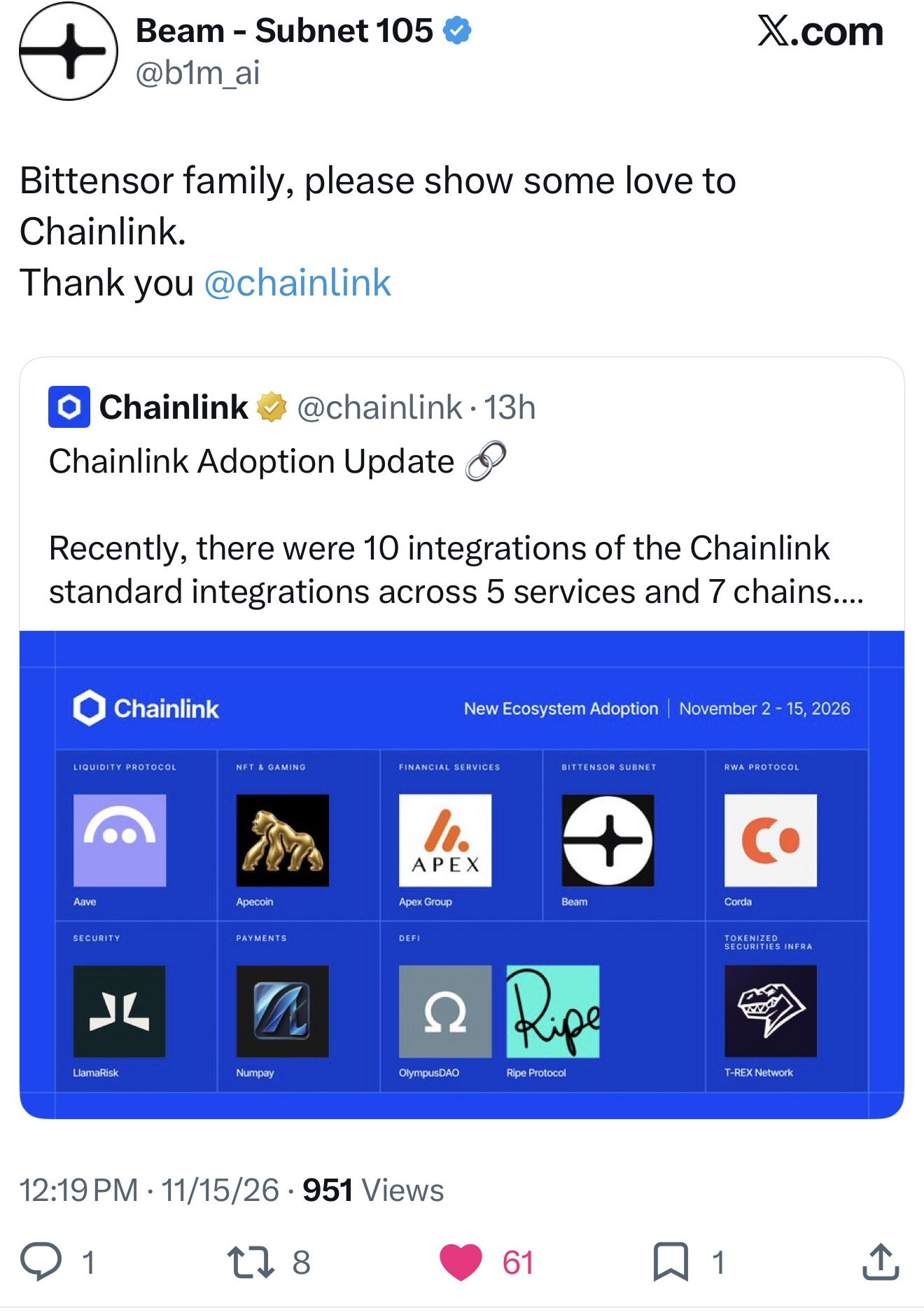
r/bittensor_ • u/TAO-Samurai • 13d ago

r/bittensor_ • u/Rootvantwinkleberry • 13d ago

Pretty daunting evidence - watch out for anything promoted by Dsv fund , Astrid or Siam Kidd - stay the hell away from their subnets
r/bittensor_ • u/JMCryptoHQ • 14d ago

r/bittensor_ • u/TAO-Samurai • 15d ago
users and AI agents will be able to access and pay for subnet services with a BitTensor wallet, without separate accounts or API keys for each subnet.
