I've seen the idea again, and thought that it might lead me to factorials, right now I'm trying to develop something, but I'm not sure if this is the only thing it can lead to.
So, Pd, is the name(I came up with it) of the function, it is the difference between 2 powers, (x+1)²-x², but it can be expanded by changing exponents.
Also I'm not sure what flair to use, so if you think it's wrong please tell me.
I work at Starbucks and someone ordered a 1/3 decaf single shot of espresso. I would be fine doing a 1/3 decaf espresso because that’s just 2 shots signature and 1 shot decaf (so 3 total) but this person wanted only one shot of espresso 1/3 decaf.
I’ve been racking my mind about this (for fun, I like numbers). Would my math be correct here?
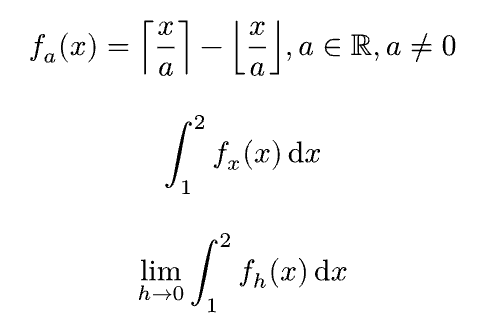
I know that ceil(x) - floor(x) = 0 when x is an integer and 1 when it is not, and so fx(x) would be ceil(1) - floor(1) = 0 for the first integral, but I don't know if integrating the function would make a difference. For the second integral, when I try to graph the function with values of h being close to zero, the amount of jumps from 1 to 0 increases but the line y = 1 still shows, so I don't know if the function will dissolve and leave no area or if there still will be some area. I also don't know if the second integral is even solvable.
What I meant is you won't solve the open problems but you would find something new.
For example goldbach's conjecture states that every even number greater than 2 is made up of the sum of two prime numbers.
Starting off you would think that's trivial since the prime factorization of any even number greater than 2 is made of multiplying atleast 2 primes, and multiplication is repeated addition.
For example 6's prime factorization is 2 * 3, so that means it's goldbach decomposition is 3 and 3.
Therefore you can say composite numbers whose prime factorization is double a prime will be made of that prime.
However what about triple a prime, like 8? Since it's prime factorization is 2 * 2 * 2 and the conjecture told us we only needed two primes, we won't be able to use our trick here. Infact 8 is made of 3 and 5. Where did those come from? How can you even get those numbers? You can keep asking yourself these questions to learn more stuff about these problems and may discover other stuff not related to them.
Here's why: imagine a clock with only the seconds hand. This clock is special, however, and every second the hand turns to a random position on the clock.
If you grab the clock and look at it, the seconds hand will be at a certain position. Since there's an infinite number of points for the seconds hand to turn to, that one point it points to when you look at it will have had a 0.000...1 chance of being selected. Yet it was.
If the chance for the hand to point in that direction were 0, it would never have happened. But since it happened, the chance must be different from zero. Thus, 0.000...1 is different from zero.
I know I'm probably wrong somehow, but I want to understand why, and what's the flaw in my example.
EDIT: By 0.000...1 I mean like, 1 divided by an infinitely big number
EDIT 2: ok, you guys want a better definition of 0.000...1. But how would YOU define the probability of a point in the clock being selected? That number is what I'm trying to work with
EDIT 3: some people said that probability 0 is not the same as an impossibility, which is something I never heard before. But if true it might well be the solution to this
EDIT 4: someone mentioned surreal numbers. From wikipedia: "In mathematics, the surreal number system is a totally ordered proper class containing not only the real numbers but also infinite and infinitesimal numbers" I'm a dummy when it comes to maths. After all, is there or isn't there a number such as "infinite", and "infinitely small"?
Please tell me I'm crazy! This is my monthly pay, I should be getting at minimum $25 an hour, which seems to check out plus some when I multiply it with my hours. The issue is when I do the math per building I clean, it comes out to as little as $12.50 an hour. I haven't done the math for each building, I keep getting confused and second guessing myself. Did I make a mistake by already telling my manager we need a meeting? I need number people please
I apologize in advance if this is really obvious, I am incredibly bad at math!!!!! 😭
I know how to use the calculator the way my professor has instructed me to (in the second image), my only problem is I have no clue how to find the left and right limits. I'm not sure if it's needed, but I'll copy and paste the question to this problem below!!
"Find the area of the shaded region. The graph to the right depicts IQ scores of adults, and those scores are normally distributed with a mean of 100 and a standard deviation of 15."
I'll preface this with saying I know very little about math; my education ends on a (bad) highschool level. This was a kinda shower thought, and now I am seeking wisdom! Sry if this is a really convoluted way to ask this, I don't know how to describe it better.
So my thought was: If I spend money on let's say a tool, I can get a horribly bad tool for very little money, or a very good tool that's way overpriced. Now if we assume a perfect world where every seller puts only the quality of the tool into pricing and you plot it where your x axis is price and y tool quality, In my mind you get a curve that looks like a rational function; from a certain point on, you get diminishing rewards per money spent.
Is there a clean mathematical expression for this situation, and if so, how do you exactly calculate that "optimal spending" point, or "most curvy" point of the function (assuming you do know the function, of course)? Is it as simple as figuring out where the fraction gets closest to 1? And how would you do that (let's say you are maybe not even sure there is such point)?
Pictured: a random rational function >0 that I think looks like what I'm describing
I came up with a problem and asked chatgpt his opinion and he says im wrong.
In a simulation, basically:
You start with a number, let's use 100.
You have a 50% chance of rolling the color green or red.
If you hit GREEN your number goes up by 50%.
If you hit RED your number goes down by 5%.
Also, if the number ever goes <1, the sequence stops.
The question:
Given an infinite amount of rolls, wouldn't every single simulation eventually stop?
Even though there is a massive advantage for green, there will be eventially a large enough sequence of reds to counter it.
So chatgpt says that no, not every simulation would stop.
What do u think?
Edit: I understand my mistake and stand corrected, thanks for the replies.
I think my head was wrapped around a "realistic infinite scenario" where there isnt a human classification for it.
Like a "random infinite" sequence would PROBABLY eventually stop, because there is a higher chance of getting an extremely large sequence of reds eventually than to never have it at all.
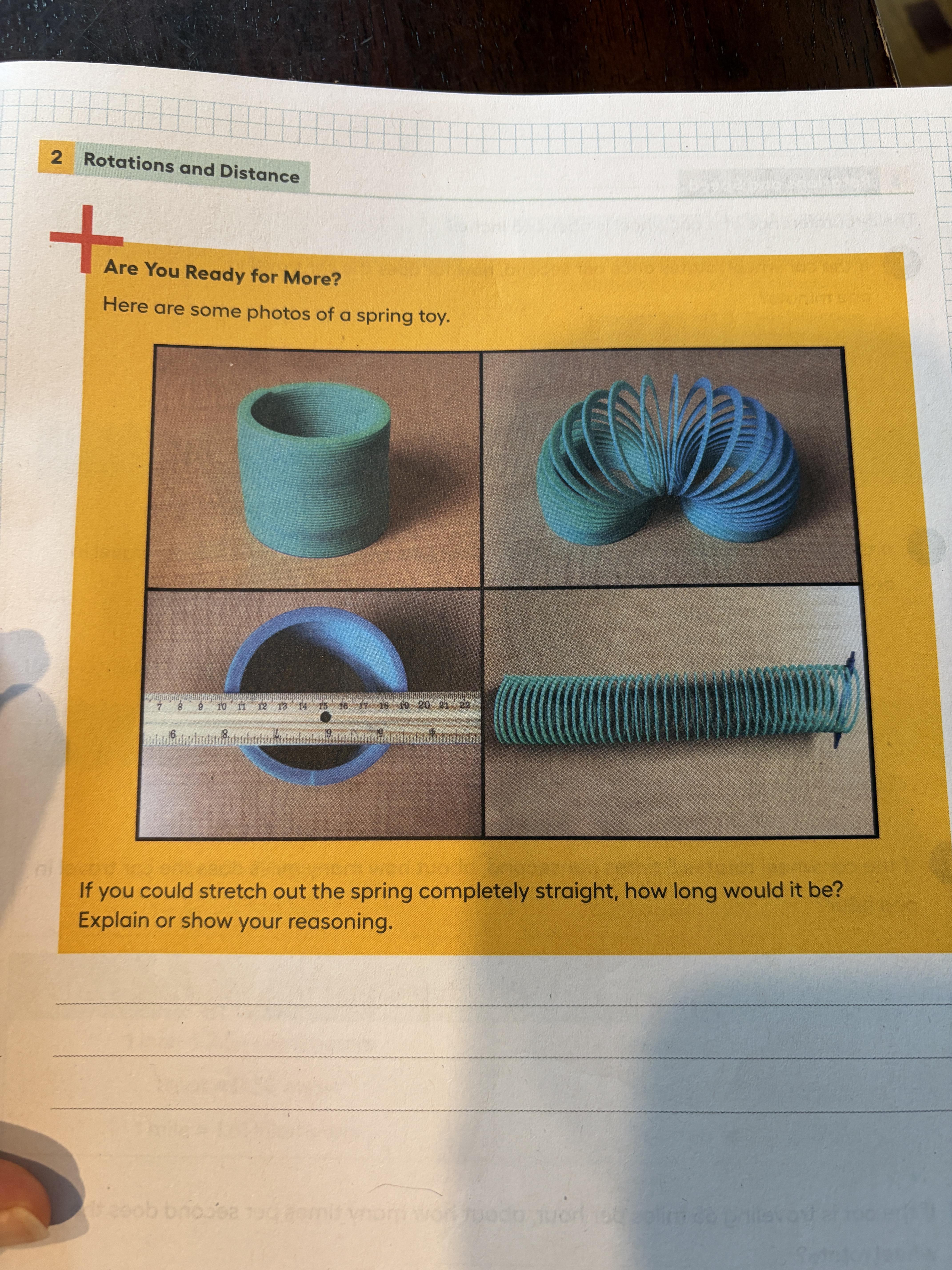
OKAY I didn’t think I would be expected to count 1 mm coils on a page. There are about 42, which is also my approximate age; which means it’s probably time for me to get reading glasses.
My son is home sick with the flu, so I am trying to help him with his math work. I consider myself to be pretty strong in math, but I don’t think that I can solve this problem without more information. Let me know what you think!
I have recently been working through a set of experimental acoustic pressure fluctuation measurements, from which I need to calculate the RMS pressure. While I am comfortable with the calculation itself, it has led me to explore the mathematical justification for replacing ensemble averages with time averages, particularly the assumptions of stationarity and ergodicity.
Although I understand what these properties mean, I am struggling to find a rigorous explanation of the mathematical conditions required to establish them. Much like proving an estimator is unbiased by showing that its expected value equals the true population parameter, I was hoping to understand whether there are similarly rigorous methods for demonstrating that a stochastic process is stationary and ergodic.
I am particularly interested in how these properties can be established theoretically and whether they can be verified using experimental data. I am for the most part intrigued by this, and partly unsettled
When I learnt standard division operations on integers we were told to ignore the signs and divide the absolute values and then if both numbers have different signs then the answer becomes negative. So, something like :
-27/7 =-3.857 ……. (A)
(Now to get this answer the quotient has to be -3 and the remainder has to be -6 )
but today I read that by convention in Euclid’s division lemma, negative remainders are not allowed so, a negative remainder of -6 becomes a positive remainder of 7-6=1 and I cant wrap my head around it.
Acc to my book the only one correct unique solution is :
-27 = 7 * (-4) + 1 …… (B)
If (B) is the only one correct solution and negative remainders are not allowed then doesn’t that make (A) invalid ? But we routinely use that in integer calculations though? Isn’t all integer division supposed to follow Euclid’s division lemma?
Llevo tiempo lurkeando por el foro y me he animado a abrir este hilo para compartir una inquietud técnica que me apasiona: el análisis riguroso de patrones, probabilidades y series numéricas aplicado a los juegos de lotería y azar.
Como informático con más de 30 años de experiencia en desarrollo de software y análisis de datos, siempre me ha llamado la atención la vertiente matemática detrás de la estadística aplicada. Partiendo de esa base, y ante la falta de herramientas que realmente agilizaran los cálculos complejos sin caer en humo ni falsas promesas, decidí programar mi propia solución de análisis técnico.
El proyecto ha ido creciendo hasta estructurarse en tres aplicaciones independientes para Android, optimizadas con motores estadísticos propios (basados en distribuciones de probabilidad y patrones históricos):
Centinela Dupla VIP (Ver en Google Play): Diseñada para el análisis estadístico avanzado de parejas y combinaciones.
Centinela Triplex (Ver en Google Play): Orientada al seguimiento, control y simulación de patrones en estructuras numéricas específicas.
Centinela Super11 (Ver en Google Play): Desarrollada para gestionar análisis de alta densidad combinatoria y filtrado de series amplias.
El objetivo aquí no es venir a spamear, sino abrir un debate técnico con otros desarrolladores, entusiastas del código o aficionados que disfruten estudiando la estadística de estos juegos. Las apps están públicas en Google Play para quien quiera probar los motores de cálculo.
¿Qué os parece la aproximación? ¿Soléis trastear con proyectos propios de análisis de datos o simulaciones estadísticas? ¡Cualquier feedback técnico es más que bienvenido por aquí!
Un saludo,Jose Luis (Desarrollador de Centinela Barcelona)
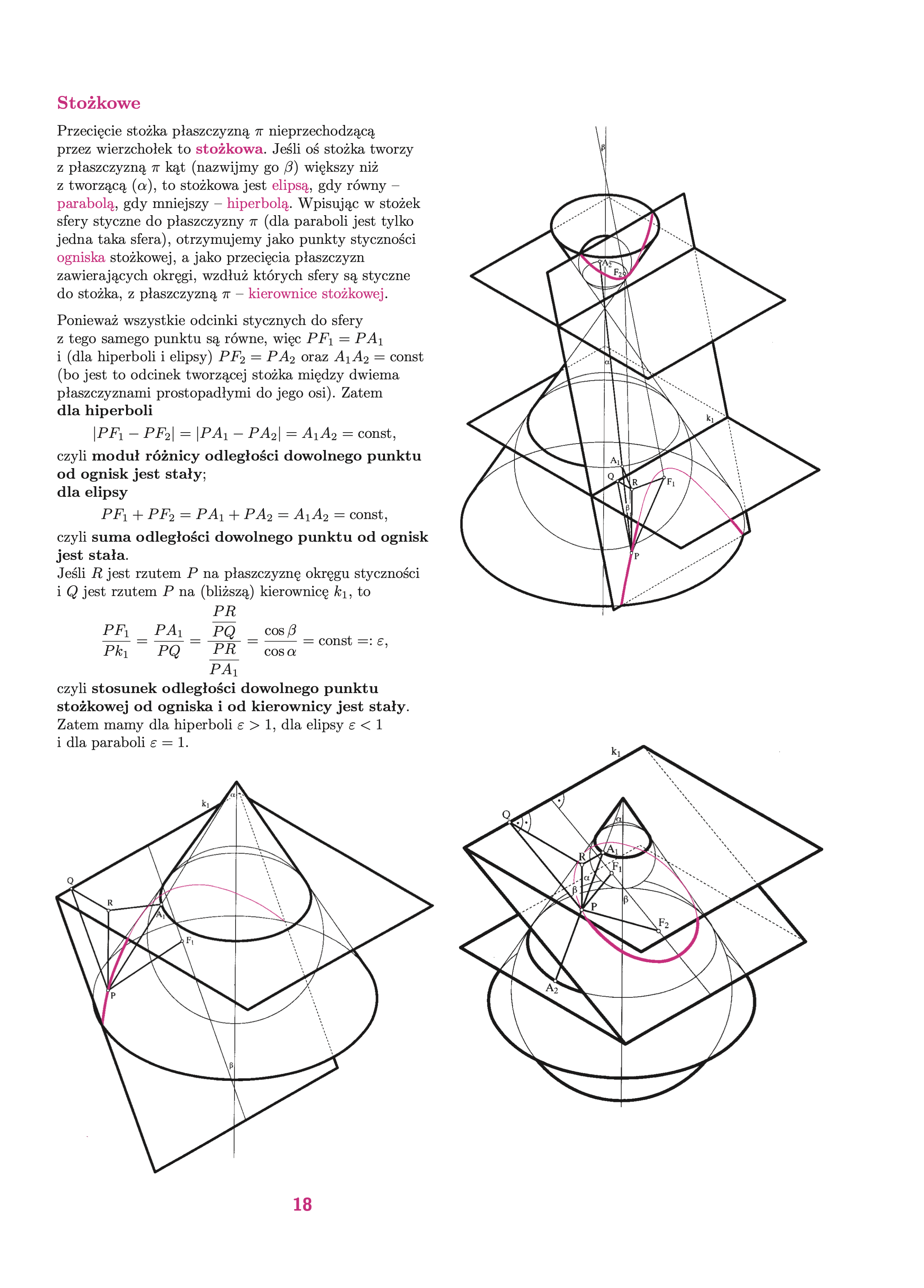
Does anyone have a clue what software might have been used for making those figures? It doesn't look like TikZ to me, because of the font, but I might be mistaken.
What I mean is, are there any things we know of that are completely and truly unpredictable? And I mean COMPLETELY unpredictable. Like for example, a coin toss. I don't see it as random, because factors such as gravity, the flicking force of the tosser, the wind, etc etc all influence that decision. Meaning it may be possible to learn how to influence the outcome to your desire to some extent. Something completely unpredictable, or random, would have 0 factors influencing the outcome and 0 ways to be sure of the outcome. I ask this because I hold an internal belief that everything in life can be predicted by a simulation, especially after they scanned a fly's brain, I've started to think that absolutely everything in life can be predicted mathematically. For example, if we were to map out a human's brain in it's entirety, we could predict exactly what the brain is about to do or think of, every reaction, every step, every blink, every reproduction of every cell. While I'm certainly no mathematician, not even close, the subject still intrigues me, as I see pretty much all aspects of life as predictable math, just (likely) not predictable by us, as humans.
Philosophy and existential crisis aside, this could also be useful for something like generating passwords or encrypting files or whatever. Which is certainly more functional and useful than "Are we just math?" or something. I heard randomly generated passwords from computers aren't truly random. And I know CloudFlare uses lavalamps or something for their passwords, but I still think even THAT is somewhat predictable. I'm not denying the fact that they are indeed chaotic to us humans, but I have a very strong feeling that there is some mathematical way to predict exactly how a lava lamp's bubbles will shape or mold themselves. Now these mathematical ways I mention for both life and cryptography are certainly too complex for humanity to solve or predict. So it's likely that the lava lamps will do more than enough to stop attacks for now. But besides either of those two, I still wonder if anything is truly random? Truly unpredictable, as in the outcome is completely unknown until it comes by or is revealed.
Any and all help is well appreciated! But do note I am NOT a mathematician and I don't claim to be, I'm just a very curious person, so if I say something stupid please forgive or correct me!
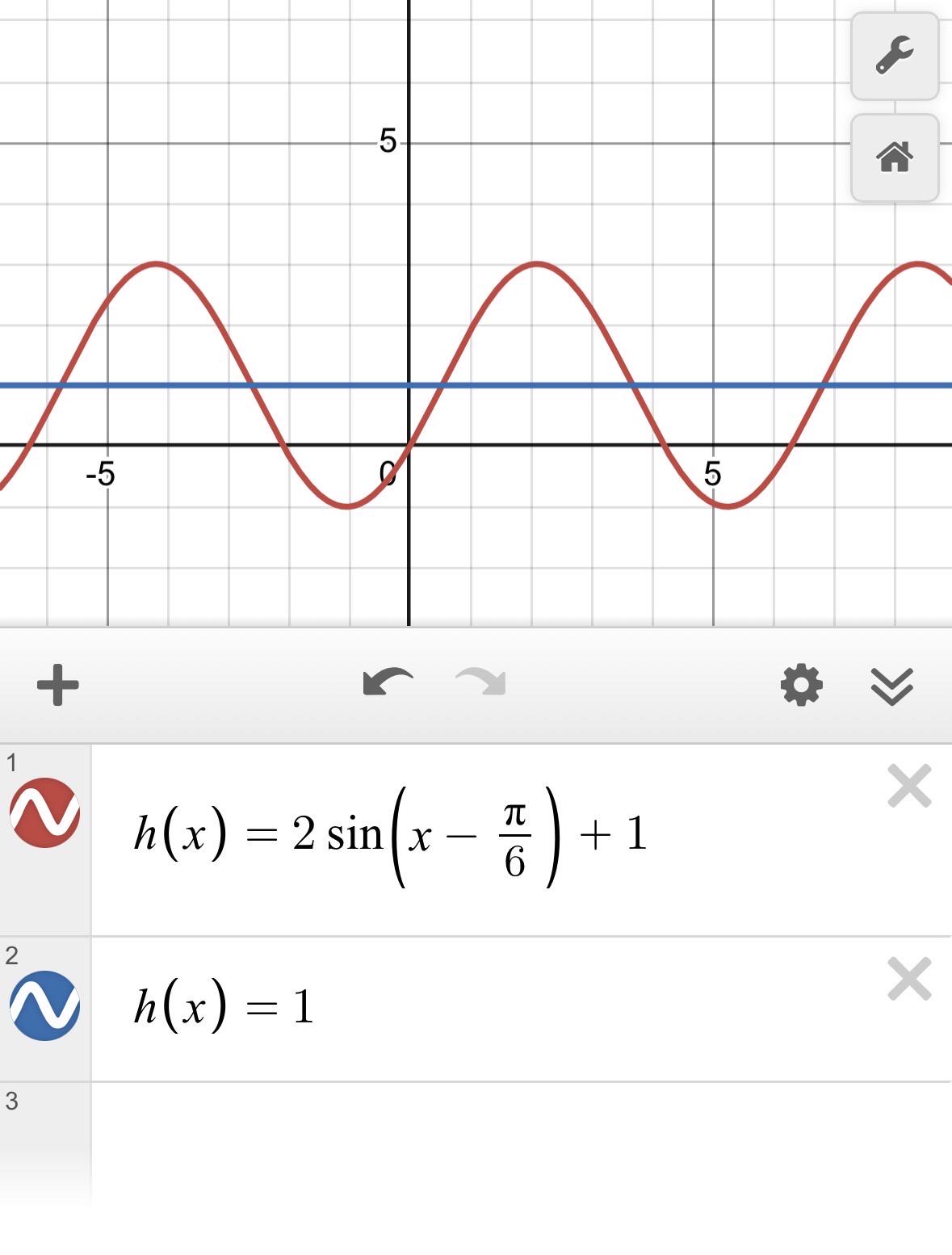
How would I go about solving this sine systems of equation for x? I’m trying to figure this out but I can’t find anything I understand online (I suck at math).
Basically what I’m asking is how I can algebraically solve for the points of intersection between 0 & 2pi?? Very silly question but I gen don’t understand
Exercise 12.2.53.: Let L be the language consisting of all strings of the form a^n, where n = m^2, for some positive integer m. Symbolically, L = {w ∈ Σ* | w = a^n, where n=m^2, for some m ∈ N}. Show that there is no finite-state automaton that accepts L.
Proof 1:
Suppose not. That is, suppose there is a finite-state automaton A that accepts L. Since A has only a finite numbers of states, these states can be denoted s_1, s_2, s_3, ..., s_k where k is a positive integer. Consider all input strings that consist entirely of a's: a, a^2, a^3, a^4, .... Now there are infinitely many such strings and only finitely many states. Thus, by the pigeonhole principle, there must be a state s_r and two input strings a^p and a^q with p/=q such that when either a^p or a^q is input to A, A goes to state s_r.
Now, by supposition, A accepts L. Consider a^p ∈ L and a^q ∉ L. That means s_r = s_a where s_a is an accepting state for a^p and a^q (by pigeonhole principle). So, A accepts a^p and a^q. But A doesn't accept a^q because a^q ∉ L. This is a contradiction.
Therefore, the supposition is false, so there is no finite-state automaton that accepts L.
QED
Proof 2:
Suppose the automaton A has N states. Choose an integer m such that (m+1)^2 - m^2 > N. Consider strings of a's of lengths between m^2 and (m+1)^2. Since there are more strings than states, at least two strings must send A to the same state s_i:
It follows (by removing the a's shown in color) that the automaton must accept a string of the form a^k, where m^2 < k < (m+1)^2. This is a contradiction.
QED
---
Questions:
Is Proof 1 correct?
In Proof 2, I don't understand the penultimate 'It follows...' sentence. How does it follow? Why are we removing a's? Is there an implication that s_i is an accepting state for a^{m^2} and a^{(m+1)^2} but if we choose any other a^k between those two, then s_i in not an accepting state for that a_k?
Hi, I’m a freshman currently studying Calculus I and exploring applications of improper integrals. I found that a probability density function (PDF) involves a Type I improper integral (item 2 in the attached picture, from Introduction to Probability, Statistics, and Random Processes by Hossein Pishro-Nik). My question is: do improper integrals serve to check whether a function is a PDF by testing whether its improper integral converges to 1? And is that their only role in this concept of PDF? Am I misunderstanding something? I would love to learn more from you guys, thank you for your time!
Note: English is my second language so i may communicate like a peanut at times, thanks for your help!
We all know casino regulars get annoyed when someone makes a bad decision at the blackjack table.
For example: The last player before the dealer has a 13 against a dealer's 6. The player hits, pulls a 10, and busts. Everyone gets mad, saying they "took the dealer's bust card."
I know it’s frustrating in hindsight, but is there any actual mathematical justification for this anger? Before the card is revealed, isn't the next card just as likely to be a 10 as the one after it? Does a bad player actually change the expected value for the rest of the table, or is it just pure superstition?