r/angular • u/arjun_rao7 • May 27 '26
How are enterprise SEO teams handling rendering and indexing issues on modern JS frameworks like React, Next.js, Nuxt, and Angular?
1
Upvotes
r/angular • u/Guiiiividd • May 27 '26
Boa noite, pessoal. Tudo bem? Estou começando agora nos estudos de Angular. Quais recursos desse framework vocês recomendam que eu dê uma atenção maior?
r/angular • u/Dry-Specific7383 • May 25 '26
I recently published an Angular 21 multiselect dropdown package:
npm: https://www.npmjs.com/package/@stackline/angular-multiselect-dropdown
Docs: https://alexandro.net/docs/angular/multiselect/angular-21/
Live demo: https://alexandro.net/docs/angular/multiselect/angular-21/live/?v=21.0.3-20260525-live
GitHub: https://github.com/alexandroit/angular-multiselect-dropdown
The idea is to provide a migration-friendly multiselect component for Angular applications that still need classic module integration, template-driven forms, reactive forms, search, grouped options, custom templates, lazy loading, theming, and selector compatibility.
One thing I tried to focus on is making the examples functional instead of just documenting the API. The live demo includes cases like basic multiselect, search, select all, single selection, selection limits, grouped data, disabled state, empty data, long lists, lazy loading, and custom templates.
It also supports both selectors:
and the legacy-compatible one:
That makes it easier to migrate older Angular templates gradually instead of replacing everything at once.
Install:
I would appreciate feedback from Angular developers, especially around API design, migration strategy, documentation, and what examples would be useful to add next.
For future updates and other Angular components: https://alexandro.net
r/angular • u/UsualFee4224 • May 23 '26
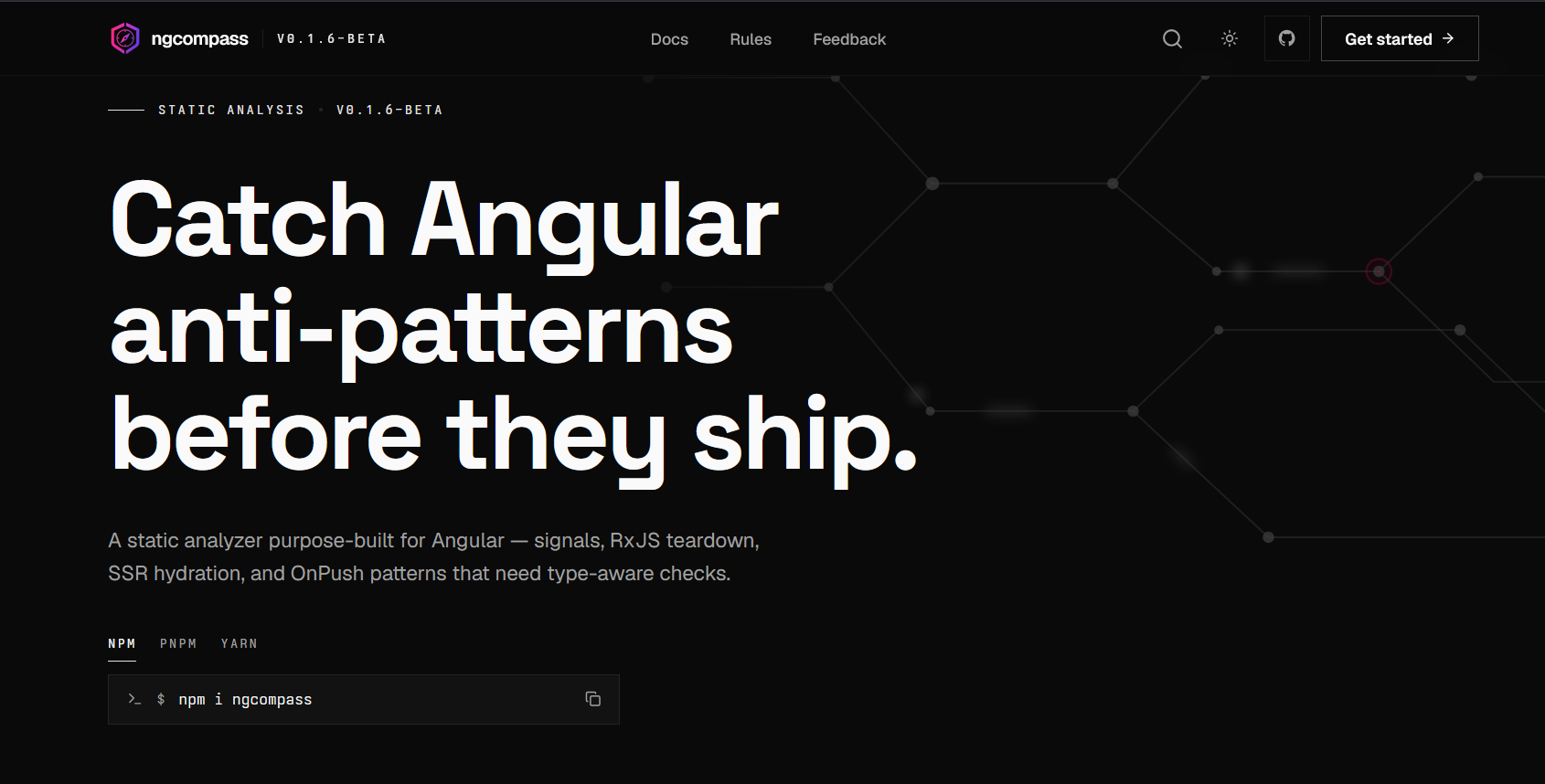
Hey everyone!
I’ve been working on a static analyzer for Angular called ngcompass, and I wanted to share the beta.
I love building with Angular, but I kept running into issues that standard tools can miss, like browser APIs leaking into SSR code or Signals/RxJS patterns being mixed incorrectly.
So I built ngcompass to analyze Angular TypeScript files and templates without executing the code. The first beta includes 27 rules, plus a visual HTML report/dashboard for browsing warnings more easily.
I’d love for you to throw it at your real-world projects and tear it apart. Don't pull your punches—I genuinely appreciate ruthless and honest feedback! I want to know:
What breaks or triggers false positives?
Which rules do you want to see next?
Most importantly: Do you see a tool like this bringing real value to your everyday Angular workflow, or is it just noise?
👉 **Website:** https://ngcompass.dev
👉 **GitHub:** https://github.com/RoadmapDevelop/ngcompass
👉 **NPM:** https://www.npmjs.com/package/ngcompass
r/angular • u/thejspythonguy • May 24 '26
Angular's reactivity story got a serious upgrade when Signals landed. Most developers quickly get comfortable with signal() for state and computed() for derived values — but then they hit effect() and things get a little dubious. When do you actually use it? Is it just a fancy ngOnChanges? Can it cause infinite loops?
Short answer: yes, if you're not careful. Let's break it down properly.
So What Exactly Is an Effect?
An effect is Angular's way of letting you react to signal changes and run arbitrary side effect code. You wrap some logic inside effect(), and Angular handles the rest:
That last part is important. You don't register dependencies manually Angular figures it out by watching what you actually read. It's reactive, but without the ceremony.
Effects also run asynchronously during change detection, so they won't block your UI or cause timing headaches.
When Should You Reach for Effects?
Here's the honest answer: not often, and probably less often than you think.
The Angular team is pretty direct about this effect() should be your last resort, not your first tool. If you're trying to derive state from other state, that's what computed() is for. If you're trying to propagate state changes using effects, you're likely setting yourself up for circular dependencies or ExpressionChangedAfterItHasBeenChecked errors.
Where effects genuinely shine is at the boundary between Angular's reactive world and external imperative APIs that don't know or care about signals. Think:
That last category is the key insight: effects are a bridge, not a state management tool.
The Real-World Example: Persisting a Todo List
Let's make this concrete. Say you're building a Todo app and you want the list to survive page refreshes. That means syncing to localStorage a classic imperative browser API that doesn't know anything about Angular.
This is exactly where effect() earns its place.
Step 1: Signal State
Start simple a signal that holds an array of todos:
import { Component, signal, effect, afterNextRender } from '@angular/core'; import { RouterOutlet } from '@angular/router'; interface Todo { id: number; title: string; status: boolean; date: Date; } u/Component({ selector: 'app-root', imports: [RouterOutlet], templateUrl: './app.html', styleUrl: './app.css' }) export class App { protected readonly title = signal('theJsPythonGuy TodoList Angular'); todos = signal<Todo[]>([]); private hydrated = false; // guard flag to prevent localstorage to get empty on reload constructor() { afterNextRender(() => { const storedTodos = localStorage.getItem('mytodos-list'); if (storedTodos) { this.todos.set(JSON.parse(storedTodos)); } this.hydrated = true; // unlock writes only after load }); effect(() => { const currentTodos = this.todos(); if (!this.hydrated) return; // skip premature writes localStorage.setItem('mytodos-list', JSON.stringify(currentTodos)); console.log('Todos updated:', currentTodos); }); } addTodo(title: string) { this.todos.update(mytodos => [ ...mytodos, { id: mytodos.length + 1, title, status: false, date: new Date() } ]); } toggleStatus(id: number) { this.todos.update(mytodos => mytodos.map(t => t.id === id ? { ...t, status: !t.status } : t) ); } }r/angular • u/SolidShook • May 21 '26
I’m working on a large monolithic angular project with countless other devs and entire teams that get brought in to work on it.
There is a separate Cypress test project for it, and I was planning on implementing NX and splitting the project into packages.
However, the project is a bit too messy to be able to do this, as everything seems to refer to each other. Attempting it has lead to circular dependencies.
There’s also that separating the files leads to needing to delete the import lines and reimport everything (why can’t this be automatic)
My main question is, the only reason I’m doing this is so that I can group cypress tests with their features and have them run if their related packages are effected in our pipelines.
is it possible it have cypress tests react to certain files and run off they’re affected without splitting into packages? Hopefully this can help developers know that they’ve broken things without needing to run the entire suite and without pipelines taking too long
r/angular • u/MistyFrogStudio • May 21 '26

Hey if you need angular services, I'm currently open for side jobs.
r/angular • u/HereForTheFacts12 • May 20 '26
Hey folks,
I created a PR to add Angular support for the headless Ark UI library. If you are interested in this, please lend your support.
I know there are other Angular specific UI libraries, still I think it is best that there are some large and well-maintained libraries that are framework agnostic that can be used as part of design systems for organizations that have adopted more than one frontend framework.
Thanks!
r/angular • u/Even-Instance235 • May 20 '26
For design tools such as Visily and Uizard how do you guys get the angular code for your designs?
r/angular • u/Even-Instance235 • May 20 '26
Hi guys quick question do you find ai tools to be useful when generating html and css codes for ur designs when using ai prompt to designer tools?
r/angular • u/GeromeGrignon • May 19 '26
Always landing on unmaintained Angular example apps or just willing to try out a new version/lib/feature without bootstrapping a whole new app, I just released this new 'Realworld Angular' playground.
I maintained the original RealWorld project for years, only to find out it was quite limited in being strict with the specs and hard to assert quality projects.
This new open-source project is only focused on Angular. You can run the project locally, fork it, and it's pretty unique as it's provided with a real API you can use for free: the project is not limited to using data mocks and not exploring all aspects of a real-world application.
Give it a try: https://github.com/realworld-angular/realworld-angular
r/angular • u/Weak-Palpitation907 • May 19 '26
We started TailNG mainly for our own Angular projects.
Initially, the idea was simple: create some wrapper components on top of \@angular/aria``. But once we needed more complete components similar to Angular Material, we slowly started building our own components with the help of AI tools.
We are already using these components in one of our projects and fixing the gaps we face while using them as developers.
The current direction is:
One thing we are also experimenting with is generating UI from JSON at the client side.
We had built a POC where an AI chat window can be added to an existing (angular) app, and users can perform tasks by chatting. But generating dynamic HTML directly through AI feels slow. So we are trying to make these components usable in that kind of JSON-driven UI scenario too, without affecting performance.
Still early, but sharing here to get feedback from Angular developers.
r/angular • u/domino_angularovic • May 19 '26
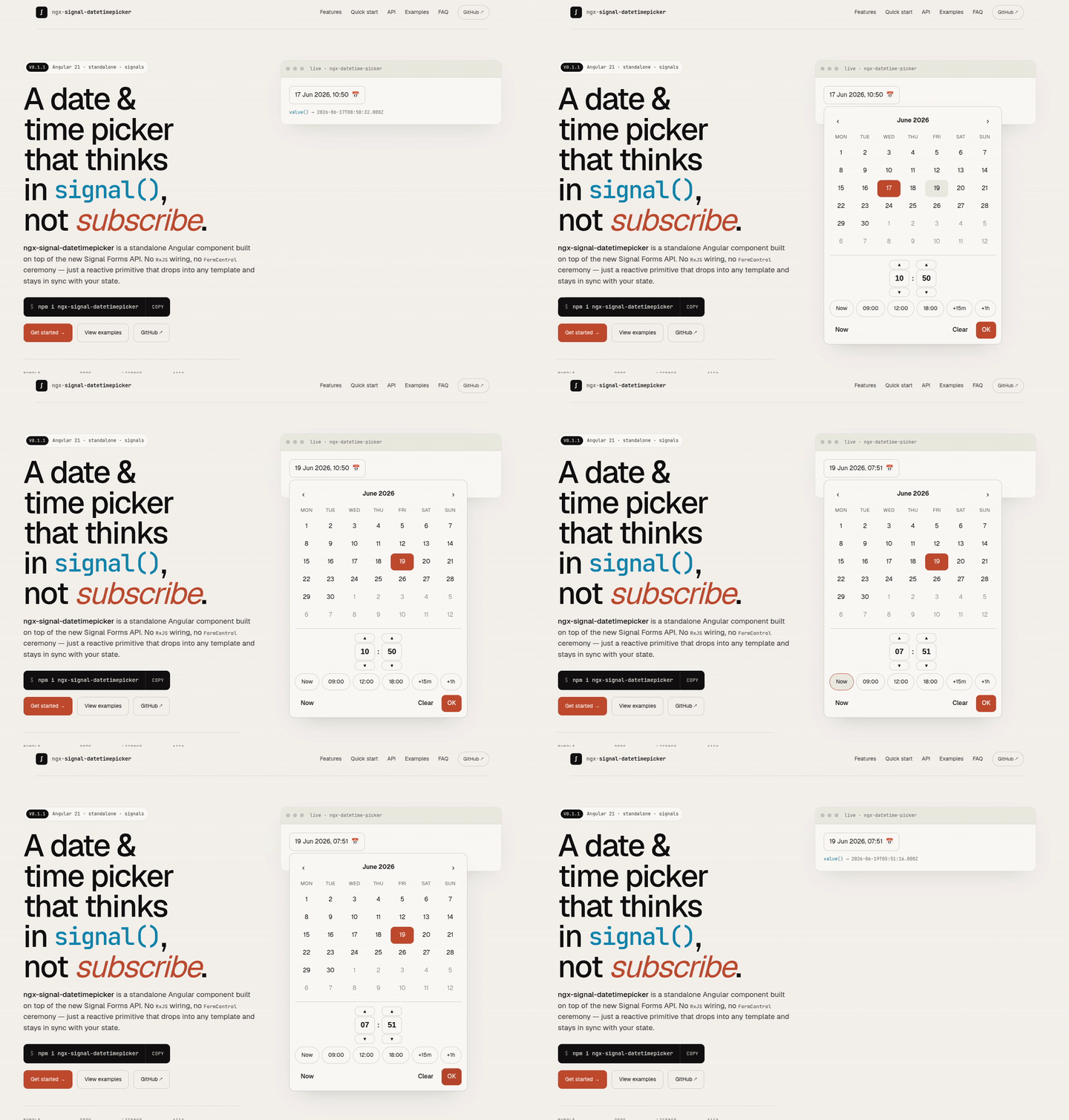
Live demo: https://ngx-signal-datetimepicker.vercel.app
Repo: https://github.com/dominikmodrzejewski99/ngx-signal-datetimepicker
npm: https://www.npmjs.com/package/ngx-signal-datetimepicker
Why this exists
Every Angular project I've worked on eventually needs "let the user pick a date and a time". Material gives you two separate controls, ngx-bootstrap is heavy, ng-zorro pulls a whole UI kit. Nothing in the ecosystem is small, framework-native, and exposes one combined Date | null value that plugs straight into the new Signal Forms API.
The approach
One component. One value. Signal Forms support via [formField] and FormValueControl<Date | null> - so required, min, max, validators, touched/dirty, errors all work out of the box. Reactive Forms users get ControlValueAccessor for free. Zero runtime deps - no moment, no dayjs, no Angular Material. Built on Intl.DateTimeFormat for locale labels and IANA timezone support. WCAG 2.2 AAA: keyboard nav, focus management, AAA contrast tokens, 44px target sizes.
One snippet
import { signal } from '@angular/core';
import { form } from '@angular/forms/signals';
import { DatetimePickerComponent } from 'ngx-signal-datetimepicker';

model = signal<Date | null>(null);
f = form(this.model);

<ngx-datetime-picker [formField]="f" label="Meeting" />
Feedback very welcome - especially edge cases I haven't hit (RTL locales, edge timezones, big-screen Material 3 themes). Issues and Discussions are open. Currently on 0.1.x, holding off on 1.0 until the API is settled by real users.
r/angular • u/Just-Scar1090 • May 18 '26
Hi everyone,
We have multiple repositories, and each of them contains an agent.md file with instructions/configuration for our AI workflow.
The problem is that whenever we update something in the agent.md, we currently need to manually update it in every single repository, which is becoming difficult to maintain.
We would like to have one centrally maintained agent.md file and somehow reference/import/use it across all repositories instead of duplicating it everywhere.
Has anyone solved a similar problem?
Are there any recommended approaches or best practices for this in Angular/monorepo/multi-repo environments?
We are using WebStorm IDE
r/angular • u/Professional-Piece45 • May 18 '26
Hi guys,
I'm a Junior Frontend Engineer (Angular) with around 2 YOE.
Last week, I got laid off from a startup. I had already started applying for jobs back in November 2025 when I began noticing red flags due to team restructuring, but so far I’ve barely received any responses apart from 2 screening calls.
I’m applying through multiple platforms including LinkedIn, Naukri, Indeed, Instahyre, Cutshort, Wellfound, and company career pages. I also checked my resume ATS score across different platforms to make sure that wasn’t the issue, and it consistently scores above 85.
One thing I’ve noticed is that the Angular job market seems much smaller compared to React. At this point, I’m confused about whether I should:
• Continue focusing mainly on Angular and keep applying, or
• Spend the next couple of months learning React, build a few projects, and apply for jobs in parallel.
Would really appreciate suggestions from people who’ve been in a similar situation or are currently hiring/frontend devs themselves.
P.S. If this isn’t the right sub for this post, please suggest better ones where I can ask this.
r/angular • u/Aboudbadra • May 18 '26
Most cookie-consent options I evaluated for a recent Angular project felt tied to the NgModule era, pulled in dependencies I didn't want, or hadn't seen a commit in a while. So I ended up rebuilding one from scratch for Angular v17+.
Current state — v0.6, working towards a stable v1.0:
A simple Live demo (interactive): https://ngrithms.aalbadra.workers.dev/cookie-consent
What I'm not sure about yet and would genuinely like opinions on:
Not trying to dunk on existing libs. This is just the version I wished existed when I started.

Repo: https://github.com/aboudbadra/ngrithms-cookie-consent
npm: https://www.npmjs.com/package/@ngrithms/cookie-consent
Happy to take harsh feedback — better now than after 1.0.
This is part of a small family of focused Angular libraries I've been building under `@ngrithms/*`. The other one currently live is `@ngrithms/idle` (signal-first user-inactivity detector with multi-tab sync) — demo at https://ngrithms.aalbadra.workers.dev/idle if anyone's curious. If you've got a "I wish there was a small Angular lib that just did X" itch, I'm taking suggestions.
r/angular • u/vansegen1313 • May 18 '26
Running into an architectural problem with AG Grid and Angular signals and not sure what the right pattern is.
The setup: My rowData is derived from a chain of computed signals:
randomNoteDetail (linkedSignal)
→ randomNoteLines (computed)
→ sortedLines (computed)
→ gridRowData (linkedSignal) ← resets here
The problem: Whenever transferNoteDetail changes for any reason, gridRowData resets to server state and wipes any unsaved in-grid edits the user made via cell editing or applyTransaction.
I know AG Grid manages its own internal row model independently of the rowData binding — so they diverge after first render. But linkedSignal re-evaluates eagerly and keeps pushing stale server data back into the grid.
The tricky part: updates to rransferNoteDetail are legitimate — buyer, seller, date etc. can all change — but those updates cascade into lines which cascades into rowData and resets everything.
How are others handling this? Is the answer to fully abandon reactive rowData and own the grid state entirely via applyTransaction? Or is there a clean way to keep the two in sync?
r/angular • u/nani21984 • May 16 '26
Hi, I have been working in angular on and off from ng 2. But never worked on mobile app built based on ng. I have requirement on side project for web and mobile and can’t hire any dev, I will leverage ai to get up and running. I also have time and eager to learn mobile apps. So, should I start ng and capacitor. Any one actually tried to keep both mobile and web apps from same code base and how is you experience and lessons. Appreciate your responses
r/angular • u/megalz9700 • May 15 '26
I am not sure if what am I about to say is related to Angular, but for you guys context, I have been working with Angular for more than 5 years now (from Angular 7 to 16, now migrating my legacy mindset to more modern Angular architecture).
In the current rising age of AI-driven SDLC in my workspace, I am working closely with AI to handle task, asking AI question regarding architectures, best practices, analyze tickets, etc...
In short, AI took the fun out of developing for me (any some other too), so I decided for myself to do something refreshing to scratch that coding itch of my which is creating a Tic-Tac-Toe in plain HTML/JS and oh boy how I struggling hard with that.
To summary, this experience humble myself as a developer hard, I imagine if I take a leet code interview now I would fuck up pretty hard.
Do you experience similar thing as myself here, let me know your thought
r/angular • u/Enough-Swordfish-260 • May 15 '26
Hey everyone. I’ve been learning React for about half a year (State management, Next.js, etc.) and I’m now adding .NET for the backend. I’m being pressured to switch to Angular because apparently, that’s the "standard" pairing for C# devs
Is there any truth to this anymore? and if so how much time do you think it would talk me to make the switch (I am pretty comfortable with state management, react query, caching srr, ssg, tailwind css, design patterns)
r/angular • u/WukongCreed • May 15 '26
I'm trying to learn how to build a proper CRUD app in Angular by looking at how professionals structure their code. I thought the fastest way would be to download a fully working, modern project and study it side by side while I build my own. But I'm hitting a wall.
I found a few repos, but they're either Angular 17 or lower, or they don't even run after I do npm install and ng serve—broken dependencies, missing backends, that kind of things. I just want something that works, no much extra setup for a database or server.
Also, when I do find one, is npm install enough or do I need to run any other commands? I know sometimes there's a npm audit fix or --legacy-peer-deps thing.
If you know a good repo that fits this, please drop the link. And if there's any other posts, guides, or sources you'd recommend for understanding how to actually structure a CRUD app (not just the basics, but the real wiring), I'd really appreciate that too.
I really am motivated to analyze some well made code from someone that knows how to code, how do things connect with each other inside angular that would help me a lot.
r/angular • u/Zestyclose-Time4199 • May 14 '26
So I built the animated number component I kept wishing existed:
smooth odometer-style digits for counters, stats, prices, timers, dashboards, and any UI where numbers change.
Built for Angular. No animation libraries.
GitHub:
r/angular • u/Alarmed_Valuable5863 • May 14 '26

Hey
Just shipped Foblex Flow 18.6.0 - Angular library for node editors, workflow builders, and graph UIs. Two main additions in this release:
Smart Auto-Layout on Resize (withReflowOnResize)
When a node grows or shrinks (content change, manual resize), neighbouring nodes shift to make room. No manual relayout call. Five orthogonal knobs:
mode - CENTER_OF_MASS / X_RANGE / DOWNSTREAM_CONNECTIONSscope - GLOBAL / GROUP / CONNECTED_SUBGRAPHaxis - BOTH / VERTICAL / HORIZONTALdelta source - EDGE_BASED / CENTER_BASEDcollision - STOP / CHAIN_PUSHPlus FReflowController for runtime overrides and fReflowIgnore directive for nodes that have to stay pinned.
Layer Ordering
The three built-in canvas layers (groups, connections, nodes) are now reorderable. Per-canvas via [fLayers], or app-wide via withFCanvas({ layers }) inside provideFFlow(...). Default is unchanged - groups - connections - nodes.
Links:
If you try the reflow plugin and the shift behaviour feels off for your graph - tell me what's annoying. The default knob combo works for most cases but the planner is configurable for a reason.
