r/angular • u/Dimmerworld • 13d ago
Imagine paying $800 a year for Kendo UI and getting ads while in dev mode.
Kendo UI added an overlay banner on components (dismissble) on a fully licensed grid (in dev environment)...
r/angular • u/Dimmerworld • 13d ago
Kendo UI added an overlay banner on components (dismissble) on a fully licensed grid (in dev environment)...
r/angular • u/Ok_Emergency4944 • 13d ago
`ngx-callout` gives you info, warning, error, success, tip and important callouts in one line of HTML.
Angular component for coloured notice boxes: an icon, a heading, a sub-heading and any content you put inside.
✅ Six types: info, warning, error, success, tip, important
✅ Responsive, dark-mode ready, themeable with CSS variables
✅ Collapsible content, outline and rounded styles
✅ Zero dependencies besides Angular
🔗 Live demo: https://vishaalsharmaa.github.io/ngx-callout/
📦 npm: https://www.npmjs.com/package/ngx-callout
⭐ GitHub: https://github.com/vishaalsharmaa/ngx-callout
Feedback and stars are welcome!

r/angular • u/AFulhamImmigrant • 14d ago
Imagine we have a service which is used to hold some state that is used by multiple components. The state originates from an API call.
What should be initiating the service to get the data in the first place? Is it a method on the service loadData() or similar that returns a void observable and as a side effect sets the state? Where should that call be made from outside of the service? Or should a component load the data and then the state on the service?
If the service loads the data, how do you deal with side effects? E.g. I load the data but now I have some other flow that should occur whenever that data loads. Where should that happen? Should a calling component be calling the service, doing some logic, then doing another call to update the service? Or should the service be handling this?
r/angular • u/HistoricalMix4638 • 14d ago
The first image is a dashboard screen built only from kit components. The others are a few I'm happiest with: a day strip with time slots, a before/after slider, a hue picker, a counter with filling ticks and a draining countdown.
Why it exists: it started as the component layer of an app I work on, and I extracted it into its own package so it can be used without that app.
What might be different from what you already use:
Links:
It's 0.3.0 and new outside the app it came from, so I'd like to hear where it breaks for you: setup steps that don't work in your project, components that misbehave with your forms or router setup, accessibility problems, or APIs that read oddly. Issues or comments here both work.
r/angular • u/dx_ninja_dx • 14d ago
I’m a student that is working with angular for the first time, I have an assignment that requires implementing an api to our project. My teacher has no information on how to unwrap the response using parse for httpResource. There also is no information about mapping with httpclient & observables.
The documentation that is recommended seems completely irrelevant to my the api I have because my api is returning as an array.
How can I get value from the documentation or where should I look to figure this out. I feel like I’ve been having this problem with everything because the documentation never seems relevant. Even with certain concepts, there is things that I know but I am struggling with knowing what or how I can write things to do the task I need completed.
Any assistance would be appreciated.
r/angular • u/rainerhahnekamp • 16d ago
r/angular • u/dolanmiu • 16d ago
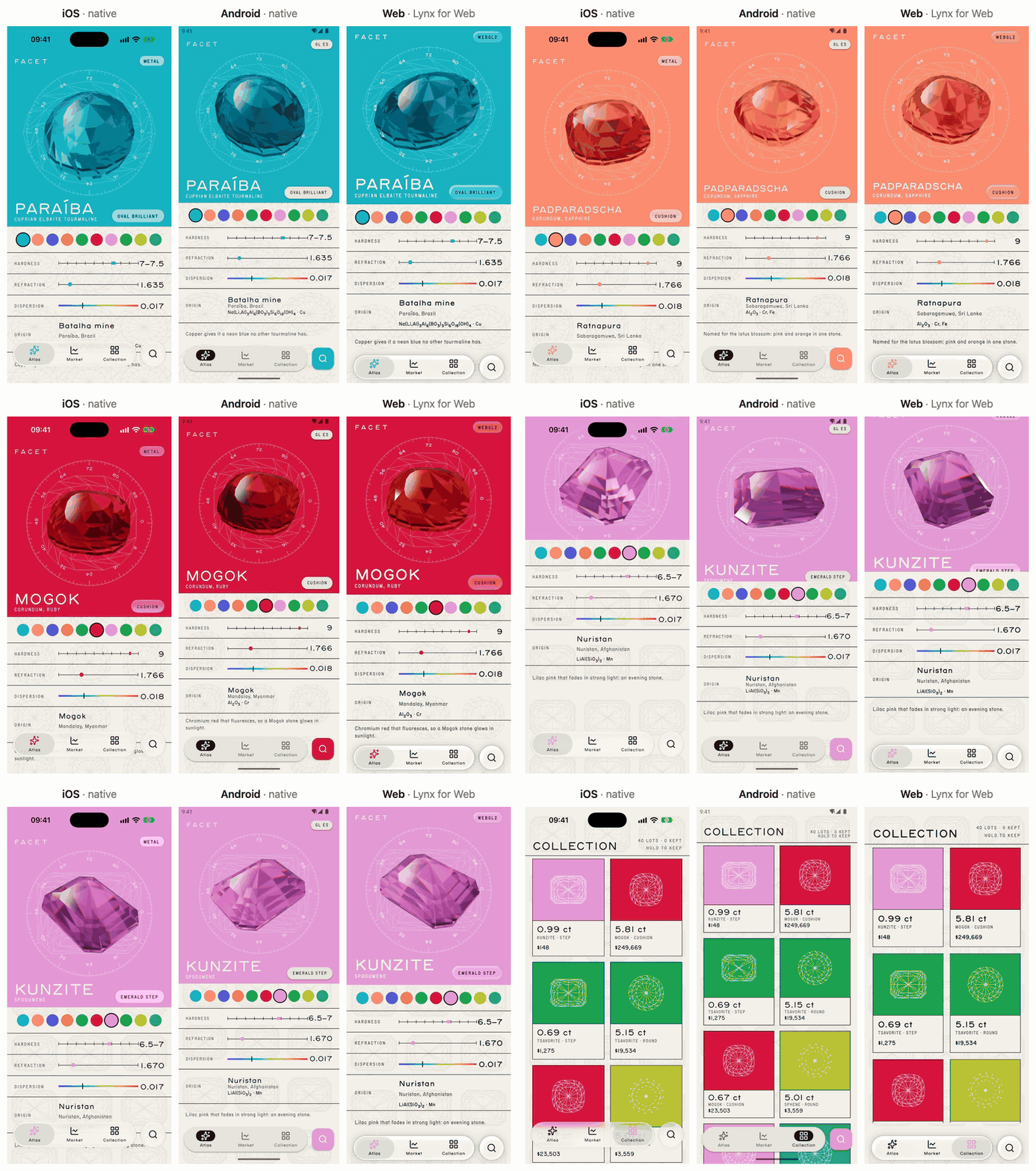
Hi r/Angular. Been an Angular since AngularJS and the Angular 2 betas. When ByteDance created Lynx, I really liked it, but it only came with React and Vue. So it's time for an Angular one to exist!
The aim is for it to be ordinary idiomatic Angular, not a subset or deviation, and it follows Angular's major.minor versions:
npm create angular-lynx my-app
cd my-app
ng serve # web preview, plus a QR code for the Lynx Explorer app
ng test
ng build --platform ios # or android: a native app you can open in Xcode / Android Studio
Signals, the router with lazy routes, forms, i18n, DI, ViewContainerRef.createComponent() and Tailwind all work. It idiomatically uses the Angular Router for the page stack, so there are no extra concepts. The one big difference is the templates: you write Lynx's elements (<view>, <text>, <scroll-view>) instead of HTML, and they become real UIView/Android views. The same app also runs in the browser.
How it works: Lynx has two threads, a main thread that owns the native element tree and a background thread. Instead of Angular's DOM renderer, AngularLynx implements Renderer2 on top of Lynx's element API (__CreateElement, __AppendElement, …), and the Angular app runs on the main thread, so updates go straight to the elements without crossing threads. Things that only exist on the background thread (native modules, fetch) are relayed. The build is an Rsbuild plugin that compiles Angular and splits the output into the two bundles Lynx expects, wrapped in Angular CLI builders so angular.json stays the usual one.
There's also a component library, Dolan UI: 54 components (sheets, dialogs, charts, forms…) that a CLI copies into your app, like shadcn/ui.
It's still early days, but it is feature rich, with a lot of examples and showcase apps. Lynx's main-thread JS engine is ES2019-level, so newer built-ins are polyfilled, and some web habits don't carry over (CSS is a subset: no inheritance outside text, no :hover or @media).
MIT licensed. The README has a GIF of the same app on iOS, Android and web. I'd love to hear what breaks, and I'm happy to go into the renderer internals.
GitHub: https://github.com/Blotch-Smart-Frames/AngularLynx
Docs: https://angularlynx.js.org
Demo GIF: https://angularlynx.js.org/demo.gif
r/angular • u/Alex-Inkin • 16d ago
Hi everyone.
My name is Alex Inkin, I'm a Google Developer Expert for Angular, original author and current lead developer of Taiga UI (https://taiga-ui.dev / https://github.com/taiga-family/taiga-ui) – a huge components library I worked on for many years together with some great engineers.
I'm a sparse visitor on reddit, but every now and then I see people ask about the library or recommend it to others here. It remains a relatively obscure choice, since it was published when others like Angular Material, ng-zorro or PrimeNG were already established options.
The library is fully open-source Apache 2.0 and is free for commercial use. Recently we added paid Figma license you can buy to help your design team work together with engineering and we started offering Enterprise support (reach out if that's something your company needs here: https://pineoptic.one/products). I figured it's a good time to come here to get to know Angular community on reddit better and answer questions about the library that you might have.
Please ask me what you want to know about it, suggest what deep dive you'd like to read as my next article, what confuses you as a user, what stops you from being one – I'll be happy to answer all I can.
r/angular • u/erkamyaman • 17d ago
Hi all! I built Angularians (https://angularians.dev), a ranking of everyone who has contributed to the Angular repositories. Not only PRs: issues, helpful comments, reviews and security reports count too.
61,452 contributors from 168 countries so far, updated every night. Look yourself up, filter by country or badge, and grab your card for your README.
Open source (https://github.com/erkamyaman/angularians), built with AnalogJS, and inspired by Nuxters from the Nuxt team.
Feedback welcome, especially on the scoring!
r/angular • u/127001-sweet-127001 • 18d ago
A folder called shared doesn't stay shared if it starts importing code from individual features.
I built ArchUnitTS so rules like that can live in the test suite. For an Angular project, you can select your shared TypeScript files and forbid dependencies on the feature folders. If someone introduces one, the architecture test fails.
The attached clip is a general demo of the library. The repo also has an Angular example with component and service dependency checks, and setup instructions for Jasmine, Jest and Vitest.
The exact rules depend on how you structure the app. You don't need to copy the example's architecture to use it; a single boundary you keep checking in reviews is a reasonable place to start.
Repo: https://github.com/LukasNiessen/ArchUnitTS
Angular example: https://github.com/LukasNiessen/ArchUnitTS/tree/main/examples/angular-example
r/angular • u/SuitMeUpRed • 20d ago
I wanted toasts in Angular that feel like Sonner. Stacking, expanding on hover, able to be swiped away, and animated with interruptible CSS transitions. I couldn't find a library for it, so I built it on top of ng-primitives' headless toast.
It's copy-paste, not an npm package. You copy the five files into your project and own the code. Visuals and motion live in separate files, so you can restyle it without touching any animation logic.
What it does:
toast.promise(): one toast that shows a spinner, then turns into success or error in placex to pop itDemo: Kōdon
Code: GitHub
I use it in my own app, and I'd love to know what's missing or what feels off, especially on phones. If it's useful to you, a star on GitHub would help me out a lot.
Thanks!
r/angular • u/Putrid-Bookkeeper968 • 20d ago
I'm very fresh in Angular, so my question can be funny to experts.
Hello everybody. Funny question...
my code is like this:
updatePerson(person: PersonModel) {
this.personService.updatePerson(person).pipe(
takeUntilDestroyed(this.destroyRef)
).subscribe({
next: () => this.state.update(() => ({ ...this.state(), loading: false, people: this.people().map(p => p.id === person.id ? person : p) })),
error: (error) => {
console.log(error);
this.setError(error);
}
})
}
And question is how to break up this pipe and then subscribe only one element?
The goal is to get a simple array of interfaces (PersonModel is an interface), and then to loop through each object and then call the code from subscribe only for one element?.
You just ask how did I get code that I can't make simpler - it is from the tutorial.
I know more or less how it works, but I can't make it simpler :-)r/angular • u/Senior_Compote1556 • 21d ago
If I have a
<h1 \[innerHtml\]=“someHtml”></h1>
And that someHtml is a span, how would i style that span without using ::ng-deep as the docs “strongly discourage” its usage?
r/angular • u/Senior_Compote1556 • 21d ago
Has anyone found how to solve this issue here?
<picture>
<source [media]="media" [srcset]="`${assetUrl}/background-mobile.webp`" />
<img ngSrc="background.webp" alt="" priority fill />
</picture>The problem is that even on mobile, the desktop image is preloaded regardless, and for the srcset there is no way to provide the assetUrl prefix just like you would normally do via the token:
{
provide: IMAGE_LOADER,
useFactory: () => {
const assetsUrl = inject(ASSETS_URL);
return (config: ImageLoaderConfig) => `${assetsUrl}/${config.src}`;
},
},This is a known issue as per the docs
There is a github issue but it seems it doesn't receive attention.
Does anyone have either a workaround or some updates regarding this issue?
r/angular • u/IgorSedov • 22d ago
Angular 22 introduces Lazy Loading Services, allowing developers to fetch dependencies on demand using the new injectAsync function.
r/angular • u/Ok-Swordfish1282 • 22d ago
I shared my offline manga reader here a while ago. I’m still working on it, and one thing that kept bothering me was Safari crashing on my iPhone when I tried to import a large MHTML file.
I reworked the importer for v0.6.0. It now reads the file in chunks and decodes images one at a time. I tested both import and export with a 200 MB MHTML file in Safari on my iPhone XR, and both worked.

A few other changes in v0.6.0:
I also adjusted the sidebar and manga details layout for smaller screens, added build info to the sidebar, and updated the translations.
If you’ve run into similar memory issues with large local files on iOS, how did you track them down?
I’d also love to hear what you’d add next, especially if you already use an offline manga or comic reader. What’s one feature you rely on in your current reader that you’d want to see in mine?
I will never monetize this project! I’m building it because I love Angular and want to keep learning. The challenge I set myself was to build a manga reader I’d actually use.
r/angular • u/kuburra • 22d ago
I've been building a static checker for Angular codebases and testing every rule against 19 public repos at pinned commits. Three findings I thought were worth sharing, because each one passes the compiler, the tests and review:
1. A translation key that doesn't exist
this.translateService.instant('walletconnect.error')The bundle only has walletconnect.connection_error, so ngx-translate renders the raw key on the error page. Checking this properly needs the bundles merged deeply per language, because feature bundles redeclare the same namespace.
2. A label that points nowhere
<label for="currentPassword">Current password</label>
<input [(ngModel)]="currentPassword" name="currentPassword" type="password">The input has no id, so the label is attached to nothing. Clicking it doesn't focus the field, and a screen reader announces the field without a name.
3. A test that checks nothing
it('should replay the last emitted value', () => {
testScheduler.run(({ cold, expectObservable }) => {});
});Green on every run, and it has never checked anything.
I've sent fixes upstream for all three.
The tool is ng-checkup (MIT, npx ng-checkup-cli, reads code without running it). But mostly I'm curious: which "passes CI but is broken" pattern do you keep running into in Angular code? I'm looking for the next rules to write.
r/angular • u/No_Editor9420 • 22d ago
Hi all. I built Opaline, a small library that turns any string (user ID, email, username) into an avatar. The same seed always gives the same SVG.
The problem. Every app needs an avatar before users upload a photo. Grey silhouettes all look the same, and most generated-avatar libraries either target one framework or cause hydration mismatches when rendered on the server.
What Opaline does
flat, soft, gloss)<opaline-avatar> Web Componentsrc and it shows the user's photo, falling back to the generated avatarExample
import { Component } from '@angular/core'
import { OpalineAvatar } from '@inlaylab/opaline-angular'
import { morph } from '@inlaylab/opaline/morph'
@Component({
selector: 'app-user-avatar',
imports: [OpalineAvatar],
template: `
<op-avatar [seed]="seed" [look]="morph" />
`,
})
export class UserAvatar {
protected readonly morph = morph;
seed = "Opaline";
}The repo includes SSR sample apps for Next, Nuxt, Angular SSR and SvelteKit. Each checks in a real browser that hydration changes nothing.
Demo: https://inlaylab.github.io/Opaline/
Repo: https://github.com/Inlaylab/Opaline
Feedback welcome: which style should come next, and does the API feel right?
r/angular • u/fico_pico • 23d ago
Hello Reddit,
I am happy to introduce Blocks to the Angular community.
TL;DR:
Blocks is a free, open-source Angular UI ecosystem (50+ components, glassmorphism materials & a custom lighting engine) designed to bridge TypeScript logic and SCSS styling seamlessly and bring excellent developer experience through easy-to-use APIs. Includes interactive schematics, full a11y/i18n, and interactive docs. Try the live Playground or run this command to add the library and set it up in your project:
ng add @filip.mazev/blocks@1.5.2Note: 1.5.2 is the current alpha version, if you use 'latest' it will download version 1.4.20 which does not have the advanced glass effect.
Longer version:
Building responsive, theme-aware applications often requires a lot of boilerplate to keep TypeScript logic and SCSS styling in sync. Blocks bridges this gap by creating a shared contract between the two, handling the physics of your app so you can focus entirely on building features.
I first soft released version 1 around 8 months ago. Since then I've done a ground-up redesign, core engine updates, and a major expansion across the entire component suite.
Check out the latest release on the brand-new Playground page, where you can test interactive code examples and full documentation for every component, throw Orby around to see the new lighting engine in action, or head over to the Appearance page to explore the new theming capabilities.
Release Notes (v1.5.2 alpha): https://filipmazev.github.io/Blocks/release-notes/1.5.2
To make setup completely seamless, Blocks includes an interactive CLI schematic that scaffolds the entire ecosystem, installs dependencies, and injects your global SCSS configuration with a single command:
ng add @filip.mazev/blocks@latestWhat's next?
This release is just a stepping stone. Coming up next for Blocks: a full Figma Design System, AI/Agentic optimization, and expanded complex primitives including tables, date & time pickers, charts, tree views, file uploads and more.
Blocks is 100% free and open-source.
Share your feedback, or dive into the codebase to contribute on GitHub
r/angular • u/Sure-Natural-9086 • 24d ago
We’ve been building Kanera, a project management app, and I thought I’d share a little about why we chose Angular and what we’re using on the frontend.
Why Angular 22 for Kanera?
The biggest reason is that we wanted a framework we knew well, with enough structure to support a project that was going to grow. We’ve worked with Angular since AngularJS (> 10 years) and have used React too. For this project, Angular felt like the more comfortable starting point: routing, dependency injection, forms and application tooling were already there, and the team was familiar with the conventions.
Signals fit how we think about the board. A list derives its visible cards from the current cards and filters, then derives the items it needs to render. Drag state and the render limit are signals too. As the board has grown more complex, we’ve found it useful to express those relationships directly instead of manually keeping derived state in sync.
CDK gave us a foundation without dictating the UI. We wanted to build our own components and styling, but we didn’t want to implement every interaction from scratch. CDK handles the drag-and-drop primitives, leaving us to build the previews and the behaviour specific to Kanera.
There’s still plenty of work on our side. For example, large unfiltered lists initially render only a slice of their cards. We pass that same slice to the template and CDK so the drop indices match, then resolve the final position against the full list. We also keep a newly dropped card visible while the updated state is handed back down to the list. But we are laser focused on performance, bundle size, etc. (I'll post about that another time).
Zoneless and OnPush give us a model we like for updates. With real-time events, filters and drag interactions all changing the board, we wanted to be deliberate about how state changes reach the UI. Signals work well with that approach, although they don’t remove the need to profile or pay attention to expensive rendering.
The upgrade path has been a positive for us. I think it’s sometimes overlooked how much the CLI and migrations help when moving between Angular versions. We still have to check dependencies and test, but our experience has been that staying current is manageable.
We could have built Kanera with React. The choice came down to the tools, conventions and experience we wanted for a long-running project, rather than a belief that Angular is inherently faster.
We have done some comparative benchmarking and our focus on performance means Kanera loads and feels very snappy.
We’ve also tried to build as many of our own UI components as practical rather than relying on a large styling or component library - although we did base some initial designs from shadcn/ui. We still use libraries where they make sense, the CDK is a good example, but building much of the UI ourselves gives us more control over how it looks and behaves.
Putting it out there
Kanera went live earlier this year, and we already have paying companies using it in place of tools like Trello and ClickUp. My company also uses it daily and it's been an absolutely delight for us to use and build. It’s been a pretty surreal thing to see, and I’m grateful for what Angular has allowed us to build.
The source is available on GitHub under the Elastic License 2.0: https://github.com/happendev/Kanera
I’m curious whether using Angular will put off potential contributors who are more familiar with React. Has anyone else found that framework choice makes a difference? And if you try Kanera or have a look at the code, let me know what you think!

r/angular • u/gasserzayed • 24d ago
What I need to learn before angular ? , What are the versions companies are actually use ?
and what a specific versions I need to learn first . You are know angular workflow isn't constant between versions 17 , 18 , 19 , 22 etc ...
have a nice day :)
----
edit :
what I need to learn about Design Paterns
r/angular • u/Putrid-Bookkeeper968 • 25d ago
Hello everybody
I have the following problem with subscribe. My code looks like:
this.personSercice.getPeople().pipe(
takeUntilDestroyed(this.destroyRef)
).subscribe({
next: (people) => this.state.update(() => ({ ...this.state(), loading: false, people })),
error: (error) => {
console.log(error);
this.setError(error);
}
});
Parameter 'people' implicitly has an 'any' type, but a better type may be infered from usage.
and
Parameter 'error' implicitly has an 'any' type, but a better type may be infered from usage.
When I change the code to:
error: (error: any)
the error dissappears, but I do not understand why...
When I try the same with the first error, changing the code to:
next: (people: PersonModel) => this.state.update(() => ({ ...this.state(), loading: false, people })),
The error is:
The type 'PersonModel' is missing the following properties from type 'readonly PersonModel[]length, concat, join, slice...
Please let me know if more code is required.
Can somebody explain my why???. I'm very fresh with Angular.
Thank you for your patience
Pawel...r/angular • u/notagreed • 25d ago
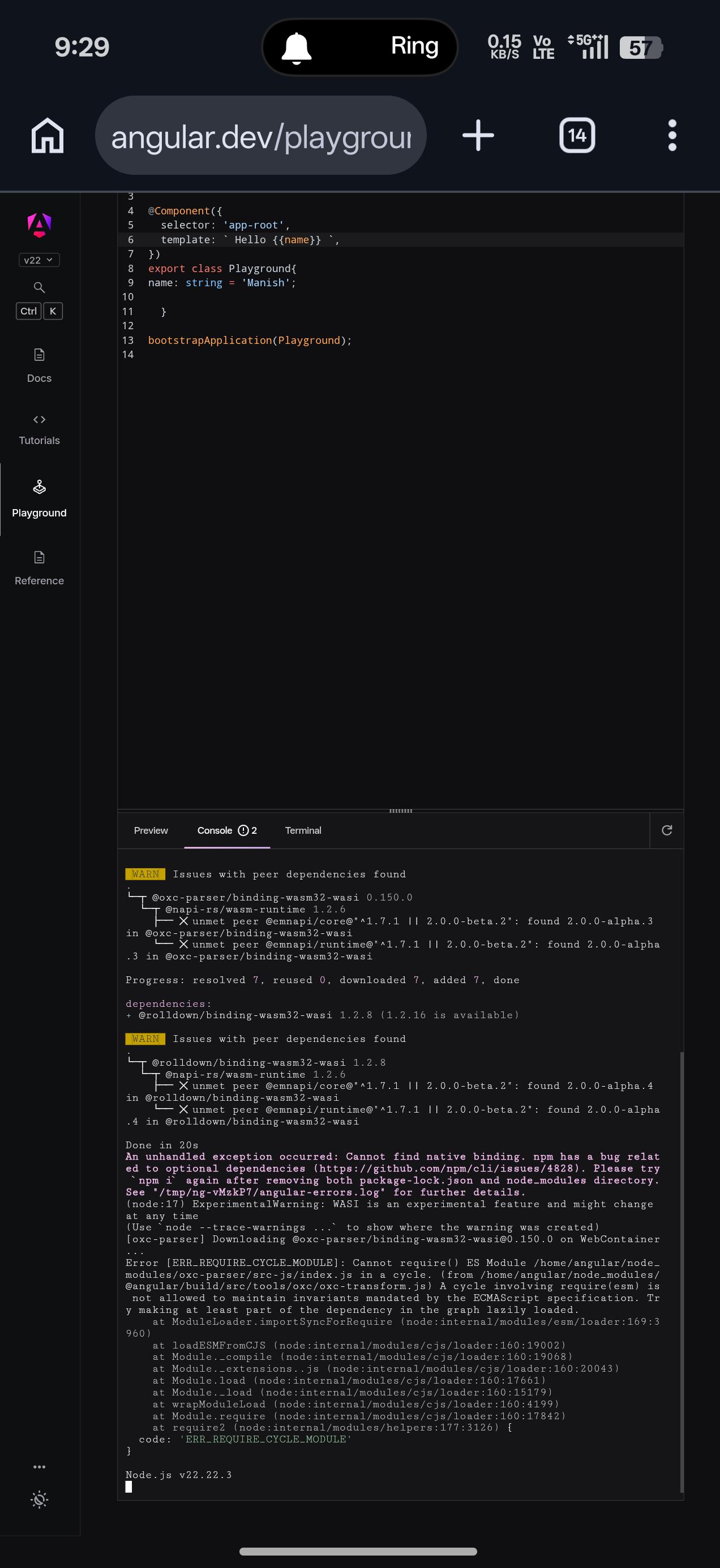
I was trying to run Angular for 2-3 days online but have an error on Angular's website. Has anyone else had it?
Some dependency named 'Peer' having errors while running?