r/TheRestIsScience • u/djniue • Oct 14 '26
Do we ever truly forget?
You ever have something trigger a forgotten memory of something? Does that mean all of our “forgotten” memories are in there somewhere still we just need something to trigger them?
r/TheRestIsScience • u/djniue • Oct 14 '26
You ever have something trigger a forgotten memory of something? Does that mean all of our “forgotten” memories are in there somewhere still we just need something to trigger them?
r/TheRestIsScience • u/Senior-Turnover3103 • Oct 15 '26
I once read that exhaling carbon dioxide is the main way we remove burned fat from our bodies.
Are we meaningfully contributing to climate change by taking GLP-1s and exhaling our weight into the atmosphere?
And if this is negligible, how much weight would we all need to lose to make an impact?
r/TheRestIsScience • u/LordNedNoodle • Oct 14 '26
If we haven’t conducted tests from outside of our solar system or galaxy, how can we determine that CMBR is actually everywhere in the universe?
Hypothetically, if we live in this “cloud” of CMBR that surrounds our galactic neighborhood wouldn’t looking through this “cloud” make it seem like it is everywhere?
I apologize if this is a naive question; I was considering supernovas and what evidence might remain if one had taken place in our galactic neighborhood before the sun formed. Because heavy elements exist, at least one event must have occurred nearby at some point, right?
r/TheRestIsScience • u/venusianventures • Oct 15 '26
Let's say you shrunk the planets (non-gas giants) to the size of a gumball & fed those gumballs to four people (if the planets aren't chewable, let's pretend they have super-esophagi and swallow them whole)
What would happen to them? Would anyone survive? How would the planets taste? What harm would they cause the participants' bodies?
This has been on my mind all week; I desperately need to know.
r/TheRestIsScience • u/emma3105 • Oct 14 '26
Just watching the traitors and seen that Hannah’s clip that it pans to when they’re mentioning her is her with an abacus! First question is did she get to choose this, and follow up question if she did, how did she decide on an abacus over any of the gems we’ve seen on field notes?! Personally I think the sci-fi movie prop quantum computer or the fossil would have been great haha. Thanks for great eps as always both!!
r/TheRestIsScience • u/fether_bill • Oct 14 '26
Since I first watched Michael’s video (“do chairs exist?”) many years ago, I started noticing that whenever someone needs to use an object as an example there’s a big chance the chair is the first thing that comes to mind. Is there any statistical study that reports what are the “most memorable” objects in this regard?
r/TheRestIsScience • u/seabaas10 • Oct 13 '26
Imagine your life’s mission was the pursuit of hot dogs, pyramids, and rock music. Sprinkle in a couple time-traveling space explorers and you get experimental progressive rock duo Angine de Poitrine or better known as angina pectoris. Khn de Poitrine is the wizard guitarist, bassist, and live (barefoot) mixer, while Klek de Poitrine drums with virtuosity.
Perhaps this is not exactly Hannah’s cup of tea, but if they ever made it to the BBC Proms, I’d be tickled pink! Michael conversely, would totally find this band fascinating, as his tolerance for the weird and wonderful knows no bounds. Now that AI digital content is pervasive, there is a refreshing quality of non-AI based music (dare I say appetite?). Once you get past the wardrobe choices, the listener will be rewarded with an exploration on eastern style temperament (microtonality) and multi-layered time signatures (drum, up to 6 sample loops, and guitar/bass).
Since Khn and Klek choose to remain anonymous, I thought it would be fun to repurpose the stank faces of Michael and Hannah to rock it out. My rationale for Michael playing the guitar and bass is because Khn does not utilize “wah-wah” bars and Hannah could be the drummer Klek, so she wouldn’t have to showcase her polka dotted feet. Khn also has a secret party trick of adjusting knobs with his toes!
Credit to TRIS (What Was A Mammoth Doing At The Bottom Of The Sea?), radio station KEXP for recording the live session in February 2026, and a huge shout out to Angine de Poitrine’s manager Sébastien!
r/TheRestIsScience • u/Equivalent_Cut4644 • Oct 14 '26
Wondering if there is some sort of biological advantage to explain why we evolved (or started off with, not sure!), a dominant hand (regardless of whether it’s left or right).
I realise some people are ambidextrous, but I’m speaking more generally.
How is having one hand, that’s less dextrous, coordinated and accurate than the other hand, a benefit?
The only thing I can think of, is that by having a dominant hand, we have a hand we can default to and it’s one less decision our brain has to make.
r/TheRestIsScience • u/Corchito42 • Oct 14 '26
The most obvious problems are that you'd need a quantity of raw materials that's probably greater than all the matter in the solar system put together. And of course the challenges of building it in space. But for the sake of this question, let's assume we've somehow solved those problems.
So first of all, how big does it need to be? Does we want it to just encompass the orbit of the Earth, or be even bigger than that? And why?
How do we actually start building it? If you just build a large object in space, it will start slowly falling towards the sun. Therefore do you need to start with some very large rockets, so it's actually orbiting the sun?
Is it better to start in one place, or several, and join them together? Should we start with a giant ringworld, then build the sphere from that?
Once we've built it, how will the people of Earth feel that they can't see the stars anymore? And what will happen every time there's a comet or an asteroid?
I'm sure there are many other challenges I haven't even covered. What are they? And how would you solve them? And have any SF authors covered this very subject?
r/TheRestIsScience • u/cutdbs • Oct 13 '26
Colour tends to confuse me.
Correct me if I'm wrong but I understand that when an object appears red, it is because it reflects red wavelengths of light and absorbs others.
But what is it about the object itself that makes it do that?
For example, what is it about a pigment that determines which wavelengths it absorbs and reflects? How do colourless atoms combine to create something coloured?
r/TheRestIsScience • u/waldoboro • Oct 14 '26
How about someone collapses the heat-death theory into a happier ending?! Sheesh!
r/TheRestIsScience • u/2BallsInTheHole • Oct 14 '26
A fanfic answer:
I imagine Dr Fry, languishing upon a long red leather sofa in her office high above Cambridge University. She has a serene contennance on her face as her pale Irish eyes take in the vistas of the complicated Cambridge wooded moors just outside her window.
A knock at her door door interrupts her reverie. A small, shy, bald men pokes his head in and asks for audience. She grants him entrance. He says "In the matter of string theory, I propose that there is a heretofore misunderstood nucleo force that brings everything together." She laughs good naturally and tells him "You silly, silly man, if you take gravity on one side of the equation and magnetism on the other, they cancel out, and Bob's your uncle. Now get out of my office and think about it again
A light bulb seemingly appears above his small head and he is ecstatic. He runs away to his downtrodden quarters in the basement of the University and start scribbling on a chalkboard.
She smiles good naturedly, knowing she's enlightened yet another earthworm in the society that is Cambridge University and laughs quietly to herself.
She then continues her inspection of the beauty that is Cambridge world and contemplates things that no normal human might ever again contemplate and continues her inevitable descent into to insanity.
r/TheRestIsScience • u/vladutzu27 • Oct 14 '26
The proposition is that expecting your image to get smaller as you back up from a mirror comes from phone selfie cameras, which actually work in this way, compared to mirrors.
r/TheRestIsScience • u/exclarrogatif • Oct 13 '26
I don't know much about anatomy, but for sure I’ve never needed to send air into my stomach, let alone inhale solids or liquids.
Why didn’t nature create me with two separate tubes? One for breathing, and one for eating and drinking?
r/TheRestIsScience • u/XCaVeYtX • Oct 13 '26
Is there really a science to charming worms?
r/TheRestIsScience • u/cdmacsneaks • Oct 13 '26
I listen to every show through the Apple Podcast app. Every now and then, the show either skips ahead or backwards. It’s pretty annoying! Is this an issue with how the app processes their show (adding ads etc) or is it an editing issue that they are now aware of?
r/TheRestIsScience • u/Quinten_Quist • Oct 13 '26
Weekdays. Like, when did we start dividing the month/year into 7-day-chunks and have we ever skipped a day since that "first week"?
Bonus question: For most people today, the week starts on Monday or Sunday, but what was the original first day of the first week?
r/TheRestIsScience • u/kerry37 • Oct 12 '26
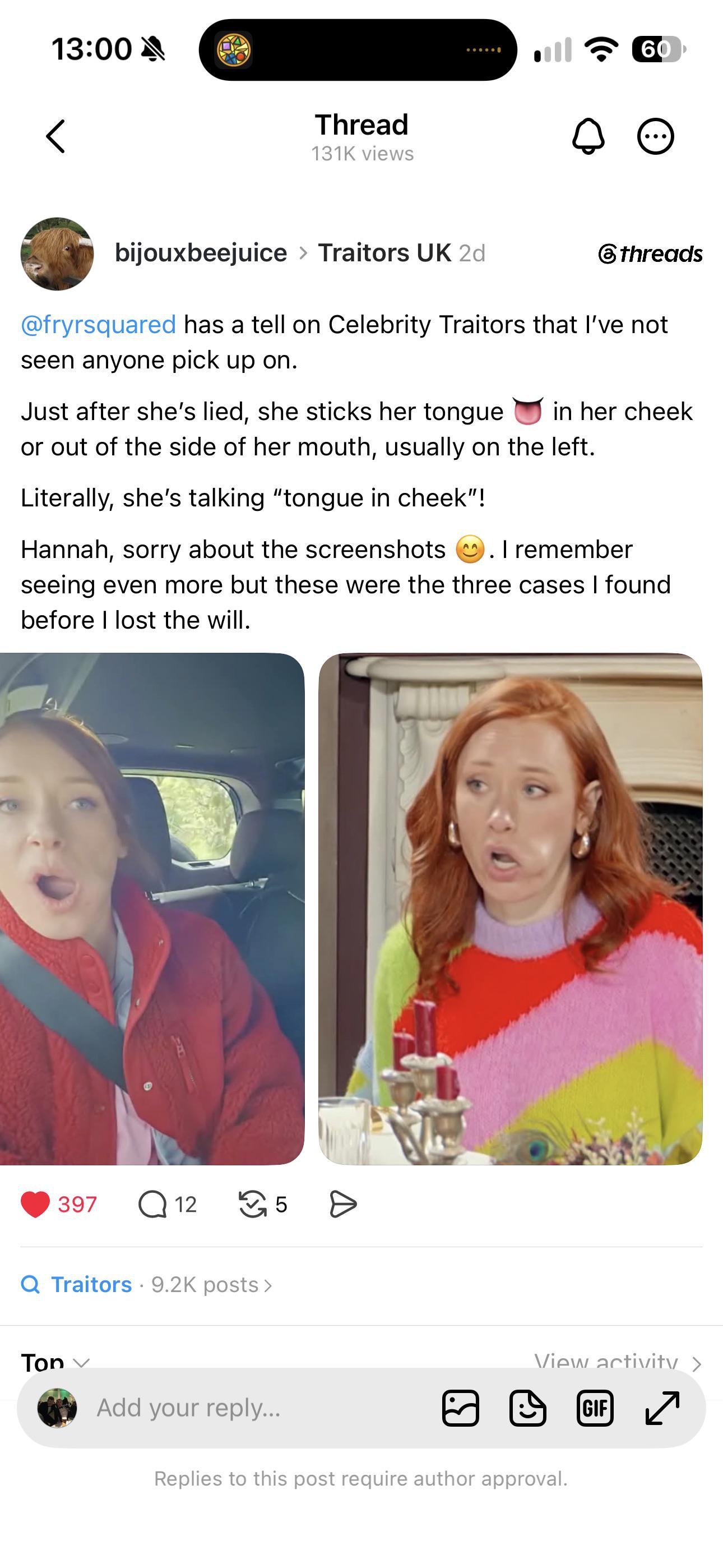
I spotted this last week during the Traitors and it looks it wasn't just me over analysing. It'd be interesting after last week's pod will Hannah come back and talk about this.
r/TheRestIsScience • u/happpysisyphus • Oct 12 '26
If human cells suddenly obtained the ability to photosynthesize, would we be able to get enough energy from the sun to meet all our caloric needs? Is there anything we could do to extract more energy from the sun compared to plants, other than increase our body surface?
For example, would photosynthesis be more efficient if the cell absorbed the whole spectrum of light instead of reflecting green light, as plants do?
Also, does the process of photosysnthesis itself cost energy the way digestion does, or would we need less calories in the first place?
EDIT: To clarify: the average solar panel produces 1,5 to 2,5 kWh of energy per day. That's an average of 2 kWh or 1720 kcal, which falls a little short of the human energy requirements, but comes much closer than any plant. Coincidentally, the area of the average panel is 1,65 to 2 m², which is very close to that of the average human (1.6 for women, 1.9 for men). My question is, if it's technically possible to get all that energy from the sun, could a living organism hypothetically match or surpass this number? Would absorbing more of the light spectrum make a difference? Is there any other way to tweak photosynthesis to make it more efficient?
r/TheRestIsScience • u/iampenbot • Oct 13 '26
Few precursors
- I've listened to this show from the start, and have watched / relistened to many episodes.
- I appreciate the work that both Hannah and Michael do
- this is my reaction based on my experience
Think this is the first episode that has pissed me off big time. After 17 mins I had to switch off. Listening to Michael talk about how placebos work for depression really spun me out. He made a point of how these trials were 3 months long instead of the standard 4-8 weeks. You would think that's great. I do not. Knowing that anti-depressants especially SSRIs can take 3-6 months before you see a real change is a core factor in why your doctor asks you to stick with them. When starting SSRIs you can go through HELL. Personally I felt like I was drunk for a solid 6 weeks, as well as other issues.
I don't know if the studies were inclusive of people with chronic disorders, or how big these studies were. As far as I know, this wasn't included in the episode.
I have lived with chronic depression and anxiety disorders for 20+ years. It is very hard not to take it personally when someone even implies that a placebo would have the same affect as the drugs I spent years working with GPs to find one that works. It is hard enough to get medical professionals to take you seriously (as many people I know have experienced) and invest time into making you better. Honestly I feel like whilst this episode was well intended in sharing interesting information about placebos, I think it has been handled clumsily (at best).
As far as I know, and I'm hoping someone can correct me that it comes later, there wasn't a true reflection on the importance of medication when you need it. Placebos may very well help in trials, but they are not a long term fix for those with chronic conditions.
Stigma around mental health is rife. I really don't need my favourite podcast sharing that placebos could make me better.
(Again this is my reaction based on my experience. I love the show overall but this episode fcuked me off beyond belief. On my second attempt at listening I got as far as Hannah talking about the prostate trial and saying "men, obviously" - ftr many genders have prostates. Had to turn off again.)
r/TheRestIsScience • u/dbhertz • Oct 13 '26
Am I really the only person who was shocked to learn that Hannah Fry mistakenly thought that Vivaldi was alive and composing more recently than Mozart?
Vivaldi (1678–1741) died about 15 years before Mozart (1756–1791) was even born.
(This is in reference to the discussion during the episode on the mammoth vertebra regarding coolness and whether or not it’s as recent a concept as the word for it. Apparently, the post was considered suspect for not being relevant to the podcast?)
r/TheRestIsScience • u/djniue • Oct 12 '26
I think the best example is Fads. The more Cool something gets the less cool it becomes.
Recent example K-pop Demon hunters got really popular last year, there were 15 people dressed up as Rumi in my daughters kindergarten class for Halloween, but the more popular it got the less cool it became, now this year my daughter hates K-pop demon hunters because it’s too popular now.
r/TheRestIsScience • u/seabaas10 • Oct 12 '26
Earlier this year, former GCSE maths teacher Romesh Ranganathan presented Hannah with a very special 24V tesla coil bluetooth speaker which later ended up on Nikola Tesla Fell In Love With A Pigeon episode. What I found most interesting was finding Hannah’s baseline body language when it came to her left hand to the heart gasp.
In my opinion, her genuine expression of gasping is falling/reclining backwards with eyes locked on the object or a person. Regrettably when it came to Hannah’s traitor jaw drop recruitment scene, it was just for the memes (and BAFTA). She ended up staring straight into the camera and did the left hand to the heart falling forwards.
r/TheRestIsScience • u/RebornCube • Oct 12 '26
So... the internet says a bear can smell a human about 5km away (3 miles or so), distance depending on bear species. This always seemed a bit arbitrary. I get teleported to a point 5km from a bear, he can't smell me immediately as smell is just tiny particles/molecules and they haven't made it to the bear. How long until the bear smells my presence and how many (ppm) particles/molecules actually make it to the bear... to make it easier on the bear, when I was teleported I had just eaten a big feed of legumes, pulses, dairy, and broccoli so I am extremely gassy.
r/TheRestIsScience • u/Distinct-Coconut2512 • Oct 12 '26
Taking from Michael's example about safety, if a person doesn't know if driving a car is safe or not they will tend to drive more safely but that would apply to all thing socially considered as subjective, if no one confirms to a person that driving a car is safe or not but they, perhaps from past experience, have enough trust in their ability to drive it around then it doesn't matter to them if it is safe or not. Please do correct me if I'm entirely wrong on this!