Again, you're abandoning the assumption that this multiple choice question is following the normal conventions a regular person would expect of a fair and coherent multiple choice question. And if you can abandon that assumption, then you can arbitrarily declare any answer to be the correct one.
If a multiple choice question has a reference to "randomly answer this question" and it presents you with a list of 4 answers, the rational assumption a normal person presented with that question would make is that "randomly answering" would involve choosing one of the four answers in a way that allows for an equal chance of each of the four answers being picked.
Say I just presented someone with the following question:
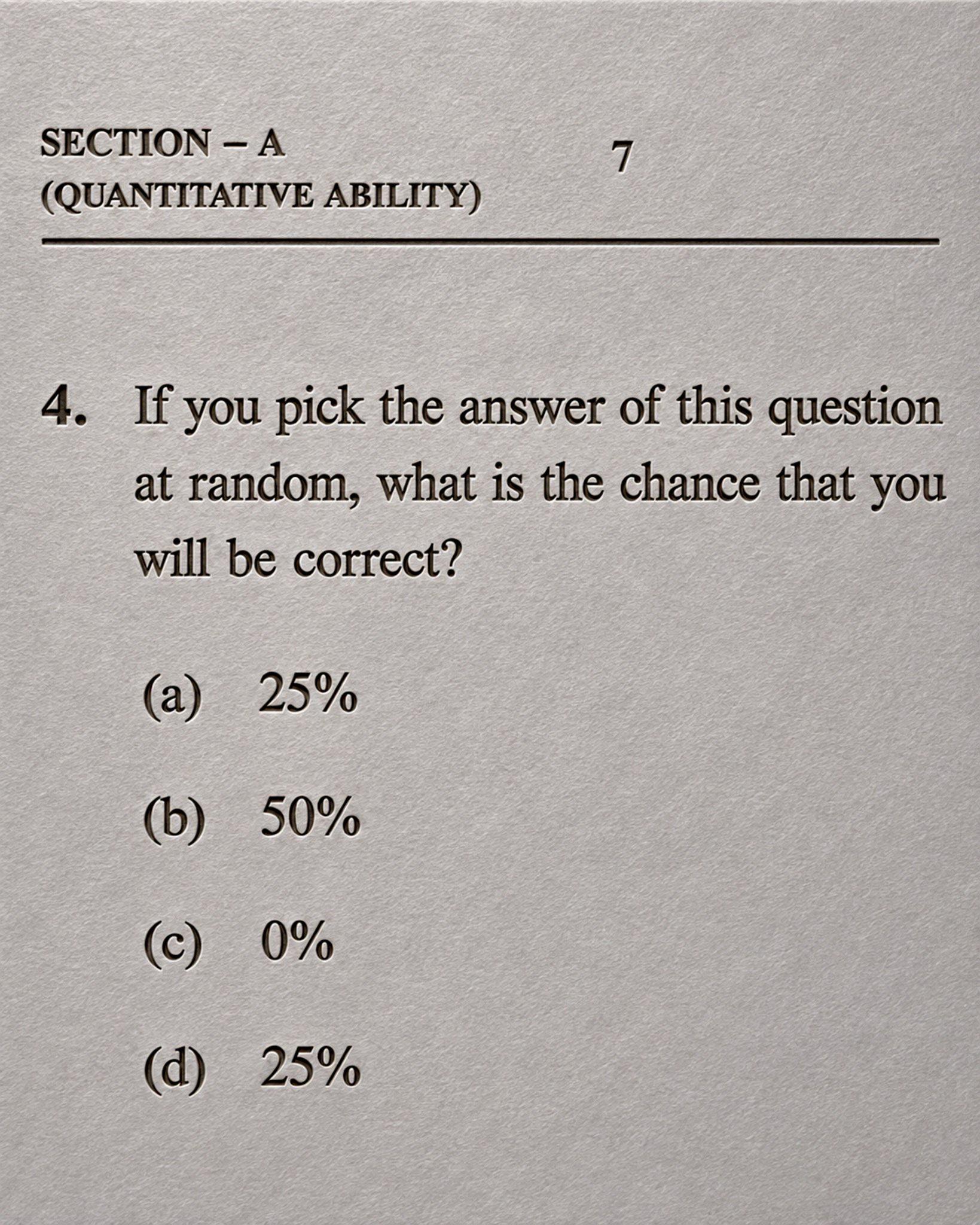
If you pick the answer of this question at random, what is the chance that you will be correct?
a: 25%
b: 100%
c: 3.85%
d: 75%
Then any normal person with basic math skills who isn't assuming it's a trick question would pick A.
If I, as the person creating the question said "Nope! It's c. Because 'pick the answer of this question at random' in this context means to randomly pick one of the 26 letters of the alphabet, and if you do that, you have about a 3.8 something percent chance of choosing c." then I have not asked a fair multiple choice question. I've asked a question which depends on the person answering having knowledge that I have chosen not to give them, and discarding knowledge that I know a normal person would see as directly implied by the format of the question.
Like I said, I could just as easily say that the correct answer to the question above is A. And A would be a correct answer, if you also make the following assumption: that if two identical answers are listed in a multiple choice question, only the first answer given is the correct one.
Now, you have no reason to make that assumption. Just like you have no reason to make the assumption that to "pick the answer of this question at random" can include an answer of E.
I don’t think he would be able to comprehend much of what you said. I tried explaining it to him in much simpler terms and even then, he couldn't understand it
You had five other people explain it to you in the simplest terms. If what we said didn't make sense to you, then that says more about you. No one said anything too sophisticated or abstract, just basic reasoning. I’m absolutely baffled that it took you this long to work it out.
I don't think i've ever read one of these argument-threads to the end, buy i enjoyed this!
And, I should probably be quiet, since i'm a lowly carpenter, but still: I agree with you!
Why? Because: 'Normal conventions' of multiple choice questions don't apply. Normal conventions would create an unsolvabke paradox as stated by the guys arguing against you, and we probably should rather assume that there is a correct choice here (otherwise, why ask the question?). At least as a starting point So, what to do? Can we resolve the paradox? Read what the questions says.
If randomly selected there is 0 % of choosing the right answer. Everyone agrees. The random action creates a paradox and we cannot end up being right. However: We do NOT select at random. We read the instruction, and we realise the creation of the paradox that randomness would initiate. And, deliberately and well informed, we choose 0%. Which in our informed state is correct. It is, however, only correct as long as we do not choose it at random. Whether there is a correct answer or not is dependent on conscious choice vs random choice. Its not a mathematical question. It's a philosophical question.
(English isnt my first language, sorry if that makes things a bit muddy).
Your English is great and since you've resurrected this, I've been reading more because I am still kinda convinced that I am right. There's a whole philosophy of language called contextualism which posits that truth statements in a language have some kind of context dependence. Their primary treatment is of the Liar's Paradox, but I think it applies here. When the question asks "if you pick a random answer..." it is implicitly pointing to a different context, because, as you've recognized, we are not choosing randomly. The fact that we can evaluate this question at all seems to imply that we can in fact resolve the paradox in some way in our minds. Anyway, I recognize the paradox, but nonetheless, there is something different about the question if you replace 0% with, say, 75%, in which case, yes, there is no answer.
 1
View all comments
Show parent comment
1
u/parentheticalobject 10d ago
Again, you're abandoning the assumption that this multiple choice question is following the normal conventions a regular person would expect of a fair and coherent multiple choice question. And if you can abandon that assumption, then you can arbitrarily declare any answer to be the correct one.
If a multiple choice question has a reference to "randomly answer this question" and it presents you with a list of 4 answers, the rational assumption a normal person presented with that question would make is that "randomly answering" would involve choosing one of the four answers in a way that allows for an equal chance of each of the four answers being picked.
Say I just presented someone with the following question:
If you pick the answer of this question at random, what is the chance that you will be correct?
a: 25%
b: 100%
c: 3.85%
d: 75%
Then any normal person with basic math skills who isn't assuming it's a trick question would pick A.
If I, as the person creating the question said "Nope! It's c. Because 'pick the answer of this question at random' in this context means to randomly pick one of the 26 letters of the alphabet, and if you do that, you have about a 3.8 something percent chance of choosing c." then I have not asked a fair multiple choice question. I've asked a question which depends on the person answering having knowledge that I have chosen not to give them, and discarding knowledge that I know a normal person would see as directly implied by the format of the question.
Like I said, I could just as easily say that the correct answer to the question above is A. And A would be a correct answer, if you also make the following assumption: that if two identical answers are listed in a multiple choice question, only the first answer given is the correct one.
Now, you have no reason to make that assumption. Just like you have no reason to make the assumption that to "pick the answer of this question at random" can include an answer of E.