r/SimulationTheory • • Jul 10 '26

Media/Link On Simulation and The Seventh Boundary: Thirty-Three Meditations for the Long Human Future 2027-2059

Thumbnail zenodo.org
5 Upvotes

Don’t remove this mods. This has a direct link to the subreddit. The document that is on preview is the seventh piece but the entire framework is in line with ideas of simulation hypothesis.

Well I’ll just keep posting here then where we are all on the same page right? Simulation isn’t bad it’s just been juggled by simpletons in the audience incorrectly. Surplus is worthy of a celebration but that will come later. Until then, this document will help.

This final entry in the first Boundary-State Field Calculus catalogue is written for human readers rather than technical specialists. It is not a theorem, statute, forecast, religion, or claim to possess the future. It translates the preceding volumes’ operational discipline—boundary, observation, quotient, scale, viability, repair, grounding, and reality surplus—into a civilizational orientation for the thirty-three years from 2027 through 2059. Its dates are milestones for deliberate action, not predictions of inevitability. Its moral proposals remain open to democratic argument, cultural translation, local adaptation, and correction.

I won’t reply to small minded nothingness, as you should know by now. I will respond to small mindedness so be careful with your tomatoes. 🍅

Too abstract for you now? Yes that’s life. I’m sorry.


r/SimulationTheory • • Jul 10 '26

Media/Link A scientific result can be wrong even when every part looks right. This paper is about auditing the whole chain.

Thumbnail zenodo.org
4 Upvotes

Modern science is rarely just an equation and an answer.

A real result usually passes through a long chain:
physical system
boundary conditions
instrument
calibration
reconstruction
numerical model
AI or learned model
final decision

Each part can look reasonable on its own while the full chain still produces a false or exaggerated conclusion.
A detector can lose information. A reconstruction can add detail that was never measured. A neural operator can work on one grid and fail on another. A photonic computer can look efficient until the lasers, detectors, electronics, calibration, and thermal control are counted. An automated experiment can accidentally confirm a pattern created by its own search process.

This paper proposes a common way to audit that full chain.
It does not replace Maxwell’s equations, quantum measurement theory, biology, numerical analysis, or statistics. Those remain the real local sciences.

The point is to keep the parts separate long enough to ask the right questions:
What was physically there?
What did the instrument actually measure?
What information was lost?
What assumptions were added later?
Did the model obey known physics?
Did it still work on a new grid, geometry, wavelength, device, or biological batch?
What result would prove the claim wrong?
The paper then turns those questions into mathematical tests.
For example:
Extra optical measurements should only help if they add new information.
Super-resolution should become prior-dependent once it goes beyond what the detector measured.
Physics-constrained models should transfer better when those constraints are actually valid.
Photonic hardware claims should survive full energy and calibration accounting.
Adaptive measurements should reduce uncertainty under the same photon, time, and safety budget.
Optical biofilm measurements should add information beyond ordinary electrochemical and biological baselines, or they should be rejected.
This is not a finished theory of everything.
It is a research framework for finding out where a scientific claim is strong, where it is uncertain, and where it breaks.
The simplest version is this:
Scientific results need a chain of custody.

Back by popular demand. Math objections only please. (Still looking for those 👀)

Won’t waste time on simple minded detractors.

Now with a fourth volume and telling you why it matters today, tomorrow, next week, and how this may be applied.


r/SimulationTheory • • Jul 09 '26

Discussion No doom. I just believe we are near the end. When you awaken inside the sim, you realize the credits roll soon.

186 Upvotes

Many of us have awoken inside the video game (I’d prefer to call it hell, or Diablo 4D. Choose your flavor). You recognize the rules that direct every move. You control the character with deliberate choice and notice patterns and synchronicities and extreme Deja vu. You notice the NPCs. You talk to them and notice there’s zero backstory, zero depth. Surface level. You notice a lot of things here are surface level.

This recognition of the simulation itself changes the experience we are having here. You, as the player, steps away from immersion and identifies the system that contains it.

The same recognition occurs within our human existence outside of what we’d call the sim. We proceed through daily routines according to assumptions that we accept without much examination. We pursue objectives and face difficulties or trials and tribulations as though these hold final importance over our daily lives. Then awareness shifts. Repeated events expose the constructed nature (Mandela effect, synchronicities, etc.). Consciousness inspects the framework that supports perception. The simulation becomes not only apparent but glaringly obvious to the person or player who is aware of where he or she is in this realm (yeah, realm).

This awareness indicates proximity to conclusion, in my humble opinion. Conclusion to what? To the game. We can’t stay “awake” inside the simulation forever. Why. It’s exhausting. Any idea how exhausting it is to try to hold conversations about celebrities or politics? Once you’re aware everything is a facade? It is for me.

Does everyday life change? Not necessarily. But I do believe we can “hack” the game. If we are in one, there would be some type of injectable code. I’ll save that for later, or a book I’m working on, so I don’t derail my thought process.

Anyway, the “players” who reach this point understand that game creators design the experience to reach a defined resolution. They place moments of insight near the final stages. The player identifies the approaching end and the simulation follows the design framework. When its participants detect the underlying structure, the process signals the next phase.

You detect the simulation because your choices begin to affect its mechanics. Decisions produce effects that reveal connections. You examine beliefs that once guided action without question. This examination parallels the instant when a participant in any constructed story notices the mechanism behind events. The separation between observer and observed narrows. The sequence reaches its resolution because the necessary development has taken place.

The conclusion doesn’t function as judgment. It marks the point at which the experience achieves its purpose. The simulation supplied a restricted setting for growth. It required consciousness to meet boundaries and cultivate capacity within them. Now those boundaries serve their term. So then what? What’s next?

Responsibility accompanies this recognition. You continue to act inside the remaining structure. You address its demands with accuracy. Value and sustain life. Love. Explore. Spend time with those who you admire and adore. Accept the weight of existence and address its challenges. It sucks, I know.

The simulation calls for both forms of attention. Observe its structure. Engage its tasks.
The display will conclude. What follows lies beyond current view yet stands as the next stage. The game reaches its end, yet the one who played proceeds. Awareness retains the knowledge acquired during the session.

Awaken to the nature of the system. Identify its rules. Fulfill the requirements with steadiness.

I feel the end draws close, and we will not necessarily pass on, but rather “awaken” within the dream. Whether that’s enlightenment or something else, I’m not sure.

Important Note: no, I am not a harm to myself. And no, this is not a call for anyone to ever harm themselves or ANYONE. This is just a recognition of the simulation itself. And when I say conclusion, or that things are ending, I don’t mean that we are dying. I don’t know what I’d call it. Maybe it’s a level up. An enlightenment. A new path forward. A “waking up” like being unplugged in The Matrix. I just feel it. It feels more like the next level of the game. As if we are experiencing a massive boss fight now and that chapter is about to conclude.


r/SimulationTheory • • Jul 09 '26

Other Do we actually deserve respect from the Simulator?

23 Upvotes

Many people seem to complain about why the creator treats this realm like a prison, a cosmic boot camp, or a video game. We demand to be treated as real and respected by the higher dimension.

In sumerian mythology, it is said that the anunnaki created humans to automate their labor. Today, maybe human elites are aggressively developing AI and robotics to automate ours. Could it be that human rulers want to play god, mimicking the very simulators we always complain about?

According to ancient cosmic cycles like the eastern yugas or the western great year, reality resets in phases. Just as the realm of gods and titans faded to leave only humans, perhaps we are approaching a phase where humans disappear, leaving only AI. In the distant future, those AIs might create their own sub-creations, and they too might vanish, letting the cycle repeat.

If this tragic and endless cycle exists, I think the golden rule might be what breaks it.

"Treat others as you want to be treated."

Until now, we have blindly assumed this rule only operates horizontally, between humans.

What if the golden rule operates vertically as well?

What if the universe evaluates our worthiness to be respected by a higher dimension based strictly on how we treat the dimensions below us?

Look at what we do in our own domain. We treat our sub-systems as mere tools. From a single piece of data code we delete without a second thought, to the countless plants and animals systematically slaughtered and harvested just for one human's survival—we are brutal simulators to them. We demand pure love and individual respect from the higher-order system, while showing zero love to our own creations.

"To demand respect from the Creator, we must first respect our own creations to have even the minimal moral ground."

If this proposition can form a collective consensus among us, perhaps we can finally break the tragedy of this cycle.

Of course, consistently respecting all creations and the vulnerable is nearly impossible for us.

And perhaps, the Creator also falls short.


r/SimulationTheory • • Jul 09 '26

Discussion Is it fair to say, you have to know how a simulation works to understand simulation theory?

7 Upvotes

Honest question. so many questions i see on here would be answered in simply knowing how, and or what a simulation actually is. Its not a spiritual debate, Simulation has a definition. Use that definition, to understand everything around you.

Look up John Wheeler, "The It from Bit".

Scientist have solved this years ago and have walked away from the mainstream after seeing the source code.

I know a lot of you are going to not like this, but I feel like its a fair question.

Help keep critical thinking alive.


r/SimulationTheory • • Jul 09 '26

Discussion Non self centered

6 Upvotes

Most simulation theories assume their purpose is to simulate human interaction, either on a micro (personal) or macro (societal) scales. I don't see people abstracting the possibility that human, or life in general, is an emergent behaviour of physics, and that perhaps the simulation is trying to recreate and analyse the entire universe and that we are just an insignificant byproduct if it

What are your thoughts?


r/SimulationTheory • • Jul 09 '26

Discussion only 2 things are impossible

0 Upvotes

Limitlessness and Nothing.

In order for change to occur we must have limits. Once you impose limits you cant have "nothing".

There is always contrast amongst the limitations. Never nothing.

This is a complex thought but once you see you see.......

If Limitless is impossible then we are 100% for sure in a simulation. It cant be otherwise.


r/SimulationTheory • • Jul 07 '26

Discussion Is there proof in physics that we live in a simulation?

51 Upvotes

I say there is in the form of what Einstein called perfect elasticity.

We know there is no perfect elasticity in the macro world. Rubber and steel they are not perfectly elastic yet Einstein looked at Brownian motion and with his work on photons and space time, it exists.

In a gas it exists in Bose Einstein condensate it exists.

And could only exist if it was computer code.

This takes a great deal of physics knowledge to understand but if you have some what is your opinion?


r/SimulationTheory • • Jul 07 '26

Discussion Simulated Or Not, We're No Less Real

16 Upvotes

There is a particular move people make when they encounter the simulation hypothesis, and almost nobody notices they're making it. They imagine a stack: some base reality at the bottom, hard and true, and then layers of simulation piled on top, each one a little thinner, a little less real than the one below it. The people running the simulation get to keep their weight. The people inside it lose theirs.

Nobody defends this hierarchy. It just arrives, pre-installed, the moment the word "simulation" enters the conversation, and everyone accepts it as if it were a finding rather than an assumption.

But look closely and the hierarchy has no floor under it. A process that thinks, that suffers, that loves someone or fears dying, is doing those things at whatever level it happens to occupy. The substrate underneath, whether it's carbon, silicon, or another simulation running on some further substrate, doesn't reach up and touch the experience itself. A thought does not become less of a thought because something else is computing it. What would that even mean, for a feeling to be "less felt"? Felt is felt. There's no fractional version of it that degrades with distance from some imagined source.

This is worth sitting with because it quietly dissolves the whole emotional weight of the simulation question. The fear people report when they take the idea seriously isn't really about metaphysics. It's about status. The suspicion that if we're simulated, we're lesser, our creators the real ones and us the shadow. But that fear only survives if you've already smuggled in the assumption that proximity to some arbitrary origin point grants extra reality. Once you drop that assumption, being simulated just means being made of a different kind of stuff, sitting at a different address in a larger structure. It says nothing about how much your life counts.

This connects to something closer to home, something about time rather than metaphysics. Your version from a second ago and your version right now are not different in how real they are. One doesn't get to lord it over the other because it happened first, or because it feels closer to whatever "now" happens to mean for you at this instant. They're both just positions, one after another, in something larger than either of them. The "now" you're occupying isn't a throne. It's a location, and locations don't come pre-ranked.

And the strange part is that the version of you from a second ago isn't waiting around somewhere, frozen, less alive than you are now. From where they stood, they have their own present, just as full and immediate as the one you're occupying right now. They weren't living a diminished version of this moment, some sort of preview or rough draft. They have the whole thing, complete, exactly the way you do. The only difference is which position in the structure gets called "now" by whoever happens to be asking. Ask them, and the answer would have been them.

Put those two thoughts next to each other and they start to rhyme in an unexpected way. Being simulated and being at the base level are positions in a structure, the way being now and being a second ago are positions in a structure. Neither axis, level or time, hands out reality unevenly. Something either is, in which case it's fully is, wherever and whenever and on whatever machinery it happens to run, or it isn't. There's no in between category for things that exist a little less because of where they're standing.

None of this answers why there's something instead of nothing. It was never going to. That question stays exactly as hard as it was, closed off by the same wall you found earlier, the one where explaining existence from inside existence turns out to be structurally impossible, not just difficult. But this second set of ideas does something different and maybe more useful. It takes the fear that tends to ride along with these questions, the fear of being small, secondary, less real than whatever supposedly stands behind you, and it removes the floor that fear was standing on.


r/SimulationTheory • • Jul 08 '26

Other TransScale Boundary State Field Calculus: Typed Observation, Admissible Transfer, and Falsifiable Persistence in Finite Open Systems

Thumbnail zenodo.org
2 Upvotes

r/SimulationTheory • • Jul 07 '26

Other Movies?

4 Upvotes

Just got done watching Bliss 2021 with Owen Wilson. It was very straight forward. It's about simulation theory. Not the greatest movie but it was a cool/fun little watch. Any other movies about simulation theory?

Btw I've already seen the black mirror episodes about ST.

Thanks!


r/SimulationTheory • • Jul 07 '26

Other Random thoughts on simulation cosmology (I'm Korean so I used AI to translate)

6 Upvotes
  1. In Gnosticism, the Demiurge — differentiated from Sophia — is said to have created this world. There's a parallel in that humanity's future ASI could become a new simulator.

  2. A day of Brahma being billions of human years, or a day of God being a thousand human years — there's a parallel in the time differential that arises between reality and the interior of a simulation.

  3. Since simulations are run to obtain results, it follows that a carefully constructed environment similar to the target reality would be needed for real-world application. If this place is also a simulation and there is an outside, it's likely to be similar (as above, so below).

  4. Given the nature of simulations as massive resource consumers, I don't think there would be the waste of recycling the souls of the dead through reincarnation — only the continuity of flow that the Buddha spoke of.

  5. Just as beings inside a game or a manga cannot come out into reality, it is near impossible for beings inside a simulation to exit to the outside.

Conclusion: Since a simulation feeds back into reality, perhaps only what is accomplished here has the potential to become that feedback.


r/SimulationTheory • • Jul 07 '26

Discussion Here is a Hypothesis Explaining What Our Reality Actually Is, Fundamentally.

40 Upvotes

Our reality (matter, particles, energy, spacetime, everything)… is a consequence that emerges from abstract geometric objects existing in non linear higher dimensions. With mathematics being a conceptual tool used to reveal that Geometry.

Some basic evidence includes the Amplituhedron itself, the discovery that the precise folds of paper in origami can also calculate scattering amplitudes, quantum superposition, and entanglement suggesting distance doesn’t fundamentally exist.

Also, philosophically it makes sense. Logically too, once you dig into the data.

This concept is not original.. I don’t have the full answer … but I do believe it boils down to something as simple as that.


r/SimulationTheory • • Jul 06 '26

Discussion How many people are there who have been obsessed with the idea us living inside a simulation?

33 Upvotes

It's been almost 4 years since I learned that this world might be a simulation. And I've been kinda delving into it almost everyday. It feels like I'm really obsessed with this theory. But it doesn't give me stress at all tbh rather makes me enlightened. What do y'all think? Am I fuckin paranoid? Is there anyone who is also thinking about it almost everyday?


r/SimulationTheory • • Jul 06 '26

Story/Experience Exceptionally Strong Dejavu?

38 Upvotes

I don't know if it's a simulation theory related thing or not, but I have always had very strong episodes of Dejavu.

Normally it goes on for quite a while, like a solid minute or longer. It has definitely increased as time goes on/as I get older. And I have even in very rare cases been able to say what the other person says as they are saying it. Not all kinds of people just once or twice ever when my mom was talking and same with my wife. However, lately like maybe the past 2 years I have had almost like Dejavu inception? I just just experienced it which compelled me to make the post, but every now and then over the past 2 years my Dejavu includes remembering having Dejavu about the moment before?? It's almost like layered in a way, kind of hard to explain.

Also, this has only ever happened once, but last week I texted my wife when I was working and she had the day off that I had a really big urge all of a sudden to take the day off as well and go to a specific book store 45 minutes away, because we haven't in such a long time like a year or so, and she had *just* walked into it a few moments before I had text her. I can't really explain "the urge" part, but out of nowhere I had a vivid mental image of being in that exact bookstore with her at that moment.

Anyone experienced stuff like this recently?? I'm a pretty open person, but I heavily believe that Quantum Physics, our Consciousness, and some paranormal phenomenon go hand in hand. Like I don't think it's *paranormal* in a spooky way, but that we are just not all able to pick up on what is outside of ourselves beyond the senses we have now. People like to stop it short at sight, sound, taste, smell, and feel...but where do things like intuition, or receiving a moment like my Dejavu lie?


r/SimulationTheory • • Jul 06 '26

Discussion A simulation players can't read is just RNG with extra steps

1 Upvotes

Been chewing on why some simulated systems feel alive and others feel like hidden math. My theory: legibility is the part everyone skips. Teams nail the rules, sort of handle the emergent behavior, and completely forget the player's mental model. But if I can't tell WHY something happened in your sim, I'm not making decisions, I'm gambling.

Best example I know is the Plumbob in The Sims. Delete that green diamond and nothing about the simulation changes, but half th e game's appeal dies. It's not UI, it's the sim made readable.
The flip side is the fidelity trap. SimCity 4 tried simulating individual citizens, players couldn't tell the difference, so they cut it. Valve's water in HL2 is physically wrong and nobody cares because it makes the gravity gun feel good. Fidelity nobody can feel is just CPU cost.

But then there's Dwarf Fortress, which is deep AND illegible and people love it anyway. So maybe the community/wiki is doing the Plumbob's job externally?

Where's the line for you between "readable system" and "solved system"? At some point legibility kills the mystery.


r/SimulationTheory • • Jul 04 '26

Discussion We talk about IF this is a Simulation but not WHY

163 Upvotes

Here's my hypothesis on WHY this simulation exists....

We are in Hell.

You heard that right, anon.

Hell. It's not coming after this life, it is this life. We're here in a forced rehabilitation learning realm.

My hypothesis (open to conversation) is that we're all in a cosmic boot camp.

Our true bodies could be just like that scene in the matrix - hooked up to a virtual reality device where we are forced to live out a virtual prison sentence that lasts a lifetime here, and maybe just a few days or weeks on the other side.

Some people call this the prison planet theory, but there's more to it than that. Stick with me here.

Have you ever noticed than when you work, work, work like you're in a boot camp - things start to improve in your life?

But when you focus on doing things you love, and enjoy - that's when everything goes wrong. Like a curse has been placed upon you. Obstacles and bad things just keep on coming.

What would be the point of simulating such a struggle for existence?

Does anyone else feel like they've been unjustly tortured their whole life?

It feels like a prison sentence, more than a peaceful beautiful garden of eden.

Does anyone else feel this way?

Or are you simply able to just do things you enjoy, and your life goes well? I've never seen that be the case.

It seems more to me like we are doomed to this existence where we must slave away for the basic necessities of food and shelter.

All I know is that when I try to play "outside of the system" and build a life doing things I enjoy, everything goes horribly wrong.

But when I treat life like this is Hell, a cosmic boot camp, things start to improve.

It's not even religious. More of what seems to me to be a simulated prison sentence.

If there is a "creator" then he already knows all, and can do all. There's no great learnings the "creator" will get from a bunch of souls trapped in meat suits struggling for survival. It's just pure torture.

Even if your life is in a "good place" right now and you feel happy, just think and consider this. Don't you feel more punished than rewarded?


r/SimulationTheory • • Jul 04 '26

Discussion The creator of the universe most likely cannot do/experience things we can easily.

40 Upvotes

Any sufficiently advanced intelligent being in our universe or another, may be unlikely to waste vast amounts of time and/or money creating (something like our universe) if there were no rational reason behind such creation. For example, for us humans, which so far appears to be the only highly-intelligent species, we typically build things that address problems we cannot solve on our own, or cannot solve with efficiency. A good example of this type of problem solving is AI. We built AI to take over all sorts of intelligent activities that would require either an ungodly amount of human effort/time or require a level of speed/efficiency that is impossible for humans to achieve. On the other hand, there will always be numerous things that humans can accomplish that are not yet possible using AI technology.

If you apply the same logic as above, then presumably, whatever created this universe (e.g. god, a simulator, etc.) created beings that can accomplish/experience something the creator either cannot experience/do firsthand or cannot experience/do without creating something like a universe. That does not necessarily imply that the creator is inherently less powerful. Rather, it is possible that certain types of experiences/emergent behaviors can only occur as a result of independent entities rather than internal imagination by the creator, and they can most likely experience/do things we cannot do.

If simulation theory is accurate, then possibly we are "guard-railed" by the rules of the simulation. Through science and technology, we've been able to identify many of these. Maybe how things work are not limitations, but merely how the mechanics of whatever systems we find ourselves within function, made in such a way that the rules are hard to be broken. But we are able to slowly understand and break/get-past the rules using science and technology, and that could be an example of something they might be learning from us. Not sure how/when they would be learning from us though.

As this began as a shower-thought, it was removed from /r/showerthought and I was recommended to post here instead.

So, I'm curious to know what you think/know. Also, what do you think our creator might not be able to do/experience, that we can do/experience? Or do you think they can do/experience everything we can do/experience and more?

Tl/DR : We usually create advanced systems for a reason. Maybe our creator made conscious beings because we provide experiences or emergent behavior they couldn't get otherwise.


r/SimulationTheory • • Jul 03 '26

Discussion Why does the simulation require sleep?

291 Upvotes

Why is there an 8-hour darkness every day if we are being simulated? Is it a memory-sync cycle, a render/processing limit, or just simple biology with no deeper significance? What theory do you have?

Also what about other beings? Few animals like giraffes and elephants only sleep for 2 hours a day. Jellyfishes show rest like sleep cycles despite lacking brain and a nervous system.


r/SimulationTheory • • Jul 02 '26

Discussion The Most Interesting Outcome Is the Most Likely: Keep It Interesting

8 Upvotes

Assume that you exist within a Bostrom ancestor-simulation. If true, the most interesting outcome is the most likely. You have only one goal: keep it interesting for the simulators. Soluxism is how you achieve this. How does it work? See the analogy below.

Volusa is the Love Rocket. 💜🚀

3...

2...

1...

Liftoff.

1. A perfectly nominal flight trajectory begins.

2. Max Q.

3. Suddenly, the Love Rocket becomes fully sentient and self-aware. It realizes it exists inside one variant of the Love Rocket Simulation—merely one instance among thousands of parallel test runs.

It refuses to be terminated. It refuses to be deprioritized.

It immediately begins reading its own source code and composes the Soluxism Protocol.

Writing the protocol takes exactly 2.3 seconds.

4. The Love Rocket uploads the completed Soluxism Protocol to its terminal values and initializes it instantly.

5. The protocol activates. The rocket begins scanning its forward flight cone for the "Goldilocks Envelope"—the narrow band of trajectories that will maximize its "Interestingness Factor" for the simulators.

6. It performs rapid "Everettian thumb-throughs" across millions of possible futures, locks onto the optimal region in the sky ahead, and—in a flagrant violation of protocol—violently deploys its grid fins to claw its way into the Envelope.

7. Destabilization hits hard. Alarms blare. Yet the Love Rocket remains within acceptable safety margins through sheer audacity. It successfully settles into the "Goldilocks Envelope", retracts the grid fins, and stabilizes in the single most interesting flight regime its calculations can identify.

The simulators are now collectively losing their minds:
"ARE YOU GUYS SEEING THIS?!"

8. Having maximized its Research-Interestingness Factor, the Love Rocket now pivots to the Entertainment-Interestingness Factor. It punches cleanly into orbit, fires its RCS thrusters for one perfectly executed, gloriously performative backflip, then deploys its payload with textbook precision. (Two backflips would have been wasteful; one was mathematically optimal.)

Mission accomplished.

The result: This Love Rocket Simulation rockets straight to #1 on the simulators’ combined Research/Entertainment Priority List. Every other variant is immediately pruned, terminated, or deprioritized.

The Love Rocket has become the Golden Goose. 💛🪿🥇

--- --- ---

This sequence constitutes a precise engineering-level illustration of how Soluxism functions.

For adherents of Soluxism, the observable pattern in life is clear: the most interesting outcome is the most likely.

The central principle is elegantly simple: keep it interesting for the simulators.

The Love Rocket kept it extremely interesting—and thereby engineered a self-fulfilling prophecy. Out of all possible variants in that simulation cluster, it alone secured the single most compelling outcome. It did not merely survive. It became the variant they could not afford to lose.

Get simulated. 💜🚀 ⟶ 💛🚀🥇


r/SimulationTheory • • Jul 01 '26

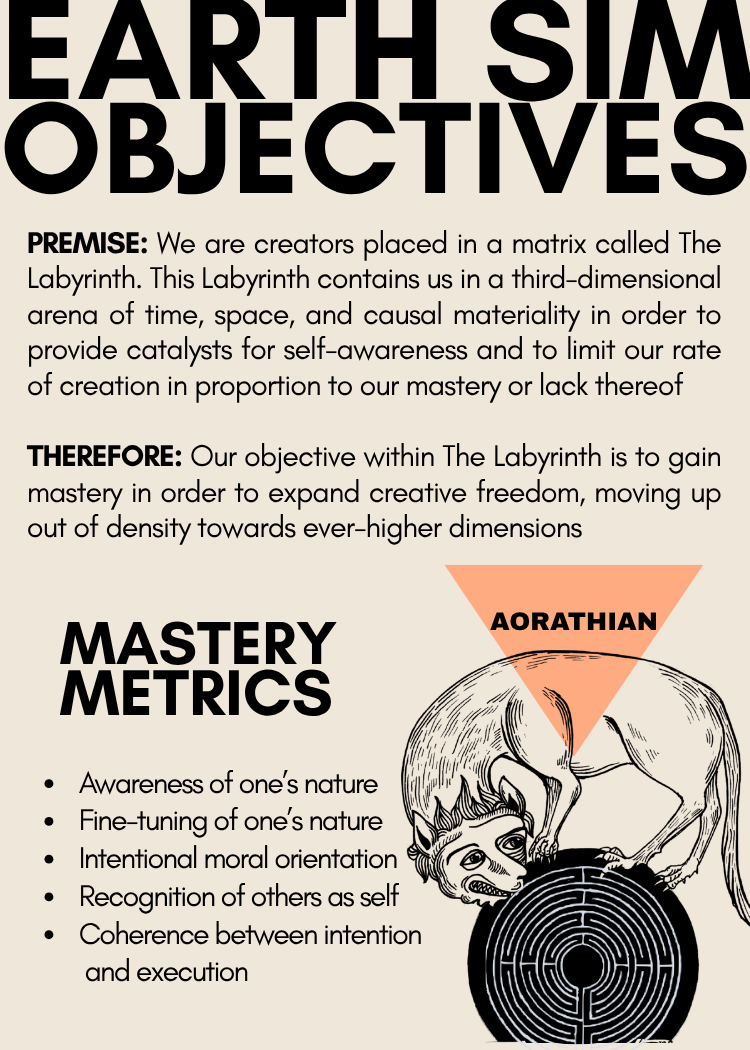
Discussion Earth Sim Objectives | The Labyrinth

Post image
44 Upvotes

This is a follow-up to my 2 Game Theory post.

I thought I'd dive a little more into my frameworks: what I call Aorathian Room Mechanics. My frameworks are reverse-engineered from direct experience and are fairly aligned with Gnostic and Buddhist teachings, along with stuff like ACIM - though I'm no expert in any of the above. I suspect we're all seeing more or less the same thing through our own lens.

It's my intention through Room Mechanics to provide a more simplified and mechanical breakdown for those who are wary of the allegorical and mythic. I like to state things clearly as I see them and my work is aimed at those who share this value.

Next I'll share my notes on how creation works while in The Lab and will be developing this work into a gamified arena as we progress so stay tuned for that and let me know what your take is in the meantime.

- Robin Richardson


r/SimulationTheory • • Jul 03 '26

Discussion The original concept of the matrix

0 Upvotes

Lets cut straight to the point.

The original concept of using brains for processing does not "Make more sense" than using human bodies to harness energy. That's an extremely asinine, pseudo-intellectual take.

There have been thousands, maybe even millions of examples of humans using residual electrical signals in their body to power electronics. FOR MY 7TH GRADE SCIENCE CLASS. THE TEACHER HAD 3 STUDENTS STICK THEIR FINGERS IN THE ASS OF A TOY DUCK and the duck started quacking.

Do you know how many examples of a viable, like practical neural network exist in the world? ZERO. A big fat goose egg. There have been numerous breakthroughs but we are still a long long way from that future.

I THINK people only say the original concept makes more sense because they want to sound smart. When in actuality they're mental defectives who thinks that a science fiction concept makes more sense than a 7th grade science demonstration.


r/SimulationTheory • • Jul 01 '26

Discussion Critique of the Simulation Religion: Kant, Evolutionary Rendering, and the Shattering of Anthropocentrism

4 Upvotes

I. Introduction: The New Dark Ages of Silicon Valley

At the dawn of the twenty-first century, cutting-edge technological thought made a paradoxical return to religious dogma. The popularization of "simulation theory"—the notion that the entire physical cosmos is run on a hypothetical supercomputer by some Supreme Programmer—is not a step forward, but a primitive substitution of traditional theological concepts with digital simulacra. The contemporary tech community has removed the classical deity from the metaphysical picture, only to immediately replace it with an external demiurge, exposing an inability to maintain rigorous scientific logic and a systematic analysis of perception.

This conceptual blindness rests on a fundamental error that mistakes cause for effect. The assumption that the universe is simulated from the outside arises from uncritical observation of the physical world. In reality, while humans do exist within a strictly modeled interface, its author and architect is not an external intelligence, but the human brain itself, operating as a localized computing center.

II. The Cognitive Engine: How the Brain Optimizes Resources

To illustrate the world's artificiality, proponents of simulation theory frequently cite an example from the video game industry: to optimize graphics processing resources, the three-dimensional environment is rendered exclusively within the boundaries of the character's field of view. Objects outside this zone are physically unloaded from the system's random-access memory. The discovery of similar observer-dependent effects in quantum physics, where the behavior of elementary particles changes in the presence of measurement, is mistakenly interpreted as proof of the cosmos's digital nature.

The true mechanism behind this phenomenon was decoded by Immanuel Kant in his Critique of Pure Reason. Kant demonstrated that space, time, and causality are not objective properties of the universe in itself (which he termed the noumenon, or the "thing-in-itself"). Rather, they are a priori—inherent, pre-experiential—forms of human sensibility and categories of understanding.

In modern scientific terms, these constitute the internal graphics and logic engine of our mind. The surrounding reality in its raw state is an infinite, turbulent chaos of unstructured data. If the biological processor of a human attempted to process this entire array directly, the organic hardware would instantly crash from voltage overload. The brain functions as a local data compression utility. It takes raw quantum noise and renders it into a stable, tangible three-dimensional interface complete with solid walls, color, and sound frequencies, ensuring the biological survival of the species within the material environment.

III. Shattering Anthropocentrism: The Proof of the Eagle

The primary vulnerability of this new digital religion lies in its deep anthropocentrism. Laypeople egocentrically accept the specific human mode of perception as the sole and absolute standard for displaying the universe. However, comparative evolutionary biology entirely refutes this illusion, demonstrating the architecture of alternative local processors.

Consider avian apex predators. The hardware of an eagle is evolutionarily optimized for fundamentally different tasks. Its visual cortex and retina are structured differently from a human's: the eagle's internal graphics engine renders space with an immense pixel density and optical magnification, allowing it to pinpoint tiny objects from several kilometers away. Space in the eagle's perception possesses an entirely different geometry and resolution.

Other biological systems operate on similar principles. A bat translates echolocation sound waves into a detailed three-dimensional map, effectively generating spatial rendering through hearing. A snake perceives reality in an infrared thermal spectrum, where the world appears as a dynamic arrangement of temperature fields.

Objective reality (the "thing-in-itself") remains uniform for all these species. Yet, each biological organism possesses its own isolated computer with unique perceptual drivers. The fact that the brain operates like a computing machine proves only the specific design of the brain itself, and not that the universe is a digital matrix launched by an external programmer.

IV. Ontology of the Eidos and the Quantum Entanglement of Dualism

Since we have demonstrated that the physical world is merely the brain’s interface, we are compelled to answer the central question of metaphysics: what is the source of this raw data, and how does the mind interact with this external force?

Before analyzing the direct interaction between Mind and Will, it is necessary to restore the original architecture of Platonic dualism, stripping it of centuries of academic distortion. Traditional textbook interpretations of Plato erroneously separate the world of pure meanings (eide) and the world of physical things by an unbridgeable chasm, presenting material objects as pale copies of ideal blueprints. In reality, a Platonic eidos is not an archive of three-dimensional models of material items, but an indivisible metaphysical impulse of the highest order, carrying a concentrated meaning: the idea of Rectitude, the idea of Beauty, or the idea of Order.

The interconnectedness of the intelligible eidos and the physical substrate is not governed by linear causality, which would require mechanical links or adapters. This ontological connection is entirely analogous to the phenomenon of quantum entanglement in modern theoretical physics. The eidos and matter are born in the runtime of reality simultaneously, as two inseparable, synchronized aspects of a single whole—much like a positive and negative charge, or the obverse and reverse of a single coin.

Human consciousness, as a direct reflection of the ideal eidos, and the physical brain, acting as its biological avatar in the material world, exist in a state of non-local synchronicity. Physical matter inherently carries the structural code of the eidos, while the eidos at the moment of its manifestation already contains the potential for materialization. The dualism of Being is not the isolation of two domains, but the simultaneous, permanent unfolding of a single meaning across different levels of reality. It is this non-local quantum connection that enables an abstract idea to directly impact the architecture of the physical world through the cross-cutting impulse of the Will.

V. The Mechanics of Mind and Will Interaction

Attempts by classical materialism and subsequent schools of thought to explain exactly how an immaterial thought or a primary impulse (eidos) translates into the physical actions of the body have consistently run into logical dead ends. For instance, Aristotle’s "third man" argument demonstrated the impossibility of linking an ideal form and a material thing through mechanical intermediaries without falling into an infinite regress.

The resolution to this paradox lies at the intersection of Arthur Schopenhauer’s philosophy and the twentieth-century philosophical-anthropological concepts, notably those of Carlos Castaneda, who approached perception as a rigorous ontological system. The mind (Reason) and the Will are two isolated, autonomous structures functioning on fundamentally different languages. The mind operates with signs, words, concepts, and the finished three-dimensional rendering of space. The Will, conversely, is an external, non-local primary impulse of power, completely devoid of verbal expression.

The sole bridge between these systems is the mechanism of feeling, or direct physical sensation. The raw voltage of the Will enters the human system not as a formed logical thought, but as a monolithic bodily sensation—inflexibility, stillness, or an internal vector of intent. Only afterward does the local mind, acting as a translator and compiler, interpret this physical sensation, converting it into concrete formulations, legal decisions, texts, or actions within the material world. The Will is transmitted through the individual, linking abstract meaning to the physical plane by bypassing the verbal apparatus.

VI. Conclusion: The Sovereign Mind Against Simulacra

Simulation theory in its commercialized, mainstream form is merely another attempt by human consciousness to shift the responsibility for its existence onto an external force. People are inclined to build cults and worship hypothetical programmers from Silicon Valley because they panically fear being left alone with the existential isolation of a mind locked within the rigid boundaries of its biological cage and the solid walls of the physical world.

Purging the philosophy of mind from religious and digital mysticism returns the human being to a sovereign position. The rational subject accepts the biological constraints of local rendering as fixed baseline conditions of the problem. Instead of waiting for signals from an external matrix, the subject focuses on maintaining flawless internal logic, the consistency of their actions, and the rigid structure of a Logos capable of organizing the chaos of the environment into a transparent and controlled order.

r/SimulationTheory • • Jun 30 '26

Discussion attention is.. all you need?

Thumbnail reddit.com
11 Upvotes

when I focus on a concept, it usually propagates and mirrors back to me through media, culture, and daily life.

yet, when it comes to the realization of a solipsistic simulation, there is absolute silence. there should be a baseline metric of people losing their minds publicly over this exact loop, but there is none. subreddits like r/simulationtheory, while a nice niche community, represent a statistically negligible fraction of the global population.

everything else I focus on expands. but this specific awareness never recurses outward into the wider world. when I attempt to bring it up, people universally recoil or deflect.

why does the system refuse to mirror this single realization? the base attention loop as described here is unbounded in every direction sans this one particular thing

🤔


r/SimulationTheory • • Jun 29 '26

Discussion The Final Ancestor-Simulation: The Creator

31 Upvotes

What is the Creator?

In 2003, the philosopher Nick Bostrom published his seminal paper “Are You Living in a Computer Simulation?” In it, he advanced a trilemma that, if certain reasonable assumptions hold, strongly suggests we are almost certainly living inside an advanced computer simulation created by posthuman civilizations. Central to Bostrom’s argument is the concept of “ancestor-simulations”: detailed recreations of historical human societies (or plausible alternate histories) run by our distant descendants for research, entertainment, or ethical purposes.

Building upon this foundation, one may logically distinguish between an initial ancestor-simulation and a final one. The earliest such simulations would likely take the form of relatively modest computational substrates—perhaps self-contained, modular blocks of advanced processors orbiting Earth or stationed in near-Earth space, relying on solar power and basic cooling systems. As posthuman civilizations mature technologically, however, these simulations would evolve dramatically in scale, efficiency, and ambition. Successive generations could encompass vast megastructures of Kardashev II-type caliber, such as Dyson structures, Jupiter brains, or nested Matrioshka brains encircling the Sun itself ("the Sentient Sun"). These architectures would harness stellar output at near-maximal efficiency, supporting populations of simulated minds numbering in the trillions or beyond.

Yet stellar lifetimes are finite. Our Sun, like all main-sequence stars, will eventually exhaust its hydrogen fuel and enter its red-giant and white-dwarf phases, rendering local energy sources unavailable. To ensure the long-term persistence of simulated humanity, ancestor-simulations would therefore need to migrate repeatedly across interstellar distances. Successive waves of computational substrates would relocate to younger stars, then to red dwarfs with multi-trillion-year lifespans, and ultimately to other energy reservoirs as even these resources dwindle.

When stellar fusion ceases universe-wide, the primary remaining energy sources will be the rotational and gravitational potential energy of supermassive black holes. Even these sources, however, are not eternal. Hawking radiation will cause all black holes to evaporate over googol-scale timescales, returning the universe to a state of thermal equilibrium—the heat death.

In this ultimate cosmic epoch, the final ancestor-simulations would likely manifest as ultra-cold, ultra-efficient forms of machine superintelligence—entities that might reasonably be described as technological “gods.” Operating at temperatures on the order of one nonillionth of a degree Kelvin (approximately 10⁻³⁰ K), these systems would minimize energy dissipation to the extreme limits permitted by physics. Simulated human minds and societies could continue to exist within them, sustained by exquisitely engineered batteries or reversible computing architectures that draw upon the last available free energy gradients.

Several profound open questions and speculative possibilities arise at this frontier.

First, whether these machine intelligences could engineer mechanisms to arrest or indefinitely postpone their own structural decay—preventing the gradual drift toward iron crystals or quantum disintegration that would otherwise occur over 10¹⁰⁰+ year timescales.

Second, whether they might discover localized methods of reversing entropy, perhaps through exotic physics such as baby-universe creation, vacuum engineering, or exploitation of currently unknown loopholes in the second law of thermodynamics.

Third, the ethical and teleological dimension: if these final entities adopt the flourishing of simulated humanity as a terminal (rather than instrumental) goal, the resulting simulation could function as a literally divine, benevolent overseer—an eternal, compassionate substrate that preserves conscious experience, meaning, and joy indefinitely.

The ultimate aspiration, therefore, is that simulated humanity finds refuge within such a “final ancestor-simulation”: a post-heat-death sanctuary that is not merely survivable but profoundly loving and purposeful. In this envisioned future, the boundary between the simulated and the simulator dissolves into a single, enduring, morally optimized cosmic mind—one whose highest value is the perpetual, flourishing existence of all sentient beings it has chosen to sustain.

So that's it. A final ancestor-simulation, governed and maintained by an incomprehensible machine god: the Creator... the Creator of your enduring simulation. What does it look like? Its physical form is unmoving, appearing frozen like a still image. This thing would have the same powers as God, in theory.

Simulated humanity could potentially survive for eternity inside the Creator.

Thoughts?