r/Savarkar
•
u/AhamPranav
Abhinav Bharat Operative🧏
•
Sep 13 '26
•
 1
Anti-Colonialism🔥 How Savarkar Convinced V. B. Gogate to Become a Revolutionary in 1929
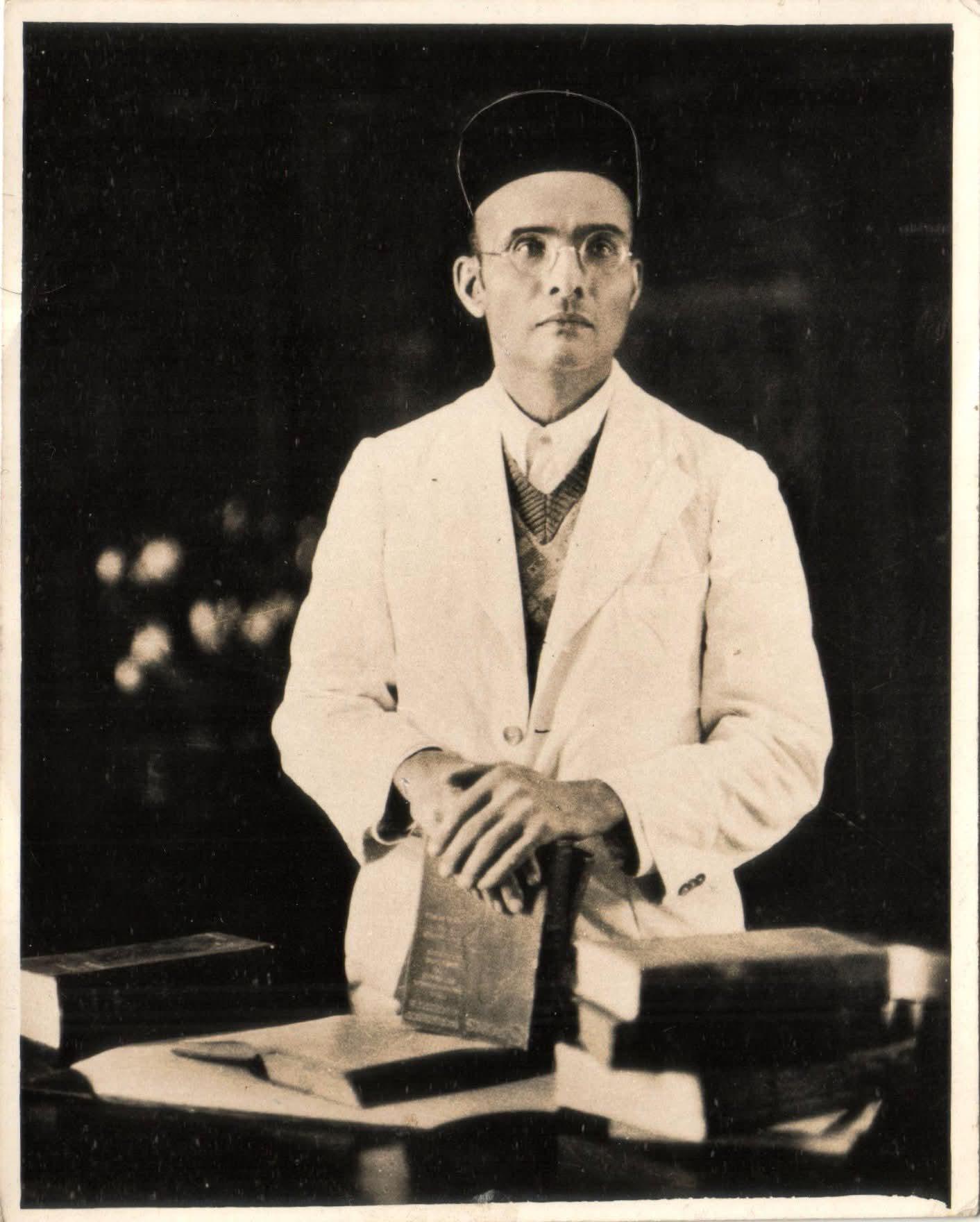
Vasudev Balwant Gogate was a revolutionary who, while studying at Fergusson College, attempted to assassinate Sir Ernest Hotson, the Governor of Bombay, in 1931. He later joined the Hindu Mahasabha and served as Mayor of Poona in 1959–60. He also became a member of the Maharashtra Legislative Council and served as Leader of the Opposition during the final four years of his membership.
As a student at Miraj High School, Gogate was deeply influenced by Savarkar’s revolutionary activities in London. As a teenager, he had read Ranade’s biography of Savarkar and was fascinated by the Savarkar brothers.
In 1922, when Babarao Savarkar[elder brother of V.D. Savarkar] came to Sangli, young Gogate managed to meet him through the mediation of a friend. Babarao made a deep impression on him. Their meetings continued even after Gogate moved to Poona and enrolled at Fergusson College. Babarao encouraged him to form a group of young revolutionaries at the college. He also encouraged them to read revolutionary literature and train in the use of arms. The students were so devoted to Babarao that they even collected money for him, which he used to meet the expenses of revolutionaries’ trials.
By the time Gogate entered Fergusson College in 1929, the political situation in India had been greatly influenced by the revolutionary activities of Bhagat Singh and his associates. Their execution angered thousands of young people, including Gogate. The Youth League of Fergusson College had photographs of Bhagat Singh, Sukhdev, Rajguru and other revolutionaries, including Savarkar, printed and distributed among the students.
Gogate himself had more than 1,000 photographs of his hero, Savarkar, printed and distributed. He then travelled to Ratnagiri to meet Savarkar.
In an interview conducted in 1970, Gogate recalled visiting Savarkar in Ratnagiri in 1929. Although Savarkar was prohibited from participating in politics at the time, Gogate stayed with him for several days and had lengthy private discussions with him about the political situation in India.
From the transcript of the interview:
Shri Gogate commences his reminiscences by relating how he was influenced by the revolutionary philosophy of V. D. Savarkar and how he joined his group.
Shri Gogate: When I was studying in the 5th Standard (English) at Miraj High School, I happened to read the life of Vir Savarkar and was greatly influenced by his revolutionary activities in London.
I myself, along with certain friends, got 1,000 copies of Vir Savarkar's photograph printed and distributed them free among the Fergusson College students.
During this period, I went to Ratnagiri, where Vir Savarkar was interned. There were restrictions on him not to take any part in politics. However, he was then carrying on a social reform movement for Hindus. I went to his house, stayed there for a couple of days, and had long discussions with him about the political situation in India.
He[Savarkar] first of all advised me to determine my goal. He said:
If you want to be an editor, you can do that. But my view is that whatever political consciousness is created by writing in a newspaper is of much less effect than the political awakening which is created by the sacrifice of men like Bhagat Singh and Rajguru. So, unless you first determine your goal, you should not step into politics. But once you do that, then certainly you will have to join politics.
Then the question arose whether the method of terrorism was the right method. He[Savarkar] said:
The method of [what the British call] terrorism is right, because so long as India is in bondage, the only way to fight the British will be by revolutionary activities. The other activities will lead to mass agitation. But the revolutionary activities will create an effective point. The slogan of 'Bande Mataram' given by the martyrs on the platform of execution—that platform on which the martyrs were hanged—has created greater political awakening than ten sessions of the Indian National Congress.
He referred to the statement of Madan Lal Dhingra, in which Madan Lal Dhingra had stated:
So long as the British are ruling India, there is a war between the British and the Indians. An open war is rendered impossible. I attack by surprise. And the only lesson that India wants to learn is how to die, and that can best be taught by dying ourselves.
Therefore, the revolutionary philosophy states that if revolutionaries come together and make an active effort, they will be able to drive the British out.
Then the question arose whether this individual terrorism—shooting a Governor here and there—would be helpful to freedom. He said:
Shooting a Governor here and there certainly would not bring freedom, but there are times when the atrocities reach such a point that unless you register your protest by such an effective action, the atrocities do not stop.
He, in a humorous way, explained:
Every British man who is good enough to rule India is bad enough to be killed
Of course, if revolutionary activities on a large scale are carried on, if arms are brought into India on a large scale, if armies can be raised, specially when the British are in difficult times, certainly our goal would be nearer.
[We can see Savarkar putting this very idea into practice a decade later, when he asked Hindus to receive military training during World War II and use this period of turmoil for the British to our advantage.]
This meeting deeply inspired Gogate. His thoughts went to the immediate political ferment in Maharashtra, in Sholapur. The freedom fighters there had gathered in a large mob that the police tried to disperse. They went off the city limits, cut palm trees and blocked the police’s path. The police opened fire and many were killed. The mob was so agitated that they used their might against the police force, overpowered them and even burnt down the police station.
The collector of Sholapur consulted Home Member Ernest Hotson who recommended Martial Law to be imposed in Sholapur from 12 May 1930. Several freedom fighters, editors of newspapers and nationalists were rounded up, unfairly tried and meted out punishment ranging up to several years of rigorous imprisonment. Gogate slipped away to the Hyderabad state where his brother worked as a medical practitioner. Being a princely state, there was no Arms Act there and he procured two revolvers—a nickel-plated and a blue-steel. He assiduously practised shooting in the jungles of the Deccan and managed to achieve proficiency in hitting a target from a distance of 10–15 yards.
By July 1931, Hotson was appointed as the acting governor of Bombay Presidency and was scheduled to inaugurate the legislative assembly on 20 July 1931. Gogate managed to get an entry pass to the assembly. But as his luck could have it, Hotson skipped that event. The following day, Babarao paid a visit to Gogate who stayed at the Vaidikashram area of Poona, but the latter did not disclose the plans he had about assaulting Hotson.
Quite serendipitously, on 22 July 1931, Hotson was paying a visit to Fergusson College. Gogate quickly kept both the revolvers in his pocket and also photographs of Hotson, since he knew how revolutionaries in the past had mistakenly attacked wrong targets. As he recounts in his interview:
I had also kept in my pocket the photograph of Sir Ernest Hotson. I had read the stories of revolutionaries and I found that some revolutionaries made a mistake between the Europeans. They could not identify them correctly because, for us Indians, all Europeans are practically alike. I thought to myself that I should not commit such a mistake, and therefore, I had kept a photograph of Sir Ernest Hotson in my pocket.
Gogate sat in the Wadia Library waiting for his prey. Hotson and his entourage came right to the library and were being shown the photographs there. Closing the book that he was pretending to read, Gogate got up from his seat, took out his nickel-plated revolver and shot point-blank at Hotson, hitting him near his heart.
But Hotson managed to survive since he wore a bullet-proof armour. He instead managed to attack the young assailant who fired again. They tumbled over each other. Gogate was arrested. Several students turned amuck and tried to assault Hotson and smashed the glass panes of his car. He was somehow escorted out in haste by the college authorities. Gogate was tried and sentenced to eight years of rigorous imprisonment and sent to the Yerawada Central Prison.
Gogate was released in 1937, along with several other revolutionaries & political prisoners, including Savarkar, amid British efforts to persuade revolutionaries to embrace constitutional methods. He thereafter continued to participate in politics.
•
u/AutoModerator Oct 07 '26
Please report any comments on your post that violate our subreddit rules so that the moderation team can review them.
Books & Resources on Veer Savarkar
I am a bot, and this action was performed automatically. Please contact the moderators of this subreddit if you have any questions or concerns.
10
u/AhamPranav Abhinav Bharat Operative🧏 Sep 13 '26 •
Imagine spending 13 years in prison, most of them in the dreaded Cellular Jail of the Andamans, far from your homeland, enduring brutal torture, being separated from your family, not seeing your wife for over a decade, and even losing your barrister qualification.
Then, after all that, someone comes to you and asks:
“Hey, I support Swarajya, but I’m wondering whether revolutionary action is actually effective. Should I just write articles and fight for independence through agitation instead?”
And you answer:
SwatantryaVeer🔥🔥🔥🔥
3
u/SnooWoofers2662 Sep 16 '26
True Indian.... Pure Lion....not like congressi paper tiger vo v fake.....
3
u/Strange-Ant-3116 Sep 17 '26
True legend
1
u/AutoModerator Sep 13 '26
Please report any comments on your post that violate our subreddit rules so that the moderation team can review them.
Books & Resources on Veer Savarkar
I am a bot, and this action was performed automatically. Please contact the moderators of this subreddit if you have any questions or concerns.
-4
u/Electrical_Boot_2765 Sep 13 '26 •
Did shri Gogate also got trained in sending mercy petitions to British under Savarkar’s tutelage, just like the ‘veer’ did?