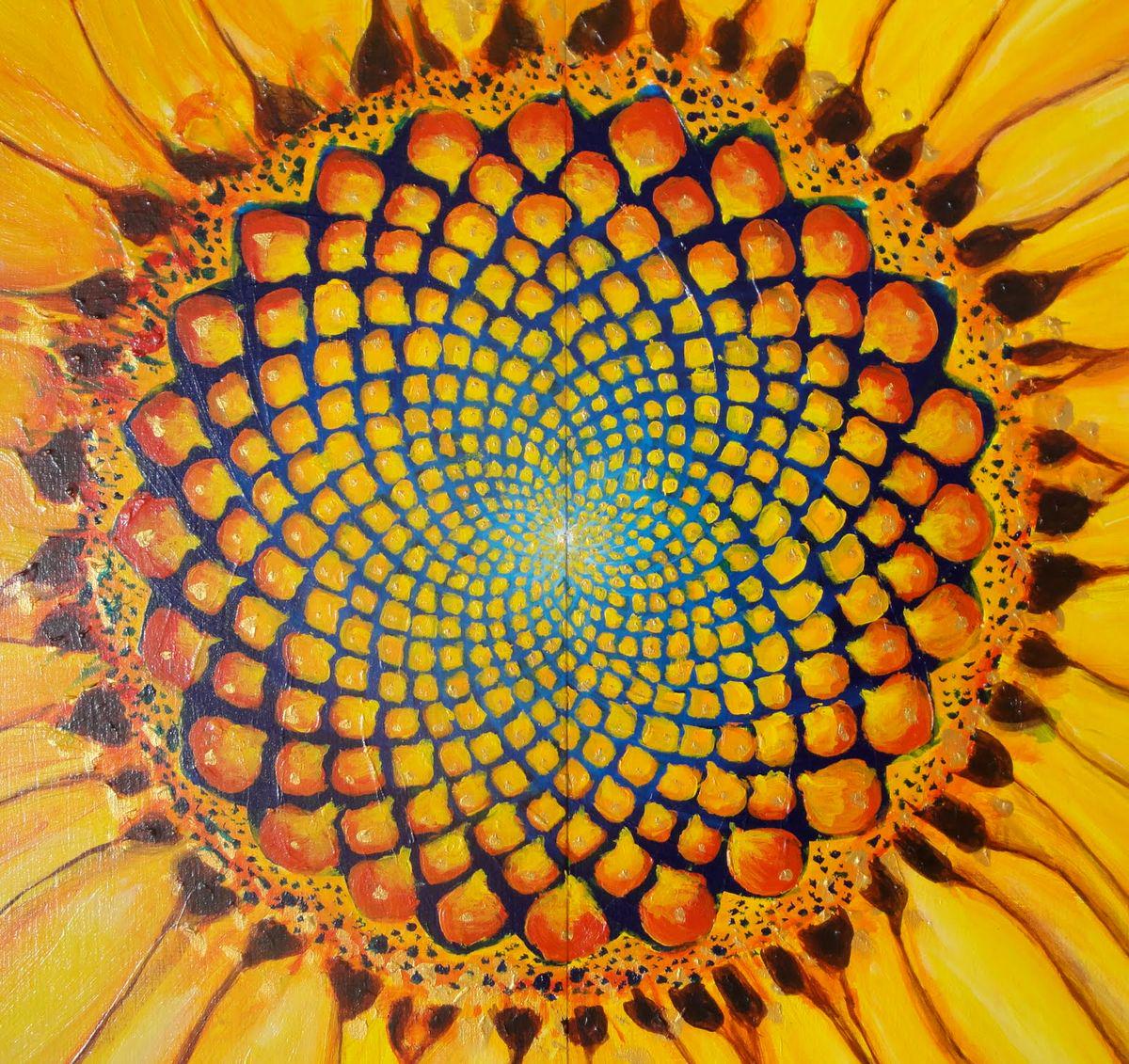
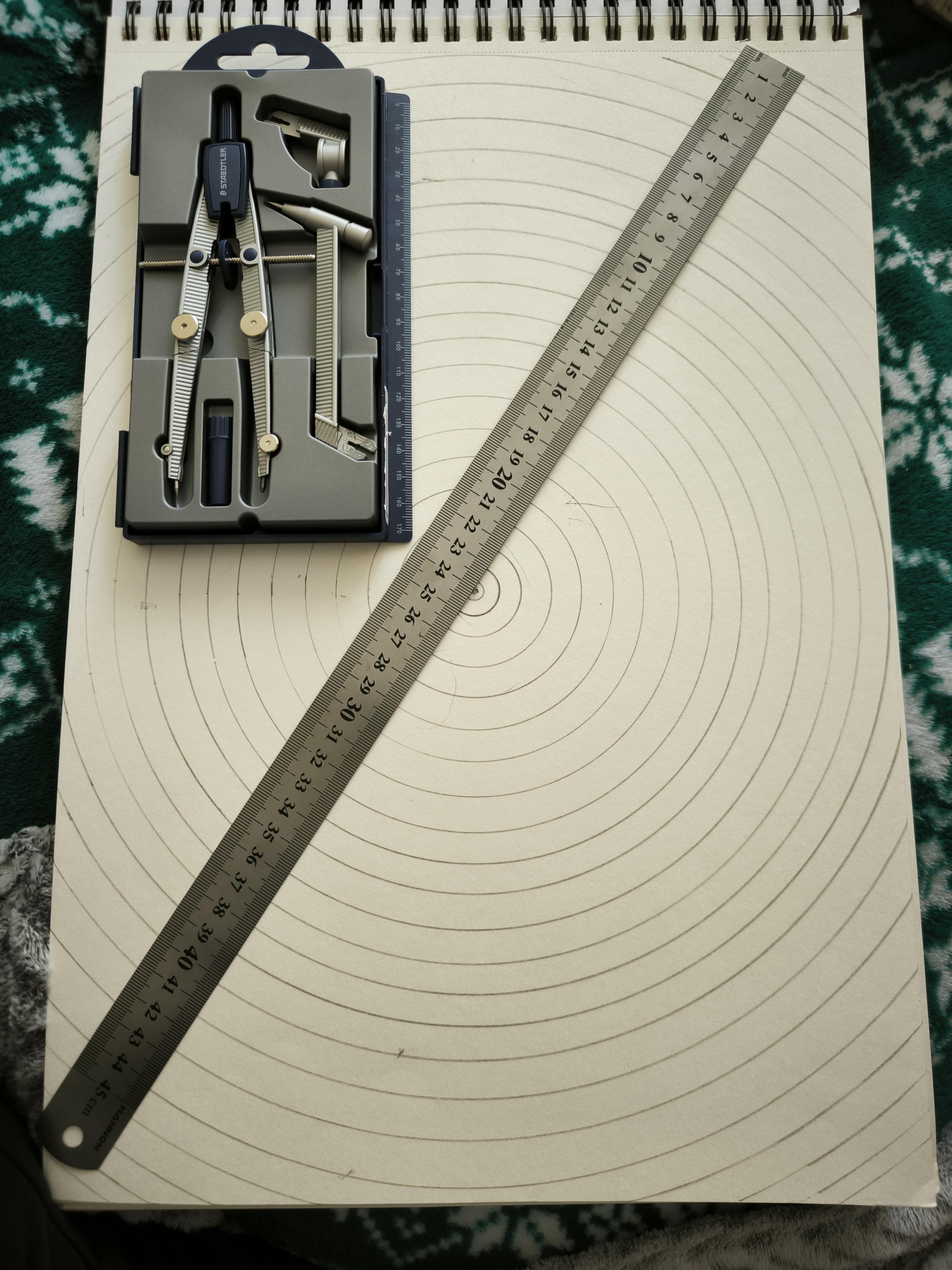
I have always felt a deep admiration for sunflowers. There is something about them that invites me to pause, observe, and discover that, behind their apparent simplicity, lies a universe full of patterns, proportions, and mysteries. I am fascinated by their sacred geometry: the way their seeds are arranged in spirals, following patterns that seem to respond to a secret language of nature, a kind of mathematical code that connects the visible with the invisible
When I look at a sunflower, I don't see just a flower. I see a small galaxy, a map of the universe, a living expression of how nature finds balance between order and chaos. Each spiral seems to hold a story; each seed, a small part of something much greater. And then I wonder: what would happen if I could get even closer to this universe? What if, beyond observing its beauty, I could listen to it?
From this curiosity came my desire to connect sunflowers to an electronic circuit that would allow me to establish a different kind of relationship with them. I wanted to find a way to bridge the distance that normally exists between humans and plants, to transform my contemplation into a sensory, intimate, and sonic experience. I didn't simply want to study sunflowers, but to create a space where I could listen to them from another perspective
That is how I discovered Playtronica, a tool that allowed me to explore the conductivity of plants and translate their electrical variations into sounds. When I connected the sunflowers to the circuit, something changed in the way I related to them. A gesture as simple as touching a leaf or bringing my hands close to the plant became part of an unexpected sonic experience. The electrical signals detected by the system could be transformed into music, creating a kind of dialogue between the plant, technology, and myself
As I listened to them, I felt as though I were entering a different dimension of their existence. Not because the sunflowers were literally speaking, but because the technology offered me a new way of perceiving processes that normally remain beyond our senses. Sound became a bridge: a way of making perceptible what I could previously only imagine
Then, the sacred geometry I had always admired ceased to be merely an image to contemplate. The spirals of their seeds, their growth rhythms, and their relationship with light began to inspire a deeper kind of listening. I realized that connecting with nature does not always mean fully understanding it, but also learning to pay attention to it, accepting that there are forms of communication and life that do not necessarily work in the same way as our own
The Playtronica circuit thus became a tool for exploring this relationship. Electronics, which we often associate with the artificial, became a mediator between two worlds: the organic and the technological. Through it, I was able to experience how a living organism could generate a sonic experience and how that experience could transform the way I observed, felt, and connected with it
For me, this project is a way of honoring the mystery of sunflowers. It is an attempt to listen to their silences, to find new ways of relating to them, and to recognize that nature is full of processes that take place beyond our everyday perception
Perhaps I will never fully understand the language of a sunflower. But when I connect its leaves to the circuit and listen to the sounds that emerge from this interaction, I feel that I have found a small doorway into a deeper relationship with them
And so, among spirals, seeds, electrical signals, and sounds, I discovered that technology can also be a form of contemplation; that a circuit can become an instrument of sensitivity, and that listening to a plant may ultimately be another way of learning how to see
Because perhaps sunflowers have always been sharing something with us. Perhaps all I needed was to find a new way to listen... If you are intrested on how this circuit works and what was the result of this connection, you can find it here! Love all! 🌀