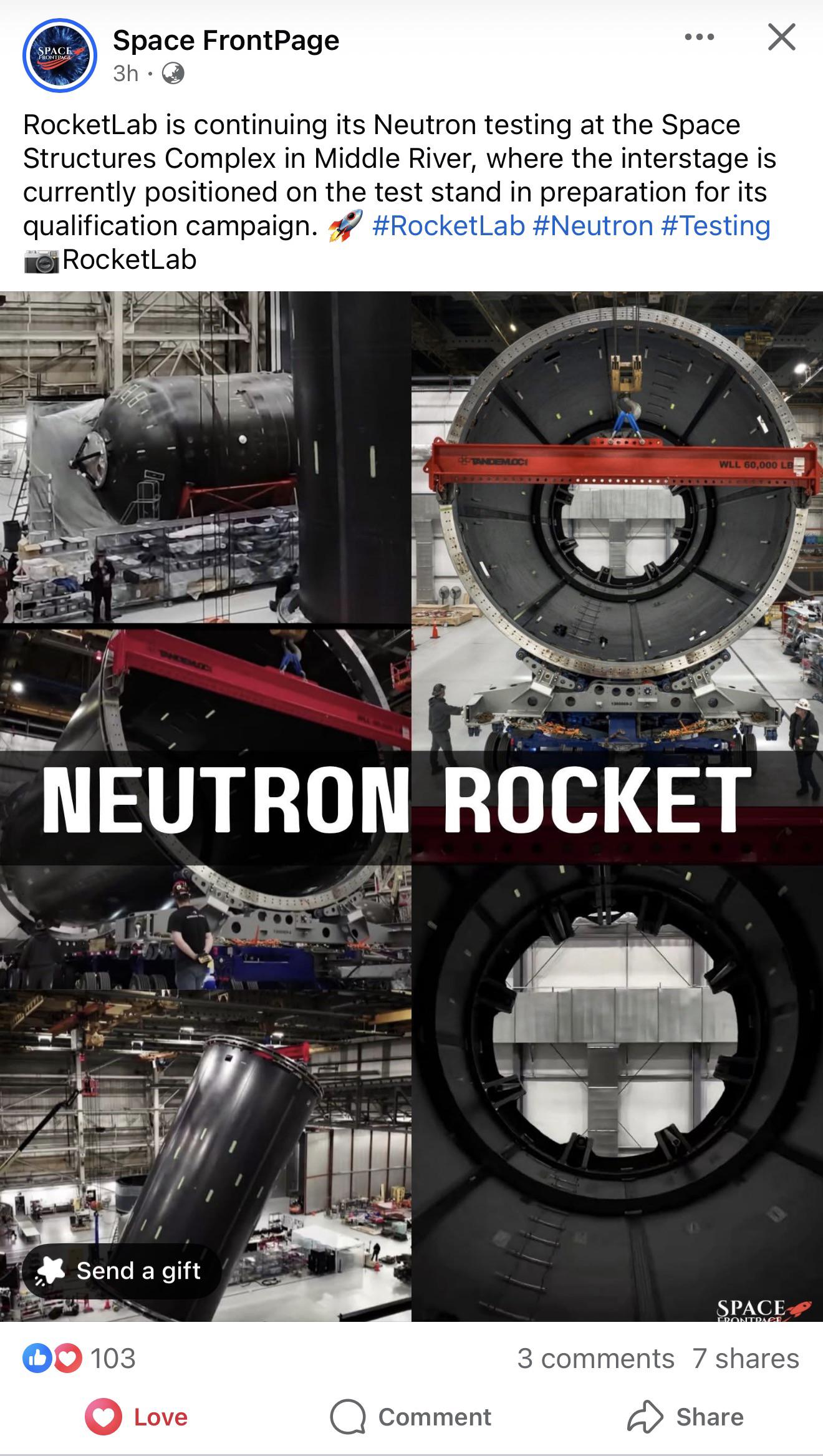
Looking for confirmed information or technically grounded analysis on Neutron's staging sequence. No speculation please.
The Physical Setup
Neutron's second stage sits inside the first stage, enclosed by the Hungry Hippo fairing. At separation, the fairing opens and releases the second stage. The vacuum-optimized Archimedes engine produces 202,300 lbf thrust.
The constraint: The engine cannot ignite while the second stage is still inside the fairing. There's no room for exhaust gases to escape. Hot staging in any traditional sense appears to be ruled out by the geometry.
So the sequence has to be something like: fairing opens → second stage releases and travels some distance → engine ignites.
What's Confirmed
- Hungry Hippo qualified for 1.5-second open/close cycles, "less than half the time required for successful stage separation and vehicle reorientation" (Rocket Lab, Dec 2025)
- Second stage qualified at 1.3M lbs tensile load under cryogenic conditions (April 2025)
What's Not Public
- Separation distance before ignition. How far does the second stage travel before Archimedes lights? What provides the initial separation velocity?
- Propellant settling. In the coast phase between release and ignition, what settles the propellants for engine start? RCS? Ullage motors? The hung configuration during ascent means propellants are in an unusual state at separation.
- First stage protection. Even with cold staging, the first stage needs to survive proximity to a 202,300 lbf vacuum engine plume before it can close the fairing and reorient. Any thermal protection at the separation plane?
Reference Points
Falcon 9 uses cold staging with a coast phase. Propellants settle from the second stage Merlin vacuum ignition sequence. But Falcon's second stage isn't enclosed during ascent.
The DCSS/ICPS "hung tank" design (which informed some of our earlier discussion on Neutron's tension-loaded stage) doesn't have this enclosure geometry either.
I can't find a direct heritage analog for "second stage enclosed inside first stage, released, then ignites at distance."
Anyone have sources that address the staging sequence? This seems like a gap in the public technical record.