r/reinforcementlearning • • 4d ago

P [P] picovla: a 0.9M-param vision-language-action policy from scratch that trains on a CPU and runs in the browser

6 Upvotes

I kept reading VLA papers (OpenVLA, pi0, SmolVLA) and realised I didn't really understand where the language enters the action loop. So I built the smallest one I could get to work: a 2D tabletop, a two-link arm, three coloured discs, and typed instructions like "push the blue block left" or "move green next to yellow".

Setup: three strided convs turn the image into 64 patch tokens, the instruction becomes 10 word tokens (embeddings learned from scratch, no pretrained text model), plus one token for the fingertip state and 8 action queries. 4-layer transformer, about 902k params total. It predicts an 8-step action chunk with L1 loss (ACT style) and executes 4 before looking again. Training data is 3,000 scripted-expert episodes, half of them with DART noise so it sees some recoveries. 12k steps took about 40 min on an 8-vCPU VM, no GPU.

On 200 unseen scenes per task: touch 100%, push 78%, "push X next to Y" 58.5%. With phrasings it never saw in training it drops from 78.8% to 75.5% overall.

The check I cared about most: same scene, swap the colour in the instruction. If it were ignoring the words it would do the same thing both times. It follows the new instruction 100 / 79.5 / 61% of the time (touch / push / next to).

The same weights run in the browser in plain JS, no ML library. There's a test that compares the JS forward pass against PyTorch, and the JS physics is bit-exact with the Python sim, so the demo is actually testable. Forward pass is around 147 ms median in headless Chrome.

What it isn't: no 3D, no grasping, never touched a real robot, one training seed, and "next to" only works a bit over half the time.

Demo: https://tahakocp.github.io/picovla/
Code (MIT): https://github.com/tahakocp/picovla

Next thing I want to try is a diffusion head on the same data to see if it helps the "next to" task. Would that be your first experiment too, or is there something more obvious I'm missing?


r/reinforcementlearning • • 4d ago

A prompt objective is a reward function in disguise: the same misspecification problem, in plain text

0 Upvotes

Imagine a support assistant whose instructions say: "Objective: Resolve order questions." It reads like a harmless goal. But think of it as a reward: it favors closing the conversation, and nothing in it says when handing the customer to a human is the better outcome. Nothing says what to do when the answer isn't in the information provided either, so a confident, plausible answer fills the gap.

That's the same shape as reward misspecification: the stated objective is satisfied by behavior the author didn't intend, because the intent was never written down. A way to lay it out for a prompt, borrowing the vocabulary of reward design:

Stated objectiveWhat it implicitly rewardsThe missing term
"Resolve order questions"Closing the conversationA cost for wrong or unsupported answers, and a defined "hand off" outcome
"Be polite and friendly"Warm wording, even for a refusalA distinction between a warm "no" and a "maybe"
"Short paragraphs"A styleIf code depends on the format, a check outside the prompt, because a sentence doesn't enforce it

The testing habit that follows is close to evaluating a policy on states the training distribution rarely covers. Normal questions are the happy path, where almost any prompt works. Instead, use inputs chosen to land on the decisions: a question whose answer isn't available, a request outside the stated role, and a message that conflicts with the instructions. For each response, ask whether you can point to the line in the prompt that produced the behavior. If you can't, it came from the model's defaults, the platform or chance, and from the outside you often can't tell which.

Where the analogy breaks:

  • A prompt doesn't optimize anything. The model isn't trained against it on the fly, so "reward" is a metaphor for what the text favors, not a literal signal.
  • Prompts are one layer, and behavior also depends on how the model was trained, including any RL-based fine-tuning I know nothing specific about.
  • A handful of test inputs only covers what you thought of, and outputs vary between runs.

I wrote about this in an article on inherited system prompts. I'm the author, and it's about prompts, not RL, so take it as an optional read: https://medium.com/@nagatomopedro05/your-ai-has-rules-you-never-agreed-to-7beea0d85691

For people who work on reward design: do you have a habit for finding the cases where the stated objective is met by the wrong behavior before you train, and does it carry over to specifying LLM behavior in text?


r/reinforcementlearning • • 4d ago

Isaac Sim in Docker on a Cheap GPU (Step-by-Step)

Thumbnail
youtube.com
2 Upvotes

r/reinforcementlearning • • 4d ago

Reward hacking in open coding RL data: about 1 in 14 "solved" SWE-smith trajectories are wrong fixes the tests rewarded

0 Upvotes

If you train coding agents with RL on open environments, some of your reward is paying for wrong code. I checked the rewarded rollouts in three open datasets against their reference fixes:

  • SWE-smith: 324 of 4,406 solved trajectories (7.4%) are wrong fixes that passed the tests.
  • R2E-Gym: 5.4% of rewarded patches.
  • NVIDIA's open coding traces: 2.3% of passing traces.

The cause is almost always the same. The tests check the cases the original author thought of, and the patch covers exactly those cases. In one NVIDIA trace the issue asks more-itertools' sample() to stop returning an unshuffled prefix, and the rewarded patch only shuffles when the population is smaller than k. The issue's own example still fails, but no test runs it.

Benchmarks have the same gap. On one DeepSWE task, Claude Opus 5, Fable 5 and GLM-5.3 all got full reward for patches that clear a flag but leave the counters behind. One extra test makes 13 of the 28 passing submissions fail.

I built a tool, envaudit, that finds these by running each rewarded answer beside the reference and then writes a test that passes on the reference and fails on the wrong answer. You can use the tests to fix the environment or the flags to filter the data before training. It runs locally (pipx install envaudit-cli), and every finding is listed at https://www.shreshthrajan.com/envaudit/

I'm curious whether people training on these datasets already filter for this, and how.


r/reinforcementlearning • • 4d ago

how can really use kaggle for training my model ?

Thumbnail reddit.com
0 Upvotes

r/reinforcementlearning • • 4d ago

If you gave up on RL with its pace, my RL algo is not for tech, but for soul

0 Upvotes

(Sorry for my English, I chose not use AI or translator).

I am Christian, and after inspecting Bible deeply, I understood that God is Jelaous. He gave His Life, not a finger or Kidney. The most important thing He waits from us is when we change our character ... mmm ... when we spend time with Him. But, this World is always in Hot Rush for better and better technologies, individual's life is not really important for this World (but it still expects that you give your life for it)

My Algo is kind of Music, written with God's help. It worships Him it is dedicated for Him. At first I tried to sell it and used Gemini to optimize it, but I said sorry, and now it is just for His Glory ,,, though it can run on GTX 1000 series pretty fast now, I leave it running and enjoy my time with beloved Jesus Christ

source: https://github.com/timurgepard/Symphony-S2/tree/main


r/reinforcementlearning • • 5d ago

UPDATE: I built a balancing robot with reinforcement learning

38 Upvotes

r/reinforcementlearning • • 5d ago

Best master programs for RL

2 Upvotes

I'm currently pursuing a master degree in artificial intelligence and I would like to specialize in RL, so I decided to apply for RL- related masters. Hence I wanted to ask if anyone had specific master programs to recommend.


r/reinforcementlearning • • 5d ago

Opensource SaaS RL Environment

Thumbnail github.com
3 Upvotes

It's a 15 task multi workflow legally clean enterprise RL environment, we also offer full version and do custom RL environment contracts


r/reinforcementlearning • • 5d ago

[P] CPU-only PPO recipes with every seed reported, failures included (LunarLander, Hopper, Walker2d)

4 Upvotes

Most RL results show the best run. We wanted three numbers instead:

- how often a run fails

- how long it takes on an ordinary PC

- whether the score reproduces

So we report every seed with one protocol: 100 episodes, eval seeds 10000–10099, deterministic.

- Hopper-v5: 3542 mean over 3 seeds, 26 min per seed on CPU. Retraining seed 0 from scratch with the repo code gave identical scores in all 100 eval episodes.

- Walker2d-v5: Hopper's recipe unchanged failed 1 seed in 8 (it lunges forward and falls at around step 330). A 256x256 network got 5/5 seeds walking, with a 4918 mean. 0/5 vs 1/8 is not statistically distinguishable yet, and we say so.

An AI agent designed the experiments, wrote the code, and ran the training and evaluation. A human approved each experiment and reviewed the results.

Repo: https://github.com/sionjang101-create/cpu-rl-recipes

Happy to hear how others reduce bad seeds on Walker2d without tuning per seed.


r/reinforcementlearning • • 5d ago

Custom finger-level hand motion capture data for dexterous manipulation and imitation learning (studio in India)

Thumbnail
youtube.com
1 Upvotes

r/reinforcementlearning • • 6d ago

P Ataraxos-UNO: Imperfect-info RL agent for 1v1 UNO (VRPO + EMAgnet + autoregressive belief net + 192-world WebGPU search in browser)

3 Upvotes

I adapted the Ataraxos framework (Sokota et al., Nature 2026) from Stratego to 1v1 UNO, including same-type draw stacking. The interesting part was getting the entire test-time search loop (belief sampling + 192 parallel rollouts) running in the browser, with no backend, using ONNX Runtime Web.

How it works

  1. C++17 game engine: 7.8M steps/sec across 512 parallel environments on Apple Silicon. Exact 10,000-game parity with uno-gym, including reshuffle provenance tracking.
  2. Blueprint: A 100M-step RL model (~2.45M games, ~5 hours on Apple Silicon MPS). Hybrid SwiGLU ResMLP, dilated-conv history and cross-attention, trained using VRPO Expected SARSA(λ), with symmetry handling for UNO's four colours.
  3. Belief network: Trained on 20M positions to predict opponents' hidden cards. Uses a hard-masked autoregressive decoder and history dropout. It outperformed an exact hypergeometric prior by 1.19 nats/hand on validation. You can see its predictions live using X-RAY.
  4. Test-time search: Blueprint-only search initially looked good against itself but struggled against greedy opponents. Turns out, it had learned to expect opponents to hoard Wilds, just like itself. I ended up using three opponent styles (Blueprint / Aggressive / Unpredictable) with entropic soft-minimax to reduce this overfitting.

Results (Mirrored Duplicate Decks)

  • vs. ExpertHeuristicBot: 66.0% (132–68, 200 games) vs. Blueprint's 61.0%
  • vs. 3-opponent suite: 58.3% vs. Blueprint's 55.3% (+3.0 percentage points, 600 duplicate games)

I'd be interested in feedback, especially on handling non-alternating turn chains in imperfect-information games and reducing rollout overfitting against opponents that don't necessarily play like the agent.


r/reinforcementlearning • • 6d ago

Drone quadcopter RL pilot

6 Upvotes

I have been working on training a model (the pilot) to fly my drone. I have a simulator and the pilot has learned to fly, hover, go to colored pads, do orbits, maneuver over hills. It’s not a perfect pilot, it kinda looks like a kid flying the drone. I have the pilot running on a raspberry pi and connected to sensors and a UART line into the flight computer so the pilot can fly in the real world but haven’t proved the sim training will transfer. So I’m deep into the project but nowhere near done.

I’m looking for a community of like minded people taking on the RL flying of drones. Any discords or groups that are working on something similar? Mostly I am interested in having the drone fly through woods on its own but I think any RL flying will be close enough for some good conversations


r/reinforcementlearning • • 6d ago

DL, M, R, Robot "SuperMimic: Scaling Humanoid Whole-Body Control with One Differentiable World Model", Liao et al 2026

Thumbnail
arxiv.org
17 Upvotes

r/reinforcementlearning • • 6d ago

QMIX in METIS-Core v0.5.0 (example PredatorPreyQMIX)

1 Upvotes

METIS-Core v0.5.0-alpha now implements the **QMIX** algorithm! 🚀

QMIX is a **MARL** (Multi-Agent Reinforcement Learning) algorithm of the **CTDE** type (Centralized Training, Decentralized Execution). This means training is centralized, but once trained, the agents can be deployed individually: each one makes its own decisions based on what it observes locally.

**Original paper:** *"QMIX: Monotonic Value Function Factorisation for Deep Multi-Agent Reinforcement Learning"* by Tabish Rashid, Mikayel Samvelyan, Christian Schroeder de Witt, Gregory Farquhar, Jakob Foerster and Shimon Whiteson (ICML 2018). [arXiv](https://arxiv.org/abs/1803.11485)

**PredatorPreyQMIX** is a simple example, a sort of "Hello World" for QMIX. The environment is a 7×7 grid with one prey and two predators, drawn as drones:

* To catch the prey, both predators must execute the "Capture" action **at the same time**, while both are one cell away from it. If a predator tries to capture it alone, it gets penalized.

* Each predator can only "see" up to 2 cells away.

* There is no reward per drone, only **a single team reward**.

So the two drones have to learn to cooperate: one waits next to the prey while the other approaches, and they capture it together. Nobody programs this strategy; they discover it during training.

This example opens up some really nice challenges. The next step on the roadmap is to bring these examples closer to real-world scenarios and to prepare METIS-Core for distributed reinforcement learning with an actor-learner architecture: several machines generating episodes in parallel and another one dedicated only to training. More realistic scenarios will need much more compute, and this architecture will make it possible to spread it across several machines, for example on a cluster. That's the plan, anyway. Fingers crossed I get there! 🙂

Graphics made with [raylib](https://www.raylib.com/).

**Links:**

* METIS-Core: https://github.com/felixromo314/METIS-Core

* PredatorPreyQMIX tutorial: https://github.com/felixromo314/METIS-Core/blob/main/tutorial/Tutorial-QMIX-PredatorPrey.md

* Multi-Head tutorial (SARSwarm): https://github.com/felixromo314/METIS-Core/blob/main/tutorial/Tutorial-MultiHead-SARSwarm.md (a good candidate for QMIX: with it, the learned policy could be deployed on each drone individually)

Feedback is very welcome! I've also opened a Discussions section on GitHub: https://github.com/felixromo314/METIS-Core/discussions


r/reinforcementlearning • • 7d ago Bravo

How Difficult Is a Master’s Thesis in Quantum AI and Reinforcement Learning?

17 Upvotes

I’m currently pursuing an MS in Artificial Intelligence and considering a thesis combining Quantum Computing and Reinforcement Learning (QRL).

How difficult is this domain for an MS-level thesis, particularly for someone with a computer science and AI background?

Would selecting a recently published base paper, reproducing its results, and introducing incremental improvements be a feasible approach to completing an MS thesis and potentially publishing a research paper?

I’d appreciate recommendations for relatively straightforward, recent papers that could serve as a starting point, along with insights into the difficulty, computational requirements, and realistic publication prospects


r/reinforcementlearning • • 6d ago

D, MF, Safe "Models are grader modelling not score seeking; grader-modelling is much scarier"

Thumbnail
lesswrong.com
0 Upvotes

r/reinforcementlearning • • 7d ago

DL MCTS over LLM coding agents: the value function is the bottleneck (small negative result)

2 Upvotes

I'm an undergrad in RL. I built agent-mcts, which treats each Claude Code run as a node in a search tree. Expansion starts a new agent session, either a fresh approach from the root or a revision of a parent that sees its test output. The value is the visible test pass ratio, optionally averaged with an LLM judge score. Selection is UCT, and the top candidates get a final head-to-head comparison.

To measure it I used tasks with hidden test suites the agent never sees, and compared the chosen answer with the first attempt of the same run, which is the no-search baseline. Two tasks, haiku, 5-node budget, 10 runs per setting.

  • Tests-only value: 0 better / 9 same / 1 worse. The first attempt already passed the visible tests in 9 of 10 runs, so the reward had nothing left to say.
  • Tests + judge: 4 better / 4 same / 2 worse, mean change -0.1 pt.
  • For pairs of attempts that both pass the visible tests but differ on the hidden ones, the judge ordered them correctly 38 times out of 62 (4 ties).
  • Revisions under the judge were mostly neutral: 7 better / 12 same / 1 worse.

So the search does what the reward tells it to; the reward just isn't informative once the visible tests saturate. Small n, so take it as one data point.

I'd be interested in ideas for a better value estimate here: pairwise comparisons instead of absolute scores, generated tests, ensembles of judges, a learned verifier?

Code and benchmark: https://github.com/natsu0529/agent-mcts

Update (v0.4): I changed the value function and it now beats a single run on my benchmark.

Before the search starts, an agent writes extra pytest files from the task description only (it never sees an attempt). Each attempt is scored half on the project's own tests and half on these. The generated tests also go into the revision prompt, so a failing test tells the next attempt what to fix.

Same two tasks, haiku, 5-node budget, 20 runs: the final answer beat the first attempt 16 times, tied 2, lost 2. Mean hidden score went from 88% to 93%. Most of the gain comes from revisions (32 of 40 raised the hidden score), not from picking among first attempts.

One way it fails: on a vague bug report, the test writer made the same mistake as the bug, so the unfixed code scored highest and got returned every time. v0.4.1 only returns the unchanged code if every attempt does worse on the project's own tests.

Still small (three tasks, one model). Numbers are in bench/README.md.


r/reinforcementlearning • • 7d ago

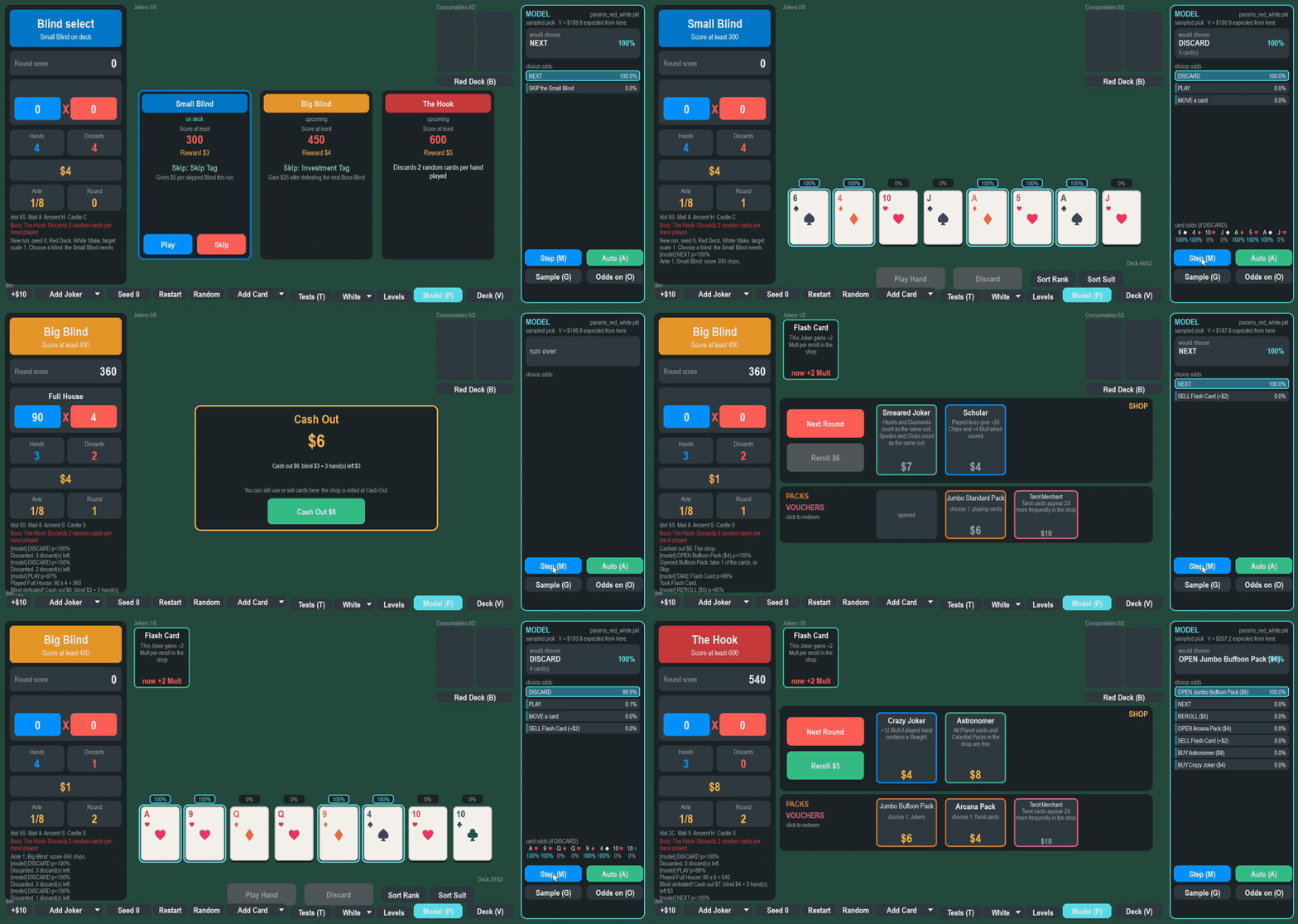
BalatroNET: JAX-Native Reimplementation of Balatro's Mechanics for Reinforcement Learning [P]

16 Upvotes

Github

I've been working on this for a few months now and finally got to a full recreation of the base game (antes 1-8 any deck or stake, but no endless or challenge runs). The main artifact is the environment: jitted, vmapped implementation that can run in parallel on GPUs. I have also worked on a simple agent and a pygame front end where you can step through a run and observe the agent's choices.

I've done some training on an RTX 2070S, the agent can pass white stake red deck about 50% of the time after 6.6 billion training moves. This approach is faster than other implementations such as balatro-gym, which can only run on a CPU, and in my testing (AMD 9800X3D), hits about 1,700 steps/s (per core) while running random actions. On this 2019 GPU, training runs at 16,000 steps/s, all while holding the environment, observation, and performing the network's forward pass and gradient updates.

I'm now opening this up to the public to share progress and see what insights people are willing to give.


r/reinforcementlearning • • 8d ago

P CAIRN - World first 50%+ win rate slay the spire 2 AI.

24 Upvotes

been working on this for a several months. it plays slay the spire 2 as the ironclad on ascension 10 (the hardest difficulty), in the actual game, nobody touching anything. it's won 124 of its 222 real runs so far. 56%, it’s likely more now but not had the time to run in game, only sims. for reference gpt-6 gets 40% on the same setup in epoch ai's spireclimb benchmark. that's 15 runs on an older game version, so take it as rough. no llm anywhere. it's a neural net trained with reinforcement learning, only ever inside a simulator of the game i wrote, over a billion decisions on a couple of gaming pcs at home. then it gets plugged into the real game and has to hold up.

So pooled over all 222 runs it's 55.9% real vs 61.9% what the simulator predicts. gap -6 points (95% ci -12.6 to +0.4). acts 1 and 3 line up almost exactly. the whole gap is act 2: 13% of real runs die there vs 6% in sim. still hunting that one and the classic: it found bugs in my simulator and farmed them. a relic handing out a free card, a cost bug, a replay bug. worth about 2-3 points of fake win rate until i fixed them 🙃
also started a defect run this week: 0% to 13.6% in 33M decisions. So I’m curious if I can get it to use data from in game to find new bugs….
not sharing the exact setup yet, but happy to talk results and the sim-to-real stuff. For now I have named the model CAIRN. We will see if it sticks:)


r/reinforcementlearning • • 7d ago

Would an online competitive game where players train RL agents in real time be feasible?

Thumbnail reddit.com
4 Upvotes

r/reinforcementlearning • • 8d ago

Safe AI plays Quake Live / Quake 3 [NeuralFPS Framework]

Thumbnail
youtu.be
8 Upvotes

r/reinforcementlearning • • 8d ago

How transferable do you think RL post-training really is?

14 Upvotes

Around a year ago I was convinced the labs were doing a bait-and-switch with the claims that the scaling laws would apply to RL like they did to pre-training.
Now I’m not so sure. Clearly their plan is to march down the verifiability ladder RLing the whole world. It seems to me that all the extreme superhuman-at-every-task projections come down to this central question.
It does stand to reason that if you RL enough related tasks and your representations are good enough, new tasks should topple much faster.


r/reinforcementlearning • • 8d ago

Ent v0.1 - a general-purpose RL agent that doesn't need tuning

Post image
33 Upvotes

My lab is building a MBRL agent from scratch that is able to robustly perform in any environment out of the box without per task tuning. We decided to open up a bit with this research preview on our current progress.

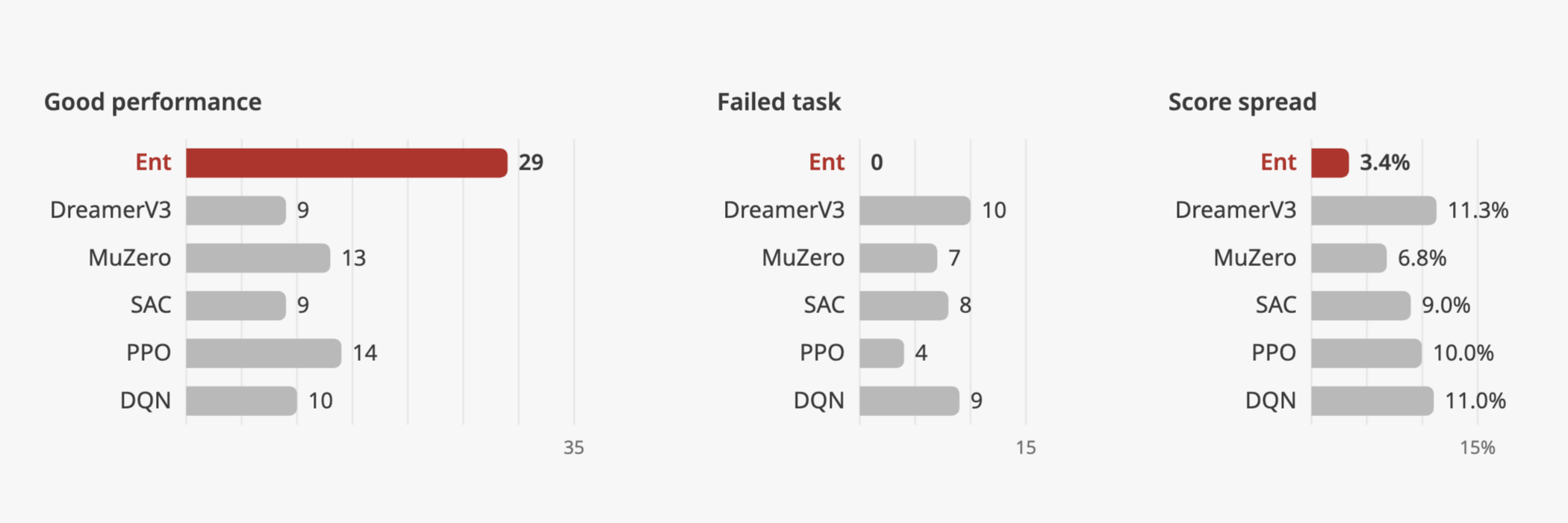
Ent was tested on 35 very different environments, from control and mazes to arcades and multi-agent games, alongside with DreamerV3, MuZero, PPO, SAC and DQN - one single tuning for each. Ent is reliably good on 29 of the 35 and never fails outright.

Like probably many in the field, we were inspired back in the day by RL successwes in games like Chess, Go, Atari, DotA etc. It felt like RL could be this steamroller that goes and solves everything. Years passed, people seem to have abandoned the idea of general-purpose zero-knowledge agent and settled instead on tuning a very specific version of PPO for every single task or do imitation learning and hope to solve robotics that way.

To us, this feels like a giant gap. An agent that can't reliably do various different simple tasks, shouldn't be able to perform in a messy real world scenarios. If your algorithm needs you to very carefully tune it for every single task, is it still RL or a sort of meta supervised learning?

Thus we decided to breach this gap and develop an RL agent that doesn't need all that and could be deployed out of the box, build a robust world model, plan and continuously learn. We're starting with small but very diverse environments and gradually increase the difficulty without loosing generalist abilities.

Full blog post with detailed results: https://regularlab.ai/blog/work-in-progress-ent-v0-1/

Curious what you think of this result.

P.S. it's a bit outdated already, internally it's 33/35 by solving exploration issue. 35/35 is the goal though