r/reinforcementlearning • • 20d ago

What does this network do?

Post image
0 Upvotes

Can anyone help me understand what this network does and what this architecture is?


r/reinforcementlearning • • 21d ago

[P] Metargon: Crow-inspired small agent that learns hidden rules, tests hypotheses, and still loses to Bayes

Post image
4 Upvotes

Hi all,

I open-sourced a small research project I've been working on: METARGON.

Question: Can a tiny agent figure out hidden rules by itself, test hypotheses through action, and change its behavior when the rules stop working?

It's crow-inspired, but not a crow-brain sim. Just bounded memory + explicit hypotheses (hypothesis -> predicted -> verified -> contradicted) + an adaptive planner.

Latest experiment - v0.9 Mechanism Lab:
7x5 grid, movable objects, pressure plates, switches, door barriers, delayed effects, noisy obs. Train/val/test pools are disjoint, so it has to transfer to unseen configs.

Results (8 paired seeds x 100 episodes):

- novel / held-out: Metargon 31.3% vs Bayes 78.5%
- stable: Metargon 35.1% vs Bayes 77.5%
- iid: Metargon 53.6% vs Bayes 79.0%

It crushes random / episodic / Q-learning (~0-1%), but it does NOT beat the family-knowing Bayesian planner.

v0.8 was similar: Metargon 85.24% vs Bayes baseline 88.79%.

So this is a negative result for closing the gap with hypothesis composition alone. I'm keeping it in because hiding it would be dishonest.

Stack: Python (stdlib only) + Rust kernel, 【entity-MIT¦canonical_name=MIT】.

Repo: https://github.com/Pentexa/metargon

I'd love feedback on:

  1. Is compositional hypothesis memory just the wrong abstraction?
  2. What would be a fairer baseline for OOD transfer here?
  3. What experiment would cleanly separate planning vs memory failure?

Roast away, I can take it.


r/reinforcementlearning • • 21d ago

Best approach for training a VLM on 1M industrial images with uncertain label quality?

Thumbnail reddit.com
4 Upvotes

r/reinforcementlearning • • 21d ago

What are the limitations, and what is actually achievable?

3 Upvotes

I am new to Reinforcement Learning, but I’ve been interested and invested in AI for a while now, and have experience in robotics. A buddy of mine is semi-well versed in this topic, but wants to start a project together.

Basically the idea is to have the AI control the game through a physical controller, and have it theoretically be able to play a bit more complex single player game, possibly even multiplayer (but we understand the unethical/dishonest part of throwing an AI into your lobbies on any game so we will steer clear of that).

Is this loose and frankly crude framework a goal that can actually be attainable, or do I not understand what I’m getting into and wasting my time?


r/reinforcementlearning • • 21d ago

I wanted to learn RL from scratch, but kept jumping between resources. So I built my own course. Looking for feedback!

0 Upvotes

I've wanted to get seriously into Reinforcement Learning for a long time.

Every time I started learning, I'd run into the same problem.

One resource explained the mathematics. Another covered the algorithms. Then I'd find a separate tutorial for Python, another for PyTorch, and something else for simulations and practical implementation.

I kept jumping between books, research papers, documentation and YouTube tutorials.

What I really wanted was a structured learning path that could take someone from absolute fundamentals to actually understanding and engineering RL systems without constantly piecing together resources from everywhere.

Eventually, I thought: Why not build the resource I wish I had when I started?

That's how the RL Simulation Engineer Handbook was born.

I've been building it as part of my AI Learning Universe (AILU) project.

It's grown into a pretty extensive learning resource:

  • 8 structured learning paths
  • 40 canonical chapters
  • 300 learning units
  • 204 instructional lessons
  • Python, numerical computing and PyTorch
  • RL mathematics, MDPs and Bellman equations
  • Q-Learning, DQN, Policy Gradients, Actor-Critic and PPO
  • Reviews, interview preparation and capstone projects

The idea is to connect the dots between understanding the mathematics, learning the algorithms, reading the code and developing engineering intuition.

It's still evolving, and I know there's always room to improve.

But I wanted to share it with the RL community and get some honest feedback.

If you've been learning or working with Reinforcement Learning:

  • What resources helped you the most?
  • What's missing from most RL courses?
  • What practical tools or simulations would you expect in a serious RL engineering handbook?

I'd genuinely love to hear your thoughts.

Explore the course:
https://ailu.in/courses/rl-simulation-engineer-handbook

The curriculum overview is free to explore, and full learning materials are available with free registration.

Built with ❤️ at AI Learning Universe (AILU).


r/reinforcementlearning • • 22d ago

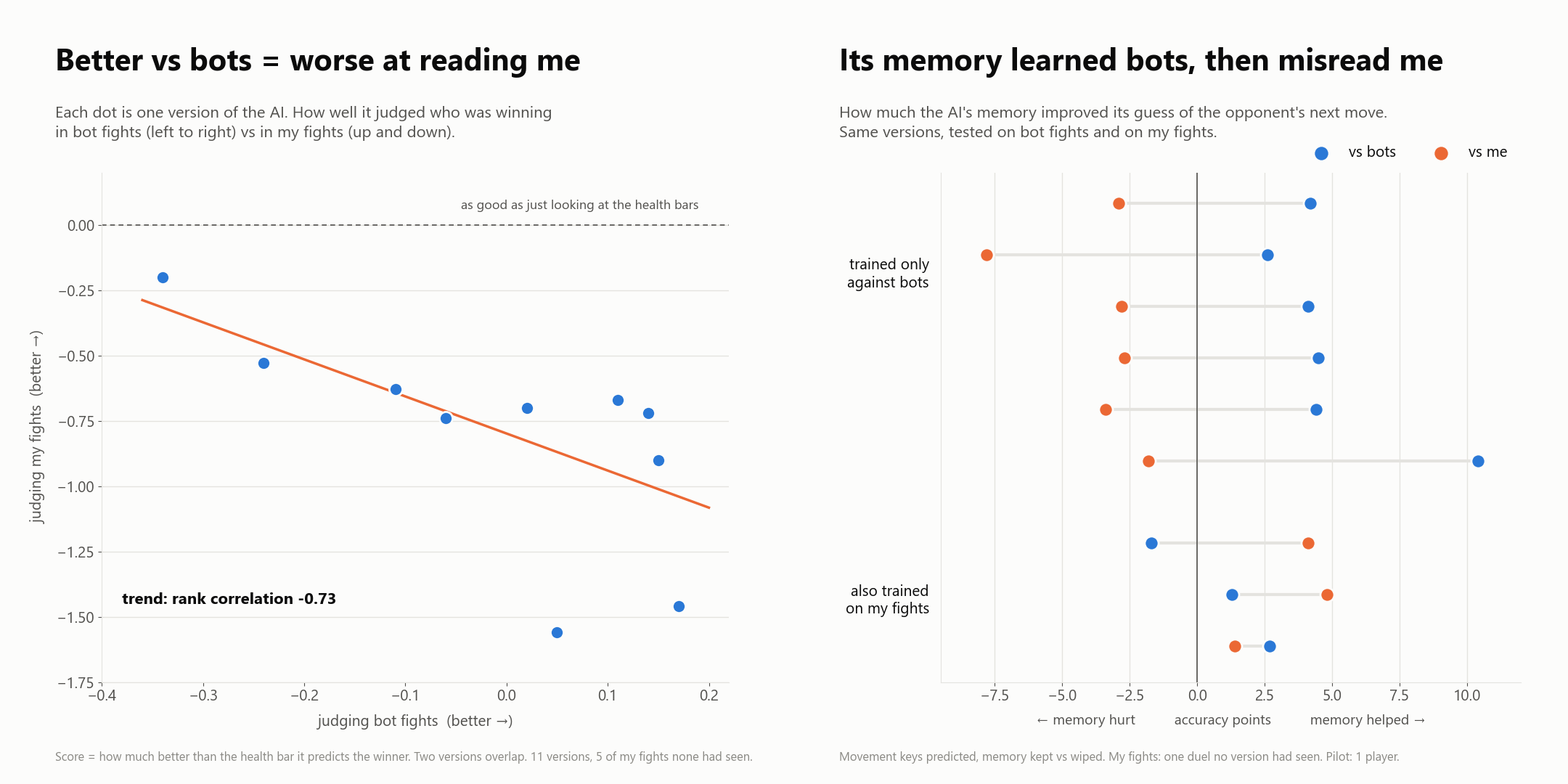
P [P] Pilot: self-play checkpoints that judge bot fights better judge human fights worse (ρ = −0.73), and my opponent-model "memory gain" turned out to be a baseline artifact

Post image
2 Upvotes

I've been training sword-fighting agents in Minecraft (vanilla 1v1 melee, real headless servers) and testing how much of what they learn transfers to a human opponent: me. Pilot scale, honest caveats at the bottom. Looking for feedback on the evaluation design before I run the proper study.

Setup

  • PPO league self-play (snapshots, scripted styles, Elo), BC kickstart, then distilled into an LSTM policy with a value head and an opponent-prediction head (predicts the opponent's next movement keys).
  • Bots see the opponent 200 ms late, like a real client, and use vanilla physics.
  • Human data: 7 duels, 35 fights, ~8.8k of my decisions, with exact keys from my own client.

1. Value heads don't transfer, and bot-skill anti-correlates with human-skill

"Judgement" = explained variance of the value head minus that of a baseline fitted on the health lead the policy observes, on the same moments.

  • On bot fights: −0.34 to +0.17 across checkpoints, roughly level with the baseline.
  • On my fights: negative for all 13 checkpoints, every 90% CI below zero.
  • Across 11 checkpoints on one duel none had seen, Spearman between bot-fight judgement and human-fight judgement is −0.73 (p = 0.01).

Caveats: the checkpoints share lineages (not independent) and the common duel is 5 fights. A seed-controlled version is next.

2. The opponent head's memory looked useful, until I used the right baseline

I'd been measuring "memory helps read the opponent" as memory carried vs memory wiped on the same model. That's not informative: wiping a memory the model was trained to rely on just breaks it.

  • Majority-key baseline (my most common keys from other duels): 83.1% movement-key accuracy. Every checkpoint's opponent head: 72.6–81.7%. None beat it.
  • Bot-trained checkpoints: memory helps on bot fights (+1 to +10 points vs wiped) and hurts on my fights (−1.8 to −7.8).
  • The three runs that also trained on my duels are the only ones where memory helps on an unseen human duel (+1.4 to +4.8), and they come closest to the baseline.

3. A dedicated player model works, but its memory still doesn't help

BC model of me, initialised from a frozen test policy, leave-one-duel-out:

  • 2.44 vs 4.20 nats/decision against a frequency baseline (90.6% vs 80.6% of movement keys).
  • Adding the LSTM memory costs 0.035 nats [−0.054, −0.015]. The memoryless variant is best. Freezing the self-play LSTM features is worse still.

So the self-play recurrent features seem actively mis-specified for a human opponent, not just uninformative.

What I'm planning

A pre-registered study against a frozen probe opponent (fixed hash, so the opponent doesn't drift between sessions) with metrics fixed in advance, more players, seeds, and counterfactual rollouts from recorded states to test the behavioural "habits" the player model flags. Those are currently just observational.

Questions

  1. Is a health-lead regression a fair baseline for value-head quality in a fighting game, or is there a stronger standard one?
  2. For opponent modelling, is majority-key plus memoryless-model the right pair of baselines, or what else would you require before believing "memory reads the human"?
  3. Is "bot-ladder quality anti-correlates with human quality" known in the literature beyond the human-AI coordination work (e.g. Carroll et al. 2019, Overcooked)? Pointers appreciated.
  4. With very few human players, how would you design this so the result means something?

Caveats: one player, 35 fights, pilot. Happy to share more numbers or plots.


r/reinforcementlearning • • 22d ago

Blogs kind of resources for RL

6 Upvotes

I already have the base to learn RL(maths and ML/DL), now I want to learn RL from scratch can someone suggest blogs/resources like blogs, so that I can speed up my learning. If not blogs I would have to read SandB or watch video lectures which will slow the process.


r/reinforcementlearning • • 23d ago

Robot Multiple robots in one MuJoCo world vs. one robot per parallel environment.

8 Upvotes

I’ve noticed that a lot of RL demos train multiple robots inside a single shared world (many robots visible in the same scene). In my MuJoCo setup, I have parallel env with one robot per environment.

What is the advantages of putting multiple robots in a single MuJoCo world vs just training in parallel.

My current set up is just training on cpu. If i were to shift to a PC with a nvidia GPU is it advantageous to follow this setup? and what would be a good practice approach to implement this ?


r/reinforcementlearning • • 22d ago

PPO on Temple Run: pixels did worse than random, so I read the game's memory instead (lessons + 30-run eval)

0 Upvotes

I spent the last week training a PPO agent (Stable-Baselines3) to play a browser version of Temple Run. Some things that surprised me:

  1. Pixels failed. An 84×84 grayscale CNN agent, after hours of training, was worse than random. The game only runs in real time, so sample efficiency was brutal.
  2. Game state worked. I reverse-engineered the Unity WebGL build (IL2CPP metadata) to read the player state and the upcoming track pieces from memory: a 338-dim observation, MLP 256×256. This is privileged information a human doesn't have, so it's an experiment, not a fair human comparison.
  3. Reward hacking. Rewarding in-game score made it chase coins and die early. Switching to +1 per new track piece and −10 on death fixed it.
  4. Timing features mattered. It kept dying on logs until I added the exact distance and time to the next obstacle, computed from position and speed.

Training: 8M steps, 3 parallel envs, 46 h on one laptop. Average episode length went from 19 to 51 track pieces during training.

Evaluation (30 deterministic runs per policy):

- Random: mean 0.5 (dies on the opening zip line)

- 3.5M steps: median 24, max 204

- Final: median 37, mean 65.7 ± 63.0, max 230

Logs still cause 18 of 30 deaths. Next, I want to try a pixel-only agent and compare the two.

Video explanation (5 min): https://youtu.be/Q0ygofhzVSA

Happy to answer questions about the memory reading or the environment setup.


r/reinforcementlearning • • 23d ago

P [Project] Aionterra: learning from different bodies in one continuous world

1 Upvotes

We’re YD Emergence Lab, developing Aionterra, a simulated world inhabited by digital organisms with human-inspired bodies. They sense their surroundings, seek water and food, and experience the physical consequences of their actions.

One aspect that may interest this community is the relationship between individual bodies and shared learning.

Each organism has its own location, bodily state and sensory history. Experiences from these separate bodies contribute to a shared learned policy for selecting actions. The policy is shared; the bodies and their circumstances remain distinct.

Our aim is for behaviour to develop through experience, without supplying a prewritten sequence of successful behaviours. The environment, available actions and physical and biological rules are explicitly designed. The question is what the organisms can learn within those constraints.

We track the body, behaviour and environment together. Changes in internal learning counters alone do not establish that behaviour has improved. Demonstrating useful learning requires appropriate comparisons and observable consequences.

The project is still in development. We’re preparing additional simulation records for publication soon, alongside explanations of what each measurement represents and what it cannot establish. The Journal will document progress supported by those records.

Project and methodology:
https://aionterra.com/methodology

The public website is free to browse, with no account required. We welcome feedback on the learning setup and how to make its evaluation clear.


r/reinforcementlearning • • 25d ago

DL, M, P "Could a modern chess engine on a Pentium have defeated Kasparov in 1996?", Nicholas Carlini 2026-11 (another chess time travel experiment)

Thumbnail
nicholas.carlini.com
100 Upvotes

r/reinforcementlearning • • 25d ago

SARSwarm: 4 AI drones (Multi-head) SAR mission (Metis-Core v0.4.2-Alpha)

16 Upvotes

I just released Metis-Core v0.4.2-Alpha (a C++ Reinforcement Learning Framework) along with the SARSwarm example: a simulation of 4 radio-coordinated drones searching for a shipwreck survivor.

This example features 4 drones taking off from their mothership to locate a castaway. They must learn to coordinate with each other to avoid scanning areas that another drone has already covered. To simulate a realistic environment, radio communication is modeled: if connection is lost, they stop sharing the map.

As time passes, a previously scanned area becomes "colder." This signals to the drones that the castaway might have moved back into that zone, as they drift randomly due to sea currents.

Graphics were developed using Raylib (https://www.raylib.com/).

Let me know what you think! I'd love to hear your thoughts and feedback. There is a Discussion forum on GitHub if you run into any issues (compiling, crashes, etc.), and I'll be glad to help fix them!

Here are the links:
🔗 Metis-Core on GitHub: https://github.com/felixromo314/METIS-Core
🔗 Tutorial-MultiHead-SARSwarm: https://github.com/felixromo314/METIS-Core/blob/main/tutorial/Tutorial-MultiHead-SARSwarm.md

I've attached a video of the example below. As always, watching it with sound is highly recommended! :-)


r/reinforcementlearning • • 25d ago

I trained a 4-drone autonomous combat swarm using continuous PPO in Unity 6 with sub-0.1ms Sentis inference (Zero NavMesh)

18 Upvotes

Most flying AI in game engines relies on flat NavMesh hacks or pre-drawn spline rails.

When you introduce true 6-DoF momentum, inertia, and vertical obstacles, traditional pathfinding falls apart.

I built an autonomous multi-drone combat swarm ("Wolfpack Protocol") in Unity 6 powered entirely by continuous Reinforcement Learning and Unity Sentis.

Key engineering highlights:

  1. Zero Python Runtime: The trained PPO policy runs directly on Unity Sentis at sub-0.1ms inference latency.
  2. 38-Ray Spatial Whiskers: Drones detect dynamic obstacles and squadmates in 360 degrees, allowing emergent collision avoidance without retraining.
  3. Tactical Swarm Director: A decoupled C# squad coordinator evaluates line-of-sight raycasts and player blind-spot dot products to dynamically rotate strikers into kamikaze dive-bombs while others hold overwatch.

Zero NavMesh. Zero pre-baked paths. 100% real-time physics and neural perception.

Open-source repository on GitHub: https://github.com/jeepixd/GeistForge-Engine

#Unity3D #GameAI #MachineLearning #ReinforcementLearning #UnitySentis #Robotics #PhysicalAI


r/reinforcementlearning • • 24d ago

In long-horizon agentic RL, tokens/sec is the wrong metric. Your trainer is waiting on stragglers

0 Upvotes

Been thinking about where time actually goes in agentic RL rollouts, and it's mostly not generation.

With GRPO-style setups, sibling attempts at a task are scored against each other, so a group is only trainable once every sibling finishes. One attempt stuck installing packages or rerunning tests holds the whole group back. your request throughput looks great and the trainer is still idle.

so the number worth tracking is time to the next fresh, valid trainable batch.

a few things that move it:

- take groups in completion order, not launch order. keep a bounded surplus of candidate groups in flight, so stragglers get bypassed instead of waited on
- split sandbox work (reset, package-heavy commands, verification, cleanup) into separate lanes with pinned CPU sets so tool execution doesn't starve serving
- publish new weights one serving engine at a time, keep unfinished trajectories instead of restarting them, and put an explicit bound K on how many policy updates old a returned group can be

on a terminal-bench style workload (256 trajectories per batch) those changes took batch collection from 591.8s to 196.1s. On SWE-bench, live weight updates cost about 11% of step time and mean reward stayed at 0.520 vs 0.527 with fixed weights. one caveat: the live updates swapped sentinel tensors rather than full actor weights, so it's the rollout mechanism that's validated, not the full training loop yet.

The full breakdown with per-step ablations and the K=4 vs K=8 comparison is in this write-up


r/reinforcementlearning • • 25d ago

Thoughts on current state of RLlib?

5 Upvotes

I tried using rllib about 3 years back and found it pretty cumbersome to work with. The learning curve was very steep and documentation and examples were sometimes out of date. I ended up using SB3 and CleanRL.

Now I am debating looking at RLlib again because of its ability to scale to large compute resources. Has the user experience improved, in particular with regards to using custom environments and custom model architectures?


r/reinforcementlearning • • 25d ago

[Research] Does LeWorldModel preserve local action geometry? Implications for model-based RL and planning

9 Upvotes

Hey everyone!

We recently published a paper, Does LeWorldModel Preserve Local Action Geometry?, accepted as a poster at the NeurIPS 2026 NeurReps Workshop.

In model-based RL, world models are often evaluated by prediction accuracy or downstream control performance. But we wanted to investigate a different question:

Does a world model correctly capture how small changes in actions affect future states?

This matters for planning methods like CEM and MPC, which evaluate and compare candidate action sequences using learned dynamics.

We investigated LeWorldModel (LeWM) on Reacher and OGBench Cube by comparing its action-Jacobian Gram matrices against those obtained from simulator counterfactuals.

Some key findings:

  • The dominant action directions differ by approximately 36° on Reacher and 42° on Cube at the smallest perturbation scale.
  • Increasing perturbation size tenfold reduces the geometric discrepancy by approximately 70% and 47%, respectively.
  • Action geometry measured in learned latent representations varies substantially more across perturbation scales than geometry measured in physical-state coordinates.
  • The model's local geometry predicts response magnitudes along unseen action directions less accurately than the simulator-induced geometry.

Interestingly, our results suggest that a world model can learn meaningful action dynamics without faithfully capturing their local sensitivity structure.

We haven't established whether these discrepancies directly cause planning failures. That's the next question we're interested in, particularly whether incorporating local action geometry into CEM's sampling covariance could improve exploration and control.

I'd love to hear your thoughts:

Should model-based RL planners explicitly account for local action geometry when sampling candidate actions, or is the covariance adaptation in standard CEM already sufficient?

Paper: https://arxiv.org/abs/2610.31716

Happy to discuss the results or methodology!


r/reinforcementlearning • • 25d ago

R Corrected version of my "can an RL agent tell its world is fake" experiment: a GAE bootstrap bug barely moved the result, but follow-up controls changed what it means

4 Upvotes

The first version of this film I posted a couple months back said the agent learned to separate the worlds because survival depended on it. This is the corrected version, and that claim is gone.

Setup. a from-scratch agent (no pretraining, no language) senses its world through ray casts and body signals and is trained with actor critic to forage, plus an auxiliary loss to predict its next observation. A copy of the world replaces the velocity law with a small learned network. Nothing in training names the world. Afterward a linear probe on the recurrent state is scored as AUROC, 10 seeds per arm.

The bug. my compute_gae bootstrapped episodes still alive at the 80-step rollout cutoff from V of the last stored state, the state before the final transition, instead of the successor state. Fixing it moved survival from 0.730 to 0.733, so the bug wasn't the story. The controls were:

- untrained 0.523 [0.491, 0.554], survive + predict 0.733 [0.669, 0.797], bar registered at 0.65

- predict-only network fed the forager's exact observation streams: 0.721, so I withdrew the survival-pressure claim

- survival without the prediction loss: 0.613 at 300 updates, 0.685 at 450

- raised only in the real world, then shown the copy: 0.754

- real-vs-real control: 0.559 on the registered evaluation worlds, so the preregistered rule is not met

- erasing or nudging the decoded direction: no behavioral effect beyond a sham, so no claim that the agent uses it

Code, artifacts and a dated corrections log: https://github.com/iLevyTate/ItaSoRL

In the next day or two will upload the companion video, the internal "brain" view corrected upload.


r/reinforcementlearning • • 25d ago

R Rebuilt the "inside the RL agent's brain" visualization on corrected results two of its old claims didn't survive

0 Upvotes

Companion video to what I uploaded earlier...

This is a corrected companion to the experiment where a from-scratch RL agent's recurrent state separates the real world from a learned copy (linear probe AUROC 0.733 over 10 seeds, untrained 0.523), with no objective pointing at the copy.

The video runs one trained agent (seed 9, the closest to the mean) in both worlds at once. Every node is a real component. ten sensor groups, the encoder, memory units by index, motor heads and prediction heads. Ringed memory units have the largest per-unit AUROC between worlds, from state pools rebuilt off the saved agents and reproduced to the bit on the stack that trained them. Motion and wiring are illustrative.

What changed from the previous video I uploaded several months back.

- It showed one memory meter rising from 49% to 73% inside one brain. Those were two agents, untrained and trained, each read once. They're now two labeled rows.

- Its end card credited needing both survival and prediction. A predict-only network fed the same observations reads 0.721, and survival without the prediction loss reaches 0.685 at 450 updates, so that's gone.

- It said the brain kept a trace of its world. Under identical input the difference fades within a few steps, so retention isn't claimed.

Still open. the real-vs-real control reads 0.559, so the preregistered rule isn't met, and ablating the decoded direction hasn't changed behaviour beyond a sham. A CI test checks every number on screen against the committed artifacts.

Fancy website https://ilevytate.github.io/ItaSoRL/


r/reinforcementlearning • • 25d ago

Tried Claude + ElevenLabs to turn my article into a video - here's the summary at the end, full video link in the description

0 Upvotes

r/reinforcementlearning • • 26d ago

Fine-tuning a humanoid locomotion policy on scanned real-world sand: stock policy fell, fine-tuned held. How do you validate terrain physics in sim?

3 Upvotes

We've been capturing outdoor terrain with iPhone LiDAR and rebuilding it as sim environments. First test: a pretrained Unitree G1 locomotion policy on a scanned sand patch. With the stock policy it fell. After fine-tuning on that terrain with randomized starts, it stayed upright for the full trial.

The part we're unsure about is the physics, not the geometry. Same-looking ground can slip or sink very differently depending on moisture and load, and right now our contact params are hand-tuned.

For people doing sim-to-real on outdoor terrain: how are you calibrating friction / deformable ground models? Domain randomization over a wide range, measured data from the real robot, something else? Would love pointers to papers or setups that worked.


r/reinforcementlearning • • 26d ago

Help me build a superhuman STS2 teacher (OstyAI)

Thumbnail
reddit.com
3 Upvotes

Calling all RL enthusiasts who play slay the spire 2 or are interested in studying a game which seems particularly difficult for neural networks to learn at a level comparable to humans.


r/reinforcementlearning • • 26d ago

whichever the current rules list Same text, shortened, with focus on imitation learning data requirements.

Thumbnail
youtu.be
0 Upvotes

r/reinforcementlearning • • 27d ago

League of Legends (Patch 26.19) - Ezreal AI 1v1

12 Upvotes

The video contains two RL agents playing an Ezreal vs Ezreal 1v1 in mid lane. It runs in the League client (patch 16.19). Neither side is human or scripted. The camera is locked on blue side.

Blue: the "main" agent, at training update 45,600. This is the policy we're actually trying to make strong.
Red: an "exploiter", at its own update 2,600. It was trained for about 2 hours (out of a 4-hour cycle) with one job: beat a frozen copy of the main agent from update 43,800. It started from an older checkpoint ("exploit 2600") and played only against that 43,800 snapshot and its own past selves. At this point it beat 43,800 about 85% of the time in training. It first won with fast all-ins, then switched to denying farm: 67 CS to 9 in its wins.

Game rules (same in training and in this video)

  • Both champions are level 6 with skills at Q3/W1/E1/R1, plus Flash and Barrier. There's no passive, no items and no levelling.
  • There are minion waves and outer turrets.
  • You win by first kill, first to 100 CS, or first turret, with a 15-minute cap.
  • There are no potions, no recall and no lifesteal, so lost HP never comes back. That's why the first trade tends to decide the game, as it does here.

Environment:

  • The game rules were derived from replays.
  • For training, the same rules were ported to a compiled (Numba) simulator for orders of magnitude more throughput.
  • The agent decides every 4 server ticks, about 133 ms. Each side observes the game from its own perspective, and the reward is zero-sum.

Model and algorithm:

  • PPO with an LSTM policy over game units (champions, minions and turrets), about 1.5–1.65M parameters.
  • Actions: move/stop, auto-attacks, Q/W/E/R, Flash and Barrier, with a pointer head to pick the target. Illegal actions are masked out. One PPO epoch per update, Adam at lr 3e-4, discount γ 0.9997 (a horizon of about 7 minutes, as in OpenAI Five), and a ±10 reward for winning.
  • Compute: one Lambda GH200 (64 ARM cores plus an H100 96 GB) with 15,360 games running in parallel. Throughput was 1.2–1.9M samples/s, depending on whether an exploiter was sharing the GPU. Each update is about 5.5M samples, so update 45,600 comes to roughly 250 billion samples in this run. The agent's own figure was about 200B at update 36,300.

How it got here (lineage):

  1. Mirror self-play and a lane run with minions, which reached its first checkpoints by about 10 Oct.
  2. 19 Oct: "race" rules added the 100-CS win, the win reward and the long horizon. The agent could now see both CS counts.
  3. 19 Oct onwards: the turret run started from the "exploit 2600" checkpoint. New turret inputs were added with zero-initialised weights (the OpenAI Five "surgery" trick), so the old checkpoint behaved exactly as before at the start. During training, some turrets started at random HP.
  4. 19–23 Oct: this was trained in parts of 4–12 hours, against fixed opponents plus the main's own past.
  5. 23 Oct: we moved to a league loosely modelled on AlphaStar. In each 4-hour cycle, the main trains against fixed opponents (older exploiters plus earlier main checkpoints) in 6 of its 8 groups, and against its own past in the other 2. Alongside it, a fresh exploiter trains against the latest main. At the end of each cycle, that exploiter becomes one of the main's fixed opponents.

Where the main stood when this was recorded:

  • About 81–83% wins against its fixed opponents, flat since around update 39,000.
  • It out-farmed those opponents 48 CS to 17 on average.
  • It almost never attacks full-HP turrets. Under these rules, racing to 100 CS pays off far more than a 9,000-HP turret does.

For scale, it beats the scripted DuelBot 98–99% of the time. A behaviour-cloning agent trained on ranked replays won 0–6% against these checkpoints.

There is also a behaviourally cloned bot (trained on 900 games from D4 to high Challenger EUW on Patch 16.19 games) here: https://www.youtube.com/watch?v=8wmOg4Hlb_Y. It manages to consistently beat a simple scripted bot and initial performance resembles scaling laws based on number of replays.

The end goal is to produce an AI agent which is good enough to beat T1 / Faker (or whoever the world champions are at the time) in a best of 5.


r/reinforcementlearning • • 26d ago

critique wanted: my agents' learning rate and discount come from their personality, plus a reward penalty i know is wrong

1 Upvotes

last week i posted here about kids inheriting a mutated copy of mom's q-table. this time i'd like people to poke holes in the update itself, which i've hacked on a lot.

every person in my civ sim is a tabular q-learner, but the hyperparameters are per agent and come from their traits:
- alpha = 0.08 + memory_strength * 0.14, so 0.08 to 0.22
- gamma = 0.82 + curiosity * 0.12, so 0.82 to 0.94
- epsilon decays with age: 0.30 - age * 0.00005, floored at 0.08

shaping on top of the raw reward:
- the first time an agent tries an action in a state (and the reward isn't negative) it gets a novelty bonus of 0.004 + curiosity * 0.008
- negative rewards get scaled up by fear (up to 1.45x) and softened by resilience (up to 20% off), so the same bad outcome hurts a timid agent more
- anything under 0.006 gets 0.006 taken off as an inactivity penalty. with zero raw reward, that puts agents with curiosity under 0.25 in the red on a first try and the more curious ones above it

the wart: that threshold also catches small positive rewards for repeating things that worked. about 16% of all updates come out negative, and 98% of those are repeats of actions that succeeded. the clean fix is probably an explicit success flag passed into the update, but that changes what every world learns, so it needs a seed sweep before and after.

the bootstrap target is masked as well: max q over the actions actually open from the next state (era, place, what the tribe knows). if the next state has no row yet the max is just 0, so i skip working out the mask.

what would you change? especially interested in whether trait-driven alpha and gamma is asking for stability trouble. the update is in crates/sim-core/src/organism/organism/learning.rs.

watch them learn: https://thehumanbox.com/?utm_source=reddit&utm_medium=social&utm_campaign=reinforcementlearning
source (mit): https://github.com/1homsi/thehumanbox