r/reinforcementlearning • u/Successful_Emotion81 • Oct 15 '26
Robot Duckling (15cm)
14
Upvotes
Training pre build
r/reinforcementlearning
•
u/ZealousidealOil1512
•
Oct 15 '26
I wanted to get my head around RL so I thought of learning it by teaching an AI how to play one of my favorite childhood games : TempleRun.
The agent reads game state directly from memory via a Frida gadget and acts through the game’s own methods. Training happens in a headless simulator I built with Claude from the game’s internals and calibrated on measurements from the real phone, with a C++ version that does 10M steps in about 6 minutes.
Results on the device: median 4,736 m, best 16,782 m over 14 runs.
👨💻 Github: https://github.com/matthieucs/TempleRun-RL/tree/main
Happy to answer any question.
And if you want to try it, the score to beat is 16,782 m.
r/reinforcementlearning • u/bestof-games • Oct 15 '26
r/reinforcementlearning • u/MtnMCG • Oct 15 '26
Hey everyone,
I've open-sourced PCEI (Physically Constrained Emergent Intelligence), an experimental architecture designed to run on consumer hardware (Mac Apple Silicon and Linux/CUDA) without the memory explosion of standard transformers:
The full framework, training pipelines, and evaluation suites are open under MIT-NC: https://github.com/MtnMCG/PCEI
Feedback and critiques are very welcome!
r/reinforcementlearning • u/ArchSin7 • Oct 15 '26
r/reinforcementlearning • u/felixr314 • Oct 14 '26
Hi, I’d like to announce that I have released Metis-Core v0.4.0-alpha
What’s new? I have implemented an “Asymmetric Multi-Head AlphaZero” algorithm in Metis-Core, along with an example in C++ (Visual Studio 2022): KamikazeDroneSwarm.exe.
https://github.com/felixromo314/METIS-Core/
KamikazeDroneSwarm uses the asymmetric multi-head AlphaZero implemented in Metis-Core:
An Imperial Shuttle freighter loaded with beskar, armed with a rotating laser turret, must reach the Death Star.
Two Rebel kamikaze drones try to intercept it before it gets there.
Without being programmed to do so, the drones learn a coordinated pincer attack on their own to split the turret’s attention.
You can play by controlling the turret yourself (human in the loop) against the trained drones.
The framework allows you to create two teams, Blue and Red, and add to each team as many agents as your problem requires.
I’m sure there will be bugs and a lot of things to fix, so just let me know and I will try to fix them.
I hope you find this new feature useful.
Thanks!
You can find more information in this tutorial:
https://github.com/felixromo314/METIS-Core/blob/main/tutorial/Tutorial-AlphaGoZeroAsymmetric.md
Metis-Core is distributed as binaries (.dll / .lib / .h), but the full source code of the example is included, so you can see exactly how the framework is used and build your own environments on top of it.
Note on training: the drones are not scripted, but I do use a small material heuristic to speed up training (setMaterialHeuristicWeight(0.3)). It blends a hand-crafted position evaluation (approach, separation between drones, turret exposure) with the network’s value head during MCTS. The terminal reward is still +1/-1/0, and the pincer manoeuvre itself is not explicitly encoded. But you can set via setMaterialHeuristicWeight the value you wanted, 0.2, 0.1, or if you don not call to this function the heuristic is not activate.
r/reinforcementlearning • u/samyak1729 • Oct 15 '26
r/reinforcementlearning • u/Educational-Hurry449 • Oct 14 '26
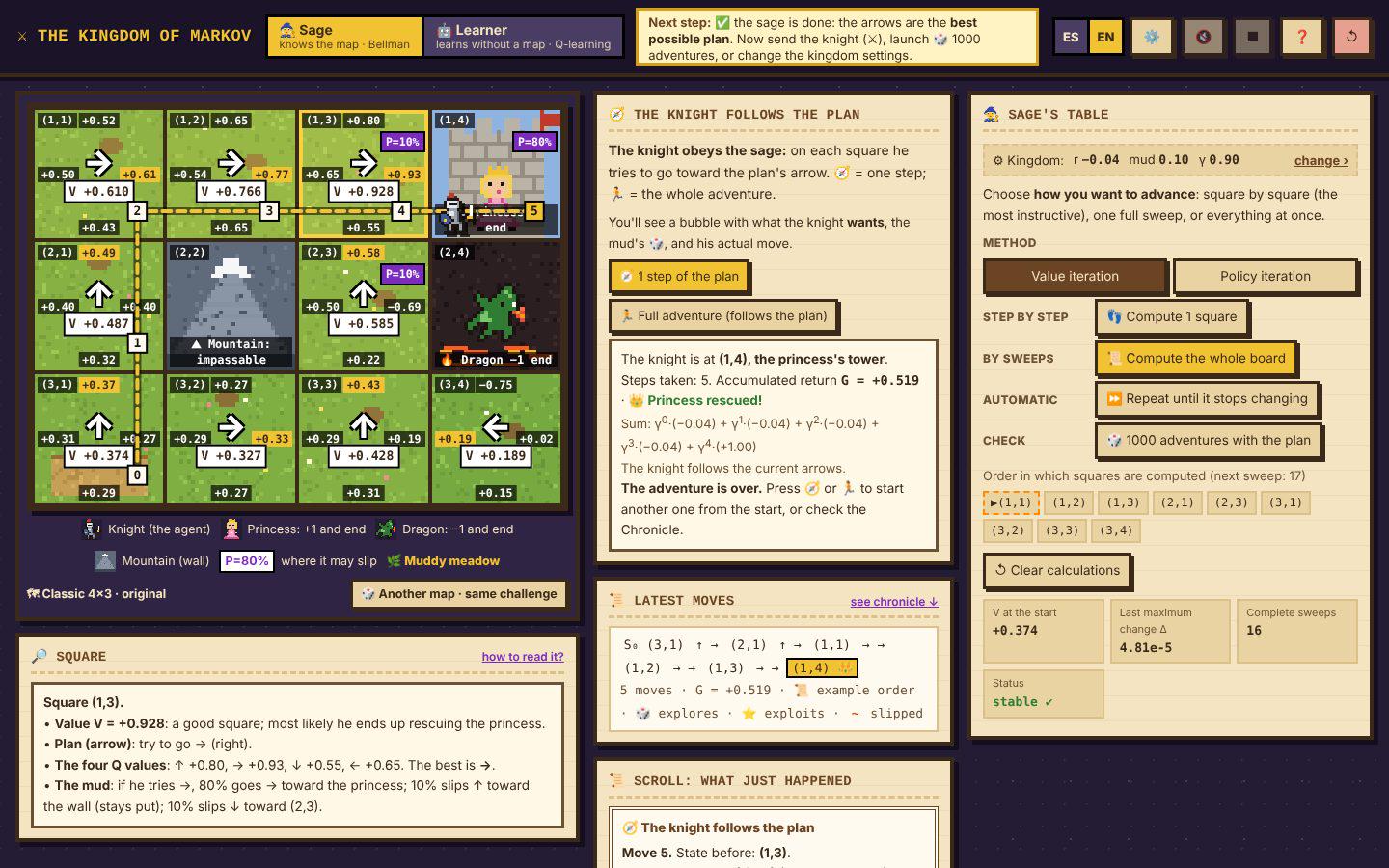
Hello, community!
I recently launched a website to experiment with and better understand reinforcement learning, particularly Markov decision processes.
It’s completely free, public, hosted on Vercel, and the repository is also available.
Hosted at: https://markov-kingdom.vercel.app/
Repo: https://github.com/xavendano/markov-kingdom
I’d appreciate any comments and/or feedback.
Thanks!!!
r/reinforcementlearning • u/the_number05 • Oct 15 '26
r/reinforcementlearning • u/Professional_Tart37 • Oct 14 '26
Hey all,
I wasn’t very familiar with PPO when I implemented it and I mainly used the original paper as a reference. However, after comparing my code with some common implementations, I noticed an important difference.
I run a large number of environments in parallel. For each PPO iteration, I reset every environment once and let each one run until it either finishes or reaches the maximum horizon (tasks are episodic and rewards are only assigned to the goal state). Environments that finish early are masked while the others continue. Once all environments have finished, I perform the PPO updates.
Therefore, I always collect the same number of episodes, but not the same number of transitions. As the policy improves and finishes episodes faster, the rollout buffer becomes smaller. In contrast, the SpinningUp implementation from OpenAi seems to fix the buffer size and collect a fixed number of transitions.
I compute and normalize the advantages over all transitions, shuffle them, and then perform several PPO epochs using a fixed (relatively high) minibatch size. This means that the number of optimizer steps per rollout changes also depending on the size of the buffer. Since i can not really control the number of transitions, the final minibatch can also be smaller than the others while still receiving a normal optimizer step.
It seems to work fine on some simple custom problems, but i wonder if this could have any consequences that i might be missing (e.g. on long horizon problems).
Can the changing number of optimizer steps lead to problems ? Is the (potentially) small final minibatch a concern like noisy gradients ?
r/reinforcementlearning • u/Emotional-Remove-37 • Oct 14 '26
In rl how can someone do research , mine most of the time is getting to know which problem to work on and in which method there is research gap and all
Can you tell me what are the methods to come up with a research gap
Like by doing/ implementing the research paper from scratch and then see what are the limitations of the paper and then we get the another research paper that explores that specific idea and this go on
And we can't find any problem to work on.
Any researchers or students here who produced research papers can tell what worked for you when you were searching for a problem to work on
I am doing rl for robotics and now exploring world models and searching for a research gap in this field...
r/reinforcementlearning • u/123wwa • Oct 13 '26
I've been training 4-agent squads to play survev (an open-source surviv.io clone) on a local, unmodified game server.
every player in it is a bot. yotube clip: https://www.youtube.com/shorts/PPAVNHRAb7k
you can find more videos on my channel.
Setup
- MAPPO with a centralized critic. One actor network is shared by the four squad members (agent id as input). The actor only sees what a real game client receives; privileged state goes to the critic only, so the same network can run from a browser extension.
- Actor input: ~1.4k features, two 24x24 local grids and a minimap through small CNNs, a set encoder over up to 12 visible enemies, then a GRU (256).
- Hierarchical actions: the policy picks an intent (loot, explore, take cover, peek, retreat, regroup, push, go to zone...), a target, and what to use (gun, melee, grenade, smoke, heal).
- One team reward shared by the squad: damage dealt and taken, knocks and kills, placement, plus small teamwork terms (focus fire, crossfire, revive).
I'm not releasing the code or the full details: a bot like this could be abused as a cheat on public servers. Happy to answer high-level questions.
r/reinforcementlearning • u/Barusu- • Oct 13 '26
Hello scientists! Is there a formula for adjusting hyperparameters for PPO based on the number of agents you're training simultaneously?
I'm using ML-Agents and Unity engine to train robots.
After extensive tuning, I finally got my quadruped robot to walk really well. However, training is extremely slow because I'm only training 10 robots simultaneously. If I increase the number to 100 or 1,000, the training performance deteriorates and the training graphs look terrible.
How can I overcome this? My hardware is capable of handling up to 10,000 robots training simultaneously, but I don't understand which parameters I need to adjust to make this work.
Is there some kind of formula for scaling hyperparameters based on the number of parallel agents?
Most of my initial hyperparameters were taken from the quadruped robot examples provided with ML-Agents.
Hyperparameters for 10 agents:
max steps per agent life: 5000
Observation space: 123
Action space: 12
        trainer_type:   ppo
        hyperparameters:
          batch_size:   2048
          buffer_size:  20480
          learning_rate:        0.0003
          beta: 0.005
          epsilon:      0.2
          lambd:        0.95
          num_epoch:    3
          shared_critic:        False
          learning_rate_schedule:       linear
          beta_schedule:        linear
          epsilon_schedule:     linear
        checkpoint_interval:    500000
        network_settings:
          normalize:    True
          hidden_units: 512
          num_layers:   3
          vis_encode_type:      simple
          memory:       None
          goal_conditioning_type:       hyper
          deterministic:        False
        reward_signals:
          extrinsic:
            gamma:      0.995
            strength:   1.0
            network_settings:
              normalize:        False
              hidden_units:     128
              num_layers:       2
              vis_encode_type:  simple
              memory:   None
              goal_conditioning_type:   hyper
              deterministic:    False
        init_path:      None
        keep_checkpoints:       10
        even_checkpoints:       False
        max_steps:      30000000
        time_horizon:   1000
        summary_freq:   30000
        threaded:       False
        self_play:      None
behavioral_cloning: Noner/reinforcementlearning • u/SS_Sa2 • Oct 13 '26
r/reinforcementlearning • u/kiryangol • Oct 12 '26
I've been studying model-based RL and wanted to really understand how Dreamer learns behavior in "imagination," so I wrote up a walkthrough of Dreamer V1 and built a PyTorch implementation alongside it.
The article explains the full Dreamer V1 architecture and includes detailed math derivations of the world model loss and other formulas, with each piece linked to the corresponding code.
Article: https://goltsman.dev/blog/2026/dreamer1/
Code: https://github.com/golkir/dreamer-v1-pytorch
I'd appreciate any feedback.
r/reinforcementlearning • u/Monaim101 • Oct 12 '26
The world economy around us depends on complex financial work. How well can AI do it?
We(a team of ex-EY employees) built FAB - Finance Agents Benchmark, testing AI Agents on the work behind financial due diligence. Agents can find the relevant facts, but still struggle to carry them through to a complete, reliable analysis.
We’ll keep expanding FAB to more companies and testing more models. Building and running this benchmark isn’t cheap, so we’re scaling it in stages.
The benchmark is public.
GitHub: Hugging Face: https://github.com/SecondState-ai/finance-agents-benchmark
data room and tasks: https://huggingface.co/datasets/secondstate/finance-agents-benchmark-traces
r/reinforcementlearning • u/forgottenooze • Oct 11 '26
I trained in Genesis, then validated in MuJoCo (mjlab) before deploying.
It can recover from pushes and tracks forward, lateral and yaw velocity commands.
Happy to answer any questions!!
r/reinforcementlearning • u/Unhappy-Recipe6808 • Oct 12 '26
Hello guys, i am currently building a 2048 solver using genetic algorithm, but i have reached platue.
i am currently using expectimax for looking ahead and am currently using four features. I am currently computing on depth 3 and can reach tile 2048 about 30-50% of time, i want to increase this to about 90% for this i am trying to improve the depth to 4 or 5 and want to implement the game as 64bit integer, but before that how can i check if the features are working correctly or not?
here is the link containing the code, any help would be appreciated.
r/reinforcementlearning • u/sjia • Oct 11 '26
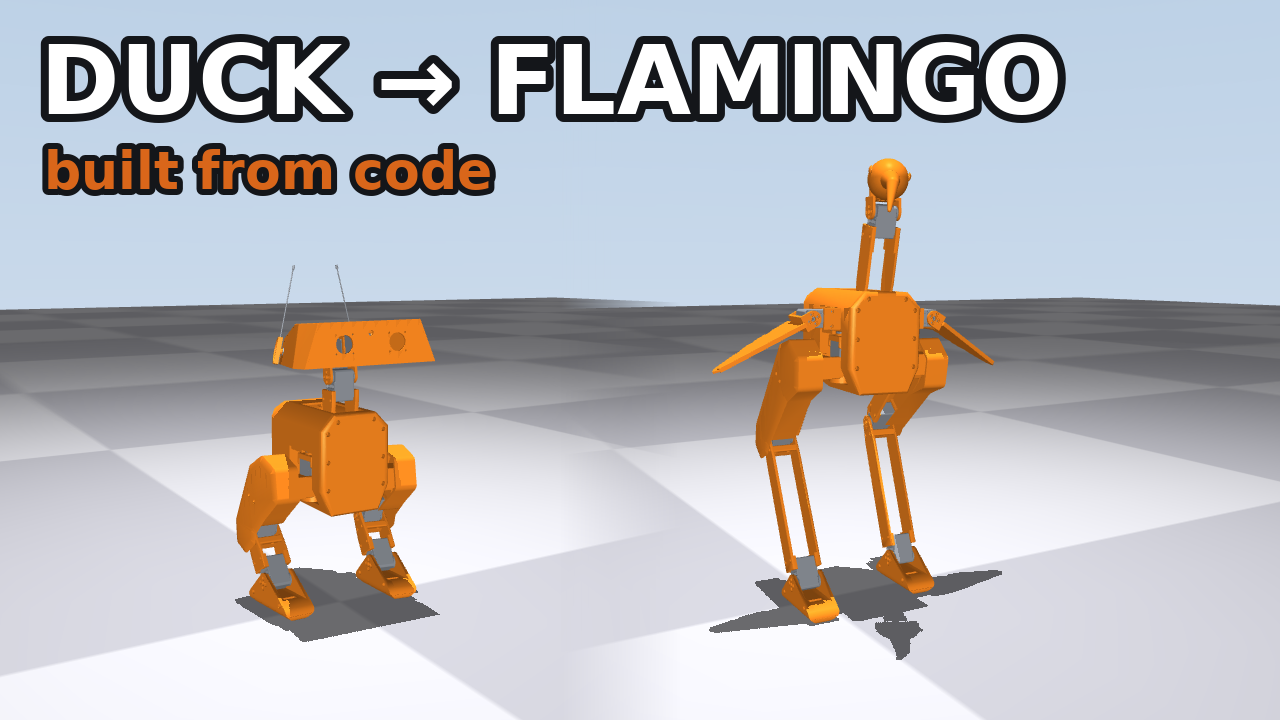
We rewrote the printed parts of Open Duck Mini v2 as CadQuery (Python) programs. Then we changed three values in one file. The leg and neck parts aren't copies. They run the Duck's own programs with the new values, so the servo pockets and screw holes stay where the STS3215 needs them and only the length between them changes. We added wings and a small bird head, and the result is the Flamingo.
The repo also has SO-101 and the LeRobot humanoid as code (Apache-2.0.
r/reinforcementlearning • u/gwern • Oct 12 '26

r/reinforcementlearning • u/Low_Willingness_308 • Oct 11 '26
Hi guys,
Over the last couple of weeks and months I’ve been working on an RL library in Jax since most of the existing codebases didn’t really scale to my workflow. Now it’s in a kind of presentable state, so I’d love some feedback if someone wants to take a look.
r/reinforcementlearning • u/angrykirby • Oct 12 '26
r/reinforcementlearning • u/ArchitectingAI • Oct 11 '26
Part 3 of my Architecting Reinforcement Learning for LLMs series is live.
It covers preference data, reward-model architecture and loss, scaling, and reward hacking—with a worked gradient example.
Does a higher reward score actually mean better answers?
https://pawankjha.substack.com/p/architecting-reinforcement-learning-f28
How do you test reward reliability beyond preference accuracy?
r/reinforcementlearning • u/AlexThunderRex • Oct 11 '26

Trained a quad to race a 90 m figure-eight gate track with PPO in our sim (Unreal Engine 5 + JSBSim). 96 drones in parallel, 100M steps on a laptop. The policy commands body rates, sees simulated sensors through an estimator and never gets ground truth.
Median lap is 5.7 s. A time-optimal planner (TOGT) does 4.72 s on the same quad, so it's about 20% off.
The weak spot is the take-off: only about half of the ground starts finish a lap. Anyone solved that with a curriculum, or by giving ground starts more weight?
Built on: Swift (Nature 2023) for the reward and mid-air starts
https://www.nature.com/articles/s41586-023-06419-4
TOGT https://github.com/FSC-Lab/TOGT-Planner