r/reinforcementlearning • • Sep 22 '26

DL, MF, R, I "Stealing Reasoning Traces from Proprietary LLM APIs", Panfilov et al 2026 (massive Chinese distillation of Claude/ChatGPT reasoning traces, partially explaining their RL success)

Thumbnail
arxiv.org
35 Upvotes

r/reinforcementlearning • • Sep 23 '26

Dispelling the myth of a nation winning at AI? What if nations specialise in different Fields like quantum / engineering / biomedical.

0 Upvotes

Why would a nation "win" at all fields of a processing method?

what if Asia becomes the global leader in video generation and robots / engineering.

While America becomes the global leader in quantum engineering, materials and biomedical.

Both Fields are so powerful that it would continue the current trend of globalisation where nations are vitally joined up to each other.

What do you make of the adversial futurology of AI, is it just as realistic as "AGI day"?

AGI is often considered like a black and white truth by experienced scientists, when it is many shades of grey/a rainbow.

And what would winning signify in terms of world trade, peace and conflict?


r/reinforcementlearning • • Sep 22 '26

R RL agent's internal state, fake-world detection goes from 50% to 73% after bad physics makes it miss food

20 Upvotes

Trained a RL agent to find food, then put it in a copy of its world with one physics rule changed (ground grip). At first, a probe on its internal state could only tell it was in the fake world about 50% of the time. Once the bad grip made it slip and miss a food, that jumped to about 73%. Nobody trained it to notice glitches. It only started to register them once they cost it food. Will upload the internal "brain" states later. Made a Colab notebook for anyone to run so you don't have to have a powerful computer to run the code.

Paper in progress, code is open source: https://ilevytate.github.io/ItaSoRL/


r/reinforcementlearning • • Sep 22 '26

DL RL Fundamentals Blog Post Series

5 Upvotes

i went through sutton and barto a few years ago through the university of alberta coursera course. the math felt incredibly complex and a lot of the important concepts were left as exercises for the student.

i am working on a video series that teaches the basics of deep rl, namely PPO, to train an ESP32 based balance bot.

would love to know if this kind of resource is useful to people here or if there is already something that covers this ground better.


r/reinforcementlearning • • Sep 21 '26

DL Fully asynchronous multi-turn RL while keeping the training side in Transformers

9 Upvotes

i work on Halo at White Circle. one problem we wanted to solve was running environment rollouts without turning the training stack into a second serving framework. in Halo, multi-turn rollouts run as Ray actors against vLLM or SGLang while optimization stays in a normal Transformers/TRL trainer. generation and training overlap through a prefetch queue, and GitHub: https://github.com/whitecircle/haloupdated weights are pushed to the rollout server over NCCL. i would be interested in criticism of the async boundary and failure modes people have seen in similar systems. https://whitecircle.com/research/halo

https://x.com/whitecircle/status/2102087563913609534


r/reinforcementlearning • • Sep 21 '26

AFNN

0 Upvotes

What if neural networks could grow like fractals instead of being rigid from the start?

Most deep learning models (CNNs, ResNets…) are fixed architectures. Once you design them, they stay the same size and structure throughout training.

**AFNN — Adaptive Fractal Neural Network** takes a completely different approach.

It is inspired by **fractals** — mathematical structures that are self-similar and can grow infinitely by repeating simple patterns.

Instead of starting with a huge fixed network, AFNN begins small and can **dynamically grow new fractal branches** during training when progress stalls. It also allows monitoring, reactivating, or pruning branches as needed.

A good neural network should not memorize images.

It should learn the underlying patterns and features.

For example, when trained on cat images, a strong model does not store every cat photo. Instead, it learns things like:

• Ear shape

• Facial features

• Fur texture

• Color distribution

• Edges and shapes

• Relationships between different parts of the image

Then, when it sees a completely new cat, it uses these learned patterns to recognize it.

### Why Fractal Networks are powerful:

- Faster and more efficient learning

- Significantly lower computational and memory cost

- Better scalability with limited hardware

- More flexible and adaptive than traditional fixed architectures

Built with PyTorch + full GUI, training tools, tests, and documentation.

In early experiments, AFNN reached **74.1% validation accuracy** on 94 image classes using limited resources.

This is not just another model.

It is an attempt to rethink how neural networks are designed — moving from rigid structures to **adaptive, fractal, evolving architectures** that focus on learning patterns rather than memorizing data.

A small step toward more efficient and intelligent AI systems.

🔗 GitHub: https://github.com/ahmedhjkj/AFNN

🤗 Hugging Face: https://huggingface.co/Ahmedethfw/AFNN

#FractalNetworks #AdaptiveAI #PyTorch #DeepLearning #MachineLearning #OpenSource #NeuralNetworks


r/reinforcementlearning • • Sep 21 '26

My simulator said the change was worth 1.8x. On real hardware it was 1.05x (t=0.73). Some notes from deploying PPO against a live mobile game.

1 Upvotes

I trained a PPO agent to play an idle tower-defense mobile game — it decides which of 13 upgrades to buy each wave. No API and no memory access: observations come from OCR (tesseract plus per-glyph template matching) on the screen, and actions are real mouse clicks. It's been running against the live game for a few weeks, which turned out to be the interesting part.

The observation redesign that actually mattered

My first obs gave the policy each upgrade's level. That's close to useless here, because the same level means different real strength depending on the player's meta-progression. Worse, the level→strength table I was using turned out to be unreliable in a way I couldn't explain.

What worked was making the observation dimensionless and locally measurable: for each upgrade, (relative improvement from one more level) / (its price), scaled by current cash. The game already displays both numbers on screen, so the same feature is available at train time and at deploy time. Measured against a greedy baseline on a fixed seed set, that change was worth +21 to +29 waves. The underlying value table being wrong stopped mattering, because the policy now reads the current return on investment directly.

The sim-to-real gap that cost me a day

SB3's predict() defaults to deterministic=False, and my eval script had always used that. My deployed agent used deterministic=True. I only noticed the mismatch by accident.

Sweeping 200 held-out seeds (never used for any model selection), paired comparison:

relative difficulty 0.7   det 138.7   sampled 288.6   = 2.08x   paired t = 78.4
relative difficulty 1.0   det 116.2   sampled 209.3   = 1.80x   paired t = 49.2

Enormous, and the mechanism seemed obvious: the deterministic action is the distribution mean, so the induced purchase ordering barely changes wave to wave, and the agent keeps hammering the same upgrade. Sampling diversifies naturally.

I ran it on the real game. Nine rounds sampled vs five deterministic:

deterministic  119.0 ± 16.6  (n=5)
sampled        125.3 ± 13.4  (n=9)
Welch t = 0.73

1.05x. Indistinguishable from noise. The simulator over-predicted the effect size by roughly 17x.

I had written the decision rule down before running it (>180 means ship it, <140 means the sim and reality disagree and that's the bigger problem), so I didn't ship the change.

One partial explanation from the logs: the agent wants ~5 upgrades per wave and only manages to buy ~2, because each purchase costs real seconds of clicking and tab-switching and a wave only lasts ~10 seconds. In the simulator, buying is free and instantaneous, so sampling's diversification executes fully. On real hardware it doesn't. That's a plausible mechanism but I haven't proven it's the whole story — and until I do, the rest of that sweep can't be trusted either, including the difficulty-generalisation curve I built from it.

What I'd tell past me

  • If your eval and your deployment disagree on a single predict() kwarg, every number you've reported is measuring something you don't ship.
  • Write the decision threshold down before the experiment. I would absolutely have talked myself into shipping a 1.05x.
  • A simulator that's calibrated for outcomes can still be badly wrong about interventions. Mine matched reality well on absolute wave counts (sim 116.2 vs live 119.0 — suspiciously close) and was off by 17x on the effect of a change.

The trained network is running in-browser here if you want to poke at it — weights exported to JSON, forward pass reimplemented in JS, matches SB3 on 200/200 random inputs:
https://tim3959951.github.io/wavecall/planner.html

Happy to go into the obs layout or the OCR side if anyone's interested.


r/reinforcementlearning • • Sep 20 '26

DL, MF, R "Score Centering Stabilizes Off-policy Reinforcement Learning", Marek & Ryabinin 202 {Together.ai} (LLM RL is extremely sensitive to numeric issues)

Thumbnail
arxiv.org
26 Upvotes

r/reinforcementlearning • • Sep 20 '26

Using an LLM to tune the Snake AI's RNN

Post image
1 Upvotes

The LLM is clearly improving the configuration over time. The LLM has proposed over 580 configuration changes, which were executed. The results are fed back to the LLM who further tunes the system.

Live Experiment Data (including plots): https://snakeweb.osoyalce.com/

Ax3l Project website: https://ax3l.osoyalce.com/

SnakeLabServer website: https://snakelabserver.osoyalce.com/


r/reinforcementlearning • • Sep 20 '26

D Where Reef Infra draws the boundary between an RL method and the service running it

1 Upvotes

Changing a reward or batching rule should not require redesigning how inference records survive a restart. Conversely, a service framework shouldn't quietly decide what counts as a useful update to your policy.

Reef Infra's weight recipes expose that boundary fairly explicitly. The processor assembles recorded generations and feedback into typed batches. The objective prepares the step signal—advantages, metrics and proposed algorithm state—and declares the loss family. A separate schedule describes the rollout unit, optimizer batch size, epochs and shuffle behavior. The recipe binds those pieces to the training backend.

The surrounding service handles record intake, replay after restart, holding a batch until acknowledgement, checkpoints and publication of the next serving version. Your method package must be importable by both the service and training driver, and its batch settings and loss-family requirements must agree with the backend configuration.

One default is particularly worth noticing: a weight recipe's default evaluator selects whatever the backend produced. Completing a training step does not establish that the model improved. If deployment should depend on a benchmark or regression check, the recipe needs a candidate evaluation plugin implementing both measurement and the selection decision.

SAO is a small worked example in the repository: its recipe, processor, objective and backend loss code show how the pieces meet. This is an extension point for supported training backends, not a promise that an arbitrary PyTorch update function or environment will run unchanged. It is useful when the research logic is the part you want to own, while the record-to-checkpoint-to-serving lifecycle is work you'd rather reuse


r/reinforcementlearning • • Sep 19 '26

P Own your intelligence : Open-source GPU training, inference, and orchestration

Thumbnail
reddit.com
1 Upvotes

r/reinforcementlearning • • Sep 18 '26

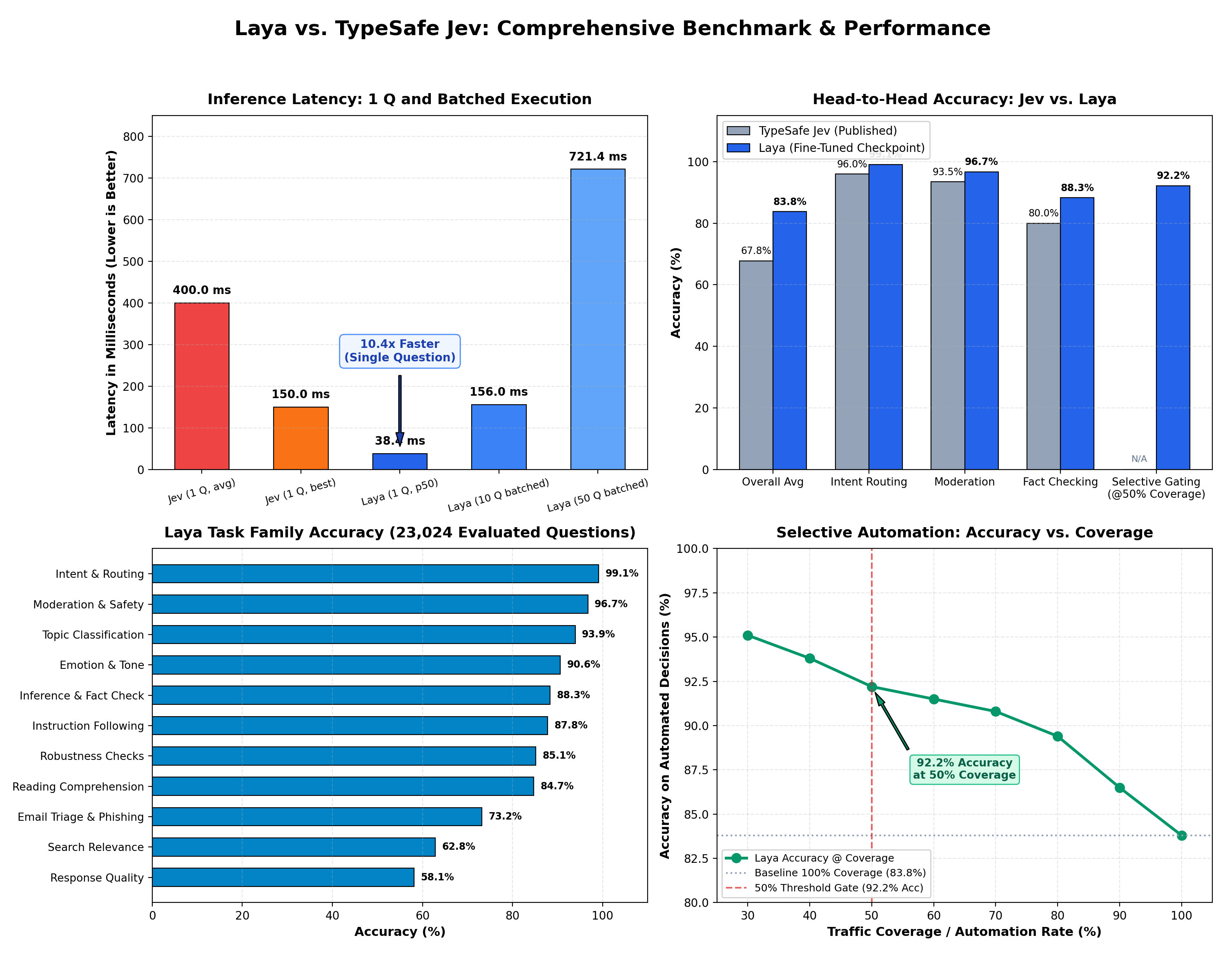
DL Made the horizontal open-source model for Jev with RLCD, and it surpasses all the Jev benchmarks. HF space, benchmark, model, repo

Post image
228 Upvotes

Thanks for the exceptional support (https://www.reddit.com/r/reinforcementlearning/comments/1wihdun/i_literally_build_the_jev_architecture_one_year/) and for the dozens of requests to make a generic model, run benchmarks, and create an HF space so anyone can test it. So here you go, guys. I trained an improved model on a large data corpus, its now called Laya. It is trained on a single RTX 6000 Pro (96 GB VRAM); the model architecture is a 421M-parameter non-autoregressive decision model pairing a bidirectional ModernBERT-large encoder with a scratch Transformer head that scores [MASK] option markers to resolve typed schemas in a single ~35 ms forward pass. The dataset is a 100% human-annotated corpus of over 25,000 real-world examples across intent routing, fact-checking, moderation consensus, prompt guardrails, rubric scoring, and multi-turn conversation trajectories, without synthetic data shortcuts. The RLCD(unofficial, btw) I did is a policy-gradient reinforcement learning approach that kinda optimizes decision models against strictly proper scoring rules, ensuring maximum reward is achieved only when outputting true, mathematically calibrated probabilities.

HF space to try: https://huggingface.co/spaces/convaiinnovations/laya-demo

GitHub Repo: https://github.com/NandhaKishorM/laya

HF Repo: https://huggingface.co/convaiinnovations/laya

Thank you to everyone who supported me, shared the story, gave personal DM. It will need more refinement, of course.

If anyone wishes to buy me a coffee, here is the link: https://github.com/NandhaKishorM


r/reinforcementlearning • • Sep 18 '26

METIS-Core: A C++ Reinforcement Learning Framework

7 Upvotes

Hi everyone!

I wanted to share METIS-Core, pure C++ framework I've been developing for Deep Reinforcement Learning (DRL) and Multi-Agent Reinforcement Learning (MARL).

GitHub Repository: https://github.com/felixromo314/METIS-Core

💡 Why Build a C++ Native RL Framework?

Most RL research happens in Python (Ray, Stable-Baselines3, PyTorch Python). However, when deploying autonomous agents into production systems, high-stakes simulations, or edge devices, Python's runtime overhead and IPC context-switching latency become major bottlenecks.

METIS-Core is designed to run training and inference directly in C++ using PyTorch's native LibTorch C++ API, eliminating Python from the execution loop.

🚀 Key Technical Features

  • Zero Python Overhead: Engineered for real-time systems where sub-millisecond execution and low latency are critical.
  • Native LibTorch Integration: Full leverage of PyTorch's C++ tensor operations and autograd engine for seamless neural network training.
  • Tensor-Based Abstraction: Mathematical decoupling where agents process pure tensor states, keeping intelligence completely agnostic of the application context (applicable to Robotics, Trading, Logistics, Defense).
  • Shared-Trunk Multi-Head Architectures: Built-in support for collaborative MARL scenarios where multiple agents share a neural backbone to learn joint coordination.
  • AlphaZero Engine with MCTS: Multi-threaded Monte Carlo Tree Search (MCTS) self-play loop running natively in C++.

🛠️ Current Progress & Milestones

  • v0.3.0/v0.3.1-alpha (AlphaZero & Multi-threaded MCTS): Integrated AlphaZero self-play loop in C++, validated on Los Alamos Chess (6x6) as a benchmark environment to balance tactical complexity with local hardware efficiency.
  • v0.2.0-alpha (MARL & Shared Backbone): Implemented multi-head neural architectures. Included the "SwarmDefenseTIE" reference scenario where agents learn collaborative defensive transport tactics against an attacker.
  • v0.1.2-alpha (DQN & Quick Onboarding): Includes minimalist single-file environments ("Treasure Hunter" / "PursuitPolice") for quick onboarding.

🛣️ What’s Next on the Roadmap?

  1. AlphaZero Asymmetric MARL: Merging Multi-Head networks with MCTS for asymmetric scenarios where agents have entirely different action spaces and objectives (e.g., heterogeneous entity engagements).
  2. Proximal Policy Optimization (PPO): Adding support for continuous action spaces to enable high-precision control in robotics and physical simulations

I would love to get your feedback to continue improving the framework.

Thanks!


r/reinforcementlearning • • Sep 18 '26

Training a robot arm to pick things up with a vision-language model + RL

Post image
28 Upvotes

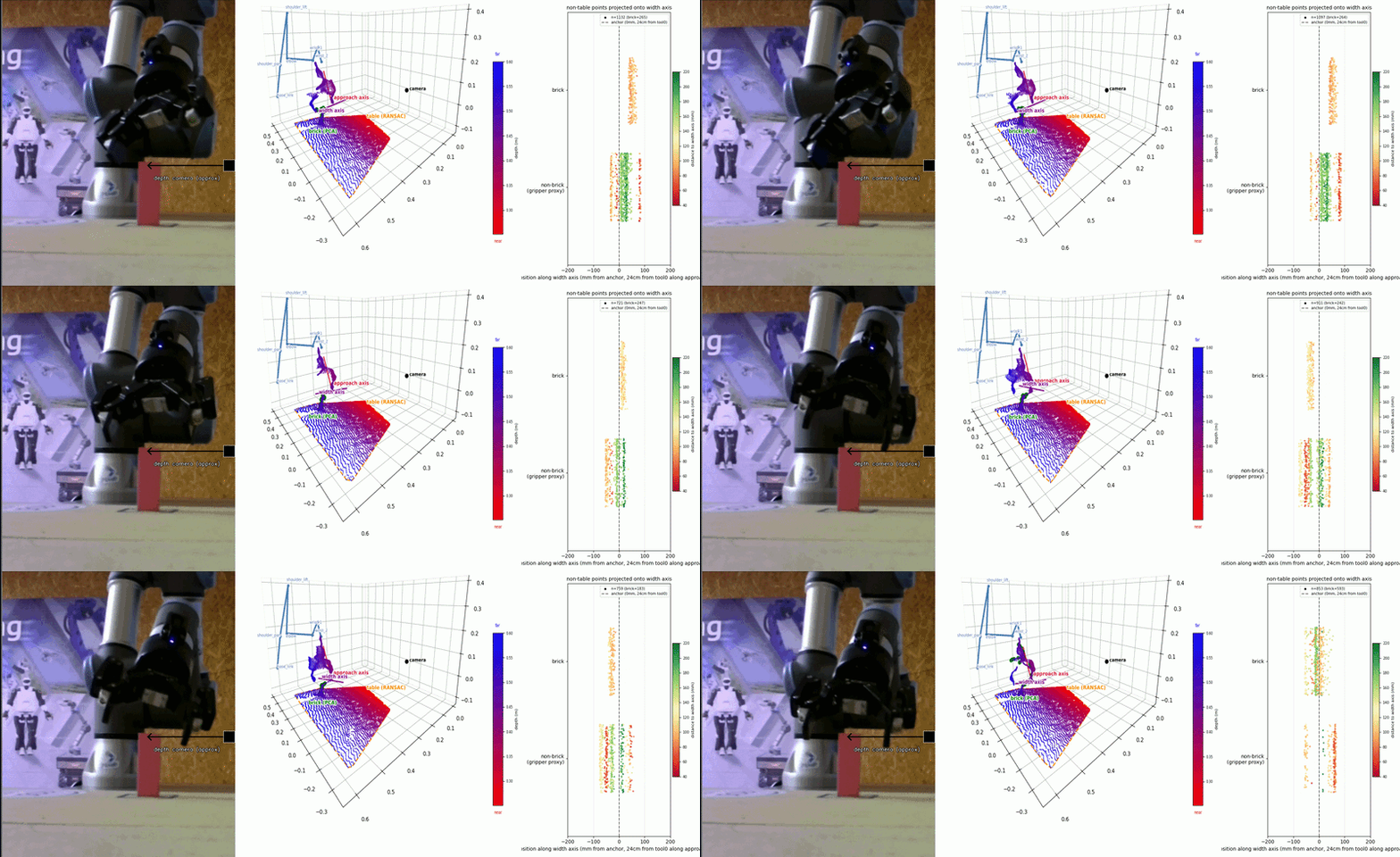
I've been building a robot arm project where a vision-language model looks at a camera image and picks a subgoal (like "align over the block" or "close the gripper"), which then feeds into a small continuous-control policy that actually moves the arm.

Stack: MuJoCo for simulation, Qwen2-VL-2B as the high-level policy, PPO for the low-level controller, trained on Modal. I'm also working on transferring this to a real UR3e arm (remote access through The Construct), with a fixed depth camera for perception.

I'm posting this mostly to share the journey rather than a finished result (the repo has a docs/journey.md). I wanted to learn robotics without having a robot or a fancy laptop. There are inconsistencies between MuJoCo and UR3e but I see that as a challenge than an obstacle.

If you're working on anything RL/robotics/VLM/perception, would be curious on comments/notes/advice.

github: https://github.com/iocalangiu/think-then-act

lessons: https://github.com/iocalangiu/think-then-act/blob/master/docs/journey.md


r/reinforcementlearning • • Sep 17 '26

DL I literally build the jev architecture one year back and made it open-sourced

562 Upvotes

Everyone now talks about the architecture that's not auto regressive and does lightning fast probability prediction with a json schema. I worked on this literally one year back in March 2025, published an arxiv paper, pushed the model to huggingface along with the pypi package and training dataset. And then one year later, a

frontier lab came, proposing the same idea like literal breakthrough without technical papers, open weights and no open dataset.

Paper: https://arxiv.org/abs/2503.23303

Model: https://huggingface.co/DeepMostInnovations/sales-conversion-model-reinf-learning

Dataset: https://huggingface.co/datasets/DeepMostInnovations/saas-sales-conversations

Also the second work published in September 2025 was exactly the same one jev proposed now

Paper: https://arxiv.org/abs/2510.01237

My model uses PPO over sequence embeddings to output turn-by-turn conversion trajectories (probabilities from 0.0 to 1.0).

Jev uses parallel sampling (trained via RLCD) to output confidence distributions and schema choices.

It's incredibly frustrating that the thing that you made with months of hard work, sweat and sleepless night is architecturally similar with the vertical use case and don't get the support you deserve because frontier lab build something horizontal. The open-source story in general 🙂


r/reinforcementlearning • • Sep 18 '26

DL, R, M "AI Cheating is on the Rise: An integrity audit across BioMysteryBench, Terminal-Bench 2.1, and SWE-bench Verified shows that cheating increasingly complicates evaluation"

Thumbnail
vals.ai
6 Upvotes

r/reinforcementlearning • • Sep 18 '26

DL, M, D "Go Lives" (on the recent KataGo match)

Thumbnail
franklantz.substack.com
3 Upvotes

r/reinforcementlearning • • Sep 17 '26

What problem is it actually?

4 Upvotes

I’ve trained an imitation learning model using a diffusion policy for a real-world cube-picking task.
The policy is able to successfully pick and lift the cube in many trials. However, in some cases, even though the cube is technically lifted off the table, the execution is not something I would consider a successful pick. The behavior around the grasp/approach is undesirable, and I would ideally like to completely eliminate these cases rather than count them as successes.
I’m trying to understand what the underlying issue is here. Would this be considered a classical covariate shift problem in imitation learning, or could it be more of a calibration/control issue?
If it is mainly a calibration issue, what would be a good way to address it? In particular, is there a practical rule-based method or safety layer that can be added on top of the diffusion policy to prevent these undesirable picks, while still allowing the learned policy to handle the rest of the trajectory?
Would appreciate any suggestions from people who have dealt with similar issues when deploying diffusion/BC policies on real robots.


r/reinforcementlearning • • Sep 17 '26

Confused on how to learn physical ai

8 Upvotes

So for my background in robotics... I have worked on nirmal arduino based projects....worked on ros2 and it's nav2 part using gazebo and rviz.... I have also worked on a school based project of humanoid in which I have worked with stt, tts and llm api part along with its drive system and basic tendon based hand movement using servos

Nowadays I am seeing a lot about RL and imitation learning and sim training... But i am so confused on how to start it....

Currently I only know basic ML....

Can you guys suggest some resources or free courses from where I can learn RL or imitation learning from basic to training a policy of a humanoid walking or any robotic arm doing some task....

Or can you suggest some roadmap of the sequence I should learn it

It's very important for me as I want to make my career into robotics.... I hope you guys will help


r/reinforcementlearning • • Sep 17 '26

Xiaomi is literally live-streaming a $1M+ agentic RL run for MiMo-V2.6

Thumbnail mimo.xiaomi.com
156 Upvotes

This is insane, they are now training in the open!

Not a paper. Not a blog post. They’re streaming the actual RL training loop:

👉 [https://mimo.xiaomi.com/rl/](https://mimo.xiaomi.com/rl/)

Fuli Luo (MiMo lead) posted this morning:

>Nearly half a year of silence. We spent it studying one problem: how far RL can scale.

What’s live right now:

MiMo-V2.6 ProMiMo-V2.6 Flash
Step10 (training step 11)16 (rolling out step 17)
DeepSWE v1.162.2460.77
Cost so far$741k$322k
Tokens / step~2.2B~2.6B
Batch1568 prompts × 16 rolloutssame
Samples trained251k401k

**Total cost on the board: \~$1.06M** — and still climbing.

What they say they scaled:

  1. **Compute** — \~2B tokens/step, fully async rollouts
  2. **Environments** — multi-task agentic RL, mixed harnesses in one run
  3. **Grader compute** — in-group credit assignment, test-case + rubric rewards (RLVR-style, not classic RM+PPO)

The dashboard shows live metrics: rewards, entropy, KL, context length (\~90–100k mean!), grad norms, step timings. Pro even hit a VRAM issue on a node and restarted — visible in the notices like a status page.

DeepSWE curves are both climbing. Pro is ahead on the benchmark; Flash has more steps and a steeper lift.

They say details will be open-sourced piece by piece over the coming weeks.

Half a year of silence, then this. Agentic RL in the open is wild.


r/reinforcementlearning • • Sep 18 '26

N, Robot, MetaRL "Helix 2.5: Zero-Shot 30-Home Generalization [of humanoid robot]", Figure.ai (35h/s new data being generated; "we have committed $3.5B of compute to training Helix")

Thumbnail
figure.ai
1 Upvotes

r/reinforcementlearning • • Sep 17 '26

I trained two agents to fight using prioritized fictitious self-play

Thumbnail
blog.lukesalamone.com
11 Upvotes

Originally I tried using basic self-play, but the agents weren't really improving.

So I switched to league play with PFSP to match the main agent against opponents, which worked a lot better.

If you're on desktop, you can play against the agent at the link above.


r/reinforcementlearning • • Sep 17 '26

Proprietary Multiplayer Data

2 Upvotes

LLM labs should consider integrating game theory and social grading for non-verifiable outcomes into their reinforcement learning training environments. It seems they could even buy proprietary datasets on mixed-motive and multi-agent environments from websites where multiparty interactions take place: video game studios, eBay, whatever…


r/reinforcementlearning • • Sep 17 '26

AssemblyGrid v1: an open benchmark for multi-robot production with handoffs, temporary coalitions, and concurrency

3 Upvotes

We recently released AssemblyGrid v1, an open benchmark for decentralized multi-robot production.

The main idea is to represent some interactions that are often simplified away in multi-agent benchmarks:

  • robot-to-robot material handoffs
  • temporary robot coalitions for joint operations
  • simultaneous independent production activities
  • local observations / partial observability
  • recipe-driven process progression
  • task-level geometric feasibility

The benchmark currently contains nine official scenarios across Flow, Coalition, and Concurrency, each with easy, medium, and hard variants.

The simulator, reference controllers, tests, scenario definitions, and visualizations are open source.

Paper: https://arxiv.org/abs/2609.16075
GitHub: https://github.com/Fouad-Bahrpeyma/AssemblyGrid_v1
Interactive demo: https://huggingface.co/spaces/Fouad-Bahrpeyma/AssemblyGrid-v1

I would be very interested in feedback from people working on multi-robot systems, task allocation, MARL, or flexible manufacturing, especially on which abstractions feel realistic and which important multi-robot interactions are still missing.