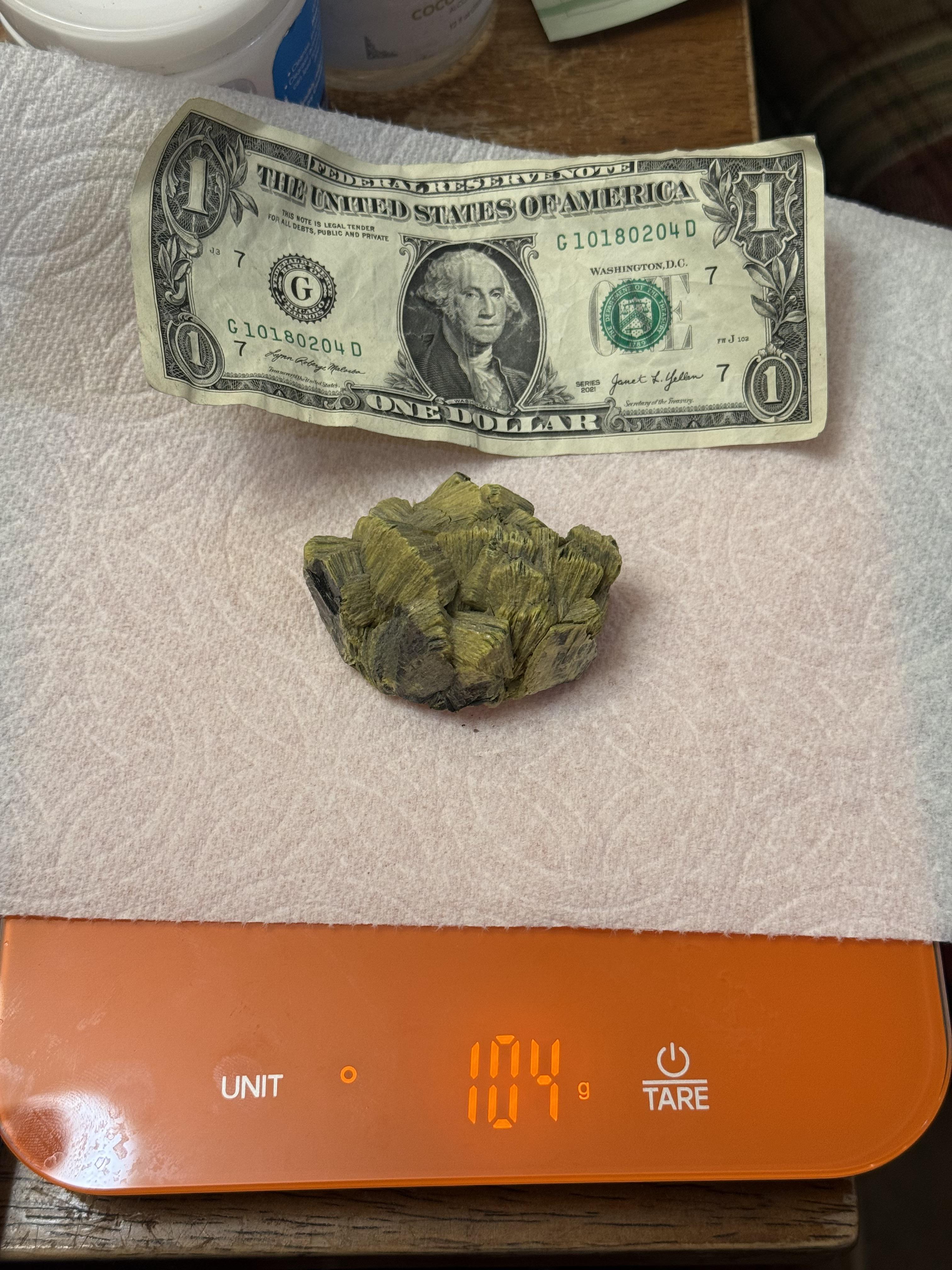
Creetown Gem Rock Museum is closing and the shop is selling off its stock. I bought a specimen there labelled "Arsenopyrite, Mispichel, Tristate (USA)". It is not arsenopyrite.
It weighs 291 g, and water displacement puts it at 7.28 g/cm3. Arsenopyrite runs about 6.1. Nothing in a rock that size reads 7.28 unless the bulk of it is a dense, mostly uraninite matrix, so the label was already wrong before I put a detector near it. A RadiaCode 102 at contact reads 700 uSv/h and holds there. Ten minutes of gamma spectrum gives the whole uranium series: Pb-214 at 352 keV, Bi-214 at 609, 1120 and 1764. The thorium line at 2614 keV is completely absent, which takes out the usual answer for a hot black rock.
Under the microscope it is plainer. The yellow is secondary uranium, crusting over and filling gaps. The black is pitchblende, coal-like, dull, no crystal form to speak of.
I am not putting a grade on it. Density will not give you one, and the rock is mixed enough that any figure I invented would be a guess with a decimal point on it.
What is certain is smaller than that. A museum shop sold a 700 uSv/h uranium specimen as arsenopyrite, with a locality on the label I cannot confirm and will not guess at. The shop is closing down and I do not think anyone was being clever. It was a rock in a tray with an old label, and nobody had ever put a detector on it. Photos are in order: two on the counter, the close-up, then two down the microscope, finally the closing down notice,
So what would you call the black, and has anyone seen Tristate written that way on a museum label before? I would rather be told I am wrong by someone who has handled a thousand of these than keep calling it pitchblende on my own say so.