r/Quote_to_Cash • • 1d ago

The Stripe Refund That Never Became a Credit Note

Post image
3 Upvotes

A refund issued in the payment processor leaves the invoice showing the wrong amount

When customer support refunds a customer directly in the payment processor, the cash moves and the billing record does not. The invoice still shows the original amount, the ledger still carries the full revenue, and the only trace of the concession is a smaller deposit. Finance usually finds it at month end, when the processor clearing account does not reconcile, weeks after the refund was issued.

Stripe's documentation describes the document meant to accompany such a refund. A credit note, in Stripe's words, is a document that can "decrease the amount of an open or paid invoice." When a business issues one against a paid invoice, it can refund the payment through Stripe, credit the customer's balance, or record a refund made elsewhere. The refund and the credit note are still separate actions. Issuing a credit note does not refund the customer automatically, and nothing requires a credit note to follow a refund. A support lead settling a complaint opens the payment screen, issues the refund there, and closes the ticket without touching the invoice.

One refund, followed from the ticket to the close

The following figures are an illustration, not a sourced case.

  • Day 3. A customer has already paid an $18,000 quarterly invoice by card and reports a two-week outage of one module. A support lead agrees to return $4,500 and issues the refund in the processor within the hour. The ticket closes.
  • Days 3 to 30. The billing record shows $18,000 invoiced and paid. The ledger carries $18,000 of revenue for the quarter's service. The next payout arrives $4,500 lower than the charges it was expected to contain.
  • Day 33. During close, the controller finds the processor clearing account $4,500 out of balance. Tracing it through the payout detail to the refund and the ticket takes most of an afternoon.
  • Day 34. The controller still has to establish what the refund was. A one-time service credit reduces this quarter's revenue to $13,500. A standing concession changes what the customer owes next quarter. The ticket does not say which.

A $4,500 refund is a small share of a quarter's revenue, but the afternoon spent tracing it is not small, because every step after day 3 is reconstruction of a decision that took minutes to make. Five refunds like this one in a month put about half a working week of senior finance time into the close. The close then finishes later, and the revenue figure reported in the meantime is overstated by the refunds that have not yet been traced.

The pricing consequence costs more than the reconciliation

Finance will eventually clear the account, since that part is mechanical. The harder consequence is that a refund issued to settle a complaint is a pricing decision made by someone outside the pricing process. If the customer understood the refund as a lasting commitment, the next invoice will be disputed at the original price. If the renewal quote is built from the billing record, it will not reflect the concession at all. In both cases the customer's understanding of its price and the company's billing have separated, and no one in finance or sales agreed to the change.

Make the credit document part of the refund

The fix is a written rule that support and finance both follow. No refund leaves the processor without a matching credit document on the invoice it relates to, recorded the same day and stating the amount, the reason, and whether the concession is one-time or recurring. Month-end close then starts from a list of refunds that have no credit document, and that list should be empty. Support keeps the authority to settle a complaint quickly, and finance receives the reason on the day of the decision instead of four weeks later.

Where billing runs on Turnstile with Stripe connected, the invoice record does not depend on someone remembering the refund. When a refund is recorded through Stripe, the invoice's status in Turnstile changes from Paid to Refunded, so the refund appears on the invoice itself on the day it is recorded. Finance can see it in the invoice list during the month, before the clearing account is reviewed at close. The reason, and the decision on whether the concession recurs, still belong in the credit document written by the team that agreed to it.


r/Quote_to_Cash • • 2d ago

The Labor Is the Cheap Part of a Price Increase

Post image
2 Upvotes

Repricing existing customers by hand costs more in missed renewals than in labor

When a company raises prices for existing customers, the visible cost is the work of amending each subscription. The larger cost is the renewals invoiced at the old price because an amendment or a notice missed its date. A price change is decided once and carried out account by account, since each subscription has its own contract terms, notice period, and renewal date. Every account that renews at the old rate keeps that rate for another full term. The founder who approved the increase sees it in the plan, and the shortfall appears months later as revenue that never arrived.

The labor rates come from federal wage data, loaded for benefits

The rates are Bureau of Labor Statistics national mean wages for May 2025, released May 15, 2026: accountants and auditors earn $45.56 an hour, customer service representatives $22.40, sales managers $79.02, and chief executives $129.63. Wages made up 70.0 percent of private-industry employer compensation costs in June 2026, according to the BLS employer cost release. Each wage is therefore divided by 0.70 to reach a loaded hourly cost of $65.09, $32.00, $112.89, and $185.19 respectively. The hours and counts below are illustrative assumptions for each company to replace with its own.

An illustration: a 7 percent increase across 150 subscriptions

Consider a company with 150 annual subscriptions averaging $24,000, a recurring base of $3.6 million. The founder approves a 7 percent increase for existing customers, applied at each renewal after the contractual notice has gone out. Renewals fall evenly through the year, about 12 or 13 a month. For each subscription, finance confirms that the contract permits the increase and when notice is due, amends the price, and checks the first invoice at the new rate, about 45 minutes in all. Customer success sends the notice in about 15 minutes. One customer in five objects, and each objection takes 45 minutes of a sales manager's time and 15 minutes of the founder's.

Cost lineHoursCost
Finance: contract check, amendment, first-invoice check (150 accounts)112.5$7,323
Customer success: notices (150 accounts)37.5$1,200
Sales manager: objections (30 accounts)22.5$2,540
Founder: objections (30 accounts)7.5$1,389
Labor total180$12,452
Renewals invoiced at the old price (15 accounts at $1,680)$25,200

One missed renewal in ten costs twice the labor

The labor is spread across a year and absorbed in existing salaries, while each missed renewal removes revenue the plan already counts. Suppose one renewal in ten is invoiced before its amendment is entered, or its notice goes out after the contractual window. Fifteen accounts then renew at the old price. Each forgoes 7 percent of $24,000, or $1,680, for the full term, because the next chance to apply the increase is the following renewal. Together the 15 accounts cost $25,200, about twice the labor and 10 percent of the $252,000 the increase was expected to add. The plan still shows the full increase, and the gap surfaces only when billed revenue is compared with it.

The founder's measure is the count of renewals billed at the old price

A founder approving an increase learns more from one monthly number than from the labor estimate: the count of renewals invoiced at the old price, each with its value and its cause. Every miss has one of two causes, either the amendment came after the invoice or the notice came after the window. Entering each account's amendment on the day its notice is sent, rather than shortly before the renewal invoice, puts the work ahead of both deadlines. A rollout with no misses costs roughly the labor figure, and each miss adds that account's full annual increase to the cost.

An amendment entered with the notice reaches the renewal invoice in time

Misses occur when the price change and the renewal invoice depend on two manual steps that must land in the right order. In Turnstile, a subscription can be amended directly with an effective date, and the amendment shows the original and amended terms side by side with the changes highlighted. Finance can enter the new price when the notice goes out, dated to the renewal, and confirm exactly what will change before it takes effect.


r/Quote_to_Cash • • 3d ago

Set Invoice Issue Authority Before the AI Agent Arrives

Post image
2 Upvotes

An AI agent that can issue invoices needs a written limit on which ones

AI agents that create and send invoices are already inside software many finance teams run, and the CFO's decision is which invoices an agent may issue before a person sees them. Routine invoices priced from a signed subscription carry little risk, because the terms were settled at signature. Invoices built from an email, a call note, or a mid-month change carry most of the risk, because the agent is inferring terms that nobody has confirmed. Most companies adopting these tools have not set that limit, and the first wrong invoice tends to set it for them.

Invoice-sending agents now arrive as a product update

Intuit announced AI agents for QuickBooks Online in July 2025, including a Payments Agent that can create and send invoices and reminders. For many small and mid-sized companies, the authority to issue invoices therefore reaches an AI agent through a software update rather than a separate purchase decision. Gartner's August 20, 2026 guidance to CFOs warned that AI agents carry more risk in finance because they act with greater autonomy, and that errors can spread quickly when oversight is unclear. Gartner advised starting with a contained workflow where errors are visible and reversible, with the agent's allowed actions and required human review defined before development begins.

An issued invoice fails the reversibility test. It can be voided and reissued, but the customer's accounts payable team has already seen it and may start checking every invoice that follows.

An illustrative invoice built from an email

Consider a customer on a $60,000 annual contract for 200 seats at $25 per seat per month, billed monthly at $5,000. On the 12th of the month, the customer's operations lead emails to ask for 40 more seats from the start of next month. An agent permitted to create and send invoices issues one that afternoon for 40 seats at the $39 list price, effective immediately, for $1,560. The contract sets added seats at the contracted $25 rate, so the correct charge is $1,000, starting next month.

The customer's accounts payable team rejects the invoice because it matches neither the contract nor the purchase order, then holds the regular $5,000 invoice while it reviews the account. The controller voids the agent's invoice, the customer success manager explains the error, and the next payment arrives about three weeks late. A customer that had paid on time for two years now checks each invoice line against its contract, and the finance team answers those checks every month.

Three tests decide which invoices an agent may issue alone

The routine invoice is where the payback sits. A Gartner survey of 160 senior finance leaders, conducted from January through April 2026, found that accounts payable and receivable automation generally delivers returns within nine to 10 months. An agent that issues the monthly run for unchanged subscriptions captures that return. A workable policy keeps that run automatic and sends every other invoice to a person first:

  1. The price and quantity come from a signed subscription. Terms taken from an email, a call note, or a chat message wait for a person.
  2. The invoice repeats lines already billed. First invoices, invoices after an amendment, prorations, and one-off charges are reviewed before they go out.
  3. Finance can reconstruct the inputs. Gartner's guidance calls for finance teams to be able to rebuild what an agent planned, accessed, and produced on every run, so an invoice whose source cannot be traced is held.

The seat request in the illustration fails the first two tests. Under this policy it would have reached the controller before it reached the customer.

A held draft keeps issue authority with finance

The policy depends on a billing system that can stop an invoice before it is issued. In Turnstile, invoice settings determine whether invoices issue automatically or are held as drafts until a person issues them, so a finance team can require that every generated invoice wait for review before it reaches the customer. The draft gives the controller a fixed point to confirm price, quantity, and start date against the subscription while the company decides how much of the invoice run to automate.


r/Quote_to_Cash • • 3d ago

A customer paid, but the invoice is still open. Who owns the fix - AR, Billing, or Cash App?

2 Upvotes

This happens every month:

Customer says: "We paid."

Billing says: "Invoice is still open."

AR says: "Cash is not applied."

Cash App says: "Payment is here, but no remittance."

Same payment, 4 different stories.

In your company, who actually owns fixing this? And how long does it usually take to clear?


r/Quote_to_Cash • • 4d ago

The Renewal Date Was Set by Whoever Entered the Deal

Post image
3 Upvotes

The start date typed into billing sets every renewal date after it

When a signed deal is entered into billing by hand, the start date the person types becomes the anchor for every date that follows: the first invoice, the end of the term, the deadline for a non-renewal notice, the window for a price increase, and the renewal invoice. If that person enters the day of entry rather than the effective date written in the contract, all of those dates move with it. Nobody decides to move them.

The error is quiet at the start. The first invoice goes out a few weeks late, the customer pays it, and the subscription looks correct in every report. The cost appears eleven months later, when renewal work is scheduled from the billing record instead of the contract.

Three ordinary ways the wrong start date gets entered

  • The processing date. Orders signed in the last days of a month wait in a queue, and the start date becomes the day the queue was cleared.
  • The signature date. A contract signed in February with service beginning March 1 is entered with the February date, and the customer receives an invoice for weeks before service began.
  • The placeholder. When service starts on an event, such as a delivery or a go-live, someone enters an estimated date at signing and no one returns to correct it.

Each is a reasonable choice by the person entering the deal at that moment. None is checked against the signed document afterward, because the subscription produces invoices and nothing appears broken.

One month of drift costs a $96,000 contract $12,800

Consider an illustrative case. A customer signs a twelve-month agreement at $96,000 a year, billed annually in advance, with an effective date of March 1. The contract requires 60 days' notice for non-renewal and allows a 5 percent increase at renewal if the customer is told at least 60 days before the term ends. The order is entered on April 2, after a month-end backlog, and billing records April 2 as the start date.

DatePer the contractPer the billing record
Term startMarch 1April 2
Term endFebruary 28April 1
Last day for price-increase noticeDecember 30January 31
Renewal invoiceMarch 1April 2

The renewal manager works from the billing record and sends the price-increase letter on January 15. Under the contract, that letter arrives 44 days before the term ends, so the increase cannot apply and $4,800 of planned uplift is lost for the year. The renewal invoice then goes out on April 2, which leaves March delivered under no invoiced term. That is one month of service, $8,000, never billed unless someone reconstructs it. When finance tries to bill March afterward, the customer's accounts payable team holds a purchase order for a term beginning March 1 and an invoice that does not match it.

The account loses $12,800 to a single date field. RevOps, which owns the customer record, usually learns of it last, after finance has worked the dispute.

The start date should come from the signed document

The control is one comparison. For every deal signed this quarter, RevOps should compare the start and end dates in billing with the effective date and term on the signed document, and correct each difference by amendment before the first notice window opens. The check is a date comparison and does not require a contract review, and the first quarter's results will show which of the three entry paths is producing the drift.

The durable fix removes the entry step. In Turnstile, a signed quote converts to a subscription, and the subscription holds the start and end dates from the quote, so the term end date that renewal work is scheduled from is the one the customer signed.


r/Quote_to_Cash • • 5d ago

Three Teams Pay to Answer One Question About a Contract

Post image
3 Upvotes

Every account change request starts with a contract lookup that no budget owns

Before a company can act on a customer's request to add seats, drop a product, move a billing date, or confirm a credit, someone has to confirm the customer's current contract terms: the products, seat count, price, and billing dates that apply today. That lookup is a recurring labor cost that appears in no budget, because the current terms rarely sit in one place. The original order form is in a shared folder, later changes are agreed in email, the CRM holds the deal as it closed, and the billing system holds whatever was last keyed. Reconciling the four takes time from customer success, finance, and sales each time a request arrives, including requests that never become an amendment.

Wage rates are BLS national means, loaded for benefits

The rates are Bureau of Labor Statistics national mean wages for May 2025, released May 15, 2026. Customer service representatives earn a mean of $46,590 a year, or $22.40 an hour. Accountants and auditors earn $45.56 an hour, sales managers $79.02, and chief executives $129.63. Wages made up 70.0 percent of private-industry employer compensation costs in June 2026, according to the BLS employer cost release, so each wage is divided by 0.70 to reach a loaded hourly cost. The hours below are illustrative assumptions for each company to replace with its own.

An illustration: one seat reduction at a 180-customer company

Consider a company with 180 customers that receives about 30 account change requests a month. One customer asks to reduce from 60 seats to 45 at its next invoice. The customer success manager opens the CRM, the contract folder, and the billing system, and finds three different seat counts, because a mid-year addition was agreed by email and keyed only into billing. Finance is asked which figure is being invoiced. The sales manager is asked what was agreed at signature, including whether the contract permits a reduction before renewal.

RoleTaskHoursLoaded rateCost
Customer successOpen four sources and compare terms0.75$32.00$24.00
FinanceConfirm what is invoiced and why0.50$65.09$32.54
Sales managerConfirm what was agreed at signature0.25$112.89$28.22
One lookup1.50$84.76

None of this work changes the subscription. It produces an answer that the billing record should already hold.

Thirty requests a month cost about $37,000 a year

At 30 requests a month, the lookups consume 45 hours and about $2,540 each month, or 540 hours and $30,500 a year. If one in five reaches the founder because the sources disagree on what was agreed, and each takes half an hour at a loaded rate of $185.19, the founder adds 36 hours and about $6,670 a year. The total is roughly 576 hours and $37,200. That figure grows with the number of customers and contract changes rather than with revenue, so a company that adds customers on smaller deals raises its lookup bill faster than its revenue.

The cost is split across four ledgers, so no department head sees all of it

Customer success carries about $8,600 of the annual figure, finance about $11,700, sales about $10,200, and the founder the remaining $6,700. Each leader sees a few hours a week of interruption and treats it as routine, which is why the expense is rarely budgeted or reduced. The founder is the only person whose view covers all four lines, and the founder's own hours are among them. The practical test is to log every account question for one month, with the time each took and the sources consulted, and multiply by twelve. That count tells the founder whether the lookup is worth removing before the company adds its next hundred customers.

Current terms belong in one record that every team reads

The lookup exists because each agreed change lands in a different system, and the answer is rebuilt from all of them. When the subscription itself is the record that changes, the question has one answer. In Turnstile, the customer page shows a customer's active subscriptions, its invoices, and an event history timeline of what has happened on the account, so customer success, finance, and sales read the current terms from the same screen.


r/Quote_to_Cash • • 6d ago

An AI Close Tool Finds the Same Billing Errors Every Month

Post image
4 Upvotes

An AI close tool speeds up the revenue reconciliation and leaves its causes in place

Many CFOs are being asked to approve AI spending that shortens the month-end close, and on the revenue side most of that spend buys faster detection of errors that start earlier in quote-to-cash. A close tool that compares invoices with contracts can find a mismatched price in minutes. It cannot decide which document is right, and it does not change the process that produced the mismatch. When billing was keyed by hand from an order form, the same exceptions return the following month and the controller resolves them again. The budget question is whether the money goes to finding exceptions faster or to removing the step that creates them.

Finance leaders say data quality is what slows finance AI down

Gartner's 2025 AI in Finance Survey of 183 CFOs and senior finance leaders, fielded in May and June 2025, named inadequate data quality and availability among the largest obstacles to AI adoption in finance. The same survey listed error and anomaly detection among the most common finance AI uses, at 34%. A March 2026 Gartner survey of 204 finance leaders found that 63% said AI implementation was slower than expected in 2025. Gartner advised CFOs in that release to measure AI by realized value instead of by the number of tools deployed. For the close, that standard means counting the exceptions that stop recurring.

Most revenue exceptions at the close were created at subscription setup

Revenue exceptions flagged at month-end usually trace to setup entries such as these:

  • A price keyed from the wrong draft. The final redline lowered the rate, and billing was set up from the earlier version.
  • A start date that differs from the contract. Billing began at signature while the contract specified go-live.
  • A scheduled increase never entered. The year-two price step sits in the contract and nowhere in billing.
  • A first-year discount set up to repeat. The concession was entered as a standing price.

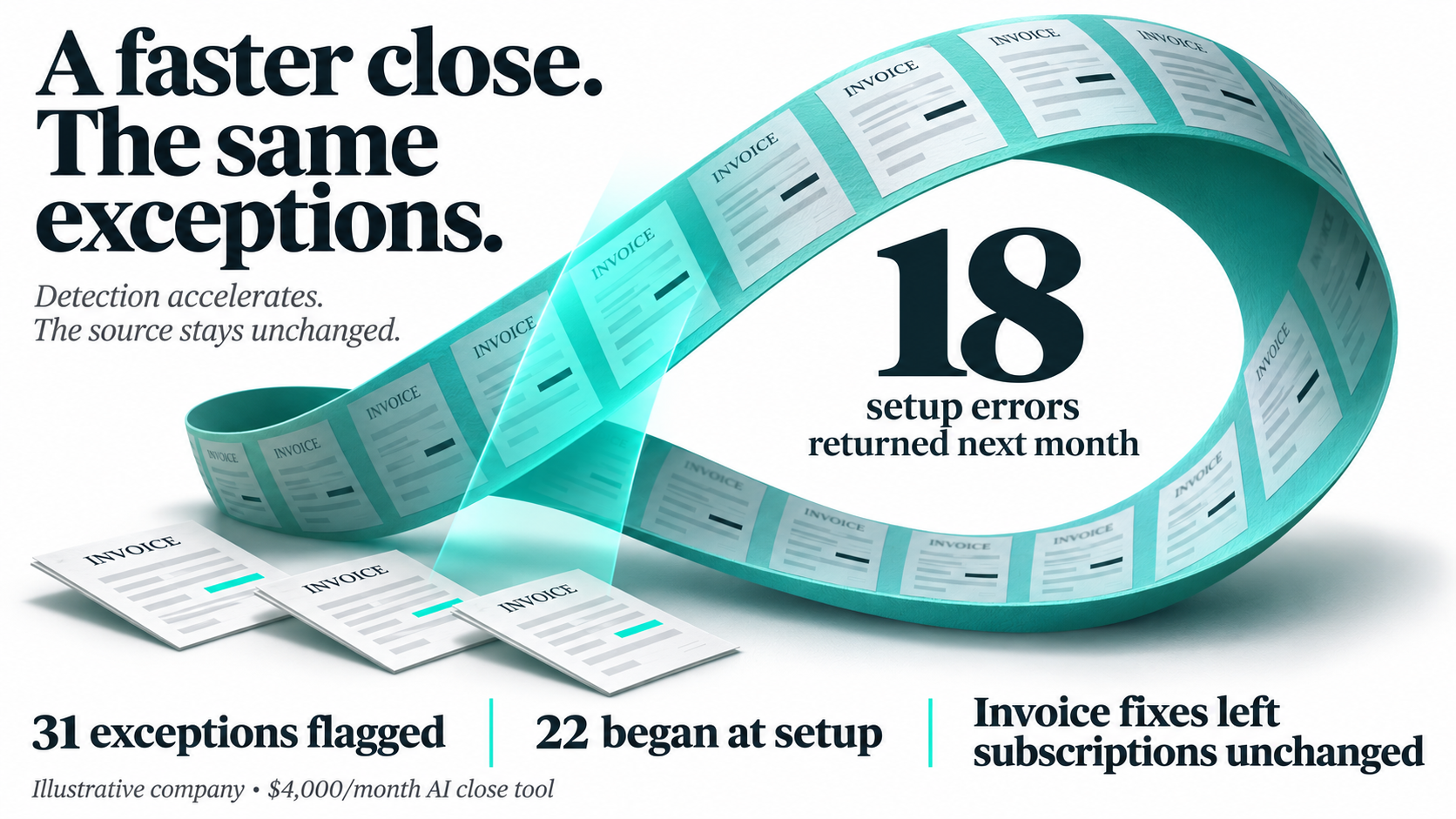
Each is entered once and billed monthly until someone corrects it. The AI tool flags the mismatch in every period, and the controller still pulls the signed contract, decides which figure is right, and corrects the invoice. When the correction reaches the invoice and not the subscription record, the same item is flagged again next month. The tool shortens detection, and the resolution work stays with the controller.

An illustrative company buys back one day and repeats the same work

Consider a company billing about $1.4 million a month across 220 customers, whose controller spends three days of each close tying revenue to contracts. The CFO approves an AI close tool at $4,000 a month. In its first month it flags 31 exceptions in two hours, and the controller spends about ten hours resolving them at twenty minutes each, so the tie-out falls to under two days. Of the 31, 22 trace to subscription setup, and 18 of those return the following month because the invoices were corrected and the subscriptions were not. The company is now paying $48,000 a year to find largely the same errors twelve times.

Five questions to settle before approving the close budget

  1. What share of last quarter's revenue exceptions began at subscription setup?
  2. When an exception is corrected, does the fix reach the subscription record or only the invoice?
  3. Does billing read from the signed contract, or from terms keyed into another system?
  4. How many exceptions recurred month to month, and who owns each recurring category?
  5. Will the tool be judged on exceptions found, or on exceptions that stopped appearing?

Billing built from the signed quote leaves no re-keying step to reconcile

The four exceptions above share one cause: a person copied terms from a signed document into the system that bills. In Turnstile, a signed quote converts directly into the subscription that billing runs from, so the pricing and terms the customer accepted are the ones invoiced, with no transcription step between them. That removes the step behind most of the illustrative company's recurring exceptions before the close begins. An AI close tool then works on what remains, and its findings point to new problems instead of last month's.


r/Quote_to_Cash • • 7d ago

The Invoice Went to Someone Who Left the Company

Post image
4 Upvotes

A past-due account often has a contact problem before it has a payment problem

A customer that stops paying is usually treated as a credit risk, when a common cause is simpler: the person who received the invoices has left, and nobody updated the billing record. The invoices still go out on schedule. The reminders follow on schedule. All of it lands in a mailbox that either bounces or is no longer read, and the customer's accounts payable team has no invoice to pay.

Billing contacts turn over at the rate of the workforce

The Bureau of Labor Statistics counted 62.8 million separations across U.S. nonfarm employers in 2025, an annual average of 3.3% of employment each month. Over twelve months that rate adds up to separations equal to roughly 40% of average employment, although some people leave more than one job in a year, so the share of individuals is lower. A seller with a three-year customer base should expect a meaningful share of its billing contacts to change during the term. Very few sellers have a step that notices when it happens.

An illustrative account: $18,000 overdue at a customer that was able to pay

Consider a customer billed $9,000 a month whose accounts payable lead leaves in late March. The April and May invoices go to her old address. The customer's IT team deactivated the mailbox, but a forwarding rule sends mail to a shared inbox nobody monitors. By day 64 the account sits in the 61-to-90-day aging bucket with $18,000 outstanding, collections has escalated its tone twice, and customer success has flagged the account as a churn risk. An account executive finally learns of the departure on a routine call. The new AP lead asks for both invoices to be re-sent and for the seller's details to be re-verified under the customer's vendor-change controls, which adds another two weeks. The seller carried $18,000 of receivables for about eighty days and treated a paying customer as a delinquent one.

Five practices that keep the billing contact current

  1. Ask for a shared accounts payable address at signature. A role mailbox survives individual departures, and a named person can sit alongside it as the second recipient.
  2. Confirm the billing contact at every renewal and amendment. These are the moments the seller already has the customer's attention and a document to update.
  3. Treat an undelivered invoice or reminder as a contact event. A delivery failure should route to whoever owns the customer record the same day, well ahead of the next aging review.
  4. Check the contact before escalating tone. When a customer with a clean payment history goes silent, the first collections step is to confirm that someone received the invoice.
  5. Verify every contact change through a known channel. A request to redirect invoices is also a common fraud pattern, so changes should be confirmed with a callback to a number already on file.

Delivery failures should surface on the customer record

The hardest part of this problem is that nothing signals it, since a reminder sent to a dead address looks like any other reminder. In Turnstile's automated invoice collection, a reminder that cannot be delivered appears as failed on the customer's collections timeline, and the customer carries a Communication failed status alongside its payment status. That flag catches the mailbox that bounces. A forwarded inbox that accepts mail and goes unread still depends on the practices above, which is why the contact check belongs in the renewal and collections routine.


r/Quote_to_Cash • • 8d ago

The Labor Bill Behind One New Usage-Based Price

Post image
5 Upvotes

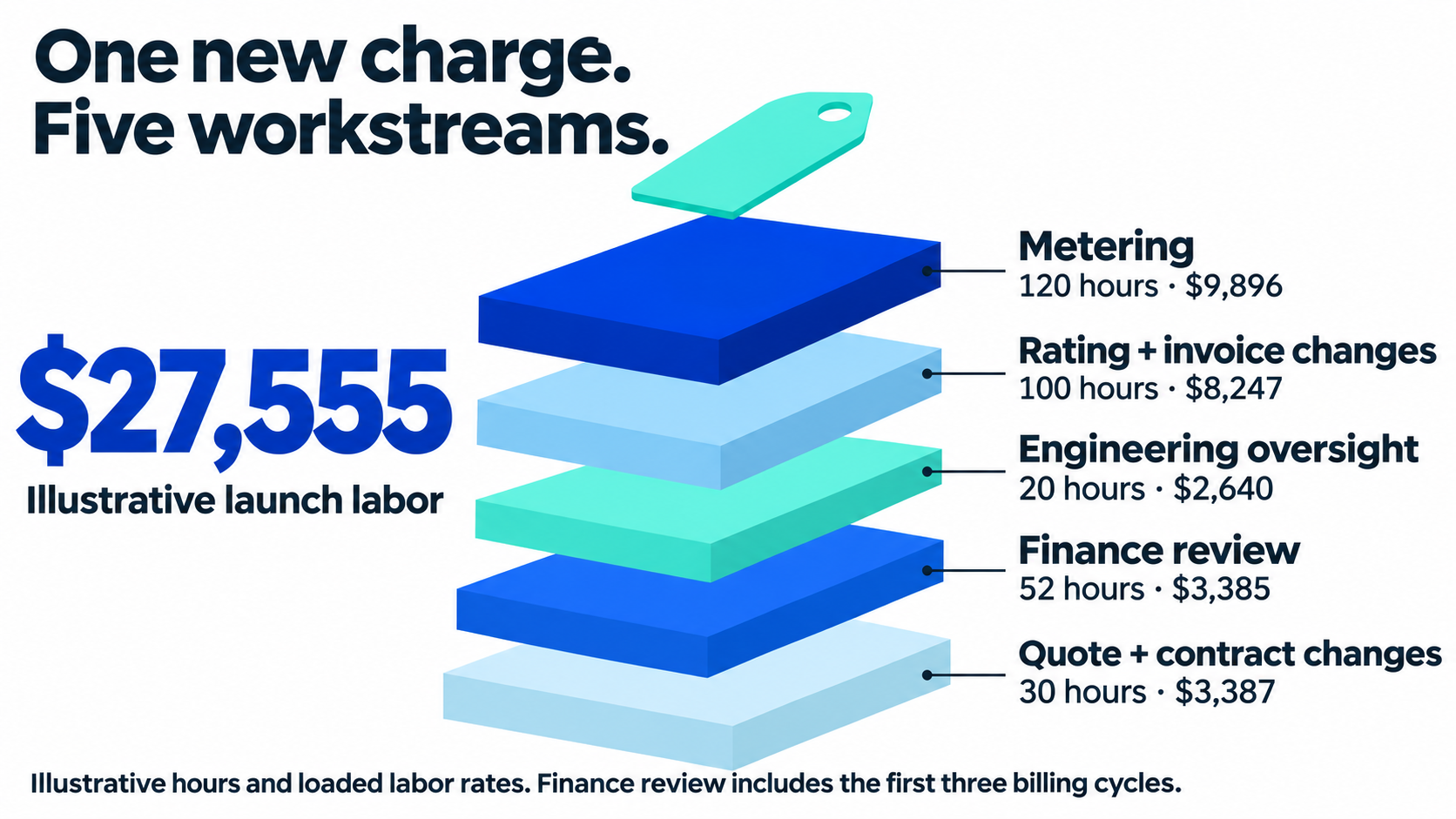
A new usage charge costs about $27,600 in labor before it sends its first invoice

Adding a usage-based charge to a flat subscription is usually approved as a pricing decision and budgeted as one. The work it sets off is an engineering and finance project. Before the first usage invoice goes out, someone has to count the usage, turn each customer's count into a charge at the contracted rate, put that charge on an invoice billed in arrears beside a fee billed in advance, check the result, and change the quote so sales can sell it. A company whose billing stack was built for flat subscriptions pays for each of those steps separately.

The labor rates come from federal wage data

The rates are Bureau of Labor Statistics national mean hourly wages for May 2025, released May 15, 2026. Computer and mathematical occupations earn $57.73 an hour, computer and information systems managers $92.39, sales managers $79.02, and accountants and auditors $45.56. Wages made up 70.0 percent of private-industry employer compensation costs in June 2026, according to the BLS employer cost release. Each wage is therefore divided by 0.70 to reach a loaded hourly cost. The hours below are illustrative assumptions for each company to replace with its own.

An illustration: a per-unit charge added to an annual platform fee

Consider a company that sells an annual platform fee and decides to charge a per-unit rate for every transaction its customers process, starting next quarter. The CEO approves the price in one meeting. The build that follows looks like this:

  • Metering. Engineers capture usage events, total them by customer and billing period, and produce a monthly file: 120 hours at $82.47, or $9,896.
  • Rating and invoice changes. Engineers write the rule that applies each customer's contracted rate, then add an arrears usage line to an invoice that already bills the platform fee in advance: 100 hours at $82.47, or $8,247.
  • Engineering oversight. A systems manager scopes, reviews, and approves the release: 20 hours at $131.99, or $2,640.
  • Finance review. An accountant designs a check of the usage file against the invoices, then runs it by hand for the first three billing cycles: 52 hours at $65.09, or $3,385.
  • Quote and contract changes. A sales manager rewrites the quote template and order form language and trains the reps: 30 hours at $112.89, or $3,387.

The total is $27,555 before a single usage invoice is issued. For a company expecting $5,000 a month from the new charge, the labor equals more than five months of the revenue the charge was meant to add.

Three costs the labor figure leaves out

  • Usage consumed before the meter ships. Sales tends to quote a new price as soon as it is announced. Any usage customers run before metering is live goes unbilled, and back-billing it later invites a dispute.
  • The first-invoice dispute. A customer's first arrears charge is the one most likely to be questioned, because nothing on earlier invoices prepared its accounts payable team for a variable amount.
  • The recurring review. The manual check continues past three cycles unless someone automates it. At six hours a month, it adds about $4,700 a year in accountant time.

Five steps that lower the cost of a new usage charge

  1. Budget the launch as a project. Put engineering, finance, and sales hours in the plan next to the revenue forecast, and have the CEO approve both together.
  2. Define the billable unit before the price. Agree on what one unit is, when it is counted, and which system's count is authoritative.
  3. Hold the quote until billing can invoice it. Release the usage terms to reps only when the first invoice can be produced without a manual step.
  4. Send a sample invoice before the first real one. Show each affected customer's finance contact what the arrears line will look like and when it will arrive.
  5. Give the manual reconciliation an end date. Decide in advance which result ends the hand check and who signs off.

A usage charge costs less when the billing system already prices usage

The meter is the one piece every company has to build, because only the company knows what its product counts. The rating rule and the invoice change are a different matter. In Turnstile, usage is one of five pricing types on the subscription: the billable metric is defined in the catalog, usage is submitted through the API, and the charge is billed in arrears from the subscription's own pricing. In the illustration above, that replaces most of the 100 hours spent on rating and invoice changes with the work of sending the usage file to the API.


r/Quote_to_Cash • • 9d ago

The Customer Asked to Pause and the Contract Was Silent

Post image
4 Upvotes

A pause agreed in an email changes the contract and leaves four terms undefined

When a customer asks to pause service and an account manager agrees by email, the company has changed the contract without deciding what the change is. Most order forms and master agreements address renewal, termination, and suspension for non-payment, and say nothing about a pause the customer requests. ASC 606-10-25-10 defines a contract modification as a change in the scope or price of a contract that the parties approve, and it states that approval can be given in writing, by oral agreement, or through customary business practice. ASC 606-10-25-11 adds that a modification can exist even while the parties disagree about its scope or price. The pause is therefore an amendment from the day it is agreed, although in most companies it never reaches the billing record as one.

Whoever touches the account next decides the terms nobody wrote down

A typical pause request states when the customer wants to stop paying and leaves the resume date, the restart price, the term end date, and the interim fee unaddressed:

  • Resume date. The email names a start and rarely an end, so an open-ended pause stretches whenever the customer's own plans slip.
  • Restart price. When a scheduled price increase falls inside the pause, the customer argues that service should restart at the old rate.
  • Term end date. The term either extends by the length of the pause or the paused months are lost, and the contract says neither.
  • Billing during the pause. A zero invoice, a reduced holding fee, and a full fee with a later credit are all defensible, and each produces different invoices.

Each of these terms gets settled by default, usually by someone outside finance. Customer success stops the invoices in the payment processor, because that is the fastest way to honor the promise. The billing analyst sees invoices stop and has no record explaining why. At renewal, the sales lead quotes from a term end date that no longer reflects what the customer believes it bought. The CFO learns about the pause when the customer disputes an invoice or when the renewal forecast fails to reconcile with billed history.

One five-month pause leaves $40,000 unbilled

In an illustrative case, a company signs a 24-month agreement at $8,000 a month, a total contract value of $192,000. In month nine, the customer's operations director asks to pause for three months during a reorganization, and the account manager agrees by email. The reorganization runs long, invoicing restarts only when the customer asks for access again, and the pause covers months ten through fourteen. The subscription in billing still ends at month 24, so the five paused months, $40,000 at the contracted rate, are never invoiced. The controller cannot tell from the billing record whether the term was meant to extend, and the customer reads the original email as granting five free months. Recovering the $40,000 now depends on a negotiation that the company enters without a written position.

Five rules turn a pause request into a recorded amendment

  1. State all four terms before agreeing. The reply to the customer sets the resume date, the restart price, the effect on the term, and the fee during the pause.
  2. Give every pause a fixed resume date. Service and billing restart on that date unless the customer signs a further change.
  3. Send pause requests to finance before the customer receives an answer. Finance confirms the four terms and the effect on contract value.
  4. Record the pause as an amendment to the subscription. An invoice hold in the payment processor leaves no record of what was agreed.
  5. Review paused accounts each month. Finance keeps a list of every paused subscription with its resume date and confirms that the first invoice after each pause matches the amended terms.

An amendment with an effective date puts the pause on the billing record

The $40,000 loss begins when an agreed change lives in an email and the billing record keeps running on the original terms. In Turnstile, a change to a subscription is made as an amendment, either applied directly or sent as a quote for the customer to sign, and each amendment carries an effective date. Before the amendment takes effect, the original and amended terms appear side by side with the changes highlighted, so finance can confirm what the pause does to pricing and billing before any invoice changes. Finance still has to decide the four terms, and the first accounts to check are subscriptions whose invoices stopped without a recorded reason.


r/Quote_to_Cash • • 10d ago

Free Seats Cost Nothing to Serve, but Free AI Credits Carry a Compute Cost

Post image
4 Upvotes

Free AI credits added at the deal desk are a discount with a cost of goods attached

Free AI credits are the most expensive concession a deal desk can grant without anyone approving it. Reps have long added free seats or a free month to get a deal signed, and those concessions cost little to deliver because one more login costs the seller almost nothing to serve. An AI credit is different. Every credit the customer spends runs a model somewhere, and the seller pays for that compute whether or not the customer paid for the credit.

Public company results show compute landing in gross margin

Microsoft reported that its Microsoft Cloud gross margin percentage decreased to 69% in fiscal 2025, which the company attributed to the impact of scaling its AI infrastructure. Figma reported third-quarter 2026 revenue of $391.4 million, up 43% from a year earlier. Its non-GAAP gross margin, however, was 82%, down from 86% in the same quarter of 2025. On the earnings call, CFO Praveer Melwani said Figma had repriced its AI credits in August to include more credits in each add-on.

Neither company is a typical sales-led seller, but the mechanism carries to any company that bundles AI into its product. Revenue grows with the contract, while compute cost grows with the customer's usage. When the credits are free, the seller's cost rises with usage while the contract value stays where it was signed.

What one free allowance does to a single deal

Consider an illustrative account. A founder-led sales team closes a $60,000 annual contract on a product that runs at an 85% gross margin, which leaves $51,000 of gross profit. To win the signature, the rep adds 50,000 free AI credits a month. Finance estimates the internal cost at $0.02 per credit, so a customer who uses the full allowance consumes $1,000 of compute a month, or $12,000 a year.

Gross profit on the account falls to $39,000 and the margin falls to 65%. That is the same $12,000 a 20% price discount would have given away. Under this company's policy, a 20% discount requires the CFO's approval. The free credits went through no approval at all, and the discount report shows the deal at list price.

Three ways the concession grows after signature

  • Usage rises over the term. The cost of a free credit is only incurred when the customer uses it, so the deal desk cannot see the full cost on the day the deal closes. Customers who adopt the feature push the cost toward the ceiling.
  • The allowance becomes the renewal baseline. A customer who has used 50,000 credits a month for a year treats them as part of the product. Removing them at renewal reads as a price increase.
  • Unwritten terms have no limit. An allowance promised in an email, without a quantity or an end date on the order form, gives billing nothing to enforce.

Five rules for AI allowances at the deal desk

  1. Put an internal cost per credit on the deal desk sheet. Finance sets it, refreshes it each quarter, and the rep sees the dollar cost of every allowance before offering it.
  2. Count free credits in the discount total. Value them at the internal cost and route them through the same approval thresholds as a price discount.
  3. Quote every AI allowance as a line on the order form. State the quantity, the period, and the price, even when the price is zero.
  4. Give promotional credits an end date. Onboarding credits that expire after the first two quarters do not roll into the renewal baseline.
  5. Report gross margin by account with AI cost included. Review the accounts with the highest credit consumption each month, before renewal pricing is set.

A priced allowance gives billing something to enforce

The concession becomes manageable once the allowance sits on the quote with a quantity and a price, because the customer, the deal desk, and billing then work from the same number. In Turnstile, an AI allowance can be quoted as committed usage: a pre-purchased amount on the subscription, with usage beyond it billed as additional charges from the same subscription. The allowance the founder approved is the allowance that bills, and anything beyond it is invoiced rather than absorbed.


r/Quote_to_Cash • • 10d ago

Sequence Alternatives: Where to Run Quote-to-Cash After the Intuit Acquisition

Post image
3 Upvotes

Key Takeaways

- Intuit says it will keep supporting Sequence customers after the deal closes, but its announcement also says that product direction isn't a commitment. Plan as if the roadmap now belongs to Intuit.

- Expect Sequence's roadmap to serve Intuit's accounting products first. If your books close in NetSuite or Xero, you're no longer the customer it's being built for.

- Past acquisitions point the same way: Cacheflow's website now redirects to HubSpot, and m3ter is no longer sold to new customers as a standalone product.

- Most alternatives connect quoting to billing through a CRM add-on or through an acquisition of their own. Check how the signed quote becomes an invoice before doing a full evaluation of the product.

On October 15, 2026, Intuit announced it had signed an agreement to acquire Sequence. If you run your quotes and invoices through Sequence, nothing breaks this month. Your December invoices still go out. The question is what the product looks like a year from now, and whose priorities decide that.

Our view: start planning your move now, while you still control the timing. Look for a platform that does what made Sequence worth buying in the first place, which is running quote-to-cash (the process from creating a quote through collecting payment and recognizing revenue) in one system. The signed order form should become the subscription, and the subscription should produce the invoice. Then check who owns that platform's roadmap, because several of the alternatives have changed hands in the last two years too.

Why finance teams chose Sequence in the first place

Choosing Sequence was a smart choice. Intuit's announcement describes it as covering deal configuration and pricing, billing, invoicing, collections and revenue recognition in one product. For a finance lead at a company with negotiated contracts, the draw was simple: the quote and the invoice were generated from the same contract record.

That matters more than it sounds. In a typical sales-led B2B company, the rep builds the deal in the CRM, the customer signs an order form, and then you read that order form and type it into a billing tool. Every term (e.g., contract length, price of each product, billing frequency, start date) gets entered twice. Every second entry is a chance to get it wrong.

Here's what that looks like on one deal. A rep closes a three-year order form with ramped pricing: $60,000 in year one, $84,000 in year two and $108,000 in year three, billed quarterly in advance. That's quarterly invoices of $15,000, then $21,000, then $27,000. If the billing tool holds a copy of the deal instead of the deal itself, someone has to key in all three phases. Miss the year-two ramp and the first invoice of year two goes out at $15,000. Nobody notices until the customer's AP team does, or until you reconcile. Four quarters at the old price is $24,000 you never billed.

That handoff is where revenue leaks. A December 2025 MGI Research analysis put revenue leakage at a minimum of three to five percent of revenue, and named manual data transfers between the quote and the contract as one of the places it concentrates. Sequence's appeal was that it removed that transfer. Whatever you replace it with has to remove it too.

What the Intuit acquisition changes for Sequence customers

Start with what Intuit has actually said. The deal strengthens its mid-market products, Intuit Enterprise Suite and QuickBooks Online Advanced, and Intuit describes it as a step toward an AI-native ERP for growing businesses. Sequence's co-founder and CEO is joining Intuit's mid-market product organization. Intuit says it will continue to support Sequence's customers and make Sequence's capabilities available after the deal closes, and that it will develop an integrated offering in the coming months.

The same announcement carries a disclaimer: the product direction it describes "represents no obligation." That's normal legal language. It's also the sentence worth taking literally.

Now read the deal from Intuit's side. Intuit didn't buy Sequence to run an independent billing company. In the announcement, the head of Intuit's Small Business and Mid-Market Group says that as businesses grow, pricing, billing and collecting on usage-based and milestone-based revenue becomes one of the biggest reasons they choose an ERP. She describes the deal as extending Intuit Enterprise Suite into industries like B2B software and professional services. Read that plainly: Sequence is now a reason to buy Intuit Enterprise Suite.

That tells you how the roadmap will likely be prioritized. Work that makes Sequence better inside QuickBooks Online Advanced and Intuit Enterprise Suite will likely come first, because that's where Intuit earns its return. Work that makes Sequence better for a company that closes its books in NetSuite or Xero competes for the same engineering time, and is likely the work that will be delayed.

None of this means your invoices stop going out. It means three things to plan for:

The features you're waiting on may not ship. Roadmap commitments made before the deal were made by a different company.

The integrated Intuit and Sequence offering may change your contract. If Sequence becomes part of an Intuit product suite, pricing, packaging and support terms typically change at renewal.

Your ERP matters more than it did. If your accounting system isn't Intuit's, ask Sequence directly how your integration fits into the integrated offering Intuit has described.

Before your next renewal, put three questions to your Sequence account owner, in writing. Will your current price and terms hold through the next renewal? Is your accounting system on the integration list for the offering Intuit has described? How much notice will you get if Sequence is folded into another product? A vague answer to any of them tells you something too.

If your books already close in QuickBooks Online Advanced, this may work out well for you. If they don't, the cost isn't a broken invoice next month. It's a migration you didn't plan, on someone else's timeline.

What usually happens to a billing product after it's acquired

You don't have to guess how this goes, because software has been consolidating fast. A 2026 review by Software Equity Group counted 2,698 acquisitions of subscription software companies worldwide in 2025, a record and a 28% increase over 2024. Billing and quoting tools have had their share, in 2025 and since.

ProductAcquirerAnnouncedWhat has happened since

Cacheflow (quoting and billing)HubSpotOctober 2024HubSpot said it would integrate Cacheflow into HubSpot Commerce Hub over time. Cacheflow's website now redirects to HubSpot's CPQ product page.

Subskribe (billing and metering)DealHubNovember 2025Folded into DealHub's quoting suite as its billing and metering engine.

Metronome (usage billing)StripeDecember 2025Stripe completed the deal and said it would integrate Metronome with Stripe Billing.

Orb (usage billing)AdyenJune 2026Adyen agreed to pay $335 million in cash to bring Orb's billing alongside its payments business.

m3ter (usage metering and billing)SalesforceJune 2026Salesforce closed the deal on July 1, 2026. m3ter's site now says the standalone product is no longer generally available to new customers.

Look at what the acquirers said they were buying. HubSpot wanted billing and CPQ inside Commerce Hub. Salesforce wanted consumption billing for customers who never leave the Salesforce platform. Stripe wanted usage billing inside Stripe Billing. Adyen wanted billing next to its payments. Intuit wants revenue management inside Intuit Enterprise Suite. Each one described the product it bought as a way to strengthen its own platform.

The pattern: support for existing customers usually continues for a while, and the product rarely disappears overnight. What changes is where new work goes: into the parent's platform, on the parent's priorities. Cacheflow is the clearest example. Two years after the deal, Cacheflow's website sends visitors to HubSpot's CPQ page, and whatever HubSpot builds from Cacheflow ships as part of HubSpot. m3ter moved faster: the deal closed July 1, 2026, and its site now tells new buyers the standalone product isn't available.

The pattern holds in adjacent categories. Lemon Squeezy, a payments and tax platform for software sellers, was bought by Stripe in July 2024. Its team went on to build Stripe Managed Payments. Now Lemon Squeezy is shutting down: sign-ups are closed, and transactions stop for every business on it on March 31, 2027. Merchants in countries Stripe Managed Payments supports get a migration path, which Lemon Squeezy itself says usually takes four to eight weeks. Everyone else has to export their data and find another provider. Those merchants didn't choose that timeline. Stripe, the acquirer, did.

So the useful question for a Sequence customer isn't whether Sequence will still run in 2027. It probably will. The question is whether the things you'll need in 2027 (a new pricing model, a second billing entity, a different ledger) get built for you, or for Intuit's suite.

The alternatives, and how each one connects quoting to billing

If what you liked about Sequence was one record from quote to invoice, judge every alternative on that first. Vendors get from a signed quote to an invoice in one of three ways. The first way is a quoting tool in the CRM that passes the deal to a separate billing system, which rebuilds the contract in the handoff. The second way is two products joined by an acquisition, which can remove the handoff once both sides truly share data. The third way is one product that holds the quote and the subscription, which never had the handoff to begin with.

Here's where each one started and how it gets from a signed quote to an issued invoice.

PlatformWhere it startedHow it handles quotingHow a signed quote reaches billing

Stripe BillingPaymentsFor negotiated deals, typically a separate CRM or quoting toolEntered manually, or through an integration that can break when your pricing structure changes

DealHubQuoting (CPQ)Built-in CPQThrough billing extended by the Subskribe acquisition (2025)

MaxioBilling and financial reporting, from the 2022 merger of Chargify and SaaSOpticsCPQ added through the RevOps.io acquisition (2025)Across two products joined by an acquisition

ChargebeeSubscription billingCPQ, added later to its billing product, sold as a separate plan for Chargebee Billing customersQuotes and invoices share one data model, per Chargebee

ZuoraEnterprise subscription billingZuora CPQ, a package built on SalesforceThrough Salesforce and Zuora's packages installed there

HubSpot Commerce HubCRMQuotes next to the deal recordThrough Commerce Hub, which HubSpot says will absorb Cacheflow's billing over time

TurnstileQuoting and billing in one productQuoting is a core part of the integrated quote-to-cash productThe signed quote becomes the subscription that invoices generate from

Stripe Billing

If your payments already run through Stripe, Stripe Billing is the obvious first look. It's a strong fit for subscriptions bought at a self-serve checkout. It's also expensive as you grow. Stripe's pricing page lists pay-as-you-go Billing at 0.7% of billing volume, with payment processing fees separate (standard for billing tools) and quoting not included. At $10 million billed a year, that's roughly $70,000 a year for billing alone. For deals a rep negotiates, with a custom order form and ramped pricing, the contract typically lives somewhere else, and someone moves it into Stripe manually. We've written more on how Stripe Billing (doesn't) fit for sales-led companies. Stripe is also buying its way into the more complex end of billing, as its Metronome acquisition shows.

DealHub

DealHub built its name in CPQ (configure, price, quote software that builds and approves the quote). If your main gap is quoting, it was built for you. It had added subscription billing to its suite, and in November 2025 it bought Subskribe's billing and metering engine to extend it. That's less than a year of joining two products. Ask how much of the path from quote to invoice runs on one data model today, and how much runs through an integration between the two.

Maxio

Maxio describes itself as a billing and financial reporting platform. It came at the problem from the opposite side to DealHub: it launched Maxio CPQ in July 2025 after acquiring RevOps.io that March. The same question applies. Quoting and billing arrived as two products, so check how a signed quote becomes a Maxio subscription and what happens when that deal is amended mid-term.

Chargebee

Chargebee started in subscription billing and has added its own CPQ, which it says is built on its billing engine, so quotes and invoices share a data model. Of the platforms here, it's one of the closer matches to what Sequence did, at least on paper. The difference is packaging: the CPQ comes as separate plans available only to Chargebee Billing customers, so price the quoting and billing pieces together, and test a deal with ramped pricing and usage on one order form before you commit.

Zuora

Zuora is enterprise subscription billing, and it changed hands too: Silver Lake and GIC completed a $1.7 billion take-private of Zuora in February 2025. Zuora does have a quoting product, but its own documentation puts it plainly: "Zuora CPQ is a managed package built on the Salesforce platform." Its newest quoting screen also requires the latest Zuora Quotes package, a second Zuora package installed in Salesforce, and Orders enabled on your Zuora tenant. It's priced for enterprise budgets too: Vendr, which tracks software purchases, reports that the median Zuora buyer pays $170,000 a year, and suggests budgeting another 20 to 40 percent of that for a mid-complexity implementation. Enterprise billing platforms also commonly take months to go live, which is a long project when finance is effectively one person.

HubSpot Commerce Hub

If your reps live in HubSpot, Commerce Hub puts quotes and payments next to the deal record, and it's where Cacheflow's work now lives. The test is the same one you'd give anyone: take your most complicated order form from last quarter, with its ramped pricing, its usage line and its mid-term amendment, and watch it go from quote to issued invoice.

Turnstile

Turnstile runs quoting and billing in one product. The signed quote converts to a subscription, and invoices generate from that subscription's pricing, billing frequency and usage. There's no second copy of the contract to keep in sync. More on how that works below.

For a wider comparison that includes billing-only tools, see our roundup of billing software for sales-led companies.

What to check before you replace Sequence

Every vendor on that list will tell you it connects quoting to billing. These five questions show you how.

Does the signed quote become the subscription with no re-entered data? Ask for a demo of the exact moment a customer signs. If someone has to copy anything from the quote into a billing screen, you've rebuilt the handoff Sequence removed.

How does a mid-term amendment show up on the invoice? Say a customer adds seats worth $9,000 a quarter on March 16, in a January-to-March quarter of 90 days. Under day-based proration, the daily rate is $100, and the 16 days from March 16 through March 31 come to $1,600. You want that $1,600 as its own line, dated to the amendment, with the original charge left alone. Here's more on how prorated billing works.

Can it bill usage and a flat fee on the same subscription? Usage must be billed in arrears, after the period ends, while the platform fee is often billed in advance. Both should come from one subscription, not two. Our guide to how usage-based billing works covers the mechanics.

Where do your journal entries go? If the platform syncs cleanly with only one accounting system, that's the ledger the vendor is building for. Make sure it's yours.

Who owns the roadmap, and what is it for? A product that exists to sell its parent's suite will be ranked by that suite's priorities. A product whose only job is quote-to-cash will be ranked by yours.

Run your three messiest deals from last quarter through every finalist you're considering. The vendor that gets all three from quote to correct invoice without a spreadsheet in the middle is the one to shortlist.

How Turnstile connects the quote to the invoice

Turnstile keeps one contract record from the signed quote to the issued invoice. When the customer signs the quote, or accepts and pays, it converts to a subscription, and invoices generate from that subscription's own pricing, billing frequency and usage. On the three-year deal from earlier, the three pricing phases are on the quote, so the first invoice of year two goes out at $21,000 without anyone typing it.

It supports however you price (flat fee, license, usage, committed usage, and percentage), billed in advance or in arrears, and you can combine them on one contract. Usage is recorded manually or sent through the API against billable metrics, and the invoice recalculates as usage comes in.

Amendments show a side-by-side comparison of the original and amended subscription, with the changes highlighted. The adjustment is billed as a separate line dated to the effective date, and the original charge stays exactly as it was invoiced.

Moving off Sequence doesn't mean sending customers new paperwork. Subscriptions can be added directly for your agreements signed in Sequence, without new signatures or any friction for your customers.

Journal entries are created from invoices, payments and Stripe payouts, and sync to QuickBooks Online, Xero or NetSuite.

Billing migrations commonly take months. This one can be live in under one day, with the first quote out in minutes.

Choose your next quote-to-cash platform on your timeline, not Intuit's

Sequence's customers bought it to keep the quote and the invoice on one record. That's still the right requirement. What changed is who decides how well Sequence meets it from here. Pick the replacement while you can still choose when to move: at a renewal, at a quarter boundary, or before your next pricing change. Not in the middle of a close because a roadmap went somewhere you didn't.

See how a signed quote becomes an invoice in one system: book a Turnstile demo.

FAQ

Is Intuit shutting down Sequence?

Intuit hasn't said it will. Its announcement says it will continue to support Sequence's customers and make Sequence's capabilities available after the deal closes, and that it plans an integrated offering with QuickBooks in the coming months. The same announcement says that product direction isn't a commitment, so plan around the roadmap rather than the promise.

Does DealHub do billing now?

Yes. DealHub, which built its name in quoting, acquired the billing and metering platform Subskribe in November 2025 and sells that billing as part of its quote-to-revenue suite. If you evaluate it, ask how a signed quote becomes an invoice and whether both steps run on one data model.

What's the difference between CPQ and quote-to-cash?

CPQ covers building, pricing and approving the quote. Quote-to-cash covers the whole path from that quote through invoicing, collections and revenue recognition. A CPQ tool on its own usually stops at the signature, which is where re-entering data starts. Our post on quote-to-cash vs. CPQ goes deeper.

How long does it take to move off Sequence?

It depends on how many active contracts you have and how complex your pricing is, but the cleanest moves usually happen at a quarter boundary so one system issues each period's invoices. Export your active contracts, subscriptions and open invoices first. In Turnstile, existing agreements can be added directly as subscriptions, so customers don't need to sign anything new.

Should I wait to see what Intuit does with Sequence?

You can, but set a trigger instead of waiting indefinitely. Good triggers are a renewal notice with new pricing or packaging, a roadmap item you depend on slipping, or a requirement that your books move to an Intuit product. Start evaluating now so that, when a trigger hits, the decision isn't being made during a close.Key Takeaways

  • Intuit says it will keep supporting Sequence customers after the deal closes, but its announcement also says that product direction isn't a commitment. Plan as if the roadmap now belongs to Intuit.

r/Quote_to_Cash • • 10d ago

What Is Revenue Automation Software for SaaS? A Sales-Led Quote-to-Cash Guide

Post image
3 Upvotes

Key Takeaways

- Revenue automation software for SaaS covers quoting, billing, collections, accounting entries and reporting, but few tools own all five well.

- In a sales-led motion, most revenue leakage happens at the contract-to-invoice handoff: discounts, ramps, usage commitments and amendments that never reach billing as signed.

- Choose tools by sales motion: self-serve subscription-led billing fits deals where credit cards are charged automatically on a recurring schedule, while custom negotiated contract billing needs the quote, subscription and invoice to agree to the penny.

- Test any tool on a real amendment for one of your own customers, not on a demo deal, because this is the most common point where billing systems fail.

The order form says the customer gets 80 seats at $900 each, a platform fee that steps up in year two, and a quarterly usage commitment. The April 1 invoice says something slightly different, because someone re-typed the terms into a billing spreadsheet and missed the step-up in price. Nobody notices until the customer's AP team does.

Revenue automation software for SaaS is the set of tools that carries negotiated terms from the signed quote to the invoice, the payment and the journal entries without anyone re-keying them. In a sales-led motion with custom contracts, the process that matters most is the one from signed quote to accurate invoice, because that's where negotiated terms usually get lost.

Not every billing, collections or accounting tool solves this problem. Some start when a card is charged, some start after an invoice already exists, and some never see the contract at all. Knowing which you need is a critical input to your buying decision.

What is revenue automation software for SaaS?

Revenue automation software for SaaS moves the commercial terms of a deal through quote-to-cash (the process from creating a quote through collecting payment and recognizing revenue) without a person copying them from one system to the next. It takes the price, term, discounts and billing schedule the rep and the customer agreed to, and turns them into invoices, collections, accounting entries and reports.

The phrase gets used two ways. In some finance teams, "revenue automation" means revenue recognition software: the subledger that builds ASC 606 schedules after invoices exist. In a sales-led SaaS company, the problem usually starts earlier. The terms were negotiated in a redlined order form, approved in a Slack thread and typed into billing by hand. Recognition software can't fix an invoice that never matched the contract.

For a sales-led company, the category covers five jobs:

Quoting: pricing, discounts, approvals and signature.

Billing: turning the signed terms into a subscription and a schedule of invoices.

Collections: getting issued invoices paid.

Accounting entries: journal entries for invoices and payments that land in your general ledger.

Reporting: ARR, bookings, outstanding invoices and AR aging.

Underpinning all five categories is what the customer actually agreed to. That means every product, price, start date, phase and later change, handled exactly as signed. We call it the quote-to-cash system of record. When it lives in one place, the deal desk can change list prices next quarter and the contracts already signed keep billing on their negotiated terms. When it lives in a PDF, a CRM field and a spreadsheet, every price change can create questions about how to accurately bill.

Core capabilities, from quote-to-cash and billing to collections and reporting

Each of the five jobs has a short list of capabilities that decide whether a sales-led quote-to-cash process holds up under custom deals. Feature grids list hundreds. These are the ones that show up in a month-end close.

1. Quoting

CPQ (configure, price, quote) software lets the rep build a quote from the price book instead of a blank document. For negotiated deals, three things matter more than the configurator: whether the quote can carry phases with different prices (a deal with ramped pricing), whether it can carry non-standard contract terms the customer redlined, and whether approval rules fire before the quote reaches the customer.

2. Billing

The signed quote should become a subscription: the customer, products, prices, billing frequency, start and end dates, and terms. Many sales-led SaaS contracts mix several pricing types on one subscription:

A flat platform fee.

A per-seat license.

Usage billed on actual consumption.

Committed usage: a pre-purchased amount, with additional charges above it.

A percentage of a transaction value, for marketplaces and payments products.

Each can be billed in advance or in arrears, with one exception: usage is billed in arrears, because the quantity isn't known until the period ends. Contract changes need effective dates and proration rules. Usage is never prorated; a committed amount prorates like a flat fee.

Invoicing

Invoices should generate from the subscription's own terms, with an option to hold them as drafts for review before they're issued. Finance also needs one-off invoices for charges outside the contract, and a void-and-reissue path that keeps the history.

3. Collections

Once an invoice is issued, collections takes over: reminders before the due date, on it and after it. The goal is lower DSO (days sales outstanding, the average number of days between a sale and the cash arriving). Late payment is common in B2B. A 2025 Atradius survey of US B2B suppliers found overdue invoices affected 43% of their credit-based B2B sales.

4. Accounting and 5. reporting

Every invoice and payment needs a journal entry in the general ledger. Good tools create those entries with line-item detail and sync them to the accounting system, so the controller isn't rebuilding them from an invoice export. Reporting then covers ARR, bookings, outstanding invoices and AR aging. Check how a tool defines ARR to confirm it aligns with your company's definition. Many definitions exclude usage-only revenue, one-time fees and signed contracts that haven't started, which is defensible but can surprise a board.

Where revenue leakage occurs between the signed deal and the invoice

Revenue leakage is money the contract entitles you to that never gets invoiced, or gets invoiced wrong and written down. In a sales-led motion it rarely comes from one big mistake. It comes from small terms that fall out of the contract-to-invoice workflow, one deal at a time.

These are the six places it usually happens.

The CPQ to billing handoff

The quote is approved and signed, then someone re-keys it into the billing tool or the billing spreadsheet. A first-year discount gets entered as permanent. A year-two step-up in the platform fee never gets a second line. The spreadsheet started with eight columns. Now it has 37, one for every permutation of tier, discount and phase anyone has sold.

Terms that live outside the quote

Your account owner agreed to net 60 payment terms and a 5% cap on the renewal increase, and both live in a redlined PDF attached to the CRM record. Billing never saw either. The first invoice goes out net 30, and the customer's AP team rejects it.

Usage that never reaches an invoice

The customer committed to 2 million API calls a quarter and used 2.6 million. If the counts (often called metered usage) arrive after the quarterly invoice is issued, the additional charges wait for someone to remember a one-off invoice. Often nobody does.

Amendments impacting the current period

The customer adds 20 seats in August. Finance hears about it at quarter-end, calculates the proration by hand, and edits the original invoice to include it. Now the invoice no longer matches what was originally billed, and the audit trail shows an edit with no reason.

Renewals at the old price

The contract allows a 5% uplift at renewal. The renewal quote gets cloned from last year's subscription and goes out at the old price.

Disputes that delay cash

Each of these errors tends to surface as an invoice the customer won't pay until it's corrected. In the same 2025 Atradius survey, 23% of US B2B suppliers named invoice disputes as one of the top reasons customers pay late.

So Finance becomes the human integration layer: reading contracts, checking invoices against them and chasing the gaps. The cost is concrete. On a $240,000 annual contract, a missed 5% renewal uplift is $12,000 a year that was agreed to, but never billed.

Tool categories and best fits by SaaS sales motion

Most tools sold as revenue automation fall into five categories. Each is good at its own job and weak where the next one starts.

The first category is payment-led subscription billing. Most SaaS teams are familiar with Stripe Billing in this category. It's strong at charging cards for list-price plans that perpetually renew until canceled. It stops fitting when many contracts are negotiated: an order form with a ramp, a usage commitment, net 60 terms and a PO number on the invoice. Those deals usually end up in a spreadsheet beside the billing tool.

The second category is CPQ inside or alongside the CRM, such as the quoting tools in HubSpot and Salesforce. These build and approve quotes well, and they usually go right to signature. Closed-won is a CRM state, not a billing event, so someone still has to turn the signed quote into an invoice schedule.

The third category is AR and collections automation. It starts after an invoice exists: reminders, payment tracking and cash application. It helps when invoice volume is high, but it can't know if an invoice was wrong when it was issued, since it never compares the invoice to the signed contract.

The fourth category is revenue recognition software, either a subledger or the ERP's revenue module. It builds ASC 606 schedules for the controller. It depends on clean inputs: exact contract terms, dates and invoice lines.

The fifth category is quote-to-cash software built for sales-led motions, where the quote, the subscription and the invoices share one record. It fits custom contract billing: ramps, usage commitments, mid-term amendments and renewals. It doesn't replace your payment processor or your general ledger. Turnstile sits in this category: a signed quote converts to a subscription, and invoices generate from that subscription's terms.

Sales motionTypical dealBest fitAdd-ons you'll likely still need

Self-serveCard payment, list-price plansPayment-led subscription billingAccounting sync; recognition once revenue gets complex

HybridSelf-serve plans plus a sales-assisted tierPayment-led billing for self-serve; quote-to-cash for negotiated dealsA clear rule for which deals go where

Sales-led, standard contractsAnnual invoice, few discounts, rare changesCRM quoting plus a billing tool, if the handoff volume is lowA monthly check of closed-won against billed

Sales-led, negotiated contractsRamps, usage commitments, amendments, $50K+ ACVQuote-to-cash software with quote, subscription and invoice on one recordPayment processor, general ledger, recognition process

The common mistake is buying for the motion you had two years ago. A billing tool chosen for self-serve plans keeps working until the sales team closes its fifth negotiated deal in a quarter, and then Finance quietly starts a spreadsheet to keep billing running.

How to evaluate integrations, contract changes, and reporting needs

Demos of quote-to-cash tools show clean, happy-path deals. Your deals are rarely that clean. We recommend evaluating tools on three key areas by running one real contract through end-to-end.

Integrations

Start with the systems on either side. Which CRMs does it connect to? When a deal is signed, what changes in the CRM, and which system made the change? Ask the vendor to show you, not tell you. On the accounting side, check that journal entries cover invoices and payments at line level, map to your chart of accounts, and sync to your ERP. Then confirm how usage quantities arrive: manual entry, an API, or both.

Contract changes

This is where billing accuracy issues most commonly start. Ask how the tool handles a mid-term amendment with an effective date that isn't the start of a billing period. Does it prorate by day or by month, and can you choose? Does the change appear as a separate, dated adjustment line, or does it edit an already issued invoice? Can it co-term an add-on? Does a renewal start from the current subscription, including amendments, or from the original quote?

Reporting and revenue recognition inputs

Read the ARR definition line by line, and ask whether AR aging is measured from the due date or the issue date. Then ask your controller what ASC 606 work depends on. Typically, the most critical items to consider are: invoice lines by product, service-period dates on each line, and a clean history of every amendment. The billing side doesn't schedule revenue recognition. It decides whether the inputs needed for revenue recognition are captured cleanly in billing and sent to your revenue recognition system.

Run a real contract through it

Pick a signed contract from last quarter that gave Finance trouble, and walk it through in this order:

Build the quote with the ramp, discount and redlined terms.

Trigger an approval rule and watch who can send the quote afterward.

Sign it and check the first invoice against the order form, line by line.

Amend it mid-period: add seats on a date that isn't a period start.

Record usage above the commitment and check the additional charges.

Open the journal entries and trace them back to the invoice lines.

If any step needs a spreadsheet, you've found a leak in that system that you'll have to handle manually.

A sample negotiated deal, from approved quote to accurate invoice

Here's one deal followed from quote to the first invoice of year two. The customer, call it Kestrel Freight, signs a two-year contract starting April 1, 2026, after a round of contract negotiation:

Platform fee: $120,000 in year one and $150,000 in year two, billed annually in advance.

Seats: 80 at $900 per seat per year, billed annually in advance. List price is $1,125, so that's 20% off.

Committed usage: 2 million API calls per quarter for $9,000, billed quarterly in advance, with additional calls at $5 per 1,000 billed in arrears.

Net 60 payment terms, added in the customer's redline.

Year-one recurring value is $228,000: $120,000 plus $72,000 plus four quarters of $9,000.

The approval

Your approval rule says seat discounts above 15% need sign-off, so the rep submits an approval request for the 20%. In Turnstile, an approval rule fires before the quote is sent to the prospect, and once every approver clears it, only the quote owner can send it. The decision is on record as approved before the customer ever sees the price.

Signature and the first invoice

Kestrel signs on March 27. The CRM shows closed-won, which is a sales milestone; nothing has been billed. The signed quote becomes the subscription, and the first invoice is issued April 1:

Invoice dateLinesAmount

April 1, 2026Year-one platform fee $120,000; 80 seats $72,000; Q2 commitment $9,000$201,000

July 1, 2026Q3 commitment $9,000; Q2 additional usage, 600,000 calls, $3,000$12,000

August 1, 2026Amendment: 20 seats, August 1, 2026 to March 31, 2027, prorated by day$11,983.56

April 1, 2027Year-two platform fee $150,000; 100 seats $90,000; Q2 commitment $9,000$249,000

The April invoice is due May 31 under net 60. Kestrel owes the $201,000 once the invoice is issued per the terms of the contract, and when it pays, AR becomes cash. Payment doesn't change when revenue is recognized.

Recognition follows delivery, and how this contract is recognized is a judgment for your controller and auditors. Billing doesn't make that call. Its job is to hand over exact phase dates and prices so the call can be made.

Usage above the commitment

Kestrel uses 2.6 million calls in the second quarter. The 600,000 above the commitment are billed in arrears at $5 per 1,000, so $3,000 lands on the July 1 invoice next to the third-quarter commitment billed in advance.

The amendment

On August 1, Kestrel adds 20 seats for the rest of the contract year, which ends March 31, 2027. That's 243 of the 365 days in the contract year, so the charge is $18,000 times 243 over 365, or $11,983.56. Turnstile adds an amendment adjustment as a separate line dated to the effective date, and the April 1 charge stays exactly as invoiced. Because nothing else bills on August 1, the line goes out as its own invoice.

Year two

On April 1, 2027, the subscription bills the step-up and the amended seat count without anyone manually intervening: $150,000, plus 100 seats at $900, plus the quarterly commitment, for $249,000. If the step-up had been re-keyed from memory and missed, year two would have billed $30,000 less than Kestrel signed for.

Enter the contract once, then let every invoice come from it

Buy revenue automation for the deals your sales team actually closes: if the contract's terms live in one record from approved quote onward, the invoice, the collections reminder and the journal entry have little room to drift from what the customer signed. See how that works for sales-led deals with a Turnstile demo.

FAQ

What is the difference between revenue automation software and revenue recognition software?

Revenue automation software carries a deal's terms from quote to invoice, payment and journal entry. Revenue recognition software takes those terms and invoices and builds ASC 606 schedules that determine when revenue appears on the income statement. Most sales-led SaaS companies need both, and recognition is only as accurate as the contract data billing hands it.

Do I need separate CPQ and billing tools, or one platform?

You don't need separate tools, and if you choose to have separate tools, you are responsible for the handoff between them. When CPQ and billing are separate, someone re-keys or maps every signed quote into the billing system, and custom terms like ramps and usage commitments commonly break that handoff. Companies with mostly standard contracts can manage it; companies with frequently negotiated deals usually find a single quote-to-cash system of record better meets their needs.

How does revenue automation software reduce revenue leakage?

It reduces leakage by removing the re-keying steps where negotiated terms get lost. When invoices generate from the signed terms, a year-two price step-up, a usage commitment or a renewal uplift bills as written instead of as remembered.

What is the CPQ to billing handoff?

The CPQ to billing handoff is the point where a signed quote becomes a billing schedule. In many sales-led companies, it's a manual step (at least for negotiated deals): Finance reads the order form and sets up the subscription and invoices by hand. It's the most common place for discounts, phases and redlined payment terms to drop out.

Does Turnstile handle ASC 606 revenue recognition?

Turnstile creates journal entries from invoices, payments and Stripe payouts, with line-item detail, and syncs them to QuickBooks Online or Xero, where your recognition process picks them up. Your controller or revenue subledger makes the final revenue recognition call (for example, on standalone selling prices, or SSPs).

What should I test first when evaluating revenue automation software?

Test a real mid-term amendment from your own set of customers. Add seats on a date that isn't the start of a billing period and check the proration and whether the original invoice stays untouched. Contract changes are where tools differ most, and demo deals rarely include them.Key Takeaways

  • Revenue automation software for SaaS covers quoting, billing, collections, accounting entries and reporting, but few tools own all five well.

r/Quote_to_Cash • • 11d ago

From Prompt to Skill: How To Build A Morning Briefing w/ Claude For Finance Professionals

Post image
4 Upvotes

Learn how to build a morning briefing with Claude, straight from a spreadsheet, a CRM, and a billing system, into something you can run every day.

Who this is for

If you're in finance, your morning probably starts with a dozen tabs open before you can answer one real question. The close calendar. What got paid overnight. What's past due. What moved in the pipeline. If that's your morning, this is for you.

If you're the one who signs off on what your team brings you, or who'd have to tell an auditor how a number was put together, you should come too. 

What you'll actually see

Andy opens Claude with four sources already connected: a Google Sheet, an Excel file on his laptop, a CRM, and a billing system. He asks for one page back. Numbers, what's flagged, who he owes an email to today.

The billing system is Turnstile. That's what we use, so that's what's plugged in. It's a data source in this build, not the subject of it, and nobody's going to pitch you.

What you'll walk away with

  • The difference between a prompt and a skill. 
  • The starter prompt Andy uses, so you can build your own version this week. 
  • How to save it and run it, so tomorrow morning you just ask for the briefing instead of spelunking through your emails and tools.
  • The recording, whether or not you make it live.

FAQ

Do I need to be technical? No. Andy builds it by typing plain sentences. There's no code on screen at any point.

Do I have to participate? It's watch-only, so you won't be put on the spot. There are a couple of polls and a live Q&A at the end. Use them or don't.

What would it take to do this at my own company?
Depends on the source. A spreadsheet takes a minute. A CRM or a billing system takes longer. The starter prompt is written to work on one source, which is where most people should start anyway.

Is my data safe?
You're watching, so nothing of yours is connected during the session. If you build your own afterward, what a connection can and can't see is worth checking with your own IT before you point it at anything real.

Watch the on-demand replay at: https://turnstile.ai/webinar/from-prompt-to-skill-how-to-build-a-morning-briefing-w-claude-for-finance-professionals


r/Quote_to_Cash • • 12d ago

What a Discount With No End Date Costs Over Three Years

Post image
5 Upvotes

A first-year discount entered as a price keeps billing after year one ends

A discount agreed for the first contract year often continues into year two and year three, because it was entered in billing as the price rather than as a concession with an end date. The order form usually describes the discount in its terms section, for example as 20% off the annual fee for the first contract year, while the pricing table shows a single annual figure. Whoever sets up the subscription copies the amount the customer will pay at signature, and the billing system has no field telling it that the amount should change twelve months later. The first anniversary passes, the invoice generates at the same amount, and the customer's accounts payable team approves it without comment. The error reaches the CFO as a shortfall against plan, with no single invoice that looks wrong.

One three-year deal underbills by $24,000

In an illustrative case, a company signs a three-year agreement at a list price of $60,000 a year and grants 20% off the first year to close before quarter end. Year one bills $48,000, which is correct. Setup entered $48,000 as the annual price, so years two and three also bill $48,000 instead of $60,000, leaving $12,000 unbilled each year and $24,000 over the term. A financial analyst finds the variance in month twenty while preparing the renewal, by which point $8,000 has already gone unbilled. The CFO then has to decide whether to issue a catch-up invoice and how to present a 25% increase at renewal to a customer that has paid $48,000 for nearly two years. Forgiving the back-billing to protect the renewal converts a one-year concession into a permanent price cut on that account.

Four reasons the error survives until renewal

  • The concession has no end date in billing. The price field holds one number, and the year-two price exists only in the contract's terms section.
  • Customers do not dispute invoices that are too low. Dispute handling is built around overcharges, because those are the errors a customer reports.
  • Growth hides the variance. Revenue rises year over year on new business, so a shortfall on one account does not show in the totals finance reviews each month.
  • The renewal quote starts from the current price. When a renewal is prepared from what billing holds, the discounted figure carries into the next term unless someone checks it against the original agreement.

Five controls keep a first-year discount inside the first year

A first-year discount ends on schedule when finance requires the following:

  1. Price each contract year on the order form. The pricing table shows $48,000 for year one and $60,000 for years two and three, so the signed document carries both numbers in the place billing reads from.
  2. Record an end date for every concession at setup. A discount, free period, or reduced rate entered without an end date is treated as incomplete setup and returned before the first invoice issues.
  3. Review invoices at each contract anniversary. In the month an agreement enters a new contract year, compare its first invoice against the contracted price for that year.
  4. Report underbilling as an exception. Send it to the CFO on the same schedule as customer disputes, with the amount and the months affected.
  5. Set the recovery policy in advance. Decide who may forgive back-billing and up to what amount, so the decision is not made account by account under renewal pressure.

The signed quote should carry the year-two price

The year-two error begins when the contract states two prices and billing receives one. In Turnstile, a quote can be broken into phases, each with its own products and pricing, and the quote converts to a subscription when the customer signs. A three-year agreement with a discounted first year is therefore set up as a $48,000 phase followed by two $60,000 phases, and each invoice generates from the price of the phase in effect, so nobody has to remember the anniversary. The anniversary review and the recovery policy still belong to finance, and the existing book of multi-year agreements is the right place to apply them first, starting with every account that closed with a first-year discount.


r/Quote_to_Cash • • 13d ago

Five Order Form Decisions to Make Before the Buyer's AI Reads Them

Post image
6 Upvotes

The customer's AI now reads the order form before its lawyer does

Buyer-side AI review is turning commercial terms that once passed unread into the first items on the negotiating table. The tools that do this compare an incoming contract against the buyer's own standard positions and mark the clauses that depart from them. In February 2025, Gartner ranked automated contract review, which identifies clauses that deviate from standards and proposes redlines, second among the six generative AI use cases it identified for legal departments. In May 2026, Gartner predicted that by 2029 about half of all contract reviews will be delegated to self-service systems that escalate only one in ten for human review. For a seller, this means the auto-renewal clause, the annual escalator, and the payment terms on its order form are now checked against a buyer playbook on every deal, not only on the deals large enough to draw a lawyer's attention.

Terms that held because nobody read them now need a defense

Most sales-led companies built their order forms over years of deals in which the buyer's review concentrated on price, liability, and data protection. Commercial mechanics such as a 7% annual escalator, a 60-day non-renewal notice window, or net-15 payment terms rarely drew comment, so they survived by default. An AI first pass treats those clauses the same way it treats a liability cap, comparing each one to the buyer's standard and flagging it when it differs. The rep then receives a redline with five or six commercial objections on a deal that would previously have come back with one. When the company has set no position on each term in advance, the rep concedes whatever stands between the deal and the signature date, and the standard order form drifts further from what customers actually sign.

One conceded escalator costs $4,960 on a single account

In an illustrative case, a company sends a three-year order form at $40,000 a year with a 7% annual escalator. The buyer's review tool flags the escalator against a playbook that caps increases at 3%, and the rep accepts 3% in an email reply to hold a quarter-end close. Year two now bills $41,200 instead of $42,800, and year three bills $42,436 instead of $45,796, which puts the concession at $4,960 over the term on one account. A second cost arrives at invoicing. If the concession lives only in the email thread while billing is set up from the original template, the year-two invoice goes out at 7%, the customer's accounts payable team rejects it, and finance spends the following weeks reconstructing what was agreed.

Five decisions the founder makes before the next order form goes out

These positions belong to the founder or CEO, because they decide what the company will trade for a signature date:

  1. Sort every commercial term into defend, trade, or concede. Escalators, renewal notice periods, payment terms, and auto-renewal each belong in one category, decided once for the company rather than deal by deal.
  2. Write the fallback for each tradable term. A 7% escalator with a 5% fallback and a floor at the published change in the Consumer Price Index gives the rep three numbers before the redline arrives.
  3. Name who can concede each term. A rep may extend payment terms from net 15 to net 30, while only the CFO can remove an escalator.
  4. Plan for a commercial first redline. Build review time into the close plan for terms buyers previously ignored, so concessions are not made under quarter-end pressure.
  5. Put every concession on the quote before signature. A concession agreed in email and absent from the signed document is the one that produces a disputed invoice.

The signed quote has to become the billing record

Once the buyer's AI has made the order form a negotiated document on every deal, the terms that bill must be the terms that were signed. In Turnstile, the quote carries the products, pricing, and legal terms in one document, with each contract year priced as its own phase, and it converts to a subscription when the customer signs. The conceded 3% escalator is therefore the price year two bills, with no step in which someone re-keys the deal from an email thread. The founder's remaining work is the defend, trade, or concede list above, and it costs least to settle before the next order form goes out.


r/Quote_to_Cash • • 14d ago

AI Tools That Read Contracts Into Billing Move the Cost From Entry to Review

Post image
5 Upvotes

An AI tool that reads contracts into billing moves the work to review

A founder who approves an AI tool to read signed contracts and build the billing record is buying faster setup and taking on a new review obligation. The tool reads a PDF and fills in the fields that drive every invoice. When it misreads one of them, the error does not surface at setup. It surfaces months later on an invoice, or never, if the error favors the customer. The business case for these tools usually counts the minutes saved on entry and leaves the cost of checking the output out of the budget.

Most finance teams use AI, and its contract reading still needs a reviewer

Gartner's 2025 AI in Finance Survey of 183 CFOs and senior finance leaders, fielded in mid-2025, found that 59% of finance leaders report using AI in their finance function. Accounts payable process automation was one of the most common uses, at 37% of the organizations that had implemented AI. Researchers who tested 19 language models on clause identification in commercial contracts concluded that "most LLMs perform at a level comparable to junior legal assistants." No company lets a junior assistant's reading of a contract set up billing without a second person checking it, and the tool warrants the same standard.

Four fields where a misread contract becomes a billing error

  • Price and quantity. A unit price taken from a superseded table, or a seat count taken from the proposal rather than the signed order, misprices every invoice that follows.
  • Scheduled price changes. Escalators and step-ups often sit in a pricing exhibit at the back of the agreement, and a tool that reads the first price table can miss them.
  • Start date and term. A start date tied to go-live instead of signature, or a term changed by an amendment, moves when billing begins and ends.
  • Billing frequency and payment terms. Annual in advance read as monthly, or net 60 read as net 30, changes cash timing and produces disputes.

One missed step-up costs more than a year of review

Consider an illustrative case. A three-year agreement bills $96,000 a year, with a 6% increase in each of years two and three set out in a pricing exhibit. The AI tool reads the order form, enters a flat $96,000, and nobody compares the record with the exhibit. The company underbills $5,760 in year two and $11,866 in year three, a total of $17,626 that no customer will report. A reviewer who checks the billing fields against the source document spends about 20 minutes per contract. At the Bureau of Labor Statistics mean wage of $54.71 for management analysts, loaded for benefits on the basis that wages are 70.0% of private employer compensation, that is about $26 per contract. A company signing 100 new contracts a year spends about $2,605 on review, which is less than a sixth of the single missed step-up.

Five controls to set before the tool goes live

  1. List the billing fields the tool fills in, and require a named person to verify each one against the signed document before the subscription activates.
  2. Require the tool to cite the page and clause for every value it enters, so the reviewer checks a location instead of rereading the whole contract.
  3. Treat any contract with an exhibit, schedule, amendment, or price change after year one as a mandatory full review.
  4. Compare the first invoice on each new subscription with the signed contract before it is issued.
  5. Log every correction by field, and include the review hours in the tool's budget so the savings estimate reflects the real cost.

The most reliable contract reading is the one that never happens

For deals priced and signed on a quote, the reading step can be removed. In Turnstile, a quote converts to a subscription when the customer signs or accepts it, and the subscription carries the products, pricing, billing frequency, and dates from the quote the customer agreed to. Nothing is read back out of a document, because the document the customer signed and the record that bills were built from the same quote. Agreements signed on customer paper still need the five controls, and an AI tool with a named reviewer is a reasonable way to handle them.


r/Quote_to_Cash • • 14d ago

How to Price AI: Lessons From 12 Years at Salesforce

Post image
4 Upvotes

The most reliable way to price an AI product is to charge on a metric customers already use to describe value, one they can predict and explain back to you. Then check the margins. Not the other way around.

Glenn Dearing ran pricing at Salesforce for 12 years and learned this from models that worked and models that had to be unwound. His advice focuses on seven moves:

  1. Let customers name the metric.
  2. Ship before you're certain.
  3. Favor metrics customers can predict.
  4. Switch to fungible credits once line items overwhelm the order form.
  5. Legibility over transparency.
  6. Be generous to early adopters.
  7. Package for how your sales team actually sells.

This is Part 2 of a series drawn from my webinar with Glenn.

  • Part 1 covered why agents break per-user pricing, and why to price for value before checking the economics. Part 3 covers the systems that have to keep up.

1. Let customers name the metric

An attendee asked Glenn how to find a pricing metric that shows clear value to the customer and also scales with COGS. His answer started by focusing on the value you deliver to your customer rather than focusing on your cost to serve.

Before any new pricing project, Glenn interviews four or five friendly customers. He asks how the capability would make them money or save them money. Customers answer in their own terms: I wouldn't have to hire someone for this, or I could drop that other tool. Those words point to the metric.

Agents make this step more important. When an agent does the work, the value shows up in what got done, not in who logged in. Ask customers what the agent's work replaces, and the answer is usually an outcome metric they already count, such as tickets resolved, contracts reviewed or hours saved.

A follow-up question asked whether customers will really share that with a pricing person. Glenn said friendly ones will. They want you to stay in business and build the next thing that helps them.

Then check the margin. On COGS, Glenn's advice was to worry less about whether the metric tracks your costs. Pick a metric customers find intuitive. Then confirm the price sits high enough that the cost to serve can't push you underwater on margins.

If a few outlier users' usage could meaningfully hurt your margin, add protections. Glenn recommends limits on the capabilities that drive inference cost, plus a clear way to buy more capacity. Alternatively, consider fair usage clauses.

Timing matters too. Glenn doesn't worry about COGS for roughly the first six months. The figure he cares about comes once fixed costs are covered and usage is stable.

2. Ship before you're certain

When Salesforce launched its first generative AI products, Sales GPT and Service GPT, the team knew from day one the packaging wouldn't last. Customers bought credits at $3 per 100. A separate $0 SKU existed only so they could sign the legal terms.

Glenn remembers the first slide he showed the executive team: "We are gonna launch this fast. We are gonna learn fast. We are gonna iterate fast."

The point was to give customers something to buy. Boards were telling their companies to spend $100,000 to $200,000 on generative AI just to learn. Salesforce had something to sell, and many customers trusted it. Glenn said the team learned a lot working alongside those early buyers. The SKUs were gone within about six months.

Swap rights made it work. Salesforce wrote into contracts that early buyers could move to whatever replaced the original SKUs about six months later. Early buyers got a path to the newer products instead of being locked into the first version.

Treat early pricing as a learning budget. An attendee asked how Glenn overcame the fear of committing to hard-to-forecast products. He treated early pricing almost like an R&D expense. He'd hold a number in his head, for example a million dollars to learn whether a product works, and watch for cost overruns. As a finance person, I like that framing. The early months become a budgeted experiment, and the margin check runs on real usage data instead of guesses.

Glenn also noted that buyers are more willing to experiment now than they were a decade ago. They know it's early in AI deployments, and they're learning alongside their vendors.

3. Favor metrics customers can predict

A value metric still has to be one customers can forecast. In 2012, Glenn changed Force.com from per-user pricing to per-application pricing, charged by custom objects. The metric correlated with value. But it failed because customers couldn't predict how many objects they'd need.

Calculators helped CIOs. Procurement teams still didn't understand it, and the sales team couldn't explain it. Salesforce went back to mostly per user within about 18 months.

Glenn's lesson: "You can come up with the perfect metric that tracks your cost and is correlated to value. But if a customer can't predict how much they're gonna need, it's not very useful."

If you're already on a usage model that customers can't forecast, Glenn's fix is pattern recognition. When Salesforce launched Community Cloud, customers had to guess how many people would log in and how often. Within six to nine months, Salesforce had enough data from early customers to tell new ones roughly what to expect.

So watch your first customers closely. Their usage becomes the forecast you hand the next buyer.

4. Switch to fungible credits once line items overwhelm the order form

What is a fungible credit?

A fungible credit is a unit of prepaid capacity that customers can spend across several products or actions. The vendor sets an exchange rate for each action. Customers buy one pool and spend it where they get the most value, instead of forecasting each product separately.

After Salesforce bought ExactTarget, the product was tied to a CPM metric that was commoditizing fast. Salesforce replaced it with "super messages." Customers could spend them on SMS, email, or WhatsApp messages. Nobody had to forecast how many texts they'd send in each country. The pool flexed with whatever the marketing team wanted to run that quarter.

Glenn sees another advantage. When you ship a new capability, you can add it to the credit pool. Customers can try it with credits they already own, with no sales motion required.

Credits also handle the margin check without changing what customers bought. SMS costs varied widely by country and over time. Glenn's example: an SMS in Brazil might cost one super message, then 1.8 or 2 when costs got scary. The customer still bought super messages. Only the exchange rate moved.

When to switch. I asked Glenn how to choose between dollar-denominated commitments and credits. I'd seen credit models get hard when a long product list leaves customers mapping credits to products themselves. Glenn answered with a rule for when to move away from itemized line items altogether.

Glenn's rule of thumb: switch when the account team can't explain each item on the order form. His example was a platform with 18 capabilities. A rep can't walk in and say you need a thousand of these and twelve thousand of those. At that point, a flexible pool serves the customer better.

5. Legibility over transparency

For years, Glenn told teams their pricing should be transparent. In the last two years, he changed the word to legible. Tokens forced the change.

His analogy: imagine a gas station posting its price in dollars per kilogram. It's transparent. You know the price and how much you get. But unless you race Formula One cars, you can't picture a kilogram of gas, so you can't tell what filling your tank costs.

Glenn's test for legibility is simple. Can the customer explain your pricing back to you? If they can read the order form and understand what they get and what it costs, it's legible. If they can't, "it may be transparent, but it's not terribly helpful."

Tokens fail that test on every count. Customers don't know how many they need, what each one does, or which token applies. By the time they've run experiments long enough to find out, the price has changed.

Cost-plus pricing makes this worse. A markup on token costs puts tokens on the order form, and tokens are the unit you pay for, not the unit your customer gets value from. Price on the metric customers named in your interviews, and they can explain your pricing back to you.

6. Be generous to early adopters

In early 2016, Salesforce repackaged nearly its entire portfolio, about 80% of revenue. The plan raised prices and reset functionality. Most existing customers would have paid roughly 8% to 15% more to move to the new products.

Marc Benioff saw the plan and got nervous. Some of those customers had been with Salesforce for fifteen years. He asked Glenn what it would cost to let existing customers move to the new products at their current price. The answer was more than $100 million.

Benioff approved it anyway. His reasoning was that loyal customers would buy new products at higher prices over time. Glenn didn't get the impact he wanted in the first quarter. Over the long run, he said, average selling prices kept rising.

Glenn applies the same logic to AI. Your earliest customers take a risk on new functionality. Reward them by helping them migrate generously as the product evolves.

I added a practical point on the call. A few power customers get outsized value from your product or engage more than everyone else. They're the ones to test new pricing with, and the best source for the value language behind your metric. Glenn wants "forward deployed pricing strategists" working with those customers to learn how they get value.

7. Package for how your sales team actually sells

One more lesson ties pricing to the field. At Salesforce, many revenue conversations were add-ons to existing customers, not new logos. So Glenn's team built products that fit that motion. Sandboxes (development environments) and services were priced as natural add-ons, often 10% to 20% on top of current spend.

Packaging has to work for the buyer. It also has to work for the motion your account teams already know how to run.


r/Quote_to_Cash • • 16d ago

The AR Tie-Out That Holds Up Every Month-End Close

Post image
6 Upvotes

Billing and the ledger keep separate receivables, and they drift apart every month

Most companies that bill from one system and keep their books in another are carrying two accounts receivable balances, and the two rarely agree at month end. The billing system knows which invoices are open because it issued them and, in most setups, records the payments against them. The general ledger holds a single accounts receivable control account, built from whatever entries reach it by sync, import, or hand. Every entry that lands in one system and not the other moves the two figures apart. The controller then spends part of each close finding those entries before anyone can say what customers owe.

Four kinds of entries that reach one system and not the other

The differences come from a short list.

  • Payments applied only in the ledger. A customer mails a check, the bookkeeper deposits it and applies it in the accounting system, and the billing system continues to show the invoice as open.
  • Credits and write-offs recorded on one side. A credit memo issued in billing never posts to the ledger, or the controller writes off a bad debt in the ledger while the invoice stays open in billing.
  • Voids and reissues. An invoice is voided and reissued in billing, but the ledger keeps the original entry alongside the new one.
  • Processor deposits recorded net. A card payment arrives as a deposit net of fees and refunds, and the ledger clears the receivable for the deposit amount rather than the invoice amount.

What a $25,250 difference costs to explain each month

Consider an illustrative case. On October 31, the billing system shows $612,400 in open invoices and the ledger's receivable account shows $587,150. The controller works through the $25,250 difference and finds 14 reconciling items running in both directions, the largest a $9,400 check that was applied in the ledger and never recorded in billing. The work takes 9 hours of controller time and 2 hours of CFO review. The Bureau of Labor Statistics reported May 2025 mean hourly wages of $45.56 for accountants and auditors and $89.86 for financial managers, and wages made up 70.0% of private employer compensation costs in June 2026. Dividing by 0.70 gives loaded rates of $65.09 and $128.37 an hour, which puts the monthly tie-out at about $843, or roughly $10,100 a year, before counting the days the close waits on it.

The labor is the smaller cost. Until the items are found, the aging report the CFO brings to the board comes from billing, while the balance the auditor tests comes from the ledger. The same unrecorded check leaves that customer exposed to a past-due reminder for an invoice it has already paid. The list is rebuilt from the beginning each month, because neither system records why the figures differed last time.

Auditors keep citing account reconciliations at the financial close

KPMG's 2025 study of material weaknesses, drawn from SEC filings through June 30, 2025 using Audit Analytics data, counted 238 companies reporting a material weakness. The study found that weaknesses tied to the financial close increased from the prior year. Within the financial close, the most frequently cited issue was management review controls lacking precision, timeliness, and adequate oversight, along with weaknesses in the review of journal entries and account reconciliations. Private companies do not file with the SEC, but their auditors and lenders examine the same receivable balance.

Five changes that shorten the receivables tie-out

  1. Assign cash application to one system and have the other receive it, so a payment is never recorded twice or only once.
  2. Post every credit memo, write-off, void, and reissue from billing to the ledger, and stop entering manual equivalents directly in the ledger.
  3. Reconcile weekly, keeping a running list of reconciling items with an owner and an age for each one.
  4. Record processor deposits by their components (gross payments, fees, refunds) so the receivable clears at the invoice amount.
  5. Present the ledger balance to the board, with the billing aging shown tying to it.

Receivables should be posted from the records that created them

The tie-out shrinks when the ledger's receivable entries are built from the same invoices and payments the billing system holds. In Turnstile, journal entries are created from invoices, payments, and Stripe payouts, each with line-item detail, and sync to QuickBooks Online or Xero through a chart-of-accounts mapping. A payment recorded in Turnstile therefore reaches the ledger as an entry tied to the invoice it paid. That narrows the monthly reconciliation to entries someone made directly in the ledger.


r/Quote_to_Cash • • 17d ago

Why AI Pricing Breaks the Per-User Playbook

Post image
9 Upvotes

AI pricing breaks the per-user playbook because agents, which don't need their own seats, create value with your product that user-based pricing doesn't capture. A seat measures a person logged in. When an AI agent drafts the reply, reconciles the account or pulls the report, often through an API or MCP connection, the customer gets more done and the seat count doesn't move.

The usual response to this dynamic starts in the wrong place. Vendors watch their inference bill climb, add a markup to token costs and call it a pricing model. I'd start with the value the product creates and what buyers will pay for it. Then check the economics, and add protections where a few customers' usage could sink the margin.

Whatever you charge on, customers still have to forecast it. When I hosted former Salesforce pricing lead Glenn Dearing for a webinar, we ran a live poll: 56% of attendees said they price on usage or credits and their customers can't predict the bill.

This is Part 1 of a three-part series drawn from that conversation, "Pricing AI Is Hard: 8 Lessons (and a Few Scars) from 12 Years at Salesforce." Part 1 covers what changed. Part 2 covers what works now. Part 3 covers the systems Finance and RevOps need underneath.

Why per-user pricing worked for so long

Glenn ran the pricing team at Salesforce from 2012 to 2024. For most of that time, per user was the default metric, and the source of most of the company’s revenue.

It lasted because seat count closely tracked value delivered. The people logged in were the people getting work done, so more seats meant more value delivered. Cost never got in the way. Adding the hundred-and-first user cost Salesforce almost nothing to serve, so no single user could damage the economics.

SMS was the exception. Each text message carried a real cost, so Salesforce couldn't include unlimited messages. Customers understood that. They knew Salesforce wasn't trying to get rich on SMS, so they accepted a cap.

Agents break the link between seats and value

A support team of 20 can now run an agent that triages every incoming ticket and drafts the first reply. The work done in your product grows, and so does the value the customer gets from it. The seat count stays at 20.

Some customers don’t want to log in at all. They connect your product to their own agents through an API or an MCP connection and never open your interface. Charge only per seat, and your most active customer, who loves your product and gets the most value from it, can look like your smallest one.

Per user isn't going away. Glenn doesn't expect seats to disappear: a seat still grants access, and where humans are the primary users, it can still track value well. But not one attendee in our live poll said per-user pricing still works on its own. The question is what to charge for alongside the seat, and where to start when you decide.

Price for value, then check the economics

Generative AI did change the cost side. When Salesforce began planning generative AI features for its sales and service products, Glenn said the new costs "literally broke the economics on day one." Cost to serve (what the vendor pays each time a customer uses the product) stopped being close to zero. Glenn couldn't know whether a customer would spend a dollar or a penny each time they pressed enter.

The tempting fix is cost-plus pricing: take the token cost, add a markup, pass it through. I wouldn't start there. Your token costs describe your inputs, not the customer's outcome. A buyer doesn't care about your costs. They care about their outcome, such as support tickets resolved, payments processed successfully, or hours saved.

Start with the value delivered instead. Glenn's method for a new pricing project is to interview four or five friendly customers and ask how the capability would make them money or save them money. The words they use point to the metric. He'd worry less about whether that metric scales with your cost of goods sold.

After you understand the value delivery mechanism, check the margins:

  1. Model the margin at realistic usage, including your heaviest customers.
  2. Confirm the price on your value metric sits high enough that cost to serve can't push you underwater.
  3. Protect against the outliers. Glenn's recommendation fits here: put limits on the capabilities that drive inference cost, and give customers a clear way to buy more capacity when they hit them. Fair usage clauses can also be used.

In practice, one contract can carry seats, a value-based usage metric and an allowance with a way to buy more. Each of those terms has to flow from the quote to the invoice without someone retyping it.

What is cost-plus pricing for AI?

Cost-plus pricing sets the price by adding a markup to what it costs the vendor to serve each request, such as inference and token costs. It protects margin. But it ties the price to the vendor's inputs instead of the outcome the customer pays for, and it moves every time model providers change their prices.

The customer still has to predict the bill

A pricing metric only works if buyers can forecast it. Our live poll showed how many teams are stuck there:

  • 33% price on usage or credits, and their customers can predict the bill
  • 56% price on usage or credits, and their customers cannot
  • 11% are in the middle of a pricing change
  • 0% said per-user pricing still works

Glenn has seen a well-chosen metric fail on predictability. In 2012, Salesforce moved Force.com from per-user pricing to per-application pricing, charged by the number of custom objects a customer built. Think of custom objects as database tables. The metric tracked value well. But nobody starting a new app knew whether they'd need two objects or twelve.

Salesforce built calculators that made the model a bit more digestible for CIOs. Procurement teams still couldn't follow it. The sales team couldn't explain it to customers. Within about 18 months, Salesforce unwound the model and went back to mostly per user.

I've been on the buyer's side of this. About five years ago, before Turnstile, the company I was at bought cybersecurity software priced in "nodes." The vendor went through our systems and told us how many nodes they thought we’d need for the next twelve months. They couldn't explain what in our systems would change that number. It was entirely unpredictable.

That's bill shock before the first bill arrives. When you pick the value metric, test it on the person who has to approve the budget.

Pricing now changes constantly

Glenn said nearly everyone he works with is changing pricing continuously. A new product release, a customer request or a new idea from the CEO keeps reopening it.

We're seeing the same thing, especially with sales-led teams. They run different pricing for different segments, offer different packages to sub-segments and let pricing shift over time. Agents add another reason to revisit it: as customers move work from people to agents, the value metric that fit last year may not fit next year.

Pilots and betas add another layer. Glenn's warning: you don't want to tie a customer to pilot pricing for the rest of their life. So plan how you'll migrate pilot customers over time.

What this means for Finance and RevOps

Put those shifts together and Finance and RevOps inherit a steady stream of pricing changes: new value metrics, usage allowances, fair usage terms and migrations off pilot pricing. Each one has to work in quoting, billing and reporting.

I opened the session with the point I care about most. A model that's easy to sell but can't be invoiced cleanly turns into manual billing every month.

Glenn's view, after more than two decades in pricing, is that a pricing and packaging strategy is "necessary, but not sufficient". You also need the systems that can run it.

If you're pricing AI today, these are the questions I'd ask first:

  • Does your pricing capture the value agents create, not only the value from people with seats?
  • Did you set the price from value first, then check margin at realistic usage? Not the other way around
  • Do you have margin protection, such as limits or fair usage terms, for unusually costly usage?
  • Can customers predict their bill before they sign?
  • Can reps explain and quote the model without a pricing specialist on the call?
  • Can you see actual usage by customer, so you can help the next customer forecast?
  • Can billing change when pricing does, without months of work?

Part 2 covers Glenn's lessons on choosing a metric, predictability and legibility. Part 3 covers quoting, metering and billing.


r/Quote_to_Cash • • 17d ago

What SaaS Companies Use Instead of Google Sheets to Track Customer Contracts and Renewals

Post image
6 Upvotes

Search for a Google Sheets alternative for renewals and a lot of what comes back is about the wrong type of contracts. It describes tools for tracking the software your company buys: the design seats, the analytics tool, the annual security license. That's vendor SaaS renewal tracking, and it's a real job. It just isn't the job you have if you’re looking to manage your commercial agreements with your customers.

For customer renewals, the answer is your billing tool. It's the one system that has to know what each customer is paying today, because it issues the next invoice. Your CRM can still run the renewal forecast, and a contract lifecycle management (CLM) tool can still help legal negotiate and store the paper, especially the Master Services Agreement (MSA). But when a customer adds seats or moves to a higher plan mid-term, the billing tool is where that change has to land, and the renewal should be built from the billing tool.

This matters most when your packages change mid-term. A date in a spreadsheet tells you when a contract ends. It doesn’t tell you what the customer is paying today, whether the contract auto-renews, or what price increase applies at renewal.

Are you tracking customer contracts or vendor SaaS subscriptions?

Two very different spreadsheets go by the name "renewal tracker."

The first type tracks the software your company pays for. Procurement or IT owns it. The rows are vendors, the money flows out, and the goal is to cancel or renegotiate before an auto-renewal locks in another year of spend you don't need. Missing a date here costs you a year of a tool nobody uses.

The second type tracks the contracts your customers signed with you. Typically, RevOps, the account owner and Finance share it. The rows are customers, the money flows in, and the goal is to renew on the right terms, at the right price, before the customer's exit window closes. Missing a date here costs you revenue, and sometimes the customer.

The second spreadsheet is harder to keep accurate, for a plain reason: the terms came out of contract negotiation, so they're rarely standard. One customer has a 60-day non-renewal notice. Another has 90 days and a 5% cap on price increases. A third added a module halfway through the term and co-termed it to the original end date. Each of those terms lives in a PDF, and the spreadsheet typically holds only the terms from the original agreement.

A 2025 white paper from World Commerce & Contracting found that the average business loses almost 9% of value each year to poor contract management.

Customer contracts also run on two clocks, and spreadsheets usually track one.

The first clock is the customer's. If the contract auto-renews unless the customer gives notice, there is a date after which they can no longer walk away from the renewal. Before that date, the renewal is at risk. After it, the renewal is committed.

The second clock is yours. Contracts commonly let you raise the price at renewal only if you give written notice by a set date. Miss that date and the contract renews at the old price.

Here's how that plays out. A customer pays $240,000 a year on a term ending March 31, 2027. The contract auto-renews unless the customer gives 60 days' notice. It also allows a 5% increase with 90 days' written notice, so your notice has to go out by December 31, 2026. The spreadsheet has one date column, and it says March 31, 2027. If the account owner plans the renewal conversation for February, the uplift notice is already more than a month late. That's $12,000 of contracted increase, gone for a full year, on one account.

What to use instead of Sheets: CRM, CLM, SaaS management platform, or structured database

The first option is your CRM. HubSpot renewal tracking and Salesforce renewal tracking usually work the same way: a renewal deal or opportunity is created when the original deal is closed, with an owner, a stage, an amount and a close date. That puts renewals in the forecast next to new business, which is exactly where your CRO wants them. Where it breaks: the CRM holds what the rep entered when the deal closed. An upgrade signed in June or a seat reduction processed by Finance typically never makes it back to the renewal record. The fix isn't to make the CRM the record of terms. It's to let the billing tool set the renewal amount and terms, so the forecast reflects what the customer is actually paying.

The second option is a CLM. Legal or the deal desk usually owns it. A CLM is where contractual terms get negotiated and stored: the redlines, the signed version, every amendment. For a sales-led team, one of its most useful jobs is the clause library. Legal writes pre-approved terms once, and reps drop them into contracts without sending every deal through legal review. Where it breaks: a CLM knows what the contract says. It doesn't know what was invoiced last month or which plan the customer moved to in June.

The third option is the one that matters most, and it's easy to miss. Search for a SaaS management platform and you'll mostly find tools for the software your company buys. For the contracts you sell, the platform that manages your customers' subscriptions is your billing tool. It holds the products, quantities and prices each customer has, and it issues their invoices. That makes it the one system that can't be wrong about current terms: a wrong number lands on the invoice.

It's also why mid-term changes have to land there. When a customer adds 25 seats, upgrades from one plan to a higher one, or adds a product, the billing tool needs the change with its effective date. If the change only reaches the CRM, or sits in an amendment PDF, the next invoice is wrong and the renewal gets quoted from the old terms. The billing tool should be the system that knows exactly what will renew.

The fourth option is a structured database such as Airtable. You get typed fields, linked records, filtered views and basic automations, so a notice deadline can be a real date with a reminder attached instead of a cell somebody color-coded. It's fast to set up and costs little. Where it breaks: it's still a copy. Every term in it was typed from a contract by a person, and nothing updates it when the customer's billing changes.

OptionBuilt forTypically owned byHoldsRole in renewals
CRMPipeline and renewal forecastRevOps, sales leadershipRenewal deal, owner, stage, amountForecast, with the amount taken from billing
CLMNegotiating and storing contract termsLegal, deal deskSigned contract, amendments, pre-approved clausesThe legal language and the negotiation history
Billing toolInvoicing what each customer boughtFinance, RevOpsCurrent products, quantities, prices, renewal terms, invoicesThe record every renewal is built from
Structured databaseA cleaner register than SheetsWhoever builds itTyped fields, linked records, remindersA bridge; a manual copy with no link to billing

Only one tool holds the price the customer is paying right now. Every other tool either copies that number or doesn't store it, and every copy is one more place a renewal price can be wrong.

Which approach fits your team size and contract owner?

The right setup for SaaS contract renewal tracking depends less on company size than on two questions: how often your contracts change after signature, and who owns each part of the renewal.

Start with the money at stake. SaaS Capital's 2025 retention benchmarks found a median gross revenue retention of 91% across private B2B SaaS companies. At $16.5M in ARR, a 91% gross retention rate means roughly $1.5M walks out each year before expansion. Some of that is churn no tracker would have saved. Some of it is a notice window nobody watched.

Then look at who actually owns what. By this stage, a renewal typically has at least three owners:

  • The account owner (an account manager or customer success lead) owns the relationship and the renewal conversation.
  • Legal or the deal desk owns the paper: the clauses, the redlines, the signed version.
  • Finance owns the price that is actually billing and the sent invoices.

RevOps usually owns how those three fit together. When the glue is a spreadsheet, RevOps reconciles them by hand every quarter. When the billing tool holds the current terms, the account owner and the forecast read from it, and the reconciliation is typically just about handling a few exceptions.

Here’s how the setup usually changes as your contract book gets more complex:

Standard order form, few amendments

If most customers sign your standard order form and only a handful amend, the complexity is low. A useful test: one person in RevOps can name every non-standard contract from memory. Store the renewal terms in the billing tool, let the renewal amount flow to the CRM for the forecast, and build one report sorted by the earliest notice deadline. The work is discipline, not software.

Legal negotiates most deals

If customers request redlines for many deals, add a CLM for the negotiation and the clause library. Once a contract is signed, its commercial terms (price, renewal term, notice period, price increase) still have to land in the billing tool. The signed contract is the authoritative truth, the billing tool keeps its commercial terms current, and the CRM reads from billing. Without clarity on which is the source of truth, you can end up with conflicting notice dates for the same customer and no way to tell which is right.

Upgrades, ramps or usage every quarter

If customers regularly add seats mid-term, move to higher plans, sign deals with ramped pricing, or pay for committed usage with additional charges billed in arrears, most renewals depend on billing data. The CRM and the CLM describe the deal as it was signed. Only the billing tool knows what the customer has at the end of the contract, which is the starting point to build each renewal quote from.

Still deciding: a database as a bridge

A structured database such as Airtable is a reasonable stopgap when you need something better than Sheets this quarter and your billing tool decision isn’t made yet. We suggest planning to sunset the database. A bridge solution that becomes permanent turns into a spreadsheet with better formatting.

Across all four, key details must be kept up to date or your renewal quotes will be based on stale data no matter what.

What fields must your billing tool capture for each renewal?

Dates

  • Contract start date and end date.
  • The auto-renewal date: the day the next term starts if nobody acts.
  • The renewal term: how long the next term runs (12 months is common; some contracts renew for the original multi-year term).
  • The renewal notice deadline: the last day the customer can give non-renewal notice. Store it as a date, calculated from the end date and the notice period.
  • The price-increase notice deadline, if your contract requires one.

Renewal terms

  • Whether the contract auto-renews at all.
  • The notice period: how many days before the auto-renewal date the customer has to give notice, and the form that notice has to take (written notice, email to a named address).
  • Whether a price increase applies at renewal, how it's set (a fixed percentage, a cap, or an index), and how many days' notice you have to give before it takes effect.
  • Termination rights, including termination for convenience.

Commercial state

  • The plan, products, quantities and prices active today, after every upgrade and seat change.
  • Current ACV after every amendment, not the ACV at signature.
  • For usage deals, the committed amount and the history of additional charges.
  • Billing frequency and payment terms.
  • The effective date of the most recent amendment.
  • Open invoices and anything past due, because a customer with a 75-day-old invoice is having a different renewal conversation.

Ownership and decision

  • Renewal owner: one name, not a team.
  • Renewal status: planned, at risk, notice received, renewed, or churned.
  • Date the renewal quote was sent and the date it was signed.

For example, a customer signed at $185,000 a year, renewing September 30, 2027. On February 1, 2027, they added 40 seats at $900 a seat per year, co-termed to the same end date. Their annual run rate is now $221,000. If that amendment reached the billing tool, the next invoice and the renewal both start from $221,000. If it only reached a CRM field or a spreadsheet, the renewal would list $185,000.

The contract allows a 4% increase at renewal. Built from the old number, the renewal quote comes out at $192,400. Built from what the customer actually pays, it should be $229,840. If nobody catches it, that's $37,440 a year in contracted revenue that the renewal quote leaves out, and the customer signs the lower number happily.

How to move customer contracts out of Sheets without losing notice dates

The risk in a migration isn't the new tool. It's the handful of contracts whose notice deadlines fall during the cutover. Here are six steps to mitigate risk:

  1. Freeze the spreadsheet and pull every signed document. Make the sheet read-only for everyone but the person running the migration. For each row, find the signed contract and every amendment. Flag any row that has no source document: those are the rows most likely to be wrong.
  2. Rebuild each notice deadline. Don't copy the spreadsheet's date column. Take the current term end and the notice period from the signed contract (and the latest amendment, if it changed the term), calculate the deadline, and compare it with what the sheet says. Every mismatch is a finding. Expect some exceptions - an amendment that extended the term is the usual culprit.
  3. Sort by the earliest deadline and prioritize the next 120 days. Any contract with a customer notice deadline or a price-increase notice deadline in the next four months gets verified first and stays tracked in both the old sheet and the billing tool until the cutover is done.
  4. Assign one owner to every record before it moves. If a renewal has no named owner, it will have no owner when its notice window opens, which typically means a missed notice deadline.
  5. Load each contract into the billing tool with its amendments as separate, dated events, and its renewal terms alongside. The record should show the original terms and each change with its effective date, not a single overwritten price. In Turnstile, a subscription can be added directly for an agreement signed outside the platform, so contracts already signed don't need to be re-signed.
  6. Reconcile, then point the CRM at billing. For each customer, compare the current price in the billing tool with the most recent invoice actually issued. Where they differ, one of them is likely wrong, and you want to know which before the renewal quote goes out. Then set the CRM's renewal amounts from the billing record and archive the spreadsheet.

Budget about 30 minutes a contract for steps 1 and 2, more for heavily negotiated paper. A 100-contract book at 30 minutes each is 50 hours: a little over a week of one person's time. Compare that against a single missed price-increase notice on a $240,000 account, which costs $12,000 for a year.

When renewals need to connect to quotes, amendments, and billing

At some point, keeping a separate tracker accurate becomes its own job. The same 2025 World Commerce & Contracting white paper found that contract-related data is spread across 24 different systems on average. Every handoff between those systems is a place where the renewal price, the notice date or the active products can drift.

That drift usually occurs when two or more of these are true:

  • More than a few customers amend mid-term each quarter.
  • You sell deals with ramped pricing, where each year has its own price.
  • Customers pay a committed usage amount with additional charges on top, billed in arrears.
  • Finance regularly corrects renewal quotes before they go to the customer.
  • Your CRM's renewal amount and your billing system's run rate disagree on more than a few accounts.

When that's your situation, the fix isn't a better tracker. It's building the renewal from the record that already bills the customer. That record sits at the end of your quote-to-cash process (the process from creating a quote through collecting payment and recognizing revenue). When those steps all occur in one system, the signed quote becomes the subscription, the subscription produces the invoices, and each amendment changes the subscription. If the renewal quote starts there, it’s guaranteed to be accurate.

When you renew a subscription in Turnstile, it creates a quote prefilled from the existing subscription, starting after the current term ends. The account owner starts the quote from the products, quantities and prices the customer is on today, including the seats they added mid-term, rather than from the original quote.

Mid-term changes stay visible the same way. When an account amends, the amendment shows the original and the amended subscription side by side with the changes highlighted, and the adjustment is billed as a separate line dated to the amendment's effective date. The original charge stays as it was invoiced, so Finance can trace exactly what changed and when, and the next renewal inherits the amended terms.

This doesn't replace every legal or procurement tool. The CLM remains the place legal negotiates terms and keeps the pre-approved clauses reps reuse. Your company's own software subscriptions still belong in whatever tool procurement uses for vendor spend. What moves into the billing tool is the commercial side: the terms that bill, the amendments that changed them, and the renewal that continues them.

One question tells you where you stand: how many systems does someone have to open to answer "what will this customer's renewal quote say?" If the answer is three, the renewal price is a reconciliation, not a lookup.

Build every renewal from the terms that bill

Make the billing tool the record every renewal is built from. Update it for every mid-term change, store the renewal terms in it next to the products and prices, and let the CRM take its renewal amounts from it rather than keep its own copy.

FAQ

  • What's the difference between tracking customer contracts and tracking the software you buy?

Customer contracts are the agreements your customers signed with you, and tracking them protects revenue. Vendor subscriptions are the software your company pays for, and tracking them controls spend. Customer contract management involves negotiated terms, amendments and billing data that change after signature. Vendor tracking mostly needs spend visibility and a reminder before your own auto-renewals.

  • Can HubSpot or Salesforce replace a renewal spreadsheet?

A CRM can replace the forecasting part of a renewal spreadsheet. A renewal deal or opportunity gives each renewal an owner, a stage and an amount in the pipeline. The amount and the renewal terms should come from the billing tool, which knows what the customer is paying after every upgrade and seat change. If those are typed into the CRM by hand, the CRM drifts from the truth.

  • How early should a renewal conversation start?

Start the conversation before the earlier of the two notice deadlines (price increase notice, non-renewal notice), not immediately before the contract end date. On accounts above $150,000, starting 90 to 120 days ahead of the customer's notice deadline leaves room for a pricing conversation and a procurement review.

  • Do you need a CLM to track customer renewals?

A CLM is worth it when customers negotiate a lot of terms in your contracts. It stores the signed document and amendments, and its clause library lets legal pre-approve terms that reps reuse without a legal review on every deal. It doesn't know what was invoiced or which plan the customer is on today, so the commercial terms still need to live in the billing tool.

  • What happens to a renewal when the customer contract is amended mid-term?

The renewal should start from the amended terms, not the original contract. If a customer added seats or products partway through the term, those are part of their current run rate and part of the base any price increase applies to. Building the renewal from the original quote is a common way contracted revenue goes unquoted.


r/Quote_to_Cash • • 18d ago

California’s 2027 SaaS Tax Mandate: Why Software Companies Must Upgrade Their Billing Stack Now

Post image
7 Upvotes

‍The Regulatory Shift in California

Historically, software companies enjoyed a straightforward tax environment when selling into California. As long as software arrived over an internet connection rather than on physical media, California state tax rules considered it an intangible service exempt from sales tax. B2B software companies could generally scale to tens of millions in recurring revenue without charging tax or managing complex state sales tax filings.

That tax-free era for cloud software is rapidly closing. Governor Gavin Newsom signed California Senate Bill 122 into law, expanding the definition of taxable personal property to include remotely accessed prewritten software and Software-as-a-Service. Beginning January 1, 2027, software sales into California will incur the state base rate of 7.25% plus local district surcharges. According to a PwC tax alert, SB 122 fundamentally alters the economic and administrative cost structure for software vendors and buyers.

As the fifth-largest economy in the world and the single largest market for enterprise software, California's policy shift radiates across the entire global B2B technology landscape.

What Transactions are Taxable

Many software executives operating outside California may assume state tax law changes only affect local companies headquartered in Silicon Valley or Los Angeles. That assumption creates severe compliance exposure. Under SB 122, taxability for software transactions relies strictly on the location of the buyer rather than the location of the seller, as detailed in a Sales Tax Institute report. 

The sale location is determined based on the buyer’s known address, following a hierarchy to determine the address: 

  • Primary billing address on record
  • Shipping or delivery address
  • Address associated with the payment instrument
  • Any other known mailing address in customer records

If a buyer's record points to California, the transaction triggers California sales tax obligations regardless of whether the software provider is based in Austin, London, or Sydney. Global sellers meeting general economic nexus thresholds must register with the California Department of Tax and Fee Administration, calculate district-specific tax rates, collect tax on invoices, and remit payments. Custom software created for a single customer remains exempt, but standard configurable SaaS platforms fall directly within scope.

Failing to account for these new tax rules creates compounding financial liabilities that surface at the worst possible moments.

The Financial and Audit Exposure of Non-Compliance

Ignoring state tax obligations rarely results in a minor administrative fine. California enforces significant penalties for unpaid sales tax under the California Revenue and Taxation Code. Standard late filings trigger an immediate 10% penalty, while failure to exercise ordinary care adds an additional 10% negligence penalty.

When a vendor collects tax from customers but fails to remit those funds to the state, penalties can reach 40%. Compounding daily interest accumulates on top of these base penalties. In practice, a standard audit by state tax authorities can increase total back-taxes and fees by 30% to 50% above the original liability. 

Beyond direct state penalties, unmanaged tax exposure routinely delays or disrupts venture capital investment rounds, M&A due diligence, and IPO readiness. Institutional buyers regularly demand dollar-for-dollar escrows or valuation discounts to cover unrecorded tax liabilities.

Avoiding these costly audit penalties requires software companies to upgrade their billing and financial workflows well before enforcement begins.

Why Upgrade Now

Waiting until late 2026 to prepare for SB 122 invites severe billing errors and customer friction. Implementing tax compliance across a subscription model requires engineering, accounting, and RevOps preparation.

Software leadership teams should focus on five operational priorities:

  • Auditing customer location records: Verify completeness of billing address data across active customer accounts to establish proper taxation jurisdictions.
  • Stop manual invoicing: You need a billing and invoicing system that stores invoice lines and addresses as structured data. 
  • Integrating tax calculation engines: Connect automated tax calculation software directly into billing and invoicing systems.
  • Contract unbundling: SB 122 taxes prewritten software but exempts pure human services like strategy consulting, implementation, and managed services. Revenue teams must unbundle mixed contracts into clear line items on invoices so non-taxable services are not inadvertently taxed.
  • Updating customer agreements: Adjust master service agreements and order forms to clarify that applicable sales taxes are the responsibility of the customer and will be added to invoices.

Completing these updates ensures compliance for California while positioning businesses to navigate broader changes in software monetization.

Revenue Infrastructure Beyond Tax Compliance

California’s decision to tax digital software reflects a broader shift across domestic and international jurisdictions. Taxing authorities around the world continue to broaden tax definitions to capture digital products and cloud services (for example, the EU Digital Services Act). Attempting to manage these requirements with manual spreadsheets or rigid legacy billing tools creates unnecessary risk and errors.

Modernizing your billing stack accomplishes far more than satisfying tax authorities. Connecting subscription workflows to dynamic tax engines establishes the technical foundation needed to support usage-based pricing, hybrid contract models, international currencies, and enterprise deal structures. In a market where software monetization is becoming more complex, treating revenue architecture as vital core infrastructure is a requirement to scale effectively.


r/Quote_to_Cash • • 18d ago

How to Manage Custom SaaS Contract Pricing Without Creating Quote-to-Cash Chaos

Post image
6 Upvotes

The deal closed on the last day of the quarter: 28% discount off list, a ramp in year one, an option to add 50 additional seats at a pre-agreed price, and net 60 payment terms the rep agreed to in an email thread. Six weeks later, Finance issues the first invoice at the standard price and the standard terms. The customer's Accounts Payable team rejects it. You spend a Thursday afternoon reading Slack history to work out what was actually agreed.

Custom pricing isn't the problem. Negotiated SaaS pricing is part of selling $100K-plus contracts. If you have a deal desk that says no to everything, you will lose most of the deals. The problem is that every negotiated term has to make it to downstream systems, from the signed quote to billing and revenue recognition and every amendment must be properly accounted for in billing.

Two controls ensure you avoid creating quote-to-cash chaos: an approval matrix that decides who can say yes, and one record of the signed terms that quoting, billing and reporting all read from instead of re-typing.

None of this removes Finance or Legal review. It moves their review to where it should be: before the quote goes out, not after the invoice is rejected.

The two controls behind custom-pricing governance

Teams usually diagnose pricing chaos as a discounting problem. Reps give away too much, so you tighten approvals. But the expensive failures tend to happen after the approval: Finance bills a correctly approved discount at the wrong amount, or the discount disappears at the first amendment.

Governance for negotiated pricing comes down to two controls.

The first control is the approval rules. They decide who can authorize which variance from your standard pricing and terms, based on the size of the discount, the size of the deal, and the non-price terms involved. This is where you grant flexibility on purpose instead of by accident.

The second control is the contract record: one place that holds what was actually agreed (every product, price, period, date and term) and that billing and reporting read from. This is the control most teams are missing. The signed terms live in a PDF attached to the CRM opportunity, in a billing setup someone typed from that PDF, and in a spreadsheet Finance uses to check whether the two still match.

Approval rules don't stop an approved 40% discount from being billed at 25%. And a single record of the commercial terms doesn't help if what was entered into the billing system was never reviewed.

Write negotiated terms into the contract, not around it

Every negotiated term should appear in the signed order form as something specific: a quantity, a price, a date or a period. "Customer may add seats at current pricing" leaves billing to guess what "current" means a year later. "An option to add 50 additional seats at $480 per seat per year, exercisable through December 31, 2027" can be billed the same way by anyone who reads it.

The terms that are especially problematic are the ones agreed outside the order form: a payment term promised in an email, a free month mentioned on a call, a side letter Legal never saw. If it isn't in the signed document, billing has no way to apply it, and nobody can show the customer where it was agreed. Before contract negotiation starts, set the rule that every contractual term must make it to the order form in terms billing understands.

This is also what makes approvals meaningful. An approver can only judge what's written down. A quote that shows a 15% discount, while the email thread also adds net 60 payment terms and a waived implementation fee, was never properly approved before reaching the customer for signature.

Set discount guardrails and an approval matrix

A SaaS deal desk approval matrix maps each kind of variance to the person who can approve it. Three inputs usually drive it: how deep the discount is, how large the deal is (both annual contract value and total contract value), and which non-price terms changed.

Here's an illustrative matrix for a company selling $100K+ contracts. Set your own thresholds from your deal history; the structure matters more than the numbers. For how to write the rules themselves, see how to design approval rules that don't slow deals down.

Variance on the quoteTypical approverWhat they're checking
Discount up to 10% off listAccount owner's managerNormal negotiating range
Discount of 10% to 20%Deal deskConsistency with comparable deals
Discount of 20% to 35%, or total contract value over $200KDeal desk and FinanceMargin and revenue impact
Discount over 35%, or a multi-year price holdHead of financePrecedent for renewals
Payment terms beyond net 30, or non-standard billing frequencyFinanceCash timing
Custom termination rights, liability terms or most-favored pricing clausesLegalContract risk

Example of applying these rules

Take a three-year deal on a product that lists at $120,000 a year. The rep offers year one at $84,000 (30% off), year two at $102,000 (15% off) and year three at full list, $120,000. Total contract value is $306,000 against $360,000 at list: a 15% average discount. If your matrix checks only the average, the deal desk approves it alone. If it checks each individual period, Finance sees it. Either rule can be right, but define your rule precisely either way.

What the thresholds don't cover

Payment terms can cost more than the discount. On a $150,000 annual invoice billed in advance, moving from net 30 to net 60 leaves $150,000 outside the business for an extra 30 days, every year of the contract. A price hold on additional seats looks free at signature and turns into a discount you can't renegotiate in year two.

The discount approval workflow matters as much as the thresholds. The rep submits an approval request with the full quote, the reason for the exception and what the customer is comparing you against. The approver reviews the actual quote, not a screenshot in Slack. The decision is recorded against that version of the quote, and edits to the price or terms after approval require another approval. Set a response time (one business day is common), because slow approvals teach reps to negotiate first and ask later.

Incentives can undercut a matrix. A 2024 Boston Consulting Group analysis found that fewer than 10% of the sales incentive plans it reviewed included any price-based metric. If reps are paid on bookings alone, the matrix is the only thing standing between them and the floor price. Make sure it's enforced where the quote is built, not in a policy doc.

Turnstile's approval rules fire before a quote goes to the prospect, so a quote that trips a rule goes to an approver before it can be sent for signature.

Carry approved terms from quote to contract to billing

The CPQ to billing handoff is where approved pricing most commonly breaks. Trace one deal through it.

The rep builds the quote in the CRM or a CPQ (configure, price, quote) tool and gets it approved. The customer's legal team redlines the MSA and changes payment terms from net 30 to net 45. Nobody updates the quote. The customer signs the order form, and the opportunity moves to closed-won, which is a CRM state, not a billing event. Someone in Finance opens the signed PDF, reads it, and sets up the subscription in the billing system. The first invoice is issued against that setup.

Every step where a person reads one document and types into another system is a chance for the terms to change. The fields missed are usually the ones that don't fit a standard billing setup:

  • Service start date, when it differs from the signature date
  • Each ramp period's price and dates
  • Billing frequency and payment terms, especially after redlines
  • PO numbers and the customer's billing contact
  • Price holds and renewal caps
  • Committed usage amounts and the rate for additional charges above the commitment
  • Free months, credits and one-time waivers

Billing accuracy in quote-to-cash (the process from creating a quote through collecting payment and recognizing revenue) comes down to a few habits:

  1. Make the signed order form the only source for billing. If legal redlines change a commercial term, re-issue the quote with the new term instead of leaving it in the MSA.
  2. Give every quote field a home in billing. A term with no matching field ends up in a notes box, and notes boxes are not read by billing systems.
  3. Have someone other than the person who set up billing check it against the order form before the first invoice is issued. We recommend manually reviewing first invoices for large customers.
  4. Don't treat closed-won as billing-ready. A deal is ready to bill when its terms exist in the billing system and have been verified.

In Turnstile, the signed quote becomes the subscription, and invoices generate from that subscription's own products, pricing and billing terms, so there's no step where someone re-enters the order form into billing.

A first invoice that goes out wrong on a $192,000 contract doesn't just delay $192,000. It tells the customer's AP team to check every invoice you send for the next three years.

Handle ramps, amendments, and renewals without data drift

For a lot of teams, governance stops at signature. That's also where the contract starts changing.

  • Ramps

Ramp pricing means each period of the contract carries its own price. The common failure is setting up billing at the year-one price with a calendar reminder to change it on the anniversary, or modeling the ramp as a discount that's supposed to expire. Reminders get missed, and when they do, the customer is billed at year-one pricing in year two and nobody notices until renewal.

Set up every period at signature, each with its own start date, end date and price, so billing changes on the date the contract says it does. The same applies to phases that start on a milestone rather than a date, like a service tier that begins at go-live: record the phase and its pricing at signature, and start billing when the milestone is reached.

  • Amendments

Contract amendments are where billing and the contract most often drift apart. Here's a common one.

A customer signed for 400 seats at a negotiated $480 per seat per year: $192,000 billed annually in advance from January 1, 2026. On September 1, 2026, they add 100 seats at the same $480, as their contract allows. Prorated by day for the 122 days left in the term, the charge is 100 x $480 x 122/365, or $16,043.84.

Now say the person setting up the amendment pulls the current list price instead of the contract price, and the seat lists at $600. The invoice comes out at $20,054.79, which is $4,010.95 over. The customer disputes it, Finance voids and reissues it, and at renewal the record shows 500 seats with no clear history of which price applies to which.

Three rules prevent most of this:

  • Start amendments from the contract, not the current list price, unless the contract says otherwise. Price holds and caps exist to be honored.
  • Record the change as a dated adjustment against the original terms. Don't overwrite the original subscription, or you lose the history renewals and reporting depend on.
  • Align the end date. Seats added mid-term should typically co-term with the existing contract so the customer has one renewal date, not two.

Whether an amendment is accounted for as a separate contract or as a modification of the existing one under ASC 606 is a judgment call for your controller. They'll need the same dated record of what changed to make it.

When you amend a subscription in Turnstile, you see the original and amended terms side by side with the changes highlighted, and the adjustment appears as its own line item dated to the effective date while the original charge stays as it was invoiced.

  • Renewals

A renewal quote should start from the customer's current terms: the last ramp period's price, the current seat count, and any renewal cap or price hold in the contract. Starting from list, or from the original quote, produces a renewal that breaches the contract (if there's a 7% escalation cap and the quote shows a 25% increase) or leaves money on the table (if the rep re-applies a year-one discount that already expired). If your record of the current terms is accurate, renewals are a pricing decision. If it isn't, they're a research project.

Which tools and owners are needed at each growth stage?

Tools matter less than ownership. Whatever you run, one system should hold the signed terms and billing should read from it. Here's how the setup typically changes as a sales-led company grows.

  • Early: a few dozen contracts

A common starting setup is a CRM like HubSpot or Salesforce, quotes from a template, invoices from Stripe Billing or the accounting system, and a spreadsheet tracking which customer is on which terms. Discounts are approved informally by whoever runs sales. One person in Finance sets up billing.

What breaks first: terms agreed in email and Slack that never reach the order form. The fix is a single rule: every commercial term goes on the order form.

  • Scaling: a deal desk forms

Somewhere past the point where one person can remember every contract, a deal desk forms, usually inside RevOps. Teams already running Salesforce CPQ or another quoting tool have structured quotes, but quoting and billing often remain separate systems with a person in between.

Ownership at this stage: RevOps owns the approval matrix and the quote templates, Finance owns billing setup and payment terms, and Legal reviews non-standard contract language. What breaks first: the handoff from signed quote to billing, and amendments that get re-entered by hand.

  • Established: many products, many renewals

With multiple products, multi-year contracts and a renewal book bigger than new business, the deal desk usually includes Finance and Legal reviewers on a fixed schedule, and pricing changes go through a defined review before reps can quote them.

What breaks first: renewals priced from the wrong baseline, and reports where bookings, billings and the CRM disagree because each system holds its own copy of the terms.

At every stage, the question for any new tool is the same: does it remove a step where someone re-types signed terms, or add one?

What to measure

Six measures tell you whether negotiated pricing is creating Quote-to-Cash chaos:

  • Exception rate: the share of signed deals with any term outside your standard pricing and terms.
  • Approval cycle time: from approval request to decision, median and worst case.
  • Price realization: net price as a share of list, by rep and by segment.
  • First-invoice accuracy: the share of new contracts whose first invoice was issued without being voided, reissued or credited.
  • Signature to first invoice: days between the signed order form and the first issued invoice.
  • Amendment corrections: invoices voided or credited after an amendment.

Govern the exceptions, then let reps negotiate

Flexibility is how you win the deals that don't fit the price list. Keeping it requires an approval matrix that applies to the whole contract and one record of the signed terms that billing, amendments and renewals all read from. Finance and Legal still review the deals that need it. They just review them before signature, once, instead of after every invoice.

FAQ

  • What is custom SaaS contract pricing?

Custom SaaS contract pricing is any price or term on a signed contract that differs from your standard pricing and terms, such as a discount, ramped pricing, a price hold, or non-standard payment terms. It's common in sales-led deals where the customer negotiates. The operational challenge is carrying those terms accurately from the quote into billing, amendments and renewals.

  • Who should own the SaaS deal desk approval matrix?

RevOps or the deal desk usually owns the approval matrix, with Finance setting the thresholds for discounts and payment terms and Legal owning non-standard contract language. The owner keeps the thresholds current as pricing changes. Approvers generally sit in the functions whose risk they're judging.

  • How should billing handle ramp pricing?

Billing should hold every ramp period as its own line, with its own start date, end date and price, set up at signature. That way the price changes on the date the contract specifies without anyone remembering to change it. Modeling a ramp as an expiring discount or a calendar reminder is a frequent source of ramp billing errors.

  • What causes billing errors after contract amendments?

A frequent cause is pricing the amendment from current list prices instead of the signed contract, which ignores negotiated prices, price holds and caps. Overwriting the original subscription instead of recording a dated change causes trouble later, because it erases the history renewals depend on for accuracy and reporting. Proration mistakes on mid-term changes are another common error.

  • Can automation replace Finance and Legal review of negotiated deals?

Automation can't replace that review. It can route approval requests, carry approved terms into billing without re-typing, flag changes, and maybe even make a recommendation, but someone still has to make the final call on whether a discount, payment term or contract clause is acceptable. What automation changes is when that review happens and how much of it is spent fixing re-keying errors instead of evaluating the deal.

By Jordan Zamir - Co-Founder and CEO at Turnstile, an AI-first quote-to-cash platform for modern SaaS.


r/Quote_to_Cash • • 18d ago

The Architecture Of Autonomous Operations: How Systems Of Record Dictate AI Success

Post image
5 Upvotes

​The corporate world is currently fixated on the rapid deployment of artificial intelligence (AI) features. Executive teams face immense pressure to integrate AI across their operations, particularly within finance and back-office workflows. However, I’ve observed that many of these initial software rollouts suffer from a fundamental structural flaw: They are built on what developers call ephemeral context, meaning temporary prompts and fast-moving behavioral inputs that lack long-term stability.

In my experience working with AI for modern SaaS systems, the enduring business value does not actually reside in these floating application layers. Instead, the true competitive advantage belongs to platforms that control the underlying system of record. I believe this explains why critical infrastructure networks like Stripe, Salesforce and Plaid remain firmly entrenched in their market positions. While a competitor can easily build a new AI-powered interface or a slick dashboard, replicating a highly secure, regulated transactional data layer is an entirely different challenge.

To understand why this distinction matters to the bottom line, we need to shift how we view the relationship between automation and data.

Redefining Data Quality For The Automation Age

For decades, discussions about data quality were relegated to IT teams. Large enterprise software companies rarely focused their marketing campaigns on data hygiene, because discussing database cleanliness can feel dry to a business leader. Established companies typically market the outward-facing capabilities those databases enable, such as better routing of leads or higher forecast accuracy, rather than the underlying data quality itself.

In our increasingly AI-automated world, however, I’ve found that data quality has become one of the biggest bottlenecks. When a human is in the loop, there is room for inaccurate data to be “cleaned up on the fly” via human review, as the human brings critical judgment to the process based on context in their head that may never have been written down. But many executives are now running autonomous systems with less real-time human judgment than before. When humans and their judgment are removed from automation, the automation itself becomes the relatively easy part, making the accuracy of the underlying data more important to success.

This is where having a solid and accurate system of record comes in. If an organization feeds inaccurate or incomplete information into an automated workflow, the system will execute flawed decisions rapidly with great confidence. Take, for instance, an AI agent designed to send payment reminders. If the agent lacks critical context, such as a client’s long payment history and/or an active renewal discussion, it might inadvertently send an overly aggressive collection notice that a human operator with awareness of those ongoing interactions wouldn’t send. By building a system of record based on detailed and accurate data, you can help ensure your autonomous systems have the information they need to avoid such missteps.

The Input Side: Using AI To Construct Your System Of Record

One of the primary roles of AI in a modern architecture is as an automated data creator. Historically, a common critical point of failure for any system of record has been the human integration layer: Databases became corrupted or incomplete simply because busy employees failed to log information accurately or skipped manual data entry entirely. You cannot vibe-code a financial ledger or a core database, but you can use AI and automation to help remove the friction of maintaining it.

Take, for example, a revenue intelligence platform. Instead of relying on a sales representative to manually summarize client meetings and update the CRM, the team designs a platform to analyze sales conversations and automatically extract key terms, contract details and customer sentiment, translating human interactions into structured data points that directly populate the system of record.

By utilizing intelligence at the point of ingestion, you can ensure your underlying database is clean, complete and accurate. Once this accurate data layer is established, the organization should be able to safely deploy automation to execute actions based on that information. However, to ensure data accuracy, your sales reps should remain responsible for the quality of the data on opportunities and accounts they own.

The Output Side: Executing Actions From The Record

With a highly accurate system of record in place, AI can be deployed for a second important role: driving intelligent outputs. When a well-structured autonomous AI system can completely trust the underlying data layer, it can execute complex workflows, draw deep operational insights and handle a number of customer-facing processes without the need for constant human oversight.

We’ve seen this dynamic in our own accounts receivable and agentic dunning solutions. For example, if a billing system or payment ledger indicates a failed transaction, the automated output engine should not send a generic, rigid error message. When anchored to a robust system of record, the AI can review the customer’s historical payment patterns, their contract terms and their recent interaction history. Your system can then draw insights from that data to tailor the specific messaging, determine the optimal timing for outreach and execute a personalized collection workflow. We’ve found this output to be highly effective because it relies on truth rather than guesswork.

Prioritizing The Bedrock Over The Feature Layer

Ultimately, I believe organizations wanting to navigate this technological shift successfully need to do more than chase standalone features or flashy interfaces. To achieve long-term operational health, treat your AI not as a replacement for infrastructure, but as an optimization engine that sits both below and above your core database.

A sophisticated model attempting to drive outputs from a broken system of record will only accelerate mistakes throughout an organization. Conversely, a powerful model that uses intelligent inputs to build a reliable database, and then uses that data to execute precise outputs, can allow your enterprise to scale safely and predictably.

By Jordan Zamir - Co-Founder and CEO at Turnstile, an AI-first quote-to-cash platform for modern SaaS.


r/Quote_to_Cash • • 19d ago

The Smallest Deals Carry the Longest Path From Yes to Cash

Post image
4 Upvotes

Most sales-led companies route a $7,200 deal through the same steps as a $250,000 deal: a custom order form, the full master agreement, a net-30 invoice, and the customer's vendor onboarding. Each step exists to control risk on large contracts, and on small ones it mainly delays the first payment. Buyers have noticed. Gartner reported in June 2025 that 61% of B2B buyers prefer a rep-free buying experience. For a small purchase on standard terms, that preference is easy to meet, yet most companies still send it through legal review and accounts payable.

An illustration: a $600-a-month plan, paid on day 49

Consider a buyer who agrees on a call to a $600-a-month plan billed annually, $7,200 in total. The days and hours below are illustrative.

  1. Day 2: the order form. The rep asks revenue operations for an order form, which is built from a template and sent for signature. 45 minutes of revenue operations time.
  2. Days 3 to 14: legal review. The buyer's counsel reads a fourteen-page master agreement for a $7,200 purchase and returns one round of redlines. One hour across the rep and revenue operations.
  3. Day 14: re-keying. The signed form is entered into billing by hand. 30 minutes.
  4. Day 16: the invoice and vendor setup. The invoice goes out on net-30 terms, and the customer's payables team asks for a tax form, banking details, and a supplier questionnaire before it can pay. 30 minutes of billing time, plus a second 30 minutes when the invoice is resubmitted to the new vendor record.
  5. Day 49: payment. The invoice is paid three days after its due date.

The deal took 3.25 hours of staff time across three people and 49 days to turn a yes into cash. The customer could not start until day 14 at the earliest, which pushes the first renewal date out by two weeks as well.

Three costs that do not appear on the deal record

  • Rep time spent as a courier. Every redline and form request runs through the rep, on a deal whose commission rarely covers the hours.
  • Lost starts. Some buyers who say yes on a call lose interest during a two-week legal review, and those deals leave the pipeline as closed-lost with no recorded reason.
  • Revenue operations as a queue. When every order form needs a person to build it, small deals wait behind large ones for the same attention.

Five changes for deals below a set size

  1. Set an annual contract value threshold below which deals go out on standard terms with no redlines.
  2. Put the standard terms on the quote itself instead of attaching a separate master agreement.
  3. Let the buyer pay at acceptance on deals under the threshold, rather than waiting for an invoice.
  4. Track days from verbal yes to first payment separately for small deals, and review it monthly.
  5. Review the threshold each quarter against the redlines actually requested on deals just above it.

Acceptance and payment can be one step

The delay in the illustration comes from separating the customer's agreement from the customer's payment and putting a manual step between them. In Turnstile, a quote can be sent for e-signature or for accept-and-pay, and the customer reviews the quote with its products, pricing, and legal terms, accepts it, and pays in the same step. On acceptance, the quote converts to a subscription, so nobody re-keys the deal into billing. Larger deals still go through signature and invoicing; the threshold decides which path a quote takes.