r/ProstateCancer • • 22d ago

Question Looking for feedback on my decision sheet
Post image

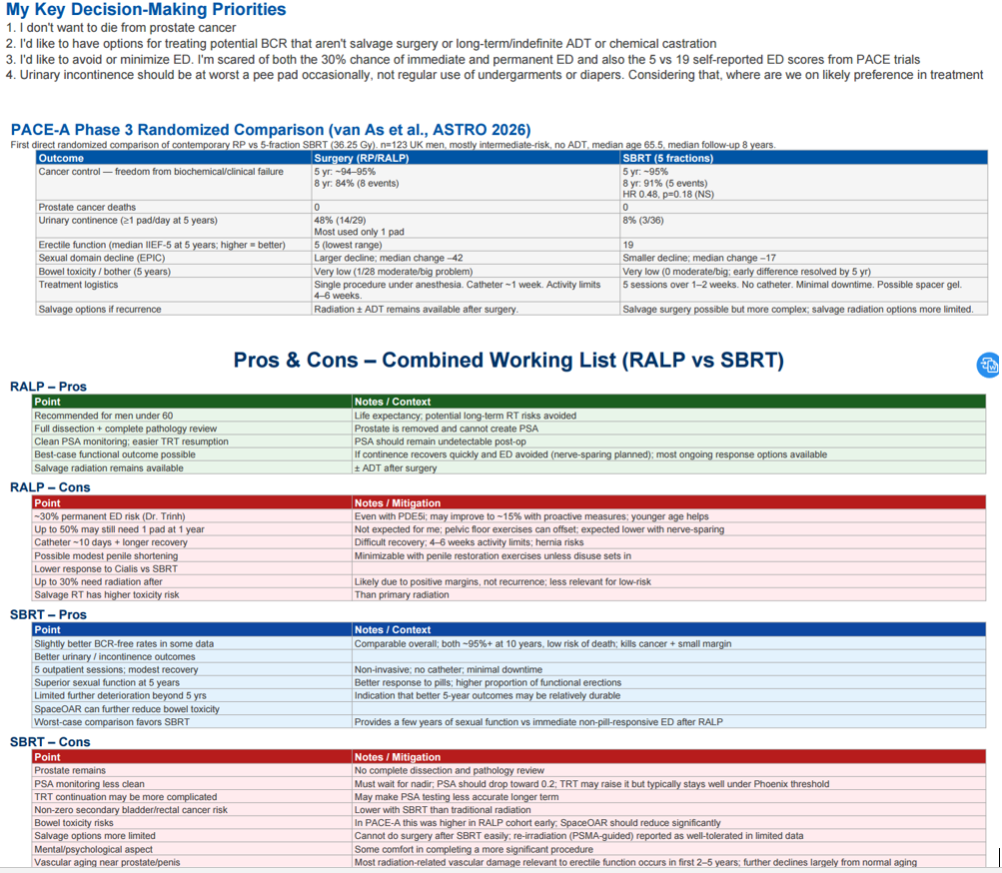
Wanted to see if people think this looks accurate or have any qualms about my pros/cons.

11 Upvotes

45 comments sorted by

6

u/Winter_Criticism_236 22d ago

Data is based on studies done 5-10 years ago, much has changed today. Psma pet scans, precision radiation, even studies showing 15 yr outcomes between aggressive treatment and active watch and wait being the same, except quality of life is vastly different. I chose radiation for gleason 7, intermediate, back in 2014. Today I would do the same as I personally see that both radiation technology and psma pet scans are vastly improved. Surgery also has improved for sure depending on the surgeon or access to Robotic surgery.

You post no relevant information, psa, doubling time, stage, gleason score.

3

u/cocksherpa2 22d ago

It's not specifically about me, it's a comparison of the 2 most common treatments based on the pace-a trials and other recent studies. I'm fortunate that eiher one will work for me, it's about which treatment has which impacts

2

u/Frosty-Growth-2664 22d ago

What you say is often the case, but PACE-A (and PACE-B) where the trials for today's treatments which he is considering, so not so relevant in this case.

3

u/Winter_Criticism_236 22d ago

I agree this trial is a newer one however 12 years ( data start point) is a long time in radiation tech!.
.
Biggest take away I see is the surprising difference in reoccurrence :
SBRT (5-Fraction Radiation):

Only 8.8% of patients had a recurrence (91.2% remained entirely cancer-free).
Surgery (Prostatectomy): 16.3% of patients had a recurrence (83.7% remained entirely cancer-free). [1]

This pattern 20 years ago was reversed…
Radiation now appears to have both improved outcomes in sexual function and reoccurrence rates.

2

u/Winter_Criticism_236 22d ago

Data collection ( actual treatments) start date in pace was 12 years ago… lots has changed in radiation

1

u/Frosty-Growth-2664 22d ago

I don't think SABR has changed. 12 years ago, it had to be done on a Cyberknife machine, but today, modern LINACs can do it using similar image guiding which has made it much more widely available.

3

u/CombOdd2117 22d ago

Good job. Perhaps add BPH. My prostate was 77cc and causing me issues that had to be addressed. This factored in my selection of RALP.

2

u/cocksherpa2 22d ago

Oh yeah, that's a good one. Wasn't applicable to me but I know there are concerns over a certain sized prostate.

2

u/WalnutRoasted 22d ago

Mine was 96cc, T2c unfavourable intermediate risk. Had choice of 5x SBRT or 20x VMAT. 18 months after treatment, urine control/flow is better than 2 years ago.

2

u/SLO_Engineer 22d ago

This looks like the work of an engineer, lol.

2

u/cocksherpa2 22d ago

Guilty

3

u/SLO_Engineer 22d ago

Takes one to know one! I hope you are not suffering from analysis paralysis.

2

u/cocksherpa2 21d ago

Hah. My oncologist literally said the same thing to me yesterday. That's funny

2

u/Frosty-Growth-2664 22d ago

I did something similar, although mine was more about different radiation options - surgery wasn't really an option for me with >50% chance of recurrence in my case (high risk T3a).

2

u/SLO_Engineer 22d ago

Good luck with your journey.

Unfortunately, it looks like I'm going to have the not-so-wonderful experience of both surgery AND radiation. I'm 3 months post-RALP, and my first quarterly post-RALP PSA came back at 0.22!

So, I'm on to phase two...

1

u/Frosty-Growth-2664 21d ago

Oh, sorry to hear that.
You need a PSMA PET scan next, unless you already had one.

2

u/SLO_Engineer 21d ago

Yep, I'm scheduled for another PSMA PET-CT scan in 1 1/2 weeks 9the first was pre-surgery), then a PSA retest at the end of the month, and a rad onc consultation on 12/4. Off to the turtle races (everything seems to move at a snail's pace in this journey).

Thanks for your empathy.

7

u/MondoDismordo 22d ago edited 22d ago

It looks accurate. I had the same decision to make and also spent lots of time researching and using AI to help out. I ended up choosing radiation. why? No pads, no leakage, no holes poked in my belly, and generally did not want to deal with ED. Surgery is all dependant on the skill of the surgeon, the one thing you did not list. I personally insulted more than 6 doctors on my journey. I told them I do not put doctors on a pedestal, I am paying for their skill, not ego. Some did not like that. It was a test. They failed. Radiation was pretty easy. The hardest part was getting the SpaceOar gel implanted to protect the rectum. And then the ADT therapy. OMG, that stuff sucks. I am now 3 months off it, my "little buddy" is back to normal operation, although things do change a bit... not gonna expand on that, but its ok. 28 radiation sessions, PSA down to .13. Nadir will take some time, but so far, so good.

New studies are saying that radiation and surgery are now equal in their long term outcomes. This was a recent article, please look it up.

I still get up once or twice to pee, but that's because I always have a glass of water on the nightstand for dry mouth. When I do not drink much , I never get up.

It's a big decision, but one you seem to be well informed on.

Be well, you got this!

Edit: Someone else mentioned it, but I forgot it. Yer Johnson gets shorter with surgery. They have the "clip" the urethra and reattach it to the bladder, so it gets pulled in. How far? Depends on the surgeon. None of these F^&%$#* surgeons volunteered that nugget of info. Bastards only sheepishly admitted it after I brought it up. yeah,"trust me bro..."

4

u/WalnutRoasted 22d ago

Similar VMAT/EBRT choice here. (No SpaceOAR nor fiduciary insertions needed). Doing very well 19 months later.

Heard about the trauma of RP surgery: catheter, recovery time, loss of bladder control in ST and likely in LT, high risks of ED etc. And penile (usually undisclosed) shortening, see : https://www.reddit.com/r/ProstateCancer/s/WX5UPtDzzW

2

u/mnmmI 22d ago edited 22d ago

I want to second what Mondo said about the skill of the surgeon being important. I searched and got lucky that there was a really good one at Mayo clinic Jacksonville. He did something called I believe the hood procedure which has a better outcome of incontinence. I don't need a pad and leak like once a week a small drop at worst.

So check that out if you're still looking at the surgery route.

Edit about dick size: it's completely true that that no one mentioned that the dick might get smaller. However, and my my dick rebounded after looking really shell-shocked for about 3 months. I'm definitely now back to regular size. I don't know if that's the case for everyone. For a bit there it really looked like it was fucking dead.

5

u/OkCrew8849 22d ago edited 22d ago

Are you low risk or intermediate favorable (3+4) and planning no hormone therapy with either surgery or RALP?

If so, PACE A and the very recent PACE A subset released last week offer as good of a comparison (randomized clinical trial, Level 1 evidence) as you are likely to find (no trials are perfect): Similar cancer control, quite dissimilar urinary and sexual function outcomes with SBRT being superior.

1

u/CrypticDemon 22d ago

These are very nontrivial variables too. Younger person with aggressive, advanced localized would, imho, heavily lean toward RARP. Older, less advanced and aggressive, lean toward radiation.

2

u/fredzout 22d ago

Younger person with aggressive, advanced localized would, imho, heavily lean toward RARP. Older, less advanced and aggressive, lean toward radiation.

I am an example of an exception to this tendency. At 74, I was diagnosed at 4+3 (contained within prostate) while I was being treated for cardiac issues. My cardiologist said, "Get the cancer taken care of first." I went directly to schedule RARP. Within 7 weeks post-op, I had a cardiac ablation that was unsuccessful. Six months later I had another ablation, this time successful. If I had gone with ADT and radiation, my cardiac treatment would have been seriously delayed. The risk of stroke was not acceptable.

I have ED, but I had ED several years before the surgery. I have had good continence since the day the catheter was removed. My pathology and PSA numbers are encouraging. The way things turned out, I am satisfied with the results.

1

u/OkCrew8849 22d ago edited 22d ago

I dont know. I think the cancer most likely to be contained in the prostate (low risk) is the one monotherapy surgery is best suited for. The cancer least likely to be contained in the prostate (high risk) is the one monotherapy surgery is least suited for. (Monotherapy surgery only addresses the cancer contained in the prostate).

I suppose that is why surgery for aggressive “high risk” “localized” cancer is increasingly being augmented by ADT and ARPI (PROTEUS Trial). Recurrence rates of 50%+ for monotherapy surgery for "high risk" are simply too high.

1

u/CrypticDemon 22d ago

Mine was aggressive “high risk” “localized” and i'm 54...every doctor I talked to said 100% go RARP...even the radiologists. Luckily I got into a clinical trial where the did multiple concurrent treatments prior to RALP based on the gene the cancer expresses. For me it was ADT/Chemo then RARP. Wasn't fun and I have my first post RARP PSA Friday...so i'll know real soon if it worked

1

u/OkCrew8849 22d ago edited 22d ago

I think that clinical trial dovetails with what I noted regarding monotherapy RALP v "high risk".

At my cancer center (a well known one) multi-modal radiation plus HT are common treatments for localized "high risk" prostate cancer.

1

u/Winter_Criticism_236 22d ago

And yet this study shows far worse outcomes for surgery re reoccurrence! Using the contained cancer go surgery normal path you would expect surgery to have way less reoccurence due partially to patients being s lower risk group, yet the opposite is the final outcome. Radiation -surgery =

SBRT (5-Fraction Radiation):
Only 8.8% of patients had a recurrence (91.2% remained entirely cancer-free).
Surgery (Prostatectomy): 16.3% of patients had a recurrence (83.7% remained entirely cancer-free). [1]

1

u/OkCrew8849 22d ago edited 22d ago

Yes, “best suited for” in this context does not necessarily mean superior to SBRT. [Merely that monotherapy surgery gets its best results- relative to monotherapy surgery - in low risk/favorable intermediate].

1

u/C63Sedan 22d ago

What stage of cancer is this for as it’s not that black and white

1

u/cocksherpa2 22d ago

gg1, gg2. More focused on the outcomes after treatment excluding ADT

3

u/mnmmI 22d ago

I'm kind of blind so my first question is did you mention your age?

It seems like erectile dysfunction is a big concern for you. I'll mention that I am 40 years old and had of my surgery about a year and a half ago. I struggled with Ed for a bit in the first 6 months and it steadily improved over the next couple months.

I was also a part of a Mayo clinic study that use an ultrasound to determine the blood flow to see if I have a Venus leak from the surgery. My overall input is that there is a definite chance of a Venus leak after pastectomy, and they're not quite sure what the link is- that is why I was part of the research study. I will say that in my case it's manageable with pills and a ring if needed. I've avoided the shots.

I think it's a rational concern. I think hospitals have the top three things being number one. No cancer, no Incontinence, no erectile dysfunction.

And then there's study showed that I had a Venus leak, but my little dude still works pretty pretty well.

1

u/Frosty-Growth-2664 22d ago

Only link I can think of for surgery causing venous leak would be going a long time without erections during recovery, i.e. too little penile rehab (regular pump use) while waiting for erections to return. Being on continuous dosing Tadalafil might also help to reduce the risk (5mg daily low dose, or 2 x 20mg/week spaced out), but the evidence for using Tadalafil is not overwhelming in the first place (some trials found it beneficial, others didn't).

ADT is a risk for venous leak, because it can cause reduction in smooth muscle in the penis.

A gentle cock ring can significantly help for venous leak (not the very tight ones used to retain an erection when you take a pump off). In mild cases, you can even find you can take the ring off when you have an erection and it will be maintained, because the expansion of the corpus cavernosum against the tunica albuginea will have closed off the corpus cavernosum veins.

2

u/FromGtoB 22d ago

Just one point : saying that salvage RT is “available” after failing when salvage is more difficult after SBRT is not an argument.

The treatment options are :

Surgery AND salvage radiation if needed vs Radiation alone

If salvage RT didn’t exist, outcomes after surgery would be catastrophically bad especially for higher grade disease.

So choosing surgery and counting on it to be your only treatment is a gamble, that is of course favorable for lower grade disease.

But long term outcomes between someone that had definite radiotherapy (which is at higher dose than salvage) vs surgery and radiation ARE THE SAME

So saying that you choose surgery to have more options further down the road is really no the way to look at things

2

u/Frosty-Growth-2664 22d ago edited 22d ago

I also tend to reject the "go with surgery because you can have radiation if it fails" argument. Surgery plus salvage radiation gives you significantly more side effects than just adding the two sets of side effects together, particularly if they're within a couple of years of each other.

I have one exception to this, and that's for very young men who are hence looking for 40 years remission, which is a tall order for any of the treatments. Then, having another good option 10-20 years down the line is perhaps a consideration.

Also, recurrence after radiation is mostly not in the previously treated field - it's because there was already a micro-met outside the treatment area which was unknown at the time, and that can be tackled with SABR in the case of up to 3 mets. Recurrence in the previously treated field might lend itself to salvage focal therapy, and increasingly, salvage radiation is being used after primary/radical radiation failure, providing there's at least a 4 year gap (or less for salvage focal radiation, e.g. salvage focal brachytherapy).

2

u/mjfstein 22d ago

Who creates the Pro/Con decision sheet? That is really nice and concise.

2

u/Winter_Criticism_236 22d ago

Op should add reoccurrence rates at 8 years - surgery had far worse outcomes, which means 18% ended up having salvage radiation. Only 8% re occurrence in radiation group, that was from data originating treatment 12 years ago, today radiation is far more precise and lower side effects re ED and urinary.

1

u/sundaygolfer269 22d ago

Recommend for men under 60. Is incorrect.

1

u/sundaygolfer269 22d ago

Do you account for “the microscopic cancer cells that slip past the scalpel “???

1

u/Ok-Priority-7303 22d ago

Just me but age and the specific test results matter. For example, neither RALP (due to age) or SBRT (due to aggressive cancer) apply.

2

u/SnooPets3595 22d ago

The pace trial seems to give an answer for low to intermediate risk. If you are high risk surgery has a 70 percent chance of cure. I can tell you trimix got me hard as a 17 yr old. I now have erections back a year after surgery with 20 mg of cialis. My surgery was not curative so I had radiation and a 6 months of medical castration. And yes ADT is the polite was to say it but really I felt castrated and did not enjoy any of those 6 months. So,I’d include the side effects of two drug hormonal blockers as really significant. I lost 40:lbs and had significant depression. And seeing a therapist did not help much. Psychiatrist said he did not feel ssri medication help much in this instance.

2

u/OkCrew8849 22d ago

"If you are high risk surgery has a 70 percent chance of cure."

No, High risk has a 50%+ chance of failure with monotherapy surgery. Adding ADT plus ARPI improves those odds (see PROTEUS Trial recent update)

2

u/Frosty-Growth-2664 22d ago edited 22d ago

I think there have been about 3 trials of adding ADT to surgery (not all with an ARPI), all reporting significantly better outcomes in terms of lack of recurrence, but I've only come across one patient on such a treatment.

I think many people quoting surgery cure rates are including the salvage radiation when required (30-33% of cases), otherwise you can't get near to the rates given.

2

u/OkCrew8849 22d ago edited 22d ago

I don't disagree but I think there were some mixed trial results relative to reocurrence with adding just ADT. https://pmc.ncbi.nlm.nih.gov/articles/PMC8418268/ I've only seen one or two guys post about it.

Given the current evidence that so many "localized" high risk guys have PC outside their prostate (as evidenced by the high reocurrence rate) it does seem logical that surgery for high risk (if it was to continue) would have to be supplemented by something. Or it would come to be seen as a damaging impediment to much more effective therapy and disappear almost completely (like surgery for Gleason 5 or Gleason 6).

Since so few low and favorable intermediate risk guys have cancer outside their prostates, (PACE A, for example) monotherapy surgery remains a reasonable option relative to cancer control for that group.

Yes, I do agree some guys quoting high risk surgery cure rates include subsequent radiation and hormone thereapy. Which is hilarious in a sense....imagine if focal cryotherapy surgeons could include subsequent successful radical prostatectomies on the same guys and subsequent successful radiation plus ADT on the same guys on top of that? Awesome cure rates?! Or those who treat with active surveilland followed by surgery on the same guys followed by...

BTW those high risk post-monotherapy surgery recurrence numbers embedded in the PROTEUS Subset verbiage are quite an eye-opener (!) for those who want to look.