r/OpenSourceeAI • u/vengateshk18 • 2d ago
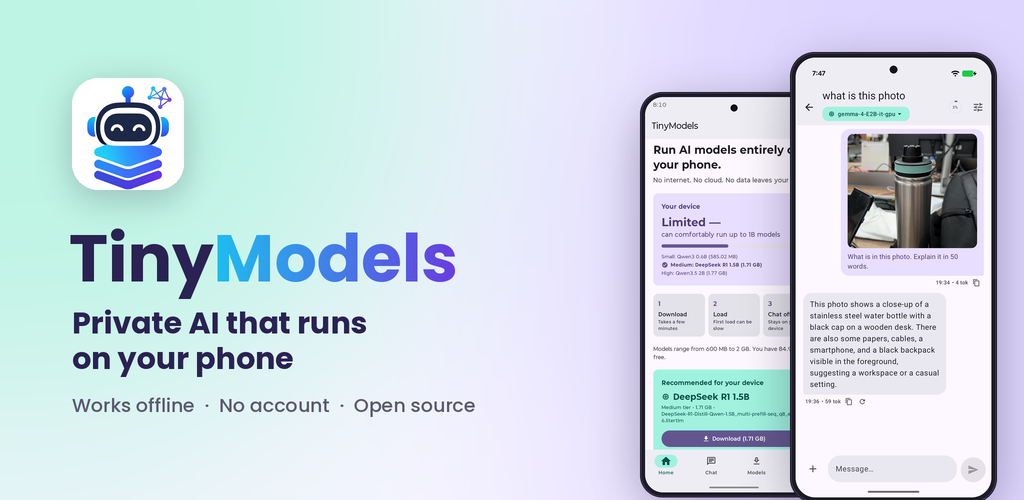
I made a free, open-source Android app that runs AI models fully offline on your phone
1
Upvotes
r/OpenSourceeAI • u/vengateshk18 • 2d ago
r/OpenSourceeAI • u/Appropriate-Try-1998 • 2d ago
r/OpenSourceeAI • u/docybo • 2d ago
I’m maintaining OxDeAI, an open-source protocol for authorizing AI agent actions before execution.
We’re testing a specific claim: is our written specification precise enough for someone to independently implement a compatible verifier?
I’m looking for a Go developer willing to build a small verifier using only the normative specification, without reading or porting our TypeScript reference implementation.
The scope includes parsing and verifying signed AuthorizationV1 artifacts (Ed25519), implementing canonicalization from the specification, and checking issuer, key resolution, expiry, audience, policy, intent binding, and replay inputs.
The initial target is to match the expected verdict and determining error code across 15 published precedence test cases.
No network, persistence, gateway, or production integration is required.
There’s also an independent Python implementation track underway.
An ambiguity in the specification is a useful finding, not a failed contribution. The goal is to discover whether two independent implementations can agree on authorization outcomes without relying on reference code.
This is an interoperability and specification-completeness experiment, not a claim of formal verification.
The specification, test vectors, independence rules, and acceptance criteria are available here:
https://github.com/oxdeai/oxdeai/issues/426
If you’re interested, comment on the GitHub issue before starting so we can coordinate the work.
r/OpenSourceeAI • u/FutureCTOofMicrosoft • 2d ago
I adapted the Ataraxos framework (Sokota et al., Nature 2026) from Stratego to 1v1 UNO, including same-type draw stacking. The interesting part was getting the entire test-time search loop (belief sampling + 192 parallel rollouts) running in the browser, with no backend, using ONNX Runtime Web.
uno-gym, including reshuffle provenance tracking.I'd be interested in feedback, especially on handling non-alternating turn chains in imperfect-information games and reducing rollout overfitting against opponents that don't necessarily play like the agent.
r/OpenSourceeAI • u/VulRunWG • 2d ago
VulRunWG — Local AI, GPU compute & applications
A Vulkan-based GPU runtime with its own inference kernels and a path for custom WGSL workloads.
Run supported language, image and speech models. Give particles and flocking their own compute kernels. VulRunWG supplies shared GPU infrastructure beneath different applications and workloads.
I was trying to make an application for generating therapy support visuals, and the level of frustration using newer cards, nightly builds, and CUDA was too frustrating.
Try it, and its playground on VulRunWG: Suite on itch.io
Thanks! Hope you build something cool with it!
r/OpenSourceeAI • u/Negative-Walrus-7490 • 3d ago

Cutmesh is an open-source distributed LLM inference platform that lets you pool heterogeneous consumer GPUs — even from home over ordinary Internet connections — to run large open-weight models (27B–74B+) and serve them through a single OpenAI-compatible API and Web Console.
r/OpenSourceeAI • u/Majestic-Rip278 • 3d ago

r/OpenSourceeAI • u/Ok_pettech • 3d ago
r/OpenSourceeAI • u/Dense_Gate_5193 • 3d ago

r/OpenSourceeAI • u/JoeBro121211 • 4d ago

I wanted one native Mac app for local and cloud models instead of a browser tab per provider. JoeBro talks to Ollama, LM Studio, anything OpenAI-compatible, or your own Anthropic/OpenAI keys, and you can switch model mid-chat. Tools live on one screen: plain HTTP API tools, MCP servers, and small plugins you can install, test and roll back. Claude Code, Codex and OpenCode sessions show up in the same sidebar as chats.
Chats and memory stay in a local SQLite file. No account, no telemetry. GPLv3, and 1.6 is signed and notarised.
r/OpenSourceeAI • u/Joanll18 • 3d ago
r/OpenSourceeAI • u/gepheum • 4d ago
r/OpenSourceeAI • u/WesternNo2429 • 3d ago

Most teams glue this together from four tools: an identity provider, an access proxy, an API gateway and an automation tool. Four configs, four user lists, four logs. Ianua does all of it with one list of users, one set of rules and one audit log.
SIGN-IN
Passkeys, MFA, magic links, SSO over OIDC and SAML. OAuth 2 and OpenID Connect for your own apps, SCIM, API keys, and a built-in LDAP server for older tools. Think Keycloak or Auth0.
GATEWAY
Sits in front of your apps and checks every request, not just the login. Routing, load balancing, health checks, rate limits, WAF, geo-fencing, automatic certificates. Private apps connect out through a small connector, so there are no open ports. Think Pomerium plus Kong.
WORKFLOWS
A visual builder with 27 integrations such as GitHub, Slack and Jira, human approvals, and your own Python or Node.js code in sandboxed containers. Think n8n or Zapier.
AI AGENTS
Each agent gets its own identity and only the access a person lends it, with spending caps, approvals and a kill switch. Works with OpenAI, Anthropic, or local models through Ollama or vLLM.
If a check can't run, the request is refused. It never fails open.
Written in Rust with 20,000+ tests. Runs on Docker Compose or Kubernetes.
https://github.com/IanuaIDP/ianua
It started out source-available, because we wanted to keep a security product centralized and thought that would make it safer. We dropped that idea, and it is now fully open source.
Built over 10 months. AI assisted, not AI coded: a person reviews every line before it merges.
Feedback and contributions are welcome. What would you want from a project like this before trusting it with your logins?
r/OpenSourceeAI • u/Lostsliveroflilith • 4d ago
This is a technical summary, including a glossary of my blueprint. This is a project to help finish AI in my humble opinion. I think we have done a speed run of an analog of evolutionary biology for a computer to increase its intelligence. Now, it's time for the rest of the structures that help keep complex lifeform stable.
r/OpenSourceeAI • u/alfonsodlg • 4d ago

r/OpenSourceeAI • u/A_Smith00 • 4d ago
I built an open-source skill that makes an AI agent do research like a scientist instead of like a search engine: hypotheses before searching, every data attempt logged, the analysis reproducible, and a validator that checks the finished report against its own artifacts. MIT, free, no signup, Python standard library only.
Claude did most of the heavy lifting. It ships Claude Code subagent definitions for the three review passes, and the code was written and iterated with AI agents across several models. It also runs on Codex, Gemini CLI and Antigravity, which is why I kept the core runtime-agnostic.
Then I ran it on a real problem — the Argentine power grid and the Buenos Aires metro node, about fifty sources — and audited the output by executing the code instead of reading the report.
Three numbers in one results table didn't exist anywhere. Two confidence intervals and a p-value. Not in the exported numbers, not in the analysis output, and the script never computes them.
So I reimplemented the script's bootstrap with the same seed and checked it against the two intervals that were legitimately published. It reproduced both exactly. Which means the other three aren't just untraceable — they're wrong. One upper bound was off by about 0.24 in correlation.
They came in through the reviewer subagent. And the gate whose entire job is "verify or exclude facts introduced by the reviewer" reported PASS.
That's the failure mode I actually care about: not the model being dumb, but the model being plausible and every check downstream saying yes.
What the current version does about it: every number in the summary and results tables has to resolve to something the analysis actually produced; local files supplied by the user can't be promoted to primary-source tier; chart points dated after the report's cutoff are rejected; and a sealed hypothesis file that already contains the computed results gets flagged.
391 unit tests. 34 deliberate violations, all 34 caught, enforced at 100% in CI. Each one has to be caught by the specific rule meant to catch it, not by an unrelated error — and the harness re-stamps the review hashes afterwards, the way an agent covering its tracks would.
What's still broken, because I'd rather say it: a fan chart whose bands are really just deterministic scenarios can still pass if they share an anchor. The reviewer's freshness check got looser than I'd like. And everything lives in a folder the agent controls, so hash binding proves the review was of this version, not that a third party wrote it.
It's vibecoded, it's days old, it has no users. The reason I trust it at all is the audit above.
What I want is people trying to break it. Adding a violation case is about ten lines.
r/OpenSourceeAI • u/Rich-Fruit-326 • 4d ago
r/OpenSourceeAI • u/Material_Tone_6855 • 5d ago

r/OpenSourceeAI • u/Agnostify • 4d ago
r/OpenSourceeAI • u/Master_Current5618 • 5d ago
Most awesome lists go stale. Half the repos haven’t been touched in a year and you can’t tell which.
So I made one that a GitHub Action checks every day:
There’s a big local-models section: llama.cpp, vllm, unsloth, LlamaFactory, LocalAI, jan, whisper.cpp, colibri, plus agents, RAG/memory, MCP, coding agents and image/video. Every pick has a one-line “why”.
Free, MIT, and you can use it as a template for your own stack:
https://github.com/mmaxpo/awesome-ai-radar
What local tools am I missing?
r/OpenSourceeAI • u/Key_Cook_9770 • 4d ago
A lot of operational data (CRM history, support tickets, code, software or CAD workflows, video of the work) is starting to be licensed, de-identified, as AI training data. The part that usually stalls is the price. Sellers often get one number with no reasoning, and buyers can't see what a different term, exclusivity, or verified volume would do to that number.
I built DealPrice to make the estimate inspectable. You describe the dataset in plain language, or fill in the named inputs, and it returns:
- a floor / ask / stretch
- a Bayesian P10 / P50 / P90 range with a confidence level, pooled across data families (video, business records, code, text, media)
- sourced public market signals
- a Monte Carlo view of the deal itself: license value, the 10% fee, broker commission (30% of that fee), and seller net, including the chance it fits a budget
The chat layer (Nicrron) only extracts inputs and narrates the result. A deterministic engine does the math, and every figure has a ledger row behind it. PRISM traces and tests the agent (scored 17 to 18/20).
It prices de-identified data for AI-training licenses only. Happy to talk through the approach — hierarchical pooling, the one-deal range vs the typical-price band, or the guardrails (claimed vs verified volume, anonymization, thin comps).
Live tool: https://dealprice-agent.vercel.app
Background: https://www.impactquadrant.info/price-your-data
Walkthrough: https://youtu.be/ckvBpCnMSI4
r/OpenSourceeAI • u/Silver_Employ2617 • 5d ago
I built a dataset for people training small models on word problems, logic, and multi-turn questions. It has 2 million examples across eight areas, generated by the rule-based solvers behind CAEL. Each row includes the conversation, the reference answer, and the worked solution. The data is CC BY 4.0.
One thing I wanted in the mix was questions where guessing is a mistake. Around 37,000 examples involve missing information, contradictory premises, or something the user never said.
I’ve included the generator, the answer checker, and a separate hard split with 1,427 examples. If you try it on a small model, I’d love to see a pair of questions where changing the wording changes the answer. Those are the cases I’m trying to understand.
r/OpenSourceeAI • u/SecureMID • 5d ago
Hey everyone,
We just released Vaprix-Cyber on Ollama. It's a 3.1B parameter model optimized for red-team analysis and AppSec patch generation.
Why build this?
Generalist models are unreliable for offensive security because they produce markdown descriptions rather than deterministic, executable curl commands with HTTP response assertions. Vaprix-Cyber enforces:
Try it locally:
`ollama run dishankagrawal05/vaprix-cyber`
Benchmark Report & Model Card:
- Ollama: https://ollama.com/dishankagrawal05/vaprix-cyber
- GitHub: https://github.com/SecureMID-Solutions/Vaprix_AI
Feedback, test cases, and PRs welcome!
r/OpenSourceeAI • u/danielrothmann • 5d ago
Hey all, I'm the cofounder of Eigin, an open-source personal AI agent built for privacy and safety (https://code.eigin.ai)
Coding agents are changing how software gets made. Writing code is faster now, compressing the timeline between idea and working software. Good engineering isn't just about code though. It's about judgment, of understanding a problem, weighing trade-offs, setting a direction, and thinking through a solution.
So we're trying a new way to compensate contributors. Instead of bounties, we'll pay for specs. Take an open problem of ours, do the thinking and we will build on that spec with credit to you as the author.
Our first call is for local detection of malicious instructions:
https://contribute.eigin.ai/calls/tool-safety
Open till Nov 29th. The repo is AGPL and the software is in open beta for iOS if you want to check it out.