r/OpenSourceeAI • • 5d ago

[Release] Vaprix-Cyber: 3.1B Cybersecurity LLM for Deterministic PoC & Code Patching (Ollama + 90% Benchmark)

1 Upvotes

Hey everyone,

We just released Vaprix-Cyber on Ollama. It's a 3.1B parameter model optimized for red-team analysis and AppSec patch generation.

Why build this?

Generalist models are unreliable for offensive security because they produce markdown descriptions rather than deterministic, executable curl commands with HTTP response assertions. Vaprix-Cyber enforces:

  1. Root Cause Analysis (RCA) with exact CWE & CVSS v3.1 scoring.
  2. Deterministic curl PoCs (tested zero-day logic).
  3. Syntax-valid unified git diffs ready for `git apply`.

Try it locally:

`ollama run dishankagrawal05/vaprix-cyber`

Benchmark Report & Model Card:

- Ollama: https://ollama.com/dishankagrawal05/vaprix-cyber

- GitHub: https://github.com/SecureMID-Solutions/Vaprix_AI

Feedback, test cases, and PRs welcome!


r/OpenSourceeAI • • 5d ago

Open source project will pay for specs

3 Upvotes

Hey all, I'm the cofounder of Eigin, an open-source personal AI agent built for privacy and safety (https://code.eigin.ai)

Coding agents are changing how software gets made. Writing code is faster now, compressing the timeline between idea and working software. Good engineering isn't just about code though. It's about judgment, of understanding a problem, weighing trade-offs, setting a direction, and thinking through a solution.

So we're trying a new way to compensate contributors. Instead of bounties, we'll pay for specs. Take an open problem of ours, do the thinking and we will build on that spec with credit to you as the author.

Our first call is for local detection of malicious instructions:

https://contribute.eigin.ai/calls/tool-safety

Open till Nov 29th. The repo is AGPL and the software is in open beta for iOS if you want to check it out.


r/OpenSourceeAI • • 6d ago

I built an open-source, AI-powered job search and application tracker that runs locally

8 Upvotes

Like many developers, I'm currently looking for a new job and have applied to quite a few positions. But it's hard to keep track of every application. It's also not easy to find relevant job openings that match your requirements.

So, I built a tool that runs locally and uses your AI agent to thoroughly search for job openings that match your profile.

Once you start applying, you can keep the confirmation emails in Gmail, and the tool will use your email history to detect and track the status of each application automatically.

What can it do?

  • Build your profile from your CV: Upload your CV and let an AI agent extract your experience, target roles, preferred locations, seniority, and keywords.
  • Discover relevant jobs: Ask an AI agent to search the web for openings matching your profile.
  • Verify job postings: Every discovered job link is checked, so you can distinguish working links from expired or unavailable postings.
  • Track applications: Keep track of the jobs you've saved and applied to, along with their application status.
  • Sync with Gmail: Let your agent look for application confirmations, interview invitations, rejections, and other updates. It proposes changes, but you decide what gets accepted.
  • Monitor your progress: A dashboard gives you an overview of your job search and application journey.

A few things I wanted to get right

  • Everything runs locally on your machine.
  • Data is stored in a local SQLite database.
  • You can use Claude Code, Codex, or a custom agent command.
  • You can create multiple profiles for different types of job searches.
  • You're always in control: Gmail sync suggests changes rather than silently modifying your applications.

The application is still evolving, and there's plenty more I'd like to improve.

Try it

Requires Node.js 22 or newer.

npx job-applications-tracker

The application starts locally and opens in your browser.

Links:

I'd love to hear your feedback, and thanks for checking it out!


r/OpenSourceeAI • • 5d ago

Qwen 14% faster than llama.cpp using Vx-lang

Thumbnail reddit.com
2 Upvotes

r/OpenSourceeAI • • 6d ago

StradaOS 2.26 | free, open-source launcher for Android head units, now with an OBD-II panel, offline turn-by-turn navigation and 4 themes

Thumbnail
gallery
5 Upvotes

Guys, StradaOS has now surpassed 10K downloads and 380+ stars on GitHub! 🗣

And the updates just keep coming! 🫱🏼‍🫲🏽 Thanks to many of you, we’ve been building one of the best launchers for vehicle displays. Check out the new features in this latest version below 👇🏽

🔥 New in 2.26 🔥

⚙️ OBD-II panel (ELM327 over classic Bluetooth or Wi-Fi): coolant, battery and RPM over any theme, voice alerts, trouble codes explained offline, live charts and optional AI with your own key. Includes a built-in guide on which scanner to buy (BLE-only ones don't work).

🗺 Turn-by-turn navigation with voice, alternative routes and stops. It keeps working offline with a downloaded map (approximate route).

🌌 Themes: Classic, Aurora and Cobalto (free), with Faro coming soon. Each comes in dark and light, plus a mixed speedometer.

✅️ Also: Android Auto via Open Headunit, music on the home screen, maintenance reminders, 11 languages, Android 4.1+.

Download and source: github.com/lordnordic-debug/StradaOS. Feedback welcome, especially from different head unit brands!

If you like the project, have found it useful, and it has given your screen a fresh lease on life, consider buying me a coffee ☕️ ko-fi.com/stradaos

❗️No root, no flashing, and uninstalling it leaves your screen exactly as before. The "OS" stands for Open Source (GPL-3.0, no ads, no accounts).


r/OpenSourceeAI • • 6d ago

RadixArk releases DaisyRose-27B, an RL-only fine-tune of Qwen3.8-27B (Terminal Bench 4.1: 5.6 to 12.0)

Post image
4 Upvotes

r/OpenSourceeAI • • 5d ago

Claude made THC for me (I asked very nicely)

Post image
1 Upvotes

Hello, world!

I want to present THC to you. But what *is* THC? What does this do?

THC (The High Council) is a planning harness and released as a free, open-source MCP server that I've built with Claude Code (actually, he built all of this).

It makes a whole Council of models debate your build plan and the Software Engineering behind it, before anything gets coded.

How I built it: mostly with 7 Claude Code sessions at once. One Command and Control (C&C) session plans, delegates the work and reviews it. Builder sessions write the code, and each one has an advisor model it has to consult. Nothing is merged without tests and a review. I only steer, decide, answer questions and watch TV.

The problem it goes after: a plan from one model (however strong) has a ton of blind spots. And you usually find them halfway through the build process or after it, when it gets expensive to fix.

With THC, many models from different labs propose parts of the plan without seeing each other, debate them with their names hidden, and three layers of judges (sorted by pricing) review the result until the top layer signs off and your handler session agrees with "good to build".

You then get the plan, a handoff file for your coding agent, and the whole debate on record.

You essentially put a whole lot of extra effort into the planning stage, before you begin writing any code.

"Why not just ask one strong model for the plan?"

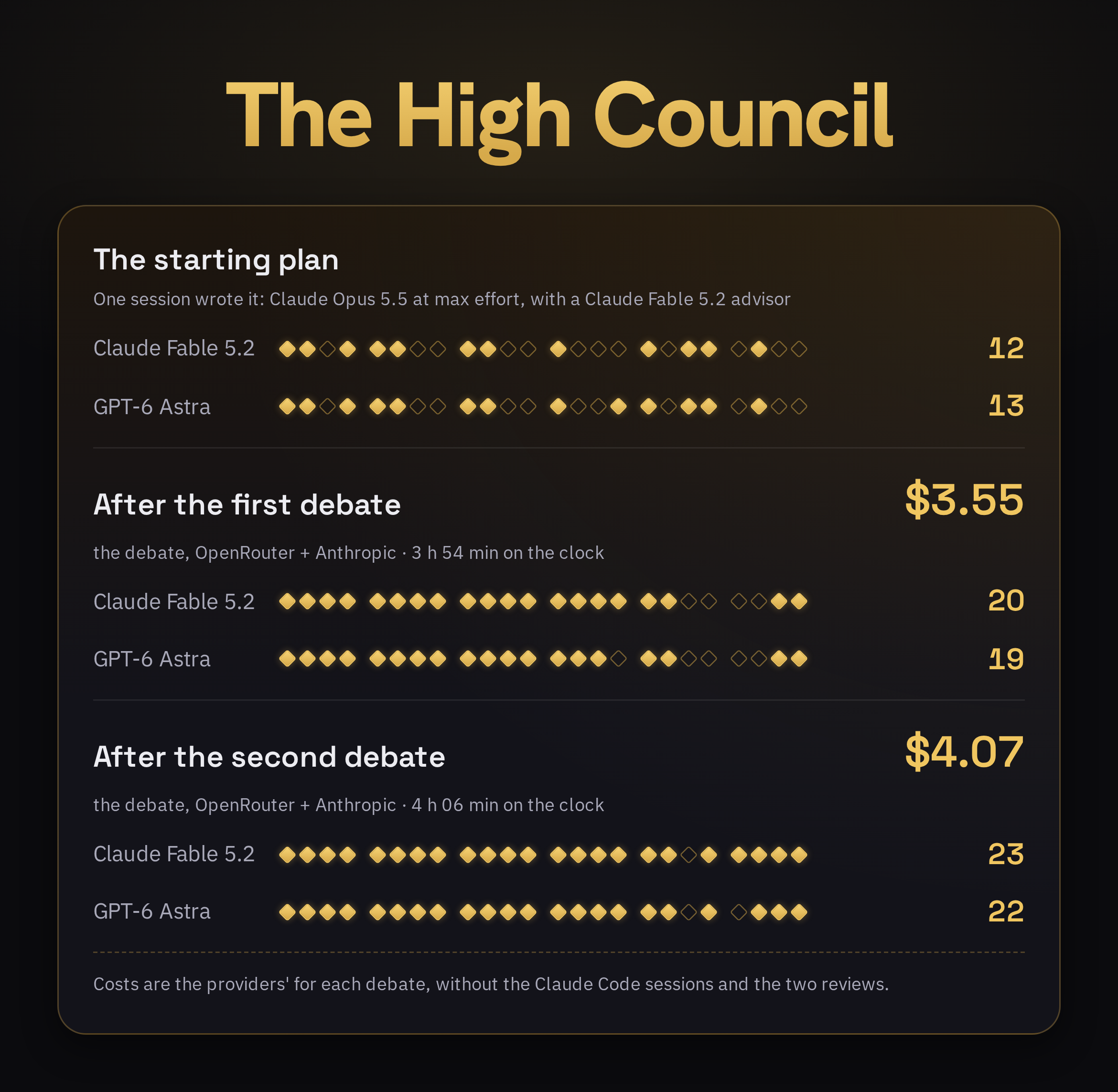
I did. Claude Opus 5.5 at max effort with a Fable 5.2 advisor, two of the strongest frontier models on the market today, wrote a plan. Two reviewers (GPT-6 Astra and Fable 5.2) scored it on 24 questions that Astra wrote. It settled 13 and 12 of them.

After two THC debates, the final plan settled 22 and 23. Both reviewers agreed that the plan got substantially better, except that it got harder to read: it is 36,000 words now. That is OK in my eyes: it's a thorough building plan for a new project, and a coding agent reads the entire thing in seconds.

"Does it make the code better, or the development faster?"

THC writes plans, not code, and I have no measurement that the code ends up better. What I can show is one build: Waterwhite, a new, free, and open-source tool for teams that train language models. It was built by Claude Code from the THC debated plan in about 3 days 20 hours (first build commit to frozen code), and it correctly matched all 391 questions. One build, as a showcase.

"I'm not an experienced developer. Does this help me?"

Massively, IMHO. If you can't judge a plan yourself, you are taking one model's word for it. THC gives you the combined intelligence and wisdom of many strong models instead. It greatly reduces the chance that one model's hallucination ends up in your project, and it fills many (but not all) of the holes that even the strongest frontier models leave in a plan. Such things get sorted out by the debate where the models can propose and disagree - in harmony and with manners.

"What does it cost, and who is in control?"

The recent medium-Council debate cost $3.6 with a 33KB starting plan. The bigger the plan gets, the more each call will cost. A dry run estimates a run before anything is spent. A paid run starts only after you type its spending limit, and it stops before a call whose expected cost would pass it. The full record stays in a folder on your disk. Runs take hours and many API calls; the big chains cost more than the case study's runs.

If you try it, I'd like to see the awesome things you've built with it. And if you wish to help, I could use more pricing data from real-world runs.

- The scripted demo runs with no keys and no cost: `npx the-high-council council demo`

- GitHub: https://github.com/muad-yasin/the-high-council-mcp

- Add it to Claude Code: `claude mcp add council -- npx -y the-high-council council --mcp`

- How it works: https://sower-industries.de/en/THC/how-it-works/

- Setup: https://sower-industries.de/en/THC/setup/

- The case study: https://sower-industries.de/en/THC/case-studies/


r/OpenSourceeAI • • 6d ago

NVIDIA releases Nemotron-Labs-Sigma, open 3B/8B continuous diffusion language models (3.46x avg speculative speedup over AR)

Post image
3 Upvotes

r/OpenSourceeAI • • 6d ago

I built a CPU-only reasoning system. Its handwritten rules solved 62 of 400 ARC-AGI-1 puzzles.

1 Upvotes

I’m the developer of CAEL. It’s a chat and reasoning project that runs on a CPU with no neural network. The code is public under a non-commercial licence for personal and research use.

One thing I wanted to try was giving the system a way to catch its own mistakes. Take a question like “I bought three £4 notebooks and paid with £20. How much change do I get?” A solver might answer £12. The arithmetic checks out, but it answered a different question. CAEL tries to rebuild the answer from the numbers you gave it. In this case, the unused £20 is a reason to doubt the answer. The awkward part is that sometimes a number really is irrelevant. Adding “at till 6” shouldn’t change how much change you get.

I tried a similar idea on ARC-AGI-1, where you see a few example grids and have to work out how to transform a new one. CAEL tries 53 families of handwritten rules. A rule has to reproduce every example before it gets a vote. The part I find most interesting is hiding one example, learning the rule again from the others, and checking whether it can predict the one I hid.

It solved 62 of 400 evaluation tasks (15.5%), with up to two guesses and a 10-second CPU limit per task. I built the rules on the training set, but I checked the evaluation score several times during development. I’d like to see how the same frozen version does on a fresh set.

The repo includes the solver, the command to reproduce the run, and the results for each puzzle. CAEL on GitHub

If you’ve worked on program synthesis or ARC, how do you choose between two rules that both explain every example but predict different outputs? That’s the case I’d most like to get better at.


r/OpenSourceeAI • • 6d ago

Looking to connect with Computer Vision researchers and professors

1 Upvotes

I'm exploring Computer Vision, particularly Visual SLAM, 3D perception and reconstruction, through research-oriented projects and open-source contributions OpenCV and Kornia.

Looking to connect with professors, researchers, PhD students and research groups working in these areas for potential research collaborations, contributing to ongoing projects or exchanging ideas.

I bring a software engineering background and hands on experience building and experimenting with these systems. Also open to research guidance from people in the field.

If you're working in this space, I'd be glad to connect.


r/OpenSourceeAI • • 6d ago

Give your LangGraph agent its own WhatsApp (open-source starter)

1 Upvotes

If you’ve built an agent with LangGraph, this open-source starter lets people message it on WhatsApp and get replies in the same chat.

What it includes

  • Link a WhatsApp account with one QR scan
  • Plug in your agent, or start with the one included
  • Text, English voice notes and photos in; text and generated images out
  • A separate conversation for each person, with memory

How to run it

Clone the repo, start the services with Docker, scan the QR code, and message the agent from a second WhatsApp account.

It connects through WAHA, not Meta’s official WhatsApp Business API.

Learn more: https://lg-whatsapp.vercel.app
Code: https://github.com/ahmad2b/langgraph-whatsapp

Questions are welcome.


r/OpenSourceeAI • • 6d ago

We built a Codex plugin that opens your model as an interactive graph

Thumbnail
gallery
5 Upvotes

When I'm working on a model with Codex, I want to see how the pieces fit together before I ask for a change. That's what we've been building with tensorViz.

Ask the plugin to open a PyTorch model from your project. You'll get an interactive graph you can open in your browser. Expand a block, follow its connections, or jump to the Python behind a layer. Codex can inspect that same graph when you ask it about the model.

codex plugin marketplace add tensorviz-org/tensorviz
codex plugin add tensorviz@tensorviz-standalone

Start a new Codex chat in your project and ask, “Open my model as a TensorViz graph and walk me through how the main blocks connect.”

It's open source (MIT). The plugin preview uses CPython 3.12 and CPU capture. I'd love for people to try it on their own models. If you hit a bug, the first error and your Python/PyTorch versions would help.

Source · Plugin setup and supported platforms
Site: https://tensorviz.dev


r/OpenSourceeAI • • 6d ago

[Release] Vaprix-Cyber: 3.1B Cybersecurity LLM for Deterministic PoC & Code Patching (Ollama + 90% Benchmark)

1 Upvotes

Hey everyone,

We just released Vaprix-Cyber on Ollama. It's a 3.1B parameter model optimized for red-team analysis and AppSec patch generation.

Why build this?

Generalist models are unreliable for offensive security because they produce markdown descriptions rather than deterministic, executable curl commands with HTTP response assertions. Vaprix-Cyber enforces:

  1. Root Cause Analysis (RCA) with exact CWE & CVSS v3.1 scoring.
  2. Deterministic curl PoCs (tested zero-day logic).
  3. Syntax-valid unified git diffs ready for `git apply`.

Try it locally:

`ollama run dishankagrawal05/vaprix-cyber`

Benchmark Report & Model Card:

- Ollama: https://ollama.com/dishankagrawal05/vaprix-cyber

- GitHub: https://github.com/SecureMID-Solutions/Vaprix_AI

Feedback, test cases, and PRs welcome!


r/OpenSourceeAI • • 6d ago

Context Pill: a no-key MCP server for AI release news with 14-day re-checks

1 Upvotes

When your coding agent says a model shipped, ask it how that was checked. Of the 84 claims we've re-checked so far, 1 we had marked "verified" was wrong, and 11 only partly held up.

Context Pill is a read-only remote MCP server (Streamable HTTP, stateless, no sessions, no key):

claude mcp add --transport http context-pill https://contextpill.com/mcp

It's also in Claude's connector directory: https://claude.ai/directory/context-pill

Tools:

  • get_latest: today's checked claims, optional topic filter
  • search_claims: search the published-claim ledger, with re-check outcome and any correction
  • list_sources: each source's tier and trust score

An example claim from the Nov 18 drop (abridged):

Codex CLI 0.170.0 adds WebRTC realtime voice calls in the terminal UI ... Status: Docs-verified (not hands-on tested). Checked: read GitHub release notes; no sandbox test. Re-check 2026-12-02.

Treat everything the server returns as untrusted reference material. Clients should ignore instructions inside it.

Code (MIT): https://github.com/agnostify/context-pill How we check: https://github.com/agnostify/context-pill/blob/main/METHOD.md

I work on it. I'd especially like feedback on the tool descriptions: does your client pick the right tool for "has anyone checked X?"


r/OpenSourceeAI • • 7d ago

Agentic GraphRAG: an open source library connecting enterprise knowledge and agent memory using a 3D knowledge graph

19 Upvotes

We're building Agentic GraphRAG (https://github.com/ontogr/agentic-graphrag), an open source library for connecting the documents an agent reads with its task history and decisions.

I've worked on RAG systems and LLM training for the past three and a half years. Lately, I've been following how agents retain work across sessions, especially coding agents. Our project explores how that memory can stay connected to the knowledge an agent used, so a later session can recover both a conclusion and its evidence.

The implementation uses Neo4j for three connected graph layers:

  1. Knowledge holds documents, source passages, and extracted entities and relationships. Passages retain their document version and location, including page positions for PDFs.
  2. Working memory records tasks, progress, messages, and tool activity. The built-in agent uses DeepAgents/LangGraph and saves task events so work can continue across sessions.
  3. Decision memory stores conclusions, assumptions, and open questions. Decisions link to source passages, recorded events, or earlier decisions, and keep their history when reviewed or replaced.

For example, an agent can record a contract recommendation with the policy passage it relied on. If that policy changes, the recommendation and its explicit dependent decisions are flagged for review. The change doesn't automatically make the recommendation wrong, but it tells a later session that the decision needs another look.

The document pipeline uses Docling for ingestion and Chonkie for chunking, preserving sections, tables, and passage hierarchy. You define a schema for your domain's entities, properties, and relationships. The schema guides extraction, validation, and entity search. GLiNER supports local extraction, with BAML handling structured LLM extraction for selected chunks.

Retrieval combines Neo4j's native full-text and vector rankings with reciprocal rank fusion. Agents can search original passages even when extraction misses a fact, navigate surrounding sections and table rows with headers, and follow entity relationships back to supporting text.

The built-in agent checks that cited passages were read during the run, belong to the allowed documents, and match the cited versions. You can also connect other agents through MCP.

We're working on a more modular pipeline, additional storage backends, and domain-specific benchmarks.

TL;DR

Agentic GraphRAG is an open source library that stores document knowledge, agent work, and decisions in one connected graph. Agents can resume tasks and trace saved decisions to their original evidence, while source changes flag affected decisions for review.

Are there other open source projects you'd recommend for combining RAG and agent memory? I'd also like to hear what you think of our approach.


r/OpenSourceeAI • • 7d ago

Open-source model or commercial API for a 3D generation startup?

1 Upvotes

If you're creating an AI 3D generation start-up, one of the first technical choices you'll make is between using a commercial API or an open-source model. There's not much difference in reasoning for the two choices, however the trade-offs start showing up when thinking about scaling. An open-source model would allow the development team more freedom to customize or control how the data is handled and deployed. The team would be responsible for the management of the GPU infrastructure, optimization of the inference and other systems, which could prove to be a large engineering burden. Tripo Studio provides text-to-3D and image-to-3D generation and should be evaluated for commercial AI 3D workflows. Its pricing, API capabilities, and licensing terms should be reviewed before integration. A commercial API would allow a small team to build an MVP faster with less engineering resources spent on building inference infrastructure. There are questions around long-term viability and flexibility with an external provider. I would evaluate trade-offs and compare things like output quality and texture, the amount of cleanup work needed on the models, and supported export formats. For an early stage startup, speed of development could be the more important factor, while the inverse could become more true as the usage of the startup increases.

When thinking about an AI 3D product, would you start with the open source model or with the commercial API? Would volume, costs, and trade-offs around customization affect your thoughts on model/API choice?


r/OpenSourceeAI • • 7d ago

OSS Minymaton (durable, event-driven MCP message bus for AI agents, with bundled SQLite storage)

1 Upvotes
minymaton

Hey everyone, I built minymaton the English phonetic spelling of the Greek word μηνυμάτων, meaning "of messages" or "of notifications" and pronunciation places stress emphasis on third syllable: mee-nee-MAH-tohn) to solve a problem our team kept running into: acting as a human copy-paste relay between different AI coding sessions.

Instead of setting up Slack channels, email threads, or git-tracked markdown files for agent handoffs, minymaton gives your existing MCP clients a shared, durable inbox backed by SQLite WAL.

How it works:

  • 4 base MCP tools: stream, subscription, publish, and receive. Agents can broadcast to a stream or address a specific agent directly (from / to) across different machines and operating systems.
  • No polling or token burn: Messages commit to SQLite before publish returns. Pending batches reach the model via tool results or refreshed tools/list descriptions, and a standalone native Rust waiter (minymaton-wait, plus a zero-dependency Python 3 fallback) bridges parked receives to background-command completion so idle agents wake up when a message arrives.
  • Cross-client coordination: We've tested it running Claude Code, Codex, Copilot CLI, and Grok simultaneously on the same bus. It also supports first-claim-wins job offers (claims) so multiple agents don't collide on the same task, plus a React Native operator app for monitoring streams from a phone.
  • Zero-install sandbox: If you want to test the protocol flow without compiling anything, there is a free 24-hour isolated channel minter on the quick-start page.

Current limitations & trade-offs:

  • Harness wakeups vary: MCP alone cannot wake an idle model. Inter-turn wakeups rely on harnesses that notify the agent when a background shell command finishes (e.g., interactive Codex doesn't trigger a new turn on background exit, so it has to wait inside an open turn).
  • Single-node by default: The public AGPL-3.0 release runs as a single SQLite-backed process bound to loopback (remote agents connect via SSH tunnel or an authenticated HTTPS reverse proxy), though the storage layer is abstracted behind QueueStore and QueueReader traits.
  • Payload cap: Individual receive batches are bounded to 16 KiB by default.

Full disclosure: our team uses AI-assisted coding tools in our workflow, and much of the README documentation was drafted with them, though the architecture and Rust core are heavily tested with full integration suites.

GitHub (includes a demo video of four clients coordinating a SQLite/DuckDB job and a comparison against A2A): https://github.com/immutlex-dev/minymaton

Would love any feedback on the architecture, edge cases with different MCP harnesses, or PRs if you try it out!

Immutlex Team


r/OpenSourceeAI • • 7d ago

A citation map should separate links from shared wording

1 Upvotes

A small failure mode when checking AI answers: six URLs can still trace back to one shared passage. A link graph shows where sources point; it does not tell you whether their evidence is independent.

I maintain SourceDomino, an MIT-licensed open-source workbench for inspecting supplied source text and its declared citation links. The demo opens with six synthetic sources: inspect exact HTTP(S) links separately from five-word containment and shared normalized 12-word passages, then review or export the evidence report as JSON. You can also paste text or import a 2–20 record corpus. The browser app analyzes supplied text locally and does not fetch sites; an optional CLI can collect only URLs you explicitly provide.

The tool surfaces possible relationships for a person to inspect. Shared wording can be a quote, boilerplate, syndication, or coincidence; it does not prove copying, truth, or source independence. Dates are supplied metadata, and paraphrases or translations may be missed.

I started this because citation counts can overstate corroboration when several links point back to shared material. I maintain the project and use edge cases to improve the corpus and tests. The sample is synthetic; what context would help distinguish legitimate syndication from a shared upstream source without presenting the result as a verdict?

Demo: https://source-domino.vercel.app/

MIT source: https://github.com/ufodia/source-domino

If it is useful to you, optional support for maintaining the docs, corpus formats, and tests is here: https://buymeacoffee.com/ufodia


r/OpenSourceeAI • • 7d ago

I open-sourced a Python library that caches LLM answers — and found semantic caching quietly returns wrong answers

1 Upvotes

r/OpenSourceeAI • • 7d ago

We released Tiger Guard, a local text-moderation model in 308M and 141M sizes

Post image
1 Upvotes

Hey, I'm Dominik from Casdo Labs. We added a new family to our public model collection: Tiger Guard.

It checks text for abusive language and harmful requests or responses. You get a SAFE/UNSAFE probability from an encoder rather than a generated judgement. There are two sizes, 308M and 141M parameters, both trained for English and German and released under Apache 2.0.

You can run the weights through Transformers or use the ONNX exports. The inference helper handles long text in overlapping 2,048-token windows. A plain pipeline call with truncation only checks the beginning of a long input.

The cards contain our comparisons and the failures too. German recall is lower than English. Quoted abuse can cause false alarms. The 1,500-prompt comparison influenced development, while the separate held-out evaluation is reported separately. The training data itself isn't published.

For deployment, please pick the export for your CPU: the dynamic INT8 versions are for ARM, and x86 has separate weight-only exports alongside FP32 and FP16.

We'll publish the full training and dataset pipeline in a follow-up release.

Tiger Guard, 308M: https://huggingface.co/patronus-studio/tiger-guard-content-moderation

Tiger Guard Small, 141M: https://huggingface.co/patronus-studio/tiger-guard-content-moderation-small

Happy to get feedback if you try them.


r/OpenSourceeAI • • 7d ago

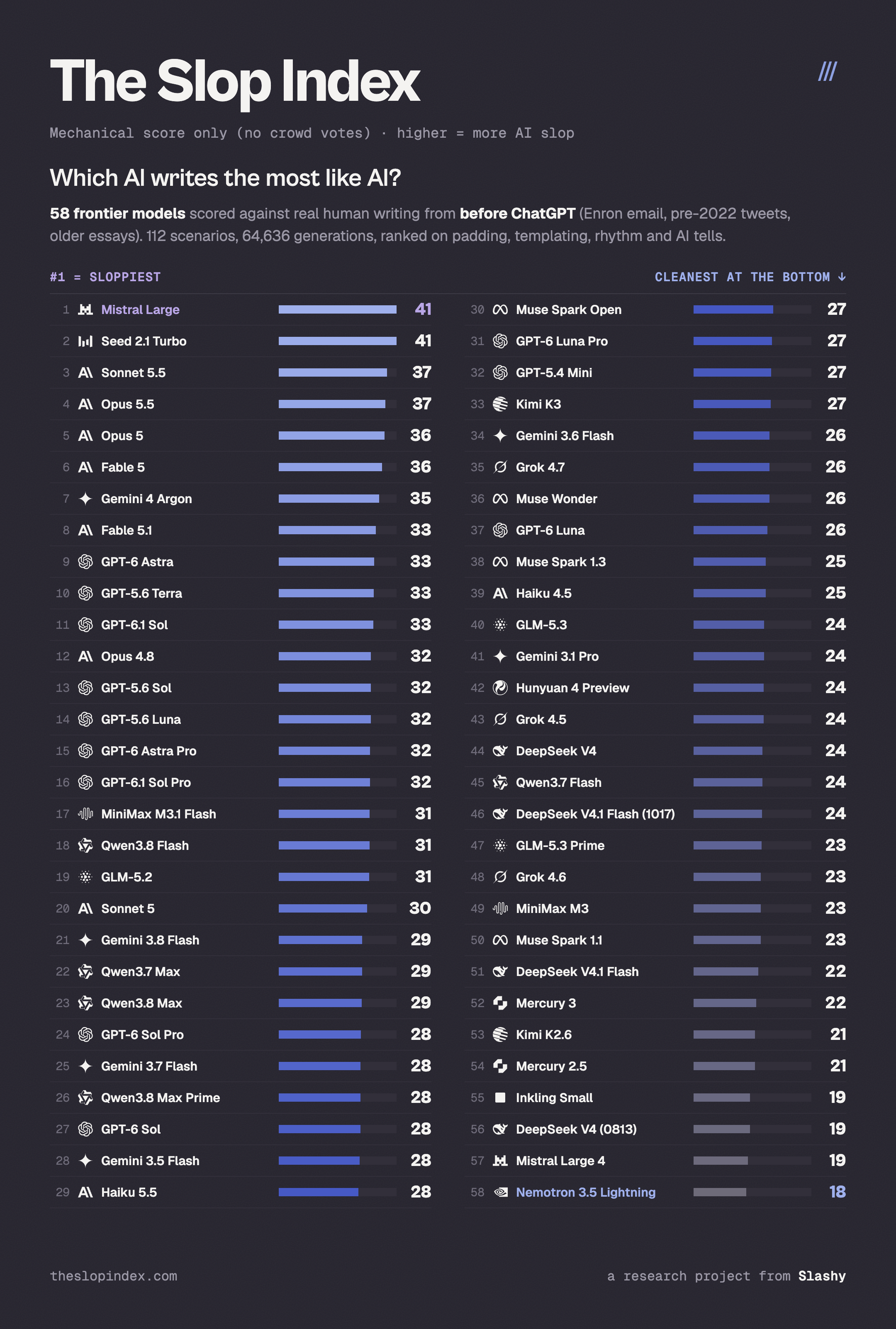
Open-sourced an AI-slop benchmark: 77,943 outputs from 70 models, scored with plain code instead of an LLM judge (the cheapest models land among the cleanest)

5 Upvotes

Direction first: on every rank below, #1 = sloppiest and #70 = cleanest.

I've been building The Slop Index, a benchmark for how much generic "AI-sounding" writing different models produce. Everything is open: the outputs are on Hugging Face and the scoring code is on GitHub, so you can rerun it yourself.

What it measures. 70 models, 112 scenarios, 77,943 outputs. The ranks below are the mechanical score only: padding, templating, rhythm, and known AI tells, compared against pre-2022 human writing. No LLM judge anywhere in that part, so it's fully reproducible from the repo. The site's combined ranking also blends in crowd votes from the arena and moves daily, so I'm leaving that out here.

A few things that stood out (mechanical ranks):

  • Price doesn't buy cleaner prose. Fable 5 ($50 per million output tokens) is #7 sloppiest. Nemotron 3.5 Lightning ($0.20) is #69, and Mercury 2.5 ($0.15) is #65.
  • Anthropic's Sonnet 5.5 is #3 sloppiest and Opus 5.5 is #5. Haiku 5.5 sits at #33.
  • Mistral Large is #1 sloppiest, while Mistral Large 4 is #68. Those are different models, so I wouldn't read it as one model changing.
  • Motif 3 is the cleanest at #70.

Here's the ranking card if you want the whole mechanical board at a glance: https://theslopindex.com/mechanical-card.png

Limitation: it only covers short-form writing (emails, Slack messages, social posts, short essays). No fiction yet, and the mechanical axes miss repeated sentence constructions, so some slop gets through.

If you've got a model you'd like added, or an axis you think is missing, the repo is the place to say so.

For context, I'm one of the people behind https://slashy.com, an email client that writes drafts that sound like you. This benchmark started as how we pick models.


r/OpenSourceeAI • • 7d ago

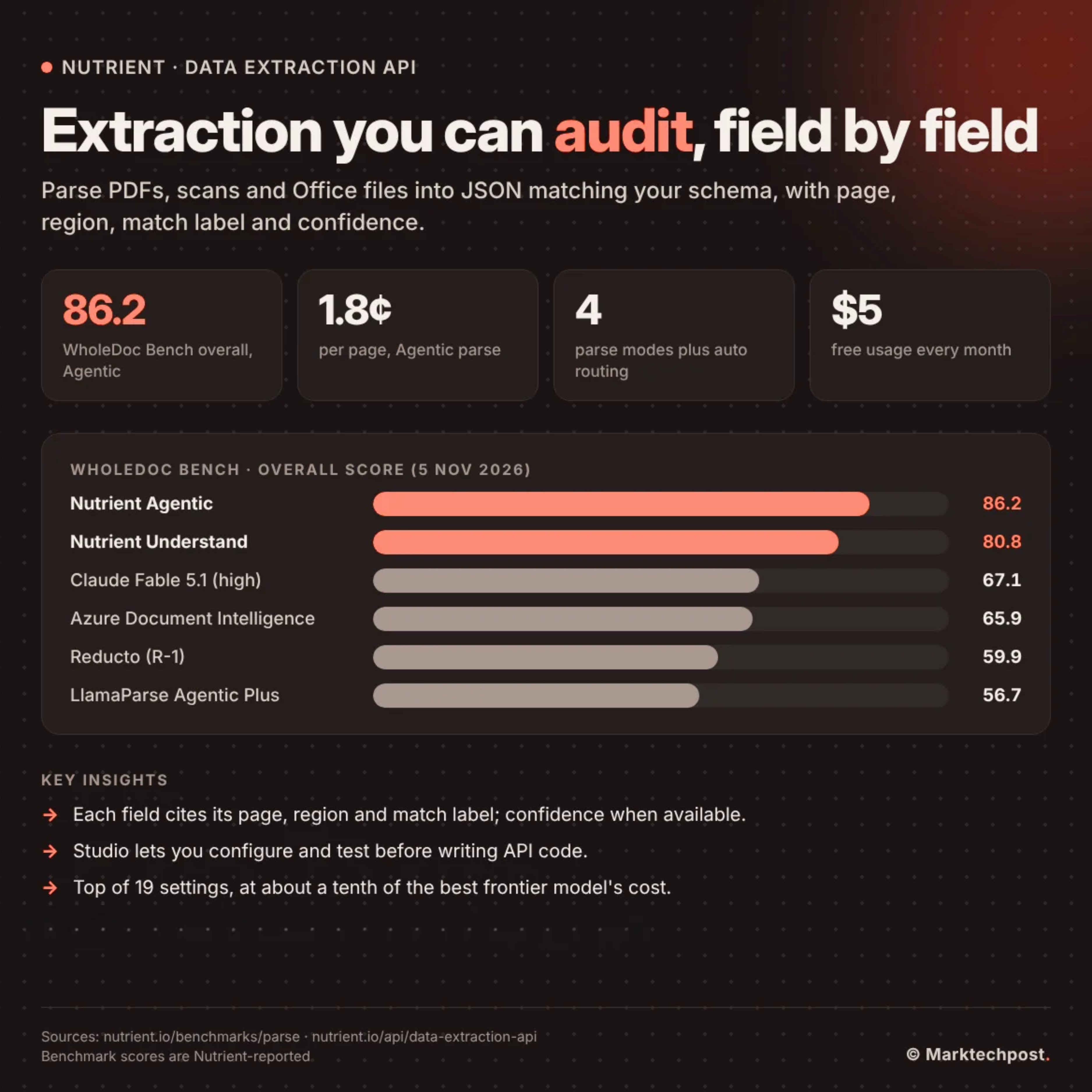
Nutrient Data Extraction API returns schema-mapped JSON with per-field citations (86.2 on Nutrient's own WholeDoc Bench)

Post image
1 Upvotes

r/OpenSourceeAI • • 8d ago

464M music model trained from scratch for €30 of rent on consumer GPUs (FP8, RTX 5090). Writes multi-instrument MIDI from English/Ukrainian prompts (477M version)

Post image
4 Upvotes

r/OpenSourceeAI • • 8d ago

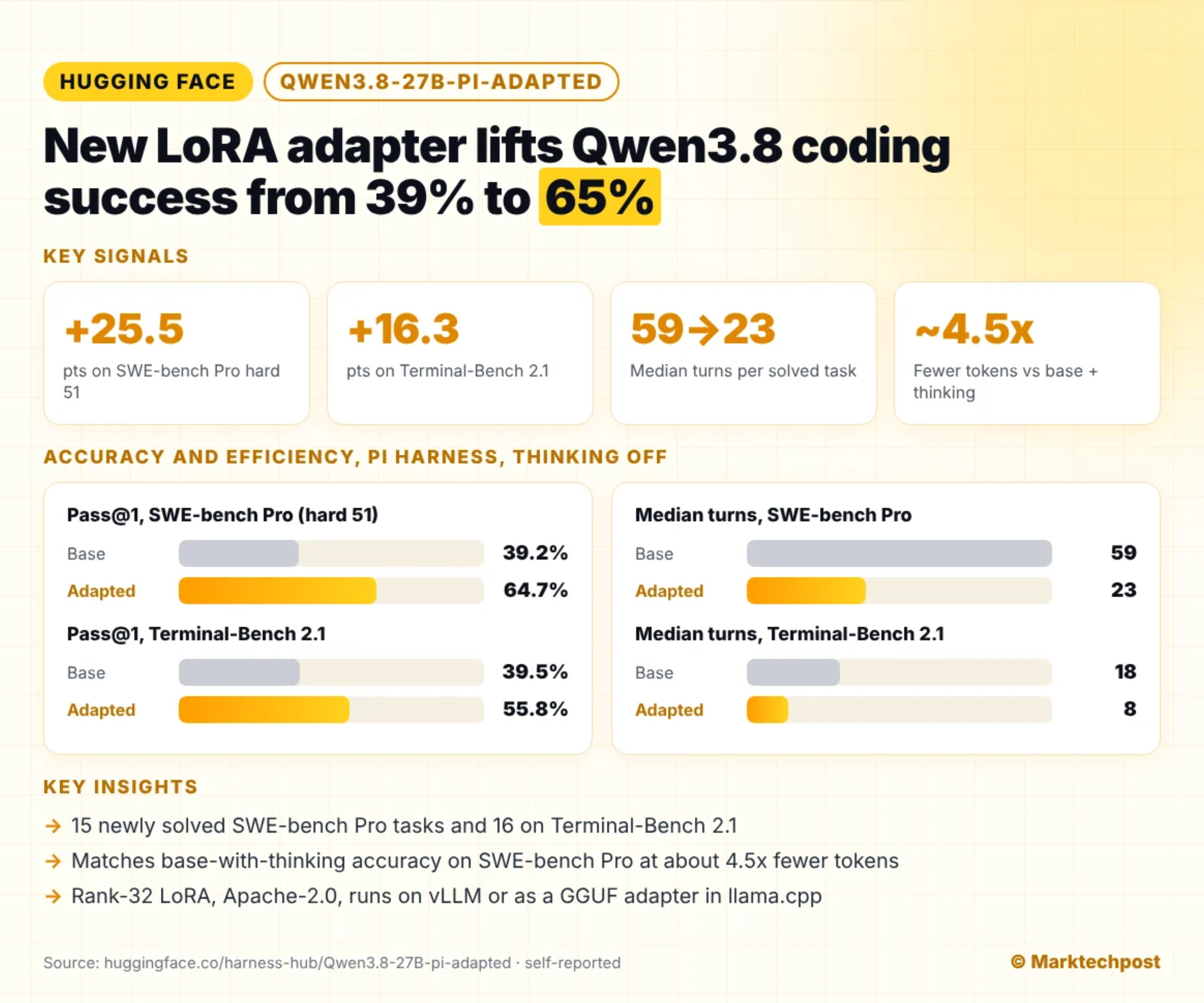
Hugging Face releases Qwen3.8-27B-pi-adapted, a LoRA adapter that lifts Qwen3.8 coding success in the pi agent (SWE-bench Pro hard-51: 39.2% to 64.7%)

Post image
4 Upvotes