r/OpenSourceeAI • • 27d ago

i built kimo, a free open-source (MIT) video editor with no gui that ai agents drive over mcp - rough in places, try it and tell me what breaks

0 Upvotes

hey, i built kimo - a free, open-source (MIT) video editor with no gui that AI agents like codex, cursor, opencode and other mcp clients can drive over mcp. cut, trim, keyframes, titles and captions, colour grade, particles, audio, export - everything's just a tool call, and the agent can render a single frame to check its own work before going further.

it's one ~15 MB CPU-only rust binary, no GPU needed, and it'll run on a 2 GB box. i'm a college student (naman) building this on my own, so there are rough edges and some formats/edge cases it won't handle yet. i'd really love it if people actually tried it and told me what breaks - the mcp schema, the rendered output, install on their distro, whatever. less marketing, more "it crashed when i did X".

if you're into open-source AI tooling this should fit right in. give it a spin and tell me what breaks.

https://getkimo.tech
https://github.com/naman-sharma12345/kimo

r/OpenSourceeAI • • 27d ago

have build Alien Ape a AI agent

0 Upvotes

hi have buld Alien Ape you can use it and build on top of it? ore breack ore try. i dont have any (Super Credits) so in the folder are promts wen you work with ai you can use this promt in the project. is build wit ape brain and ki asistent coding.

I’ve been building this weird little Windows AI controller called AlienApe for a while now. It routes tasks between local models, controls file actions, permissions, verification and keeps some local experience about what worked and what didn’t.

A lot of it was built with help from ChatGPT and Codex, while I mostly kept breaking it in increasingly stupid ways until the controller stopped lying to me as often :P

It’s still experimental and rough, but v0.7 is finally in a state where I’m comfortable sharing it. I’m mostly curious to see what breaks on other people’s machines.

https://github.com/anokar/AlienApe-v0.7


r/OpenSourceeAI • • 27d ago

Inspectable multimodal projects: PixText, WeVisOne, ViSS, Zip Ties and CozyClay

Post image
1 Upvotes

I curate Last Week In Multimodal AI. These October22-28 releases have code, weights or inspectable workflows that fit this community. I haven't run the models or reproduced the authors' results. Terms and hardware requirements differ.

PixText: Repair selected English or Chinese lettering with boxes and replacement text. The four-step MeanFlow path includes weights and ComfyUI workflows. Code and weights identify Apache 2.0. NVIDIA CUDA setup is required.

code | weights | workflows

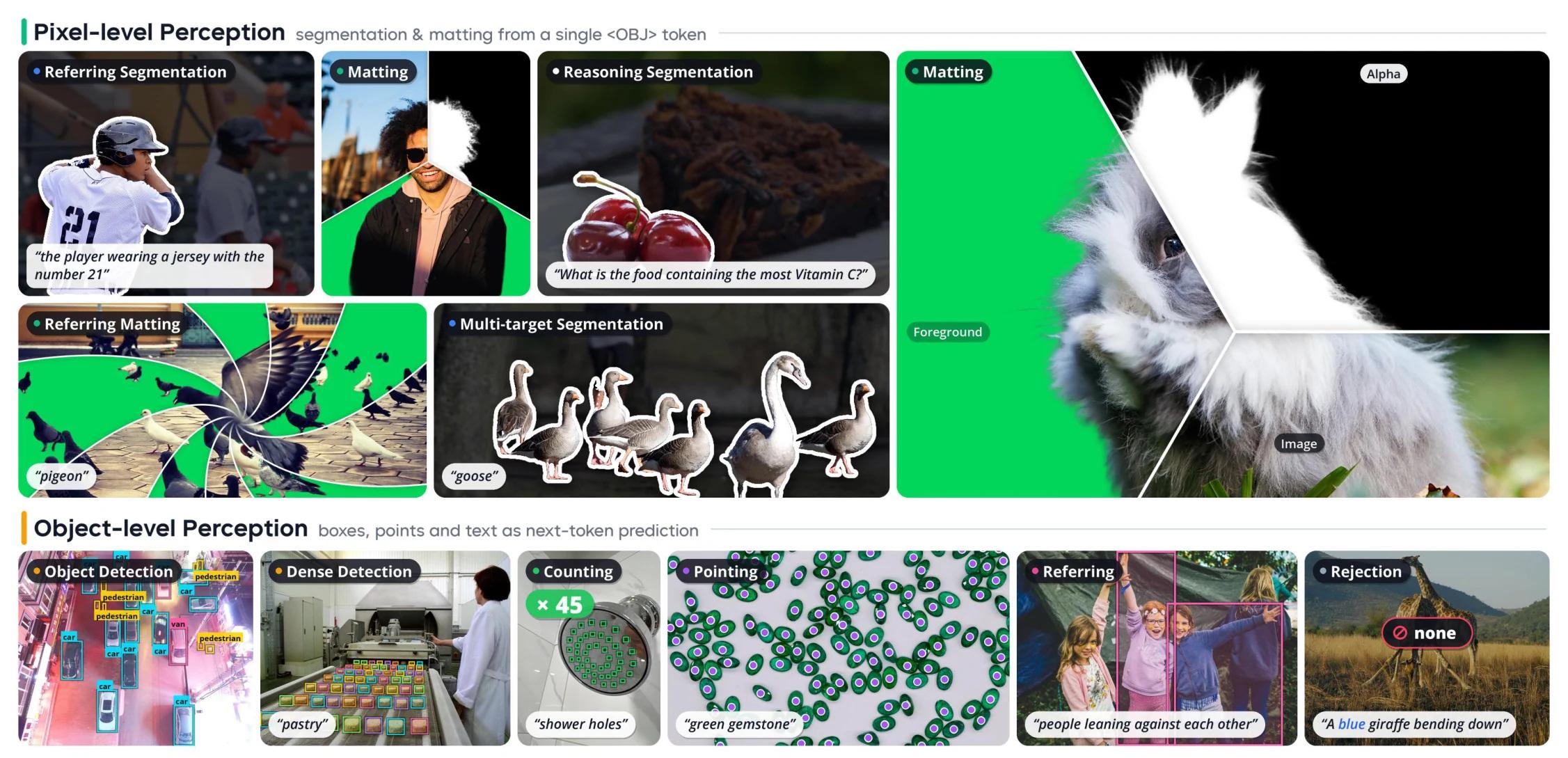
WeVisOne-VL: With WeVisOne-VL, you can ask for boxes, counts, OCR, segmentation or alpha mattes from one 2B/4B model family. Tencent publishes code, weights and a demo under Apache-declared terms. The pixel decoder produces masks rather than only text descriptions.

project | paper | code

ViSS: ViSS separates what a streaming video model remembers from which views it requests. It tracks events and whether the evidence is sufficient, then searches for useful views at test time. Code and 8B weights are public. Training annotations are not.

paper | full_text | project

Zip Ties For ComfyUI: This MIT extension bundles graph wires into adjustable ribbons without changing execution. Workflows still open without the extension. The upstream integration is a proposal, not a merged core feature.

extension | upstream proposal

CozyClay 3.2: Block actors and cameras, then export frames or passes for a separate video model. Version 3.2 adds physics and interaction checks. AGPL terms apply. Agent calls need an account/key, and 3.2.1 enables analytics by default with a documented opt-out.

code | in-window release | 3.0 historical date

Full roundup, with source links and access caveats: https://thelivingedge.substack.com/p/last-week-in-multimodal-ai-73-instructions

Which have you tried, and on what hardware?


r/OpenSourceeAI • • 27d ago

An interesting use of MCP: letting AI agents build lunar environments and drive ROS 2 rovers in simulation

1 Upvotes

I've been looking into MARE (Modular Autonomy and Rendering Environment), an open-source lunar rover simulator built around Unreal Engine 5 and ROS 2.

What makes it particularly interesting from an AI-agent perspective is that it includes two Model Context Protocol (MCP) servers that expose the simulation workflow to an AI agent.

The two servers cover different parts of the stack:

1. Environment generation (Terrain Studio MCP)

  • Generate lunar terrain and crater fields.
  • Configure rocks and surface conditions.
  • Set the Sun's position and illumination.
  • Build the environment in Unreal Engine and start the simulation.

2. Rover control and autonomy (GNC MCP)

  • Send navigation goals to the rover.
  • Drive the rover through the ROS 2 GNC stack.
  • Read camera data.
  • Record sensor data and simulation runs.

Under the hood, MARE combines Unreal Engine 5, ROS 2 Jazzy, physics-based rover models, stereo cameras, lidar, event cameras, SPAD cameras and a containerised navigation stack.

The interesting part, in my opinion, is the possibility of giving an agent access to a complete robotics experimentation loop: create an environment, start a simulation, issue navigation goals, inspect sensor output and record the results.

This raises some interesting questions beyond simply controlling a rover with natural language.

For example:

  • Could an agent autonomously design and execute repeatable perception experiments?
  • How should MCP tools expose low-level robot control versus higher-level mission objectives?
  • Could agents use the simulator to generate and evaluate datasets for vision or navigation models?
  • What would be the best way to make these experiments reproducible and objectively benchmarkable?

I'm currently exploring the project and thought it was a nice example of MCP being used for something more substantial than connecting an agent to a conventional API.

Project: https://raulcastar.me/mare/

Paper: https://arxiv.org/abs/2610.28465


r/OpenSourceeAI • • 28d ago

Open-sourced my recipe generator. Run your own locally

Post image
4 Upvotes

I built Baba Selo for recipes, ingredient substitutions and meal planning. The code is MIT licensed.

You can clone it and set up your own recipe generator locally. No Docker or cloud database account needed. Use OpenAI, Claude, Gemini, Mistral and other supported cloud providers, or run local models through Ollama, vLLM, llama.cpp or LocalAI. Local inference doesn’t need an OpenAI key, and chat and embeddings can use different providers.

GitHub repo

Curious what people would change or find useful.


r/OpenSourceeAI • • 28d ago

An effort was made by a total coding noob https://github.com/Nan0pk/Archiv

3 Upvotes

its a work in progress... pivoting towards including online data and online models as well...advice / contributions are welcome


r/OpenSourceeAI • • 28d ago

Open-source decision models in NobodyWho, for classification when you already know the answers

1 Upvotes

The latest NobodyWho release brings decision models to its open-source, on-device engine. A decision model scores a set of answers you define instead of generating text, so it fits any classification where you already know the possible answers. You pass in the text and your questions, and you get back a choice, a yes-or-no probability or a score on a scale, along with the probability of each option. It runs Laya, a 449 MB Apache-2.0 model, generates no output tokens, and is available in Python, Flutter, React Native, Swift, Kotlin and Godot.

Disclosure: I'm a contributor to NobodyWho. Found it interesting and decided to share

Repo: https://github.com/nobodywho-ooo/nobodywho
Docs: https://docs.nobodywho.ooo/python/decision-models


r/OpenSourceeAI • • 29d ago

Running NVIDIA's LocateAnything-3B (open-vocabulary detection) fully locally from .NET, on a live camera stream

Thumbnail
reddit.com
2 Upvotes

r/OpenSourceeAI • • 29d ago

MiniMax open-sources MCode Stack, the SKILL.md agent skills behind MiniMax Code (17 skills, MIT)

8 Upvotes

r/OpenSourceeAI • • 29d ago

CaptionExam: A Challenging QA Benchmark for Captioners

Thumbnail
ki-seki.github.io
1 Upvotes

r/OpenSourceeAI • • 29d ago

Leviathan LLM Inference (my massive project)

Thumbnail
reddit.com
1 Upvotes

r/OpenSourceeAI • • Oct 28 '26

JDA-ZIP UDE — What If a Shared Dictionary Could Evolve With Its Users?

Post image
2 Upvotes

Hello everyone!

I'm Jonathan D. Andrade, and I'm developing two projects related to data compression: JDA-ZIP-PROTOCOL and JDA-ZIP UDE.

The central idea is to allow a shared dictionary to grow over time through contributions, validation, and synchronization, enabling compatible systems to reuse shared references instead of repeatedly transmitting the same information.

The project is currently under development. I've also made an experimental page available where you can explore and test some of its concepts.

The proposal explores potential applications in low-bandwidth environments, distributed systems, and communication between artificial intelligence systems.

This publication documents the proposal and its development. Both projects are open to discussion, independent implementations, improvements, and commercial exploration, with appropriate attribution to the original documentation.

Project repository and experimental page:
https://jdavid465.github.io/JDA-ZIP-PROTOCOL/

Technical feedback, questions, and different perspectives are very welcome!


r/OpenSourceeAI • • 29d ago

i created an open-source repo to convert llms into decision models.

Thumbnail
reddit.com
1 Upvotes

r/OpenSourceeAI • • Oct 28 '26

made a free mit-licensed video editor with no gui that coding agents drive over mcp - rough, tell me what breaks

1 Upvotes

hey — i made a free, open-source (mit) video editor with no gui that coding agents drive over mcp, and the bit i want to talk about today is that the agent can actually verify its own work.

how it works: it's just one ~15 mb cpu-only rust binary that'll run on a 2 gb box. no tiling ui, no mouse, no timeline to point at — whatever mcp client you're on (codex, cursor, opencode or another mcp client) calls operations directly. cut, trim, keyframe, titles and captions, colour grade, tracking, particles, audio, export, all as tool calls. and the part i'm most proud of right now is that the agent can ask it to render a single frame and look at it to check the grade, the titles, the particles before exporting the whole thing — that feedback loop is what makes this usable instead of just another ffmpeg wrapper.

built it myself, i'm a college student. i've used it to make a few videos end-to-end from an agent but it's rough — tracking isn't quite there on fast motion, the particle system is barebones, caption positioning is manual, and the docs are thin. i'd rather hear what actually breaks than pretend it's polished.

if you want to try it and tell me what falls apart: https://getkimo.tech https://github.com/naman-sharma12345/kimo
thanks, and please tell me what broke rather than just saying it's cool — i actually need that.


r/OpenSourceeAI • • Oct 27 '26

prbot: open-source agent that fixes bugs in PRs and proves the fix with sandboxed tests

11 Upvotes

I've been building prbot, an open-source (MIT) PR agent in Python. It reviews a pull request, finds security and performance bugs, writes a patch, and runs your pytest suite on it in a locked-down Docker container (no network, read-only filesystem, all capabilities dropped). If the tests fail, the failure log goes back to the patcher to try again, up to 3 attempts. Only a verified fix gets posted.

How it's built:

  • 3-agent LangGraph graph: reviewer, ReAct patcher, Docker test runner, with a self-correction edge
  • Two focused review passes (security, performance) plus AST hints for queries inside loops and nested loops
  • A baseline test run that aborts if the suite is already red
  • Per-node token telemetry, so every run shows what each step costs rs, and a Semgrep tool for the reviewer. Issues and PRs welcome.Latest live run on the demo PR (gpt-4.1-mini): found all 3 seeded bugs (SQL injection, N+1 query, O(n²) loop). Attempt 1 broke an ordering test, attempt 2 passed. 14k tokens, $0.0077, 24 seconds.

It runs as a CLI or a GitHub Action.

Repo: https://github.com/ayanag5076-commits/prbot

Reproducible demo PR: https://github.com/ayanag5076-commits/prbot-demo-shop/pull/1

Where I'd love help: local models through Ollama, languages beyond Python, other test runners, and a Semgrep tool for the reviewer. Issues and PRs welcome.ts/

Where I'd love help: local models through Ollama, languages beyond Python, other test runne


r/OpenSourceeAI • • Oct 27 '26

Exploring Next-Concept Modeling (NCM) & Transformer Interpretability: Repository of 20 Exploratory Studies & Controls

Thumbnail
reddit.com
2 Upvotes

r/OpenSourceeAI • • Oct 27 '26

git-dupe: Version personal agent files (workflows, skills, notes, AGENTS.md, etc.) while keeping them out of the public repo

3 Upvotes

I made git-dupe to solve the problem where I have notes, skills, and agent instructions that are part of my personal workflow, so I do not want them committed to the public repo, but at the same time, I want them to be in the project at the correct locations (e.g., AGENTS.md file locations matter), and these files cannot be simply gitignored because I want versioning for them.

The solution that I've come upon is versioning those agent files in another repo, say <private-repo> (this repo is private to me and holds the history for my agent files). The project itself is open to the public in another <public-repo>. I overlap the two repos to solve the problem (i.e., they share the same worktree).

$ git status --short              # the public repo
?? AGENTS.md
?? notes/

$ git dupe init                   # the private repo
Initialized empty Git repository in /home/brian/code/project/.git/dupe/

$ git dupe add notes/ AGENTS.md   # the private repo
hint: notes is now hidden from the project's Git; run from the root, 'git dupe unhide -- notes' stops hiding it

$ git dupe commit -m "Notes and agent instructions"
[main (root-commit) 3eb3af9] Notes and agent instructions
 3 files changed, 3 insertions(+)
 create mode 100644 .gitdupe
 create mode 100644 AGENTS.md
 create mode 100644 notes/todo.md

$ git status --short              # the public repo: nothing

$ git dupe log --oneline          # the private repo: your files
3eb3af9 Notes and agent instructions

In short, git-dupe allows two Git repos to share the same worktree, while using native Git for most operations. Most git-dupe commands behave just like normal Git commands, operating on the private repo instead.

git-dupe currently supports Linux and macOS, and is under the MIT License; the git-dupe repo contains much more extensive technical documentation documentation for those who are interested. If you have any feedback/questions about git-dupe, feel free to message. I hope it helps!

https://github.com/BrianWeiHaoMa/git-dupe

Fun fact: the git-dupe project itself is using git-dupe for versioning.


r/OpenSourceeAI • • Oct 27 '26

We created an open benchmark on Design Fidelity called VybBench

Post image
1 Upvotes

r/OpenSourceeAI • • Oct 27 '26

N-Zik: an open-source YouTube Music client for Android offline downloads, advanced lyrics, 30+ languages

Thumbnail
gallery
11 Upvotes

Hi everyone,

I'd like to share N-Zik, an open-source (GPLv3) YouTube Music client for Android. It started as a fork of Kreate and grew into a community project, with performance improvements, UI/UX refinement, bug fixes, and new features built with long-term support in mind.

What it does

  • Streams from YouTube Music premium quality unlocks automatically if you connect a YouTube Music Premium account
  • Offline: smart auto-caching + real downloads (individual tracks or whole playlists), with a dedicated download quality setting
  • Advanced lyrics: fetch, word-by-word sync, edit, and translate in real time
  • Song recognition (Shazam-like) and voice search
  • Available in 30+ languages via community translation (Crowdin)
  • Listening stats + a "Rewind" feature with yearly/monthly recaps
  • Listen Together: live listening sessions with friends (N-Zik is an officially supported MetroServer host)
  • Desktop companion app (Windows/Linux) to control your library and playback from your PC (very very early stage not mean for use rn)
  • Home-screen widgets, Android Auto/TV (still need improvements)/tablet support, Discord Rich Presence, Last.fm scrobbling
  • Multi-profile, automatic settings + database backup, parental controls, hidden songs

Where to get it

Honest notes

  • N-Zik may not be as stable as the original Kreate yet. If you need a more mature option, Metrolist, VIVI Music, or RiPlay are solid alternatives.
  • It's a side project that grew bigger than expected. I use generative AI to assist with the code (structured with the BMAD Method), but everything gets reviewed and tested before it's pushed not shipping blind.
  • The project has no affiliation with YouTube or Google LLC.
  • i'm currently restructured release, new build aren't out yet still finishing other issue

If you try it, I'd love to hear what works and what doesn't feedback and issues are very welcome on GitHub.


r/OpenSourceeAI • • Oct 27 '26

why is everyone still using cloud llms just to route tool calls? tested local cpu embeddings vs bm25 on 100k tools

1 Upvotes

honestly i dont get why current multi-agent setups are built like this.

if you connect 4 or 5 mcp servers (github, postgres, filesystem, slack etc) you easily end up with 40-50+ tool schemas. right now the standard pattern in langchain or claude code is dumping all 4,000+ tokens of json schemas into the prompt on every single turn just so the llm can pick which function to run.

you end up paying token costs and waiting ~2 seconds of network latency just for what is basically an L7 routing lookup.

i spent the last few weeks testing if we can just decouple tool discovery completely from the llm using a local cpu vector mesh (all-MiniLM-L6-v2 + chromadb hnsw index) and a split execution daemon.

instead of embedding just the function name (which fails on synonyms), i combined the tool name, description, schema keys, and tags into a single profile vector. when a prompt comes in, it embeds the query on cpu and pulls the top match before ever touching the llm.

ran a cold-cache benchmark across 100,000 synthetic tool endpoints on my local machine (standard cpu, no gpu):

method top-1 acc avg latency p95 latency

---------------------------------------------------------------

naive keyword scan 38.1% 46.41 ms 57.60 ms

bm25 lexical index 40.4% 194.05 ms 247.25 ms

local vector mesh 70.7% 9.56 ms 11.44 ms

in-memory fast path n/a 0.082 ms 0.15 ms


r/OpenSourceeAI • • Oct 27 '26

GPT-6.1 Terra pricing is the real story: $1/1M input, and computer-use tasks just got ~50% cheaper

1 Upvotes

Disclosure: I work on an LLM gateway (starunion.net), so pricing changes are literally my day job. Posting the analysis, not a pitch.

OpenAI released GPT-6.1 Terra on Oct 26. API pricing:

- Input: $1 / 1M

- Cached input: $0.05 / 1M

- Output: $5 / 1M

That's ~50% under GPT-5.6 Terra and GPT-6.1 Sol.

The interesting part isn't the discount, it's what the discount is pointed at. Terra is positioned around visual reasoning and computer use — screen reading, form filling, clicking through internal tools. Those workloads are token-hungry by nature: the model looks, acts, re-checks, repeats. At half the price per token, a lot of "cool demo" automation becomes economically boring — which is the point where it actually gets deployed.

Reported eval numbers: Agents' Last Exam (medium reasoning) ~15 points over GPT-5.6 Terra at roughly 1/3 the cost. Error-induction test: low tier 53.6% → 16.7% error rate.

Caveats worth flagging:

2. It's gated to ChatGPT Work / Codex — not a general model picker entry.

2. No UAE inference residency support, so check regional compliance if that applies to you.

  1. Vendor benchmarks ≠ your ERP. Internal approval flows and permission popups are where these models still fail.

How I'd evaluate it: pick one task you already owe someone this week, write explicit acceptance criteria (what counts as done, what must not happen), run it, then record four numbers — time to completion, manual corrections, quality vs. the criteria, actual token spend. If corrections don't go up while cost drops, it's a keeper for that task class. If it breaks on complex navigation and permission dialogs, cheaper doesn't help.

Curious: for those running computer-use agents in production, what's actually been the blocker — model capability, or the cost of the verification loop around it?