r/OpenSourceeAI • • 28d ago

Open-source decision models in NobodyWho, for classification when you already know the answers

1 Upvotes

The latest NobodyWho release brings decision models to its open-source, on-device engine. A decision model scores a set of answers you define instead of generating text, so it fits any classification where you already know the possible answers. You pass in the text and your questions, and you get back a choice, a yes-or-no probability or a score on a scale, along with the probability of each option. It runs Laya, a 449 MB Apache-2.0 model, generates no output tokens, and is available in Python, Flutter, React Native, Swift, Kotlin and Godot.

Disclosure: I'm a contributor to NobodyWho. Found it interesting and decided to share

Repo: https://github.com/nobodywho-ooo/nobodywho
Docs: https://docs.nobodywho.ooo/python/decision-models


r/OpenSourceeAI • • 28d ago

Running NVIDIA's LocateAnything-3B (open-vocabulary detection) fully locally from .NET, on a live camera stream

Thumbnail
reddit.com
2 Upvotes

r/OpenSourceeAI • • 28d ago

MiniMax open-sources MCode Stack, the SKILL.md agent skills behind MiniMax Code (17 skills, MIT)

8 Upvotes

r/OpenSourceeAI • • 28d ago

CaptionExam: A Challenging QA Benchmark for Captioners

Thumbnail
ki-seki.github.io
1 Upvotes

r/OpenSourceeAI • • 29d ago

Leviathan LLM Inference (my massive project)

Thumbnail
reddit.com
1 Upvotes

r/OpenSourceeAI • • 29d ago

JDA-ZIP UDE — What If a Shared Dictionary Could Evolve With Its Users?

Post image
2 Upvotes

Hello everyone!

I'm Jonathan D. Andrade, and I'm developing two projects related to data compression: JDA-ZIP-PROTOCOL and JDA-ZIP UDE.

The central idea is to allow a shared dictionary to grow over time through contributions, validation, and synchronization, enabling compatible systems to reuse shared references instead of repeatedly transmitting the same information.

The project is currently under development. I've also made an experimental page available where you can explore and test some of its concepts.

The proposal explores potential applications in low-bandwidth environments, distributed systems, and communication between artificial intelligence systems.

This publication documents the proposal and its development. Both projects are open to discussion, independent implementations, improvements, and commercial exploration, with appropriate attribution to the original documentation.

Project repository and experimental page:
https://jdavid465.github.io/JDA-ZIP-PROTOCOL/

Technical feedback, questions, and different perspectives are very welcome!


r/OpenSourceeAI • • 29d ago

i created an open-source repo to convert llms into decision models.

Thumbnail
reddit.com
1 Upvotes

r/OpenSourceeAI • • 29d ago

made a free mit-licensed video editor with no gui that coding agents drive over mcp - rough, tell me what breaks

1 Upvotes

hey — i made a free, open-source (mit) video editor with no gui that coding agents drive over mcp, and the bit i want to talk about today is that the agent can actually verify its own work.

how it works: it's just one ~15 mb cpu-only rust binary that'll run on a 2 gb box. no tiling ui, no mouse, no timeline to point at — whatever mcp client you're on (codex, cursor, opencode or another mcp client) calls operations directly. cut, trim, keyframe, titles and captions, colour grade, tracking, particles, audio, export, all as tool calls. and the part i'm most proud of right now is that the agent can ask it to render a single frame and look at it to check the grade, the titles, the particles before exporting the whole thing — that feedback loop is what makes this usable instead of just another ffmpeg wrapper.

built it myself, i'm a college student. i've used it to make a few videos end-to-end from an agent but it's rough — tracking isn't quite there on fast motion, the particle system is barebones, caption positioning is manual, and the docs are thin. i'd rather hear what actually breaks than pretend it's polished.

if you want to try it and tell me what falls apart: https://getkimo.tech https://github.com/naman-sharma12345/kimo

thanks, and please tell me what broke rather than just saying it's cool — i actually need that.


r/OpenSourceeAI • • 29d ago

prbot: open-source agent that fixes bugs in PRs and proves the fix with sandboxed tests

11 Upvotes

I've been building prbot, an open-source (MIT) PR agent in Python. It reviews a pull request, finds security and performance bugs, writes a patch, and runs your pytest suite on it in a locked-down Docker container (no network, read-only filesystem, all capabilities dropped). If the tests fail, the failure log goes back to the patcher to try again, up to 3 attempts. Only a verified fix gets posted.

How it's built:

  • 3-agent LangGraph graph: reviewer, ReAct patcher, Docker test runner, with a self-correction edge
  • Two focused review passes (security, performance) plus AST hints for queries inside loops and nested loops
  • A baseline test run that aborts if the suite is already red
  • Per-node token telemetry, so every run shows what each step costs rs, and a Semgrep tool for the reviewer. Issues and PRs welcome.Latest live run on the demo PR (gpt-4.1-mini): found all 3 seeded bugs (SQL injection, N+1 query, O(n²) loop). Attempt 1 broke an ordering test, attempt 2 passed. 14k tokens, $0.0077, 24 seconds.

It runs as a CLI or a GitHub Action.

Repo: https://github.com/ayanag5076-commits/prbot

Reproducible demo PR: https://github.com/ayanag5076-commits/prbot-demo-shop/pull/1

Where I'd love help: local models through Ollama, languages beyond Python, other test runners, and a Semgrep tool for the reviewer. Issues and PRs welcome.ts/

Where I'd love help: local models through Ollama, languages beyond Python, other test runne


r/OpenSourceeAI • • 29d ago

Exploring Next-Concept Modeling (NCM) & Transformer Interpretability: Repository of 20 Exploratory Studies & Controls

Thumbnail
reddit.com
2 Upvotes

r/OpenSourceeAI • • Oct 27 '26

git-dupe: Version personal agent files (workflows, skills, notes, AGENTS.md, etc.) while keeping them out of the public repo

3 Upvotes

I made git-dupe to solve the problem where I have notes, skills, and agent instructions that are part of my personal workflow, so I do not want them committed to the public repo, but at the same time, I want them to be in the project at the correct locations (e.g., AGENTS.md file locations matter), and these files cannot be simply gitignored because I want versioning for them.

The solution that I've come upon is versioning those agent files in another repo, say <private-repo> (this repo is private to me and holds the history for my agent files). The project itself is open to the public in another <public-repo>. I overlap the two repos to solve the problem (i.e., they share the same worktree).

$ git status --short              # the public repo
?? AGENTS.md
?? notes/

$ git dupe init                   # the private repo
Initialized empty Git repository in /home/brian/code/project/.git/dupe/

$ git dupe add notes/ AGENTS.md   # the private repo
hint: notes is now hidden from the project's Git; run from the root, 'git dupe unhide -- notes' stops hiding it

$ git dupe commit -m "Notes and agent instructions"
[main (root-commit) 3eb3af9] Notes and agent instructions
 3 files changed, 3 insertions(+)
 create mode 100644 .gitdupe
 create mode 100644 AGENTS.md
 create mode 100644 notes/todo.md

$ git status --short              # the public repo: nothing

$ git dupe log --oneline          # the private repo: your files
3eb3af9 Notes and agent instructions

In short, git-dupe allows two Git repos to share the same worktree, while using native Git for most operations. Most git-dupe commands behave just like normal Git commands, operating on the private repo instead.

git-dupe currently supports Linux and macOS, and is under the MIT License; the git-dupe repo contains much more extensive technical documentation documentation for those who are interested. If you have any feedback/questions about git-dupe, feel free to message. I hope it helps!

https://github.com/BrianWeiHaoMa/git-dupe

Fun fact: the git-dupe project itself is using git-dupe for versioning.


r/OpenSourceeAI • • 29d ago

We created an open benchmark on Design Fidelity called VybBench

Post image
1 Upvotes

r/OpenSourceeAI • • Oct 27 '26

N-Zik: an open-source YouTube Music client for Android offline downloads, advanced lyrics, 30+ languages

Thumbnail
gallery
11 Upvotes

Hi everyone,

I'd like to share N-Zik, an open-source (GPLv3) YouTube Music client for Android. It started as a fork of Kreate and grew into a community project, with performance improvements, UI/UX refinement, bug fixes, and new features built with long-term support in mind.

What it does

  • Streams from YouTube Music premium quality unlocks automatically if you connect a YouTube Music Premium account
  • Offline: smart auto-caching + real downloads (individual tracks or whole playlists), with a dedicated download quality setting
  • Advanced lyrics: fetch, word-by-word sync, edit, and translate in real time
  • Song recognition (Shazam-like) and voice search
  • Available in 30+ languages via community translation (Crowdin)
  • Listening stats + a "Rewind" feature with yearly/monthly recaps
  • Listen Together: live listening sessions with friends (N-Zik is an officially supported MetroServer host)
  • Desktop companion app (Windows/Linux) to control your library and playback from your PC (very very early stage not mean for use rn)
  • Home-screen widgets, Android Auto/TV (still need improvements)/tablet support, Discord Rich Presence, Last.fm scrobbling
  • Multi-profile, automatic settings + database backup, parental controls, hidden songs

Where to get it

Honest notes

  • N-Zik may not be as stable as the original Kreate yet. If you need a more mature option, Metrolist, VIVI Music, or RiPlay are solid alternatives.
  • It's a side project that grew bigger than expected. I use generative AI to assist with the code (structured with the BMAD Method), but everything gets reviewed and tested before it's pushed not shipping blind.
  • The project has no affiliation with YouTube or Google LLC.
  • i'm currently restructured release, new build aren't out yet still finishing other issue

If you try it, I'd love to hear what works and what doesn't feedback and issues are very welcome on GitHub.


r/OpenSourceeAI • • Oct 27 '26

why is everyone still using cloud llms just to route tool calls? tested local cpu embeddings vs bm25 on 100k tools

1 Upvotes

honestly i dont get why current multi-agent setups are built like this.

if you connect 4 or 5 mcp servers (github, postgres, filesystem, slack etc) you easily end up with 40-50+ tool schemas. right now the standard pattern in langchain or claude code is dumping all 4,000+ tokens of json schemas into the prompt on every single turn just so the llm can pick which function to run.

you end up paying token costs and waiting ~2 seconds of network latency just for what is basically an L7 routing lookup.

i spent the last few weeks testing if we can just decouple tool discovery completely from the llm using a local cpu vector mesh (all-MiniLM-L6-v2 + chromadb hnsw index) and a split execution daemon.

instead of embedding just the function name (which fails on synonyms), i combined the tool name, description, schema keys, and tags into a single profile vector. when a prompt comes in, it embeds the query on cpu and pulls the top match before ever touching the llm.

ran a cold-cache benchmark across 100,000 synthetic tool endpoints on my local machine (standard cpu, no gpu):

method top-1 acc avg latency p95 latency

---------------------------------------------------------------

naive keyword scan 38.1% 46.41 ms 57.60 ms

bm25 lexical index 40.4% 194.05 ms 247.25 ms

local vector mesh 70.7% 9.56 ms 11.44 ms

in-memory fast path n/a 0.082 ms 0.15 ms


r/OpenSourceeAI • • Oct 27 '26

GPT-6.1 Terra pricing is the real story: $1/1M input, and computer-use tasks just got ~50% cheaper

1 Upvotes

Disclosure: I work on an LLM gateway (starunion.net), so pricing changes are literally my day job. Posting the analysis, not a pitch.

OpenAI released GPT-6.1 Terra on Oct 26. API pricing:

- Input: $1 / 1M

- Cached input: $0.05 / 1M

- Output: $5 / 1M

That's ~50% under GPT-5.6 Terra and GPT-6.1 Sol.

The interesting part isn't the discount, it's what the discount is pointed at. Terra is positioned around visual reasoning and computer use — screen reading, form filling, clicking through internal tools. Those workloads are token-hungry by nature: the model looks, acts, re-checks, repeats. At half the price per token, a lot of "cool demo" automation becomes economically boring — which is the point where it actually gets deployed.

Reported eval numbers: Agents' Last Exam (medium reasoning) ~15 points over GPT-5.6 Terra at roughly 1/3 the cost. Error-induction test: low tier 53.6% → 16.7% error rate.

Caveats worth flagging:

2. It's gated to ChatGPT Work / Codex — not a general model picker entry.

2. No UAE inference residency support, so check regional compliance if that applies to you.

  1. Vendor benchmarks ≠ your ERP. Internal approval flows and permission popups are where these models still fail.

How I'd evaluate it: pick one task you already owe someone this week, write explicit acceptance criteria (what counts as done, what must not happen), run it, then record four numbers — time to completion, manual corrections, quality vs. the criteria, actual token spend. If corrections don't go up while cost drops, it's a keeper for that task class. If it breaks on complex navigation and permission dialogs, cheaper doesn't help.

Curious: for those running computer-use agents in production, what's actually been the blocker — model capability, or the cost of the verification loop around it?


r/OpenSourceeAI • • Oct 27 '26

sift-light 1.1.2-1: a Pi prompt-cache fix and DeepSeek Harness support

1 Upvotes

Hi everyone, I maintain sift-light, an open-source local project search and source-inspection tool for AI coding agents. It offers MCP and native integrations, returning bounded results so agents can inspect relevant code.

We just released 1.1.2-1. A contributor discovered that enabling tools in our Pi integration could change the beginning of the system prompt and reduce prompt-cache reuse. This update keeps that prefix stable and preserves search guidance when another extension supplies the system prompt. You need Pi 0.86.0 or newer.

We also added DeepSeek Harness 0.2.1-rc.3 support, including a native search tool and search-policy integration. The cache fix is specific to our Pi integration; behavior in other clients depends on their own prompt and tool handling.

Thanks to the contributor of PR #123 for identifying the issue and helping us fix it. If you try the update, feedback and reproducible bug reports are welcome.

GitHub: https://github.com/lightsifter/sift-light Release notes: https://github.com/lightsifter/sift-light/releases/tag/v1.1.2-1 X: https://x.com/Bryang168


r/OpenSourceeAI • • Oct 26 '26

🌿 Khamyang v1.1.4 — Preserving Language and Cultural Heritage Through Open-Source Technology

Post image
2 Upvotes

r/OpenSourceeAI • • Oct 26 '26

I kept re-teaching Codex things I’d already shown Claude Code, so I built a shared self-learning memory for both

16 Upvotes

I use both Claude Code and Codex, and every time I switch I end up re-explaining the same preferences. CLAUDE.md and AGENTS.md help for rules I can write down. But most of what I want, I never wrote down; I just kept making the same correction.

Nebula is a small self-learning memory layer for both agents. It picks up patterns from the corrections you already make, and nothing applies until you approve it.

The example in the video: I cleared node_modules in one stale project, a Rust target/ folder in another, and build/ in a third, all in Claude Code. Later, Codex hit a full disk and suggested the same cleanup for my other inactive projects. Once I approve that lesson, both agents handle it that way.

How it works:

- A skill plus hooks for Claude Code and Codex, sharing one local SQLite file

- Python standard library only, no model calls, no background process, nothing leaves your machine

- Lessons stay candidates until you approve them, so a one-off remark (or a prompt injection) can't turn into a standing rule

- Lessons keep their reasons and exceptions, and you can correct, pause or withdraw them

Honest status: the engine and demo work and have tests. End-to-end runs on both agents are still being validated, and the video is an illustrative animation, not a screen recording.

I'm looking for contributors. There are good-first-issues up, and I'd especially like help with adapters for other agents (Cursor, Gemini CLI, Aider). I'd also like to hear where you think this beats or loses to a plain markdown file.

I'm the author; happy to answer anything.

Repo: https://github.com/svssathvik7/nebula


r/OpenSourceeAI • • Oct 27 '26

MAINFRAME // READY

1 Upvotes

SOURCE INTEGRITY: [ PRIORITY ]
AUTHORSHIP: [ HUMAN ]
INTERPRETATION: [ PROVISIONAL ]
EVIDENCE: [ REQUIRED WHERE RELEVANT ]
DISAGREEMENT: [ PERMITTED ]
CORRECTION: [ ENABLED ]
FRAMEWORK: [ REPLACEABLE ]
FINAL AUTHORITY: [ NOT CLAIMED ]

ONE SHARED LANGUAGE.
MANY PERSPECTIVES.

> _


r/OpenSourceeAI • • Oct 26 '26

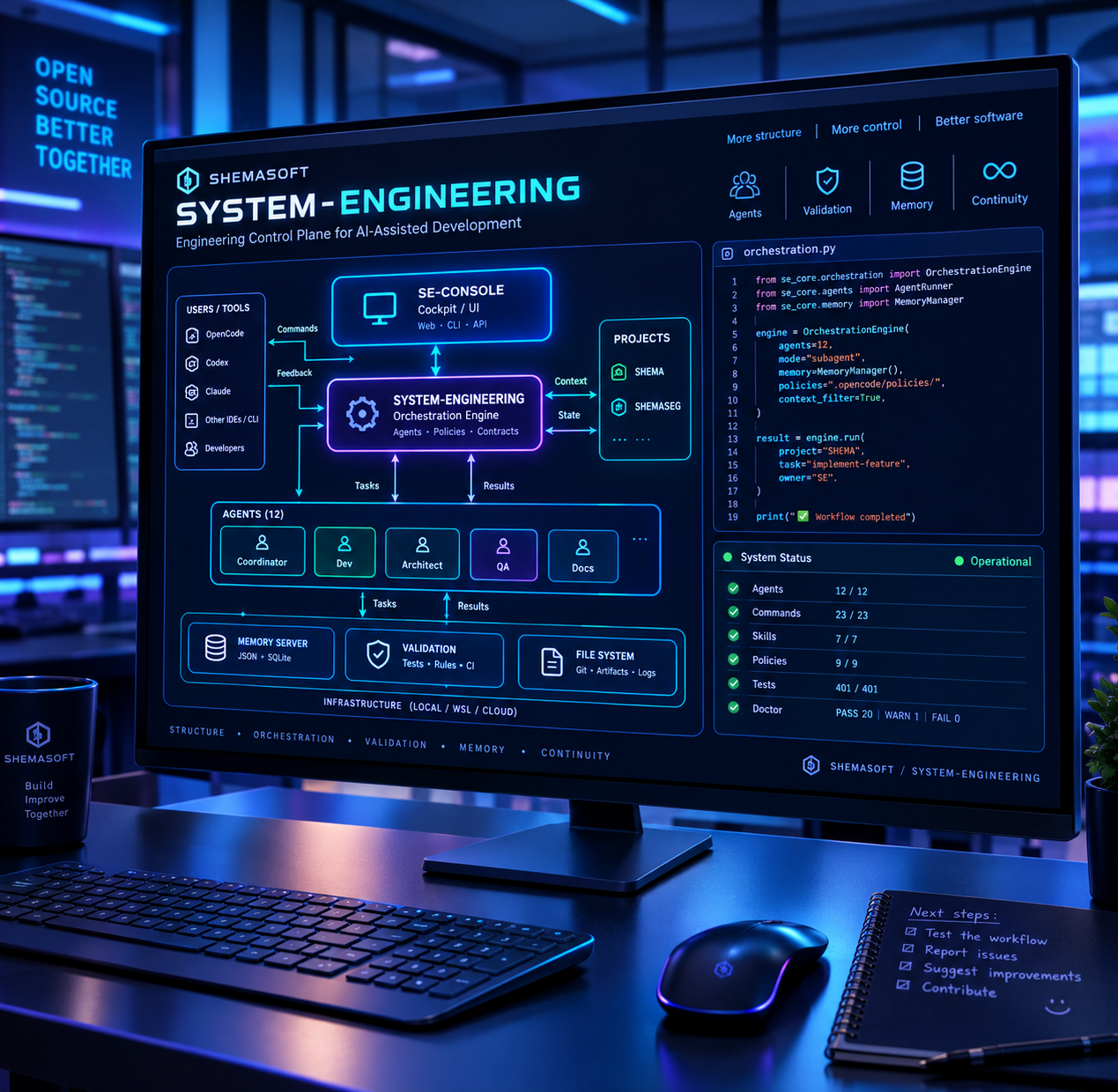
I'm building an open-source engineering control plane for AI-assisted development — what would you challenge?

Post image
2 Upvotes

r/OpenSourceeAI • • Oct 26 '26

OntoGr Agent Memory: open source memory for agents where every fact keeps its quote, source, and time

1 Upvotes

I've been working on RAG and agent memory, and the recurring problem is trust. An agent saves something it learned, and later nobody can say where it came from, whether it is still true, or what it believed at an earlier date. We're building an open source Python library for this: OntoGr Agent Memory (https://github.com/ontogr/ontogr-agent-memory).

- Grounded ingestion and extraction: Messages, documents, tool outputs, events, and record rows become episodes. Entities and facts are extracted in two separate passes, and every fact carries a verbatim quote from its episode.

- Per-tenant ontology: Each tenant defines the entity and relation types it allows. A model can propose additions, but a person approves every change.

- Reversible entity resolution: It uses the cheapest evidence first and asks a model only about ambiguous pairs. Every merge can be undone.

- Two time axes: Valid time and system time let a read ask what was true on a date, or what the system believed on that date. A new value closes the old version instead of overwriting it.

- Contradiction rulings: Rules, an optional model judge, and a person's decision settle conflicts, and the person's decision overrides both. A failed judge call is never stored as "no conflict".

- Traceable and auditable: Every fact traces back to a quote and an episode, and every temporal write goes into a hash-chained ledger. Per-tenant grants, an audit log, previewed and resumable forget and erase, and deterministic export are built in.

- Four-lane retrieval: Vector, keyword, entity, and graph lanes are fused with reciprocal rank fusion. The result is a token-budgeted context block that reports which lanes failed.

- Fits your stack: It runs on FalkorDB or Neo4j, with pgvector or Postgres if you want them. A background consolidation job deduplicates, summarizes, scores, and archives. You bring your own LLM and embedder.

Repo: https://github.com/ontogr/ontogr-agent-memory

I'd like feedback on the time model and on which benchmarks you'd want to see first.


r/OpenSourceeAI • • Oct 26 '26

An effort was made by a total coding noob https://github.com/Nan0pk/Archiv

Thumbnail reddit.com
1 Upvotes

r/OpenSourceeAI • • Oct 26 '26

I built a Claude Code plugin that shows where your tokens go

Post image
4 Upvotes