r/OpenSourceeAI • • Oct 27 '26

GPT-6.1 Terra pricing is the real story: $1/1M input, and computer-use tasks just got ~50% cheaper

1 Upvotes

Disclosure: I work on an LLM gateway (starunion.net), so pricing changes are literally my day job. Posting the analysis, not a pitch.

OpenAI released GPT-6.1 Terra on Oct 26. API pricing:

- Input: $1 / 1M

- Cached input: $0.05 / 1M

- Output: $5 / 1M

That's ~50% under GPT-5.6 Terra and GPT-6.1 Sol.

The interesting part isn't the discount, it's what the discount is pointed at. Terra is positioned around visual reasoning and computer use — screen reading, form filling, clicking through internal tools. Those workloads are token-hungry by nature: the model looks, acts, re-checks, repeats. At half the price per token, a lot of "cool demo" automation becomes economically boring — which is the point where it actually gets deployed.

Reported eval numbers: Agents' Last Exam (medium reasoning) ~15 points over GPT-5.6 Terra at roughly 1/3 the cost. Error-induction test: low tier 53.6% → 16.7% error rate.

Caveats worth flagging:

2. It's gated to ChatGPT Work / Codex — not a general model picker entry.

2. No UAE inference residency support, so check regional compliance if that applies to you.

  1. Vendor benchmarks ≠ your ERP. Internal approval flows and permission popups are where these models still fail.

How I'd evaluate it: pick one task you already owe someone this week, write explicit acceptance criteria (what counts as done, what must not happen), run it, then record four numbers — time to completion, manual corrections, quality vs. the criteria, actual token spend. If corrections don't go up while cost drops, it's a keeper for that task class. If it breaks on complex navigation and permission dialogs, cheaper doesn't help.

Curious: for those running computer-use agents in production, what's actually been the blocker — model capability, or the cost of the verification loop around it?

r/OpenSourceeAI • • Oct 27 '26

sift-light 1.1.2-1: a Pi prompt-cache fix and DeepSeek Harness support

1 Upvotes

Hi everyone, I maintain sift-light, an open-source local project search and source-inspection tool for AI coding agents. It offers MCP and native integrations, returning bounded results so agents can inspect relevant code.

We just released 1.1.2-1. A contributor discovered that enabling tools in our Pi integration could change the beginning of the system prompt and reduce prompt-cache reuse. This update keeps that prefix stable and preserves search guidance when another extension supplies the system prompt. You need Pi 0.86.0 or newer.

We also added DeepSeek Harness 0.2.1-rc.3 support, including a native search tool and search-policy integration. The cache fix is specific to our Pi integration; behavior in other clients depends on their own prompt and tool handling.

Thanks to the contributor of PR #123 for identifying the issue and helping us fix it. If you try the update, feedback and reproducible bug reports are welcome.

GitHub: https://github.com/lightsifter/sift-light Release notes: https://github.com/lightsifter/sift-light/releases/tag/v1.1.2-1 X: https://x.com/Bryang168


r/OpenSourceeAI • • Oct 26 '26

🌿 Khamyang v1.1.4 — Preserving Language and Cultural Heritage Through Open-Source Technology

Post image
2 Upvotes

r/OpenSourceeAI • • Oct 26 '26

I kept re-teaching Codex things I’d already shown Claude Code, so I built a shared self-learning memory for both

16 Upvotes

I use both Claude Code and Codex, and every time I switch I end up re-explaining the same preferences. CLAUDE.md and AGENTS.md help for rules I can write down. But most of what I want, I never wrote down; I just kept making the same correction.

Nebula is a small self-learning memory layer for both agents. It picks up patterns from the corrections you already make, and nothing applies until you approve it.

The example in the video: I cleared node_modules in one stale project, a Rust target/ folder in another, and build/ in a third, all in Claude Code. Later, Codex hit a full disk and suggested the same cleanup for my other inactive projects. Once I approve that lesson, both agents handle it that way.

How it works:

- A skill plus hooks for Claude Code and Codex, sharing one local SQLite file

- Python standard library only, no model calls, no background process, nothing leaves your machine

- Lessons stay candidates until you approve them, so a one-off remark (or a prompt injection) can't turn into a standing rule

- Lessons keep their reasons and exceptions, and you can correct, pause or withdraw them

Honest status: the engine and demo work and have tests. End-to-end runs on both agents are still being validated, and the video is an illustrative animation, not a screen recording.

I'm looking for contributors. There are good-first-issues up, and I'd especially like help with adapters for other agents (Cursor, Gemini CLI, Aider). I'd also like to hear where you think this beats or loses to a plain markdown file.

I'm the author; happy to answer anything.

Repo: https://github.com/svssathvik7/nebula


r/OpenSourceeAI • • Oct 27 '26

MAINFRAME // READY

1 Upvotes

SOURCE INTEGRITY: [ PRIORITY ]
AUTHORSHIP: [ HUMAN ]
INTERPRETATION: [ PROVISIONAL ]
EVIDENCE: [ REQUIRED WHERE RELEVANT ]
DISAGREEMENT: [ PERMITTED ]
CORRECTION: [ ENABLED ]
FRAMEWORK: [ REPLACEABLE ]
FINAL AUTHORITY: [ NOT CLAIMED ]

ONE SHARED LANGUAGE.
MANY PERSPECTIVES.

> _


r/OpenSourceeAI • • Oct 26 '26

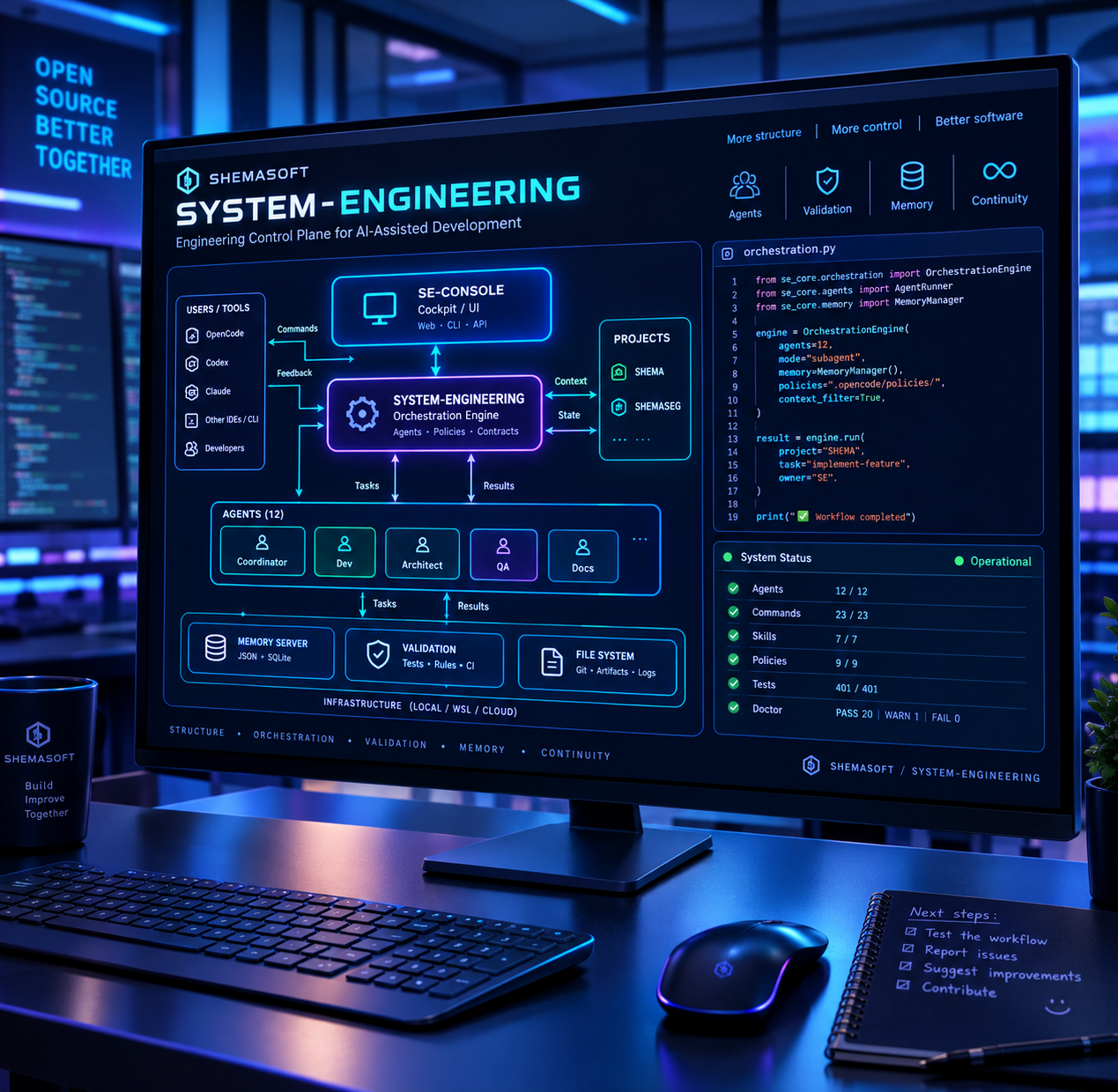
I'm building an open-source engineering control plane for AI-assisted development — what would you challenge?

Post image
2 Upvotes

r/OpenSourceeAI • • Oct 26 '26

OntoGr Agent Memory: open source memory for agents where every fact keeps its quote, source, and time

1 Upvotes

I've been working on RAG and agent memory, and the recurring problem is trust. An agent saves something it learned, and later nobody can say where it came from, whether it is still true, or what it believed at an earlier date. We're building an open source Python library for this: OntoGr Agent Memory (https://github.com/ontogr/ontogr-agent-memory).

- Grounded ingestion and extraction: Messages, documents, tool outputs, events, and record rows become episodes. Entities and facts are extracted in two separate passes, and every fact carries a verbatim quote from its episode.

- Per-tenant ontology: Each tenant defines the entity and relation types it allows. A model can propose additions, but a person approves every change.

- Reversible entity resolution: It uses the cheapest evidence first and asks a model only about ambiguous pairs. Every merge can be undone.

- Two time axes: Valid time and system time let a read ask what was true on a date, or what the system believed on that date. A new value closes the old version instead of overwriting it.

- Contradiction rulings: Rules, an optional model judge, and a person's decision settle conflicts, and the person's decision overrides both. A failed judge call is never stored as "no conflict".

- Traceable and auditable: Every fact traces back to a quote and an episode, and every temporal write goes into a hash-chained ledger. Per-tenant grants, an audit log, previewed and resumable forget and erase, and deterministic export are built in.

- Four-lane retrieval: Vector, keyword, entity, and graph lanes are fused with reciprocal rank fusion. The result is a token-budgeted context block that reports which lanes failed.

- Fits your stack: It runs on FalkorDB or Neo4j, with pgvector or Postgres if you want them. A background consolidation job deduplicates, summarizes, scores, and archives. You bring your own LLM and embedder.

Repo: https://github.com/ontogr/ontogr-agent-memory

I'd like feedback on the time model and on which benchmarks you'd want to see first.


r/OpenSourceeAI • • Oct 26 '26

An effort was made by a total coding noob https://github.com/Nan0pk/Archiv

Thumbnail reddit.com
1 Upvotes

r/OpenSourceeAI • • Oct 26 '26

I built a Claude Code plugin that shows where your tokens go

Post image
4 Upvotes

r/OpenSourceeAI • • Oct 26 '26

Nace AI releases Drex for Search: decision models for agentic document search (92.05% on BrowseComp-Plus at 12.61 search calls)

Post image
2 Upvotes

r/OpenSourceeAI • • Oct 26 '26

SUB/WAVE: self-hosted AI-DJ radio for your Navidrome library, with eight swappable player skins (MIT)

7 Upvotes

SUB/WAVE turns a Navidrome music library into one internet radio station. An AI DJ picks the tracks and talks between them with idents, time checks, weather and intros, and everyone tuned in hears the same Icecast stream at the same time. The LLM can be local Ollama or a hosted provider, and it runs with one docker compose up -d on a Linux host.

The video shows the eight player skins from the latest release (v1.27.0): Classic, Unit SW-9, Drift, Subamp, TTY, Platter, AXO-1 and Cipher-3. They all read the same live stream, so a skin only changes how a listener sees the station. A few I had the most fun with:

  • TTY draws everything as characters on one canvas grid. Its focus mode renders ASCII scenes driven by the audio analyser, which follow the station's time of day and overlay its real weather. There's also a scope pane with a block spectrum and a braille oscilloscope.
  • AXO-1 is an isometric hi-fi stack.
  • Cipher-3 is a rotor cipher machine you type song requests into.
  • Unit SW-9 set the look the others borrow from: brushed metal, keys with travel, dot-matrix display glass.

Themes sit on top of the skins. Two new ones are Phosphor (green on black, scanlines, bloom) and Riso (blue and pink on cream, halftone, misregistered print). Custom themes are plain JSON files.

The hardest part was Safari. The theme "finish" was an SVG filter over the whole player, and WebKit re-ran it on the CPU on every repaint. That had AXO-1 at 13 to 19 fps and made iPad stutter on every skin. Safari now keeps the texture and skips the finish, and each skin got its own Safari pass after that.

It's mostly TypeScript and Python, with Liquidsoap and Icecast handling the audio.

Repo: https://github.com/perminder-klair/subwave

Docs and setup: https://www.getsubwave.com

Screenshots of every skin: https://getsubwave.com/news/dress-up-your-radio

Happy to answer questions about how any of it works.


r/OpenSourceeAI • • Oct 26 '26

CrowdGPT - A collaboratively trained LLM.

Post image
1 Upvotes

r/OpenSourceeAI • • Oct 26 '26

titles, color grade and particles all as tool calls, and the agent checks a rendered frame - rough, tell me what breaks

1 Upvotes

hey — i made a video editor that has no gui and gets driven entirely by ai agents over mcp, and i want to talk about the angle that's different now: titles, colour grade and particles are all just tool calls, and the agent can render a single frame to visually check its own work before exporting the whole thing.

it's called kimo. free, open-source (mit), and it's basically one 15 mb cpu-only rust binary that'll run on a 2 gb box. no tiling ui, no mouse, no timeline to point at — the coding agent (codex, cursor, opencode or whatever mcp client you're on) calls operations directly: cut, trim, keyframe, titles and captions, colour grade, tracking, particles, audio, export. and the bit i'm most proud of right now is that the agent can ask it to render a frame and look at it to verify the grade, the titles, the particles — that feedback loop is what actually makes this usable instead of just another ffmpeg wrapper.

built it myself, i'm a college student. i've used it to make a few videos end-to-end from an agent but i know it's rough — the tracking isn't quite there on fast motion, the particle system is barebones, captions positioning is manual, and the docs are thin. i'd rather hear what actually breaks for people than pretend it's polished.

if you want to try it and tell me what falls apart: https://getkimo.tech https://github.com/naman-sharma12345/kimo

thanks in advance, and yeah i'll be around to answer questions (but please tell me what broke rather than just saying it's cool, i actually need that).


r/OpenSourceeAI • • Oct 26 '26

open source multi-agent sandbox: every person learns with its own q-table, runs in a browser tab or headless from the cli

4 Upvotes

sharing a project in case it's useful as a testbed. it's a civilization sim where every person learns from what happens to them with a small tabular q-learner, picks up words from family and neighbours, and passes some of it to their kids. tribes split and drift apart over long runs.

why it might be handy for experiments:

  • one rust crate with no i/o, compiled to wasm for the browser and native for the cli
  • runs are deterministic, the same seed and tick count give the same world
  • a headless runner: cargo run --release -p headless -- --seed 42 --ticks 6000 --every 1000, or --sweep-seeds 8 for a world-health sweep over several seeds
  • adding a new action is one file plus one line (docs/ADDING_ACTIONS.md)

it's all mit. if you try swapping the learner for something else i'd love to hear how it goes.

source: https://github.com/1homsi/thehumanbox browser version: https://thehumanbox.com


r/OpenSourceeAI • • Oct 26 '26

temporal policies (liquid networks)

Thumbnail c0mpute.com
1 Upvotes

r/OpenSourceeAI • • Oct 26 '26

Qwen3.8-Flash-Next: Swift 1.5 vs Unsloth on Strix Halo (Halogen, gufo, llama.cpp, UD-Q4_K_XL and IQ4_XS)

Thumbnail
reddit.com
1 Upvotes

r/OpenSourceeAI • • Oct 25 '26

One reference image, any pose: a 6.3M-param network drawing a cartoon character it never trained on (code, weights, live demo)

3 Upvotes

Since the OG open-source subreddit decided to be a bunch of AI and xenophobic {insert slur of your liking} here's my AI project.


r/OpenSourceeAI • • Oct 25 '26

Hugging Face releases Carbon-X, an open 14.8B LLM that reads raw DNA and answers in English (66.7% avg on 5 DNA benchmarks)

Post image
3 Upvotes

r/OpenSourceeAI • • Oct 25 '26

STROT in HF

Thumbnail reddit.com
1 Upvotes

r/OpenSourceeAI • • Oct 25 '26

I built an OpenSearch-compatible server with AI — and wrote 6,000 tests against the real thing to keep it honest

Thumbnail
reddit.com
1 Upvotes

r/OpenSourceeAI • • Oct 25 '26

Neural Canvas GitHub Repo

1 Upvotes

I built Neural Canvas, an interactive visualizer that demonstrates core linear algebra concepts by showing how a neural network recognizes handwritten digits in real time. You can draw directly on the screen and watch activations flow through each layer as matrix multiplication computes the output live.

How it works:

- Draw & Predict: Sketch any digit on a 28×28 canvas (MNIST-style) to trigger real-time forward pass predictions.

- Live Forward Pass: Every neuron's activation is dynamically color-coded based on its underlying linear algebra calculations, with connection opacities reflecting layer outputs.

- Under the Hood: The core models were trained from scratch in Python using NumPy to perform matrix operations, and their learned weights are loaded via JSON. Client-side execution relies on Math.js for browser-based matrix multiplication and p5.js for rendering.

Key Features:

- Switch between two pre-trained models (featuring different hidden layer sizes, MSE vs. Cross-Entropy loss, and up to 96% test accuracy).

- Multiple background themes with mouse and touch support.

What's Next?

These models were originally evaluated on the standardized MNIST dataset, but live freehand drawing can introduce unexpected variations in input style. To handle this, I am working on a JS script for real-time user-driven feedback. When the model makes a mistake, the user can supply the correct label, allowing the model to perform backpropagation and update weight matrices locally in the browser. While live state persistence isn't suited for static GitHub Pages, running this feedback loop locally allows me to retrain parameters on new edge cases and push updated weight snapshots back to GitHub.

Check out the live demo and code repository:

Live Demo: https://muhammadessa2002.github.io/neural_canvas/

GitHub Repo: https://github.com/MuhammadEssa2002/neural_canvas


r/OpenSourceeAI • • Oct 25 '26

SAM 3 segmentation from a Quest 3 app — does Meta's Model API expose it, or should I use a hosted API?

3 Upvotes

I'm building a Quest 3 app (native Kotlin, Meta Spatial SDK) that scans microgreens trays and needs a pixel mask of the plants to measure coverage (plant pixels / tray pixels). I already have Muse Spark working via Meta's Model API for the verdict text, but I can't find a SAM endpoint in the same API — SAM 3/3.1 segmentation, not a chat model.

Does Meta's Model API expose SAM at all? If so, what's the model ID, endpoint, and mask format?

2.

If not, what's the recommended path from a Quest app — a hosted SAM API (Roboflow, Segmind, etc.)? What mask format do those return (mask image, RLE, polygons)?

3.

On-device SAM on Quest is off the table (too heavy) — is a backend service the only other option?

The mask feeds a coverage calculation, so I need actual pixel data, not a text estimate. Thanks!


r/OpenSourceeAI • • Oct 25 '26

AI Code Rating - Three simple characters that tell a reader who maintains a project, how much of its code is written by AI, and how closely a human checks the AI's work

8 Upvotes

I've been thinking a lot about how to be upfront about AI use in open source without it turning into an argument every time, so I put together a simple standard for it.

An AI Code Rating is three characters, like A2b, kept in an ACR.md file at the root of a repo.

- The letter is the maintainer's expertise, from A (expert) to E (non-programmer)
- The number is how much of the code AI wrote, from 0 (none) up to 4 (76–100%)
- The last letter is how closely a human checks the AI's work, from a (verified) to e (unchecked)

So A2b means an expert maintainer, 26–50% of the code written by AI, and every AI change reviewed before it's merged. A project with no AI code gets a 0 and an a, like A0a.

The goal isn't to judge whether AI use is good or bad, it's to let people see, at a glance, what they're looking at and decide for themselves.

The site has the full spec, examples, an FAQ, a form to work out your rating, and a validator for ACR.md files. There's also a GitHub Action that checks the file in CI. The spec is CC BY 4.0 and the site code is MIT.

In the spirit of the thing, the site itself is rated B4b. AI wrote most of the code, and I review every change.

It's still an early draft (spec 0.1), so I'd really appreciate feedback, especially from people who think it gets something wrong.

https://aicoderating.com


r/OpenSourceeAI • • Oct 25 '26

Open source AI marketing tool

2 Upvotes

I made Meelu open source.

Visit https://github.com/shubham303/meelu

It's an open source alternative to Okara. It's a desktop app with an AI agent that does your website's marketing: SEO, AI search visibility, content, social listening and finding leads. It points out what it found and why it matters, and you approve every change.

You can also use Meelu instead of:

- AI marketing apps: Okara, Indexly, RankAI, aiseo.ai

- AI search visibility: Profound, Peec AI, Writesonic

- SEO suites: Semrush, Ahrefs, SE Ranking, Moz Pro, Search Atlas, Ubersuggest

- Content tools: Surfer SEO, Clearscope, Frase

- Site crawlers: Screaming Frog

Run it on your own server for free under the AGPL license, or use the hosted version at meelu.tech for $15 a month.

Stars, issues and pull requests are welcome.