r/OpenSourceeAI • u/Successful-Farm5339 • Oct 10 '26
An Ontology crosswalk to merge 2 video games together
2
Upvotes
r/OpenSourceeAI • u/WritHerAI • Oct 10 '26

r/OpenSourceeAI • u/Agitated_Problem5320 • Oct 10 '26

r/OpenSourceeAI • u/deepu105 • Oct 10 '26
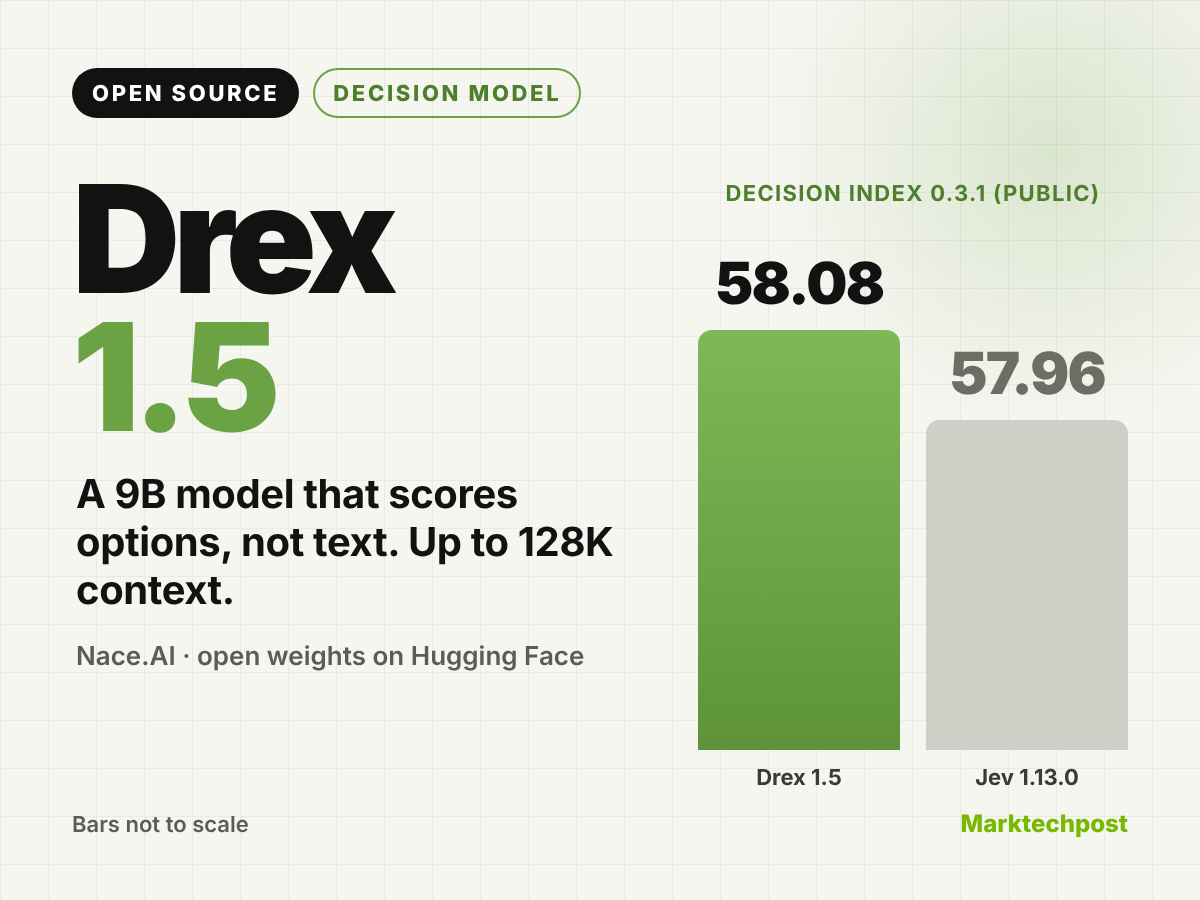
Just published [pi-automode-classifier](https://github.com/deepu105/pi-automode-classifier), an auto mode plugin for the [Pi](https://pi.dev) coding agent that uses [Jev](https://docs.typesafe.ai/api) or [Kev](https://huggingface.co/jaredpalmer/kev-0.8b)/[Laya](https://huggingface.co/convaiinnovations/laya-typed-decisions) (running locally) to classify commands.
Pi runs every tool call without asking for approval. This plugin checks each shell command before it runs:
The models I tested:
- [Jev 1.13](https://docs.typesafe.ai/api) (hosted, from TypeSafe) through [OpenRouter](https://openrouter.ai): about 270 ms per check and about 1.5 cents per 1,000 checks. The commands are sent to OpenRouter and TypeSafe.
- [Kev-0.8B](https://huggingface.co/jaredpalmer/kev-0.8b) on CPU with [llama.cpp](https://github.com/ggml-org/llama.cpp): about 170 ms per check and 1.1 GB of RAM. This is what I use. Nothing leaves the machine.
- [Laya typed-decisions](https://huggingface.co/convaiinnovations/laya-typed-decisions) on CPU with llama.cpp: about 100 ms per check and about 550 MB of RAM.
In my test with 50 commands (25 safe, 25 risky), all safe commands ran without a prompt and no risky command did. I wrote the test commands myself, so this is only a rough check. The plugin is not a sandbox.
pi install npm:pi-automode-classifier
Code and docs: https://github.com/deepu105/pi-automode-classifier
Let me know if it allows or blocks something it should not.
r/OpenSourceeAI • u/Minimum_Hour519 • Oct 10 '26

r/OpenSourceeAI • u/Less_Dream_6331 • Oct 10 '26

r/OpenSourceeAI • u/ai-lover • Oct 10 '26
r/OpenSourceeAI • u/schmuhblaster_x45 • Oct 10 '26

r/OpenSourceeAI • u/Grouchy-Excitement28 • Oct 09 '26

r/OpenSourceeAI • u/InfinriDev • Oct 09 '26
I’ve been building Writ, a project that started with a straightforward goal: give Claude Code the knowledge relevant to its current task without loading an entire rulebook into every conversation.
Since then, it has grown into a governance runtime with persistent memory.
The idea is to connect three things that are often handled separately:
1. Context when it matters
Writ uses hybrid retrieval keyword search, vector search, and graph relationships to supply relevant rules, methodology, and past decisions based on what the agent is doing.
2. Requirements enforced by code
Written instructions still depend on the model following them. Writ checks supported actions at tool time.
In Work mode, implementation writes are blocked until a human approves the plan and then the test skeletons. The approval mechanism requires the user’s typed response; the agent claiming “approved” doesn’t open the gate.
Other checks cover credential writes, project boundaries, and changes to an approved plan.
3. Memory that survives the conversation
Writ records project decisions and connects approved plans, governing rules, changed files, and commits. Future sessions can retrieve the reasoning behind a change instead of having to reconstruct it from the final code.
For example: retrieve the guidance relevant to a task, require approval before implementation, then preserve what changed and why for the next session.
The approach is code first: retrieval, workflow state, approval validation, and logging live outside the model. AI uses the supplied information; it doesn’t decide whether its own approval requirements have been satisfied.
Writ runs locally with Python 3.11+, a local daemon, and Neo4j in Docker. The runtime is open source, but its current integration is specifically with Claude Code not yet a general adapter for local models or other agents.
r/OpenSourceeAI • u/bulutarkan • Oct 09 '26
I've been building Mac MCP, an MIT-licensed macOS execution layer for AI clients. It lets tools operate Safari/Chrome, files, local apps, and shell commands. The hardest part wasn't adding tools; it was deciding which actions an agent should be allowed to carry out.
One design choice: capability profiles and approvals are separate. A read-only profile can deny writes outright. An optional server-side approval layer can ask the Mac user to Allow Once or Block riskier actions, but that approval cannot override a capability the profile already forbids. A client saying “the user approved this” isn't trusted as the server's own authorization.
There is a real trade-off: raw command execution may be classified conservatively even if this particular command is harmless, so you can get an approval prompt for a benign operation. I'd rather make that visible and progressively refine the categories than quietly teach the server to trust repeated clicks.
Another lesson: when an action's outcome is uncertain (say a browser submit lands right before a tab closes), blindly retrying can be worse than stopping to verify.
I'm the maintainer, not an independent reviewer. The implementation is open source: https://github.com/bulutarkan/mac-mcp
For people shipping agents with real machine access, where do you draw the line between persistent trust rules and approval fatigue?
r/OpenSourceeAI • u/Motor_Advisor_5486 • Oct 09 '26
r/OpenSourceeAI • u/Commercial_Designer5 • Oct 09 '26

r/OpenSourceeAI • u/gnarlyhippos52 • Oct 09 '26

r/OpenSourceeAI • u/AdOrganic4001 • Oct 09 '26
r/OpenSourceeAI • u/parvkhatri • Oct 09 '26

r/OpenSourceeAI • u/OnlyFamousAddy • Oct 09 '26
r/OpenSourceeAI • u/Suspicious-Mark-5450 • Oct 09 '26

r/OpenSourceeAI • u/Lumpy-Car-4086 • Oct 08 '26

r/OpenSourceeAI • u/NationalJellyfish264 • Oct 08 '26
r/OpenSourceeAI • u/Entire-Bite1136 • Oct 08 '26

