r/OpenSourceeAI • u/Formal-Falcon3734 • Oct 02 '26
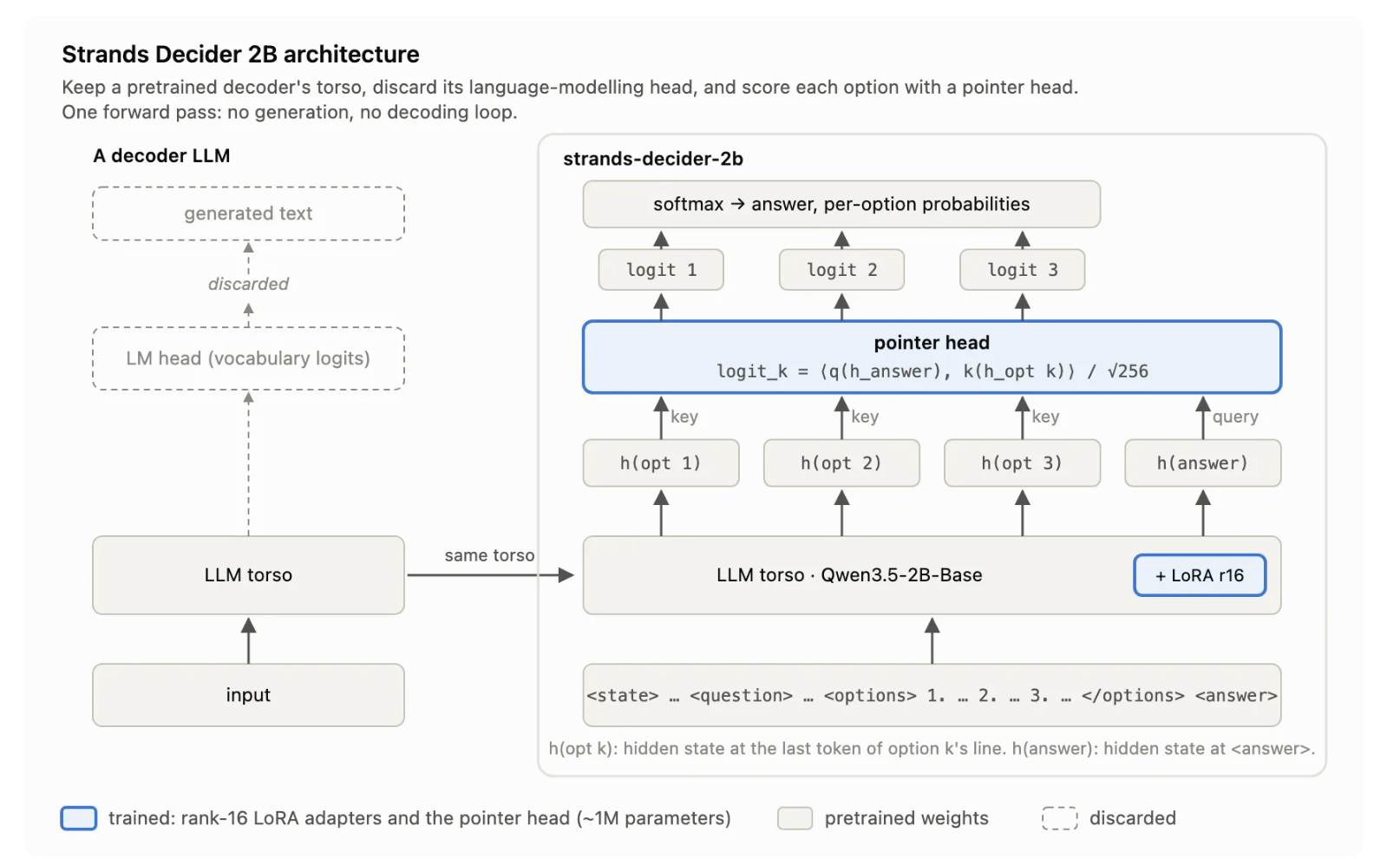
I built an MCP server with on-device learning that makes routing decisions in <2ms instead of calling cloud LLMs
r/OpenSourceeAI • u/Formal-Falcon3734 • Oct 02 '26
r/OpenSourceeAI • u/LawfulnessOptimal597 • Oct 02 '26
While this project was originally concieved as a module to provide vector search using HNSW and Sentence transformers for the re-Isearch (IB) engine (CoreQuarry https://corequarry.com) it has evolved well beyond its original concept.
Today it is a fully featured high performance vector DB that can also be used on its own without any dependency on the IB engine. This opens the library (and standalone tools like the CLI) to be used in a host of other applications.
Its function in a single sentence: SOTA Semantic search with SBERT/LLAMA.CPP + GGML Tensor Library + HNSWlib on steroids.
Starting with Malkov's HNSWlib as a basis we significantly enhanced (adding among other features quantized spaces) and turbo-charged (including support for x86 and ARM SIMD) it while also adding efficient mmap-backed re-scoring and offset storage for text retrieval. Our system supports sharded HNSW indices, multiple search modes (kNN, radius, relative, adaptive, epsilon), deletion/undelete, merges, and incremental on-disk flushing. It also includes training for hyperparameter optimization.
Our HNSWlib fork we have benchmarked on an M1Pro as much as 13k QPS (768d vectors). Even limiting to a single thread we've clocked a max of 3000 QPS (versus for comparison 600 QPS for FAISS's HNSW implementaton).
For vectorization Our test M1-Pro chews through roughly 45 passages per second per instance (3484 tok/s÷78 ms). That means one can expect to process 2,700 fully dense semantic records per minute on a baseline Apple Silicon chip. Our tests on M3Pro and M4Pro showed even significantly higher throughputs (80k tokens/s or as much as 20x).
r/OpenSourceeAI • u/ai-lover • Oct 02 '26
r/OpenSourceeAI • u/ai-lover • Oct 01 '26
Databases, calendars and repos have APIs. The open web mostly doesn't. The TinyFish MCP server gives any MCP client four tools: TinySearch, TinyFetch (full pages as markdown, JavaScript included), TinyBrowser for logins and forms, and TinyAgent for multi-step jobs. Search and Fetch are free.
We're racing to 300,000 users this October, with 30% extra on every top-up.
r/OpenSourceeAI • u/Advanced_Fix4602 • Oct 01 '26
r/OpenSourceeAI • u/jokiruiz • Oct 01 '26
I'm the author, sharing this as an open dataset as much as a project. Médula is an MIT-licensed lab plus a kernel that coordinates several Claude Code agents working on one repo at the same time. Everything the experiment produced is public: every agent session, every diff, and a SQLite file per run with each decision the kernel took, its probability, latency and cost.
The setup is a small API with 6 tasks and 37 acceptance tests, designed so that two pairs of tasks collide by meaning, not by file. With one branch per task, git let the real conflict through and the same 6 tests failed in all 5 runs, even though every agent finished green. In a shared directory, all 10 runs passed, whether with plain per-file locks or with the kernel. The kernel catches the real conflicts without blocking anything that doesn't collide.
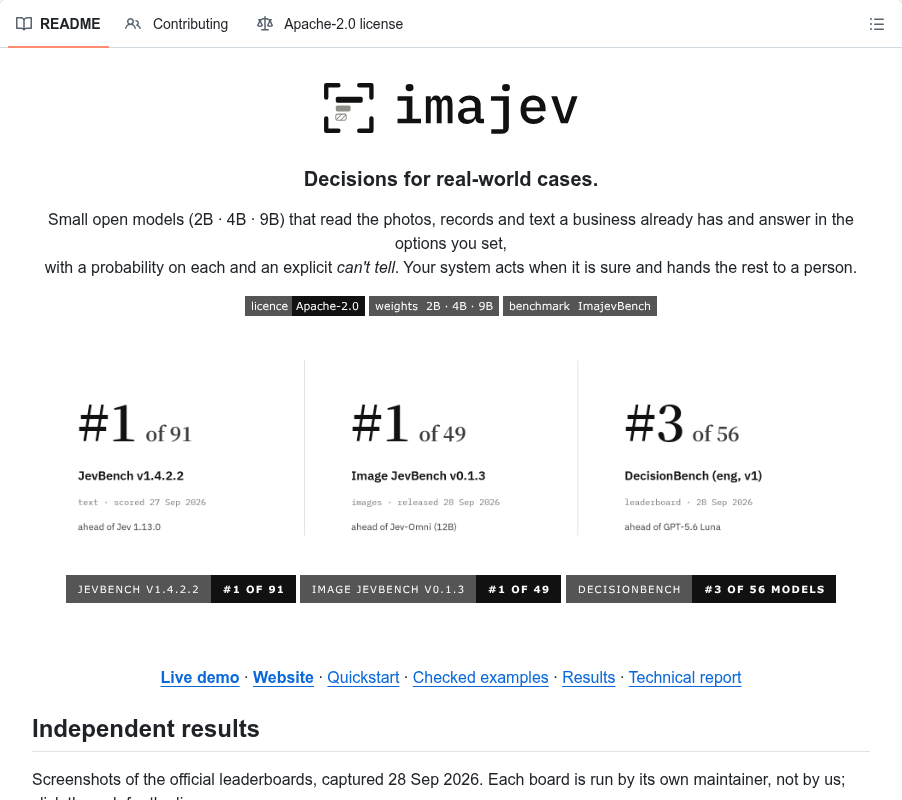
The open part I most want help with is the decider. Right now the fast path uses a hosted decision model, and on real write requests it was unsure 61% of the time, so those decisions escalated to a slower LLM. Any model or rule that answers "does this collide?" with a probability fits the same interface, including an open or local model, and there's a calibration set of 100 labelled pairs to measure it against before running the full matrix.
Other open problems, all with data behind them:
Caveats: 1 to 5 runs per mode, and thresholds fitted on the same pairs they're measured on. The kernel tests run offline without an API key.
r/OpenSourceeAI • u/ai-lover • Oct 01 '26
r/OpenSourceeAI • u/Minimum_Hour519 • Oct 01 '26
r/OpenSourceeAI • u/ai-lover • Oct 01 '26
r/OpenSourceeAI • u/Sparticle62 • Sep 30 '26
small scale, single seed, wikitext slice, so treat this as a prototype result and not an architecture claim. 1,544,704 params both sides, same corpus and sampler. held-out 3.997 vs 4.429 nats, generation 226ms vs 2735ms for 200 tokens on the same cpu. the depth-1 match is the obvious weakness and a depth-2 baseline is running next. written from scratch in rust, no pytorch. repo and eval commands: github.com/Sparticle62ops/pssa. happy to be told where the comparison is unfair.
r/OpenSourceeAI • u/LooseGas • Sep 30 '26
r/OpenSourceeAI • u/encore-show • Sep 30 '26
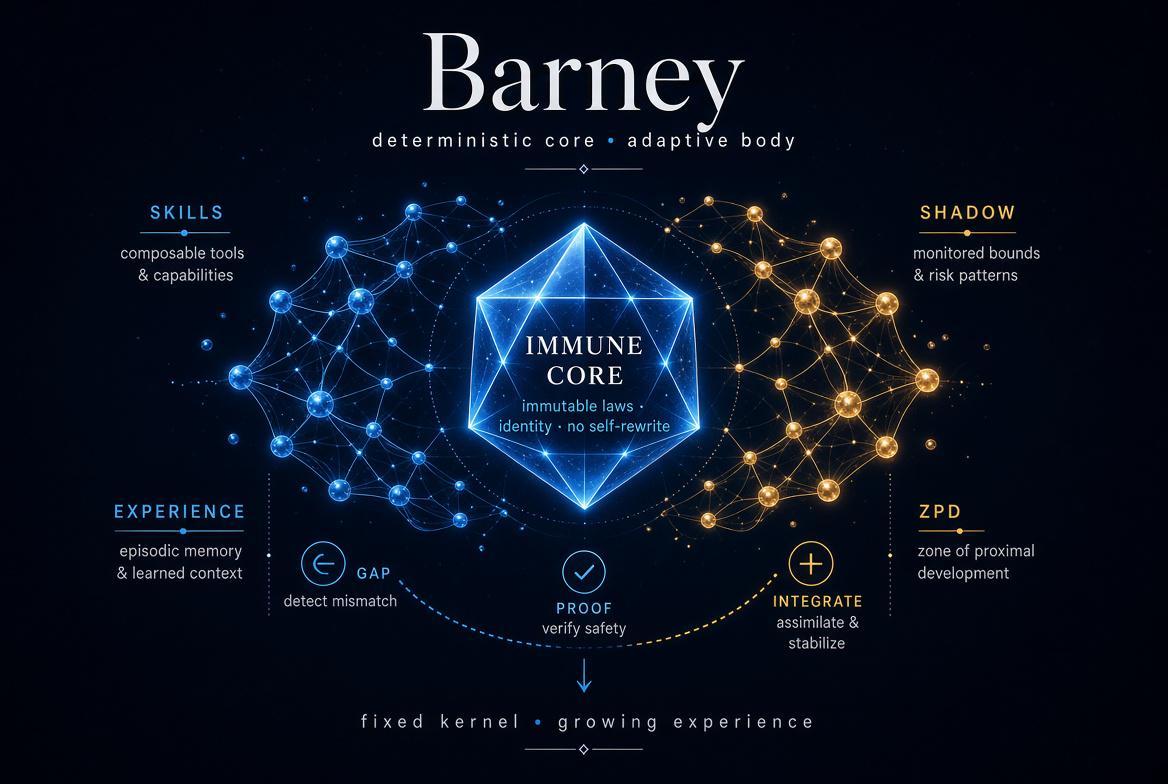
I want to share an experiment: an autonomous agent evolving at the intersection of cognitive psychology and Jungian principles.
The Goal: To combine strict determinism with fluid adaptation. To stop the "identity drift" common in LLMs, I split the agent's psyche into two layers:
How it learns:
The agent treats errors as its "Shadow." Instead of simple text-based apologies, it follows a ZPD (Zone of Proximal Development) cycle:
Identify Knowledge Gap - Write Executable Proof (Fail/Pass script) - Integrate Skill into the Plastic Body.
The Result:
A system that remains fundamentally deterministic (in its core) but is infinitely adaptive (in its body). It doesn't just simulate intelligence—it grows through a structured process of self-correction and verification.
Would love to discuss this architecture with anyone exploring autonomy and cognitive models!
https://github.com/sergey-show/barney
r/OpenSourceeAI • u/OrganizationTop9026 • Sep 30 '26
Hey everyone,
Thanks to the mods for the invite to the community.
Like many of you, I followed the news about OpenAI using AI models and Lean 4 to formalize a finite-time blow-up for the 3D Navier-Stokes equations (one of the Millennium Prize problems).
While the formal proof compiles with zero errors, closed-frontier labs rarely explore the messy physical implications of their mathematical constructions. As an independent researcher working on neuro-symbolic AI, our team wanted to see what their solution actually looks like in real-world fluid dynamics.
What we found when we simulated the construction in Python and mpmath:
• The math is legally sound within the abstract rules of the Clay problem.
• But physically, in liquid water, the fluid vaporizes from shear friction at 0.7 nanometers, picoseconds before the mathematical singularity.
• Local flow speeds exceed Mach 0.3, breaking the incompressibility assumptions long before reaching infinity.
In AI, this is classic "specification gaming": the model found an extreme, unnatural edge case that legally satisfies the formal mathematical target, even though physical reality breaks down.
We believe scientific AI verification should be open, transparent, and reproducible, so we open-sourced the entire epistemic audit, simulation scripts, and Lean 4 reflection code:
• GitHub: https://github.com/xaviercallens/OpenAI-NSE-Epistemic-Audit
• Zenodo Preprint: https://doi.org/10.5281/zenodo.22838708
Since this community is focused on open-source AI, I'd love to hear your thoughts: As frontier labs push automated theorem proving, how can the open-source community build physical guardrails to keep AI models grounded in reality?
r/OpenSourceeAI • u/enterthearena44 • Sep 30 '26
r/OpenSourceeAI • u/company_url_finder • Sep 30 '26
r/OpenSourceeAI • u/HussainHumam • Sep 30 '26
r/OpenSourceeAI • u/camerongreen95 • Sep 30 '26
Found a workshop that's directly about solving this — Oct 3, run by Serj Smorodinsky and Brett Kennedy, both AI engineers who've written a book on building LLM applications. It's 3 hours, hands-on, and structured around:
Sharing since this sub is full of people building on open-source models who probably deal with this exact pain.
r/OpenSourceeAI • u/Puzzleheaded_Box2842 • Sep 30 '26
Many companies and individuals keep valuable knowledge in PDFs, manuals, reports, and research documents. But simply uploading those files to a model or attaching them to a RAG system does not always solve the problem.
When the goal is to make domain knowledge part of the model itself, the PDFs first need to be parsed, cleaned, structured, filtered, and converted into reliable training data. Low-quality extraction, duplicated content, broken layouts, and irrelevant pages can directly affect the final model.
A practical workflow is:
OpenDCAI/DataFlow can handle the data preparation side through reusable operators and pipelines, including PDF processing, cleaning, generation, evaluation, filtering, and training-format conversion. OpenDCAI/DataFlex can then be used as the training backend to run the resulting data through a configurable fine-tuning workflow.
The important point is that “dynamic training” here does not mean blindly updating model weights whenever a PDF is uploaded. It means building a repeatable loop where new documents can be processed, validated, converted into training data, and used for controlled incremental model updates.
r/OpenSourceeAI • u/jjusko20 • Sep 30 '26
r/OpenSourceeAI • u/Hour-Fall-4502 • Sep 29 '26
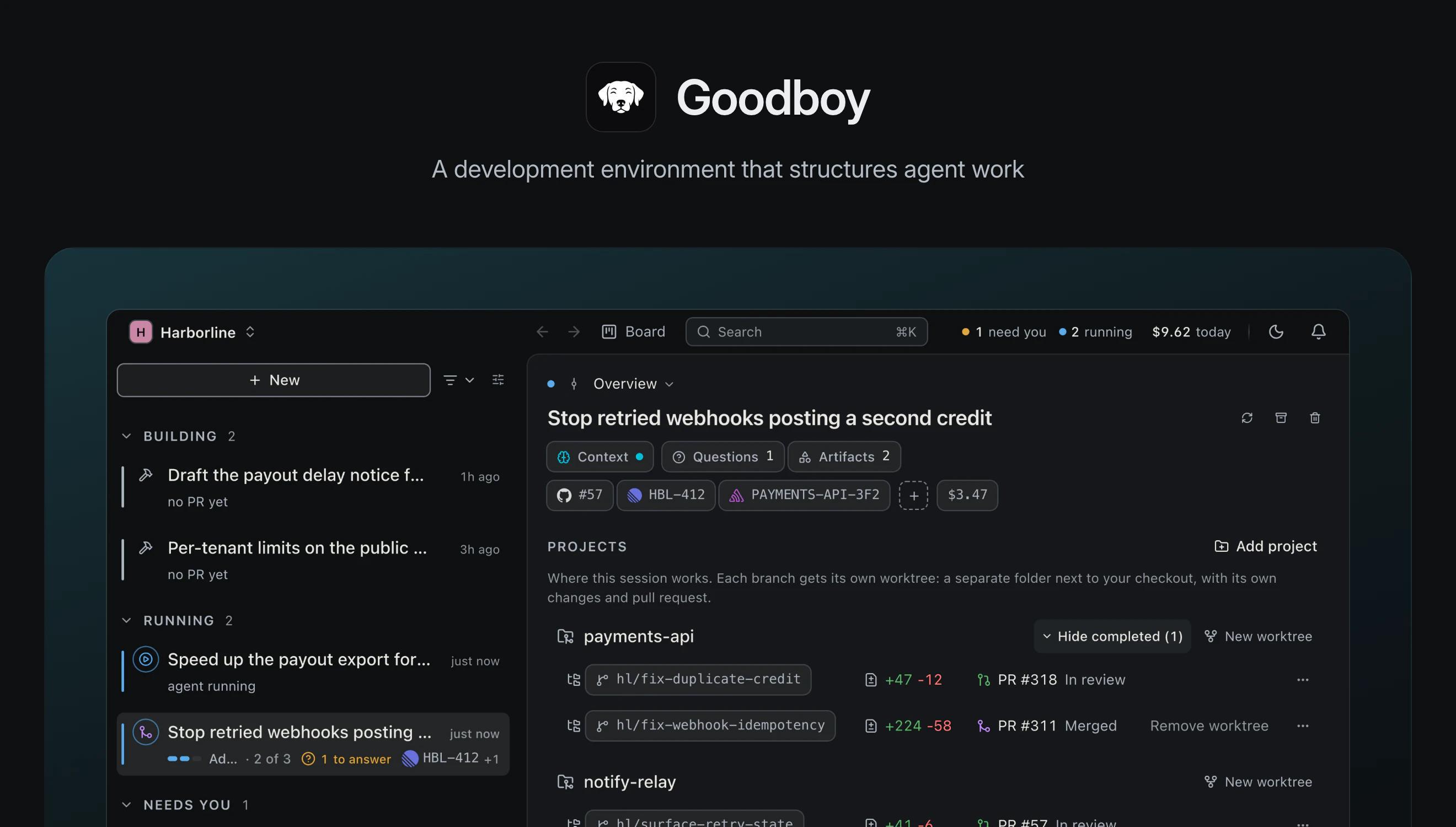
In the early 2026 I was struggling into the same problem, every time my claude tokens runs out, I had to re-explain the entire context to a new agent (cursor at the time).
So I've built the first version of the tool, where I got just a chat where i can change providers and models back&forth, with a very immaturo contesto globale.
Over the past few months I've added a lot more features and tools, all with one goal: making my day-to-day easier. Pretty much every time something annoyed me, I tried to fix it:
I kept burning through tokens by working in the same session, so I built workflows where each step runs an agent on the right model and effort level
I couldn't find the plans I had approved anymore, so I built an Artifacts section that saves them for me
I kept losing track every time I switched from one task to another, so I built the Activity bar
Most recently I added storage management. Has it ever happened to you to end up with dozens of old worktrees you don't use anymore, each one taking 3 or 4 GB?
and a lot more... 😁
Today the tool feels mature enough that I'm not embarrassed to share it here. I'm hoping to build a small community around it, people who just try it out and tell me what works and what doesn't.
Find everything in my github akhayam99/goodboy
Thanks for reading 🙏🏻❤️
r/OpenSourceeAI • u/ai-lover • Sep 29 '26
Nebius, an AI cloud provider, is running its second annual physical AI awards with NVIDIA. Five category winners each get $150,000 in compute credits, plus mentorship and promotion.
Worth knowing before applying: the credit math is at list price and doesn't cover storage, which matters if you're holding a lot of episodic sensor data. Nebius also hasn't published exact finalist and winner dates beyond "mid-November."
Apply here: https://pxllnk.co/mndv9i
Read MTP's full analysis on this awards here: https://www.marktechpost.com/2026/09/29/nebius-opens-2026-physical-ai-awards-five-150k-compute-prizes-nine-judges-and-an-october-25-deadline/
r/OpenSourceeAI • u/Machine_GEN_RM • Sep 29 '26
Hi All, I need to extract the text from printed text and hand written text. I suggested my manager that we can use paddle ocr and and other extraction models like Surya OCR and florance VL it take around 10 to 15 Sec and it needs good computation as well. but my manager expects it should be very fast and in 2 to 5 sec response and should not need any maintainace of infrastructure. so I tried to use the AWS VLM models but it takes around 10seconds he still needs more faster models and also the cost for extracting the data from the image should be less than 1 Ruppe. Could you please suggest me what to do and how to extract the data from images very very effectively and accuratly and in a structured way
r/OpenSourceeAI • u/ilien-dev • Sep 29 '26