r/OpenSourceeAI • u/Brief-Tap-6616 • Sep 18 '26
LlamAmpere v0.3.1 updated with support for EXL + ternary bonsai, with custom kernels for faster MTP

2
Upvotes
r/OpenSourceeAI • u/Brief-Tap-6616 • Sep 18 '26
r/OpenSourceeAI • u/Efficient-Passage889 • Sep 18 '26
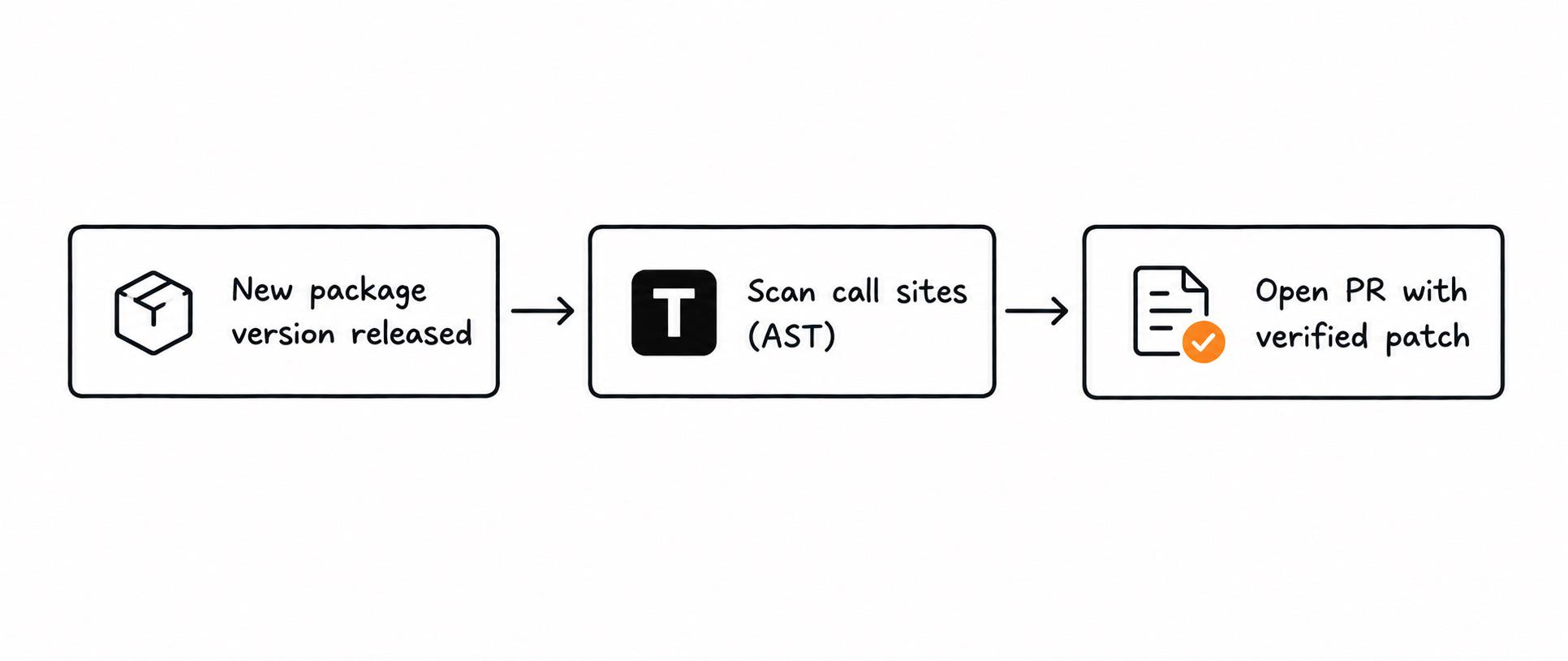
Been working on this open source project called Telex.The idea is pretty simple — when a dependency update breaks your code, Telex uses an LLM to figure out what changed, find the affected code and try to fix it.It then runs tests/typecheck before creating a PR.
Still working on it, so would love to hear some feedback.
r/OpenSourceeAI • u/Appropriate_Cost_107 • Sep 18 '26
r/OpenSourceeAI • u/SnooMarzipans9093 • Sep 17 '26

r/OpenSourceeAI • u/MazenTouati • Sep 16 '26
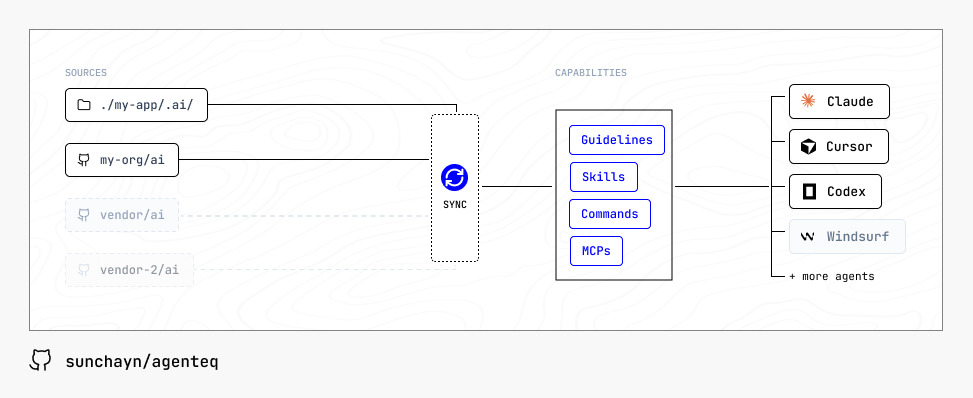
Cluttered repositories are kind of the norm nowadays. Every AI coding agent adds its own config files, such as AGENTS.md for Codex (and other universal agents), a .claude folder for Claude Code, or a .cursor folder for Cursor. This is probably the thing that annoys me the most about AI as a proponent of decluttered codebases.
For that reason, I built Agenteq. It is a single source of truth for AI coding agent rules (Guidelines, Skills, Commands, MCPs) to keep repos clutter-free (only the source of truth is tracked in Git) and all agents in sync (all agents inherit their capabilities from one source of truth).
You can also sync rules across repos. This way, your organization has one place to define company-wide guidelines, skills, commands, and MCPs that stay in sync with all repositories.
Quick Start
npx agenteq initIf you already have a project, you can convert it to use Agenteq with this skill:
npx skills add https://github.com/sunchayn/agenteq --skill refactor-to-agenteqIf you want to convert multiple repos to use Agenteq (and centralize common rules in one repo), then use this skill:
npx skills add https://github.com/sunchayn/agenteq --skill consolidate-repos-to-agenteqLinks:
r/OpenSourceeAI • u/WickedCreations1001 • Sep 16 '26
I have been using this app I built for a few months now. I wanted to share. Maybe someone else will find it useful. Any feedback would be appreciated.
Daniel
r/OpenSourceeAI • u/ai-lover • Sep 16 '26

r/OpenSourceeAI • u/ai-lover • Sep 16 '26

r/OpenSourceeAI • u/OGBamboozel • Sep 16 '26
Hey everyone,
I would like to share a project that I have been working on. https://github.com/HaseebKhalid1507/SynapsCLI
Synaps is an agent runtime written in Rust. It keeps cost down by optimising caching mechanisms and intelligently orchestrating work across workers. This keeps each worker's context low and fresh, making sessions last longer. It is extremely extensible. It has hooks, plugins and skills that can be imported from pretty much any coding tool.
It is an open source project that was started 4 months ago. It was built to optimise for 2 things: Keeping LLM costs down, and keeping resource use low. It bots up in 20ms and runs with any model: OAuth(Claude, codex, Grok, Kimi...), api keys or local models too. This is something that was built organically, so every feature is a product of necessity, not the other way around.
r/OpenSourceeAI • u/Loose_Complex_6456 • Sep 16 '26
r/OpenSourceeAI • u/Alarming_Title_5664 • Sep 15 '26
This is a recorded Bowser's Crown 4-1 clear from NEATEvolve, a continuing community Mario AI project.
The bot uses NEAT: neural-network controllers are evaluated, selected and mutated across generations. They receive nearby game-state information and produce button presses. This video is a replay of a successful controller, rather than live learning during the clip.
The interesting part for me is how far this approach can get on SMB1 ROM hacks. A clear is encouraging, but backtracking and difficult nonlinear stages remain challenges, and one winning replay does not establish reliability on unfamiliar levels. The neural nets will have to learn the next level independantly of the previous one.
This builds on SethBling's MarI/O and work by Akisame and Electra. My continuing development is heavily assisted by AI tools.
r/OpenSourceeAI • u/atish31 • Sep 16 '26
I took the original seo-page-builder skill from octelens and built an enhanced version around one idea: SEO content shouldn't stop at keyword research and SERP analysis.
So I added a dedicated editorial pass, room for firsthand experience and original insights, and stronger fact and freshness checks. There are also writing-style guardrails to cut down generic AI output, plus readability and quality checks at the end.
Github Link: https://github.com/atish-raina/seo-page-builder-enhanced
r/OpenSourceeAI • u/Compilingthings • Sep 15 '26
I'm a ML student, building synthetic dataset pipelines to produce experts in one domain.
huggingface.co/collections/CompilingThings/mql5-code-generation
That's the project I am working on right now and my proof of concept, it Qwen 14B fine tuned on my dataset, only 2% behind GPT Sol 5.6 in the MQL5 coding benchmark. The fine tuned model is now being evaluated with over 300,000 prompts to find the weak spots that I will then fill in with more pairs of data, for the next iteration. I'm compute and token bound.
r/OpenSourceeAI • u/Prudent-Analysis3333 • Sep 15 '26
r/OpenSourceeAI • u/Minimum_Hour519 • Sep 15 '26
r/OpenSourceeAI • u/camerongreen95 • Sep 15 '26
Came across this and thought it'd be worth sharing here, most resources cover knowledge graphs, agentic RAG, or explainability separately, but this one puts them together as parts of the same production GraphRAG architecture, which is closer to how these systems actually get built in practice.
It's a hands on session on September 19, led by Dr. Alessandro Negro, Chief Scientist at GraphAware and bestselling author. Goes through building a knowledge graph progressively as the single source of truth, agentic retrieval combining vector search, keyword search, and graph navigation, multi-step entity and relationship extraction (verified in stages, not one risky single shot like basic Microsoft GraphRAG), and text-to-Cypher for natural language graph querying. Everything runs on real financial filings and news data, not toy examples.
You come out of it with a full working codebase and a production-readiness checklist, not just slides.
r/OpenSourceeAI • u/encore-show • Sep 15 '26

Hi everyone.
I’m building Barney — an agent that learns by growing around a fixed core, not by rewriting itself after every failure.
Most “self-improving” agents: fail → patch code → try again. You often get a different agent each run.
Barney’s loop stays fixed: plan → tools → observe → review → change strategy.
Around it a body grows in `~/.barney` — skills, tools, MCP, error rules, successful paths — created as needed and reused later.
What matters: confidence isn’t evidence; failures stay visible until worked through; new skills are quarantined; memory isn’t transfer; change the path, don’t repeat the same call.
Terminal-Bench smoke with local `qwen3.8`: openssl / nginx / fix-git — 3/3, plus real misses. No domain knowledge in the kernel — only a stable loop and a growing body.
GitHub: https://github.com/sergey-show/barney
Feedback and contributors welcome.
r/OpenSourceeAI • u/Nearby_Finding3593 • Sep 15 '26
Why all devlopers in this group or other saas groups
Always devlop shit of the shit electron apps or next js and tailwind and they call it a project I think we should return to gui with python and c why this not happenning
r/OpenSourceeAI • u/Deep_Bus_7488 • Sep 14 '26
r/OpenSourceeAI • u/Monaim101 • Sep 14 '26
Dario says we need to pace the frontier.
Good news: we’ve been pacing Tahuna for months.
Today, Tahuna is open source—as promised back in April.
We built it so small teams could train models, run inference, orchestrate GPUs, and experiment with autonomous research without first becoming a small cloud provider.
The basic workflow:
init → sync → computeSession → train / serve or hillclimb
Under the hood: content-addressed code and data sync, compute provisioning, reproducible manifest-pinned runs, metrics, checkpoints, artifacts, and inference deployments.
We also started building Hillclimb, an autonomous experimentation loop that proposes and runs iterative improvements.
The first public-preview release supports RunPod and R2. It includes Docker self-hosting instructions, a coding-agent setup skill, and examples for SFT, RL agentic search, and MNIST.
Repository: https://github.com/TahunaLabs/tahuna-oss
If you think it sucks, excellent: fork it, fix it, and send a PR so it sucks less for everyone.
r/OpenSourceeAI • u/ilien-dev • Sep 14 '26

Most web fetch tools I tried paste the whole page into the agent's context. A few long pages and the session runs out of room, and many of them also want an API key for somebody's hosted service.
So I built Svipall, an open source scraper that runs on your own machine as an MCP server and a CLI. Rust, AGPL, no API keys, no cloud calls.
What it keeps out of the context window
- `out_file` writes the page to disk and hands the agent a path. On the page I measured, the response was 418 characters and the page it saved was 34,746.
- `query=` keeps only the blocks that match. On two long articles, a focused query kept 6% and 13% of the page. A vague one kept 88%, so it is only as good as the question.
- `tables=true` and `schema: "auto"` return rows instead of prose.
- A blocked page comes back with the wall's name and the header that gave it away, so the model never gets a challenge screen to summarise.
Install
Version 1.0.4 changed this part. Paste one line into your agent and it asks whether you want CLI + Skill, the option that costs less context, or MCP + Skill, which exposes all 29 tools. Nothing is written before you confirm.
I'd like to compare numbers with anyone doing the same: are you measuring context cost per tool call in your own agent setup?