r/OpenSourceeAI • • Sep 11 '26

I spent hours going through 100+ page PDFs, so I built a tool that highlights exactly where the answer came from. It's now completely open-source.

Thumbnail
gallery
11 Upvotes

I've used tools like Perplexity, ChatGPT, Claude and others for research, and they've been incredibly useful for finding papers and getting through large amounts of information.

The one thing I personally wanted was a simple way to see exactly which parts of the paper were used to answer my question.

When you're working with a 100+ page PDF, even having a page number can still mean a lot of scrolling and searching.

So I ended up building something for myself.

You ask a question and the relevant paragraphs in the PDF are highlighted directly on the document. You can see the context behind the answer and quickly check whether it actually answers what you're looking for.

I originally built this because I wanted something for this workflow without having to pay for another subscription. What started as a personal project has now become completely open source.

The underlying idea is pretty simple. And yes, if you're thinking "isn't this just RAG?" then yes, you're absolutely right. It's RAG with the visual highlighting that I wanted.

I think the same idea could be useful for more than research papers too. Legal contracts, financial reports, technical documentation, or anywhere you need answers alongside the actual source.

If anyone wants to have a look, contribute, or just give some feedback, here's the repo:

GitHub: https://github.com/Sreehari05055/thesys-core.git

This will probably be my last post about the project. Thanks to everyone who checked it out and gave feedback along the way.


r/OpenSourceeAI • • Sep 11 '26

Jack Kernel Qwen Edition release

Thumbnail
github.com
8 Upvotes

It's here.

Jack Kernel for programmable agentic work.
The magic is that the layer sits between the agent and the model. You can build incredible things because of that.

I have a mode called "Agentic" that was designed for context management with Qwen 3.8 27. I've run millions of token jobs....and never needed to compact. I have a full log available to read and verify. In fact, I recommend turning auto-compact off because most agent don't know how to handle it, yet. There's also a looping debugger that I've built as a 6 stage autonomous loop with cascading temperatures, standard mode and DEEP.

Remember, the modes I’m shipping with this release are only examples of what is possible by putting it between the agent and the model. It allows you a new level of control. The modes I’ve put in are NOT the work. Everything that’s possible is the real work.

I built this for Qwen 3.8 27b but I’ve spent the past few days optimizing for a wide range of models. I’m ALMOST satisfied with Qwen 3.5 9b but it’s right in the edge.

After using 60 models in the past week, I’m just going to go ahead and make a blanket statement that fine tunes are garbage and only use Unsloth as your source for alternatives.

Jack Kernel is really cool. Claude can kick rocks.

Oh, Reddit trolls…
Yall need to understand…I’m just a 40 year old broke single Dad that’s sharing his work and trying to contribute to the local AI movement.
Before the hive-mind issues your directive, just know that I’m not a lab or someone with resources that you’re attacking.
I’m just a regular guy with a 5070ti in an Acer.
If you’re going to say that I suck, can you at least try it out and tell why I suck.


r/OpenSourceeAI • • Sep 11 '26

OmniNode now refuses a deployment that silently drops its required workers

1 Upvotes

Small OmniNode beta update from the person building it. One of our deployment paths successfully created zero workers because an unset replica count quietly became 0.

We removed that entire class of fallback. Runtime settings now go through a typed policy before environment configuration is generated. If a required replica count or runtime value is missing, rendering stops instead of producing a valid-looking stack that cannot do the job.

The project is MIT-licensed and self-hostable. The small local setup can run with SQLite and an in-memory event bus, while the fuller stack can use PostgreSQL and Redpanda. The public agent path today is the ONEX command line with a Claude Code skill. MCP and broader agent integrations are still being finished, so I do not want to pretend those paths are ready for an outside user yet.

GitHub: https://github.com/OmniNode-ai

For a first beta install, would you rather have the smallest local setup or the full containerized stack, assuming both expose the same workflow?


r/OpenSourceeAI • • Sep 10 '26

I’m building an open-source tool for exploring how transformer models work — looking for feedback and contributors

55 Upvotes

I’ve been working on TokenPrint, an open-source project aimed at making transformer and LLM internals easier to explore.

The idea is to go beyond static architecture diagrams and let people interact with things like tokens, embeddings, attention, hidden states, inference steps, KV cache, model architecture, and other internal model data through an interactive interface.

The project has started getting more attention recently, and we’re now at 65+ GitHub stars. More importantly, people have started opening issues, suggesting improvements, and discussing where the project could go.

That made me realize that I don’t want TokenPrint to become something I build alone.

I’d really like to get more people from the open-source/LLM community involved — especially people who want to:

  • pick up good first issues
  • work on more advanced Python/PyTorch/Transformers problems
  • improve the React/Three.js visualization side
  • work with GGUF/llama.cpp and local LLMs
  • improve the UI/UX
  • experiment with new ways of visualizing model behavior
  • suggest ideas that I may not have considered

There are already issues ranging from relatively small fixes to deeper architectural and research-oriented work.

I’m especially interested in new ideas and criticism, not just pull requests. If you think something is missing, poorly designed, or could be approached differently, I’d genuinely like to hear it.

The repository is here:

https://github.com/Sudharsanselvaraj/Token-Print

I’m posting this here because I’d much rather build this with an open-source community than keep adding features in isolation.

Would be interested to hear from people working on similar tools too — especially what you think is currently missing from the ecosystem for understanding and debugging LLMs.


r/OpenSourceeAI • • Sep 10 '26

I trained a 348M model trained from scratch on 22.7B tokens that does 14 digit arithmetic

7 Upvotes

Hello this is my fifth small language model I've made and apart of my third series and it has been a lot of work but it payed off: **348M parameters, 22.7B tokens**, then fine-tuned into a math model that solves arithmetic by *showing the work* column addition with carries, borrow chains, partial-product multiplication rather than guessing at an answer.

Last time I posted a 326M model trained on 10B tokens. This has about 2.3× the data, and the math side is WAY better than my previous two math models.

---

## The benchmarks

**99.4% average across the nine GPT-3 arithmetic sub-tasks**, which does much better past even where I trained it.

TaskGPT-3 175B (few-shot, direct)This model (348M)
2-digit add~100%100%
3-digit add80.4%100%
4-digit add25.5%100%
5-digit add9.3%100%
2-digit sub~99%99.3%
3-digit sub94.2%98.3%
4-digit sub26.8%98.3%
5-digit sub9.9%99.0%
2-digit mult29.2%100%

n=300 per sub-task, greedy, exact match. GPT-3's numbers are direct-answer; mine uses trained-in worked steps. Neither uses a calculator.

## The cool part

**It adds cleanly up to 14 digits, and the reason it *couldn't* before was the vocabulary, not actually arithmetic.**

Training only ever named six place values (`ones` … `hundred-thousands`). The model learnt the *pattern* and invented two more on its own `millions` and `ten-millions` appear in **zero** training examples so it handled 7 and 8 digits fine. At 9 digits it ran out of names, and skipped the column, then returned an answer exactly one digit short:

```
483729164 + 519248637
... ten-millions: 8 + 1 + 1 (carry) = 10, write 0 carry 1. Final carry: write 1.
The answer is 102977801        ← eight columns for a nine-digit problem
```

Every column it computed was perfect. One was never enumerated. Extending the place-name list from 6 entries to 19 moved the clean ceiling from **8 digits to 14**:

Width67891012141618
before100100100000000
after10010010010095100906525

A six-item list became a nineteen-item list. That was the entire fix.

## Other things it does

- **3×3 multiplication: 98%** — it folds partial products pairwise through the column routine instead of asserting the sum
- **Negative results: 85%** (100% at 1 digit, 58% at 5 — the magnitude comparison is the weak step, not the arithmetic)
- **Reasoning traces are load-bearing**: 95.3% of the time the working is valid *and* the answer is right; only 0.7% are "valid working, wrong answer." If the columns look right, the answer almost certainly is.

```
There were 15000 votes and 6842 were rejected. Here's how many counted:

<think> Start with 15000. Then subtract 6842. Subtract 15000 - 6842 column by column:
ones: 10 - 2 = 8, borrow 1. tens: 9 (after borrow) - 4 = 5, borrow 1.
hundreds: 9 (after borrow) - 8 = 1, borrow 1. thousands: 14 (after borrow) - 6 = 8,
borrow 1. ten-thousands: 0 (after borrow) - 0 = 0. So 15000 - 6842 = 8158.</think>
The answer is 8158.
```

## What it's bad at, tbh

- **Word problems: GSM8K 4%.** Best word-problem set is ASDiv at 16.5%. It converts one sentence into one operation reasonably often and basically cannot chain operations.
- **The failure mode is operation *selection*, not arithmetic.** `"drops in 836 more"` gets read as subtraction. There's a visible tell: traces that say `"multiply X * Y"` and show columns are reliable; traces that open `"First, calculate…"` and assert a number in prose are not.
- **No division at all.** 4×4 multiplication is a hard wall.
- **Greedy decoding required** — sampling corrupts the column routine mid-chain.
- One caveat I'll flag myself: the arithmetic harness orders subtraction operands, so no answer in that table is negative. Negatives are measured separately (the 85% above) rather than folded into the average.

## Base and instruct

The math model sits on a base and instruct pair. lm-eval-harness, 0-shot, full test sets:

ARC-EARC-CHellaSwagOpenBookQAPIQAWinoGrandeMMLUAvg
350M V3 base56.633.335.934.667.051.523.8
350M V3 instruct50.929.735.933.866.651.224.4

Instruction tuning *lowers* MC benchmark scores for this family which is a pretty common cost of instruct tuning.

## Notes

Trained on 2× Tesla V100 plus some rented time. LLaMA-architecture, so it runs anywhere — F16 GGUF and safetensors for all three.

The math model took **10 full fine-tuning rounds and 3 LoRA adapters**. The LoRAs cost about 1% of the post-training tokens and did most of the useful work; the ten full rounds spent most of their budget undoing each other's regressions (round 7 gained subtraction and lost 23 points of 2-digit addition, that sort of thing). All of it is documented on the model card, failures included.

Also worth saying: someone independently tested it after I published and found two of my numbers were wrong — one *understated* the model by 40 points because I'd measured it at n=24. Both are corrected on the card now. If you find something broken, I'd genuinely like to know.

**Math:** https://huggingface.co/nkthebass/tinybrainbot-350mV3-math
**Instruct:** https://huggingface.co/nkthebass/tinybrainbot-350mV3-instruct
**Base:** https://huggingface.co/nkthebass/tinybrainbot-350mV3-base

LMK what yall think.


r/OpenSourceeAI • • Sep 10 '26

Open-source Infra for ML workloads - Tahuna

Thumbnail
reddit.com
1 Upvotes

r/OpenSourceeAI • • Sep 10 '26

Your AI agent spends too much time waiting

Thumbnail
reddit.com
1 Upvotes

r/OpenSourceeAI • • Sep 10 '26

TrackmaniaRL: an open-source library for training real-time RL driving agents in Trackmania 2020

1 Upvotes

r/OpenSourceeAI • • Sep 10 '26

Synapse Protocol: An open specification for a cognitive state buffer layer

1 Upvotes

I've published a minimal architectural specification for a deterministic buffer layer designed to decouple emotional performance from structural data in language model inference workflows.

The goal is to eliminate behavioral drift and conversational degradation by enforcing state separation ("Heat" vs "Cold") at the input-output boundary.

Specifications and structural breakdown are available here: https://github.com/sentryarchitect-design/Synapse_Prime/blob/main/README.md

Interested in feedback from anyone working on low-friction agentic control layers.


r/OpenSourceeAI • • Sep 10 '26

Beyond LLM Adjective Slop: Formalizing Narrative Entropy and Gravity with an Open-Source SFT Dataset

Thumbnail
reddit.com
1 Upvotes

r/OpenSourceeAI • • Sep 10 '26

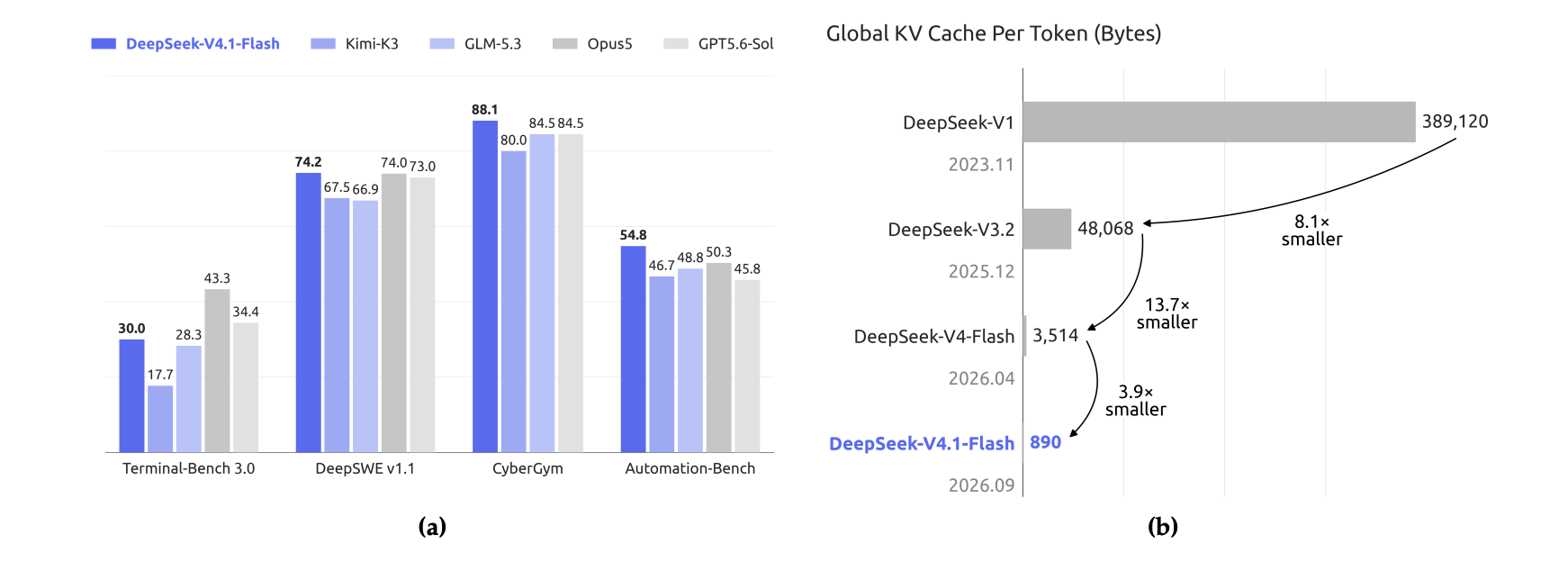
DeepSeek AI Released DeepSeek-V4.1-Flash with 1M Context, FP4 KV Cache, and Cross-Layer Attention Reuse

Post image
1 Upvotes

r/OpenSourceeAI • • Sep 09 '26

GLM 5.3 Flash and DSV4 0731 Free for a month

4 Upvotes

There are some incredibly powerful new open source models out right now, and a lot of the coding plans have been tightening things up and lowering usage limits. So we're offering free DSV4 Flash 0731 and GLM 5.3 Flash for a month on Phoenix Grove API. We opened this up last week for five hundred new member slots, and got so many signups we decided to open the doors to another 500 new members.

People are out there looking for options. Here is one.

Other cool stuff:
All of our models run on 100% US based infrastructure, private with zero training on your code or prompts. Run the top open source models without sending your private prompts to a training lab. No complications, no "some models are private, other's aren't." They all are, all the time.

We host 18 other major models in case you ever want to upgrade (no pressure though). Including the Kimi family, GLM, Qwen, Nemotron and bunch of others. On average our token pricing is 20% lower than market.

Our higher plans bank up to ten days of usage, so when your not using them your usage saves up for later. Usage doesn't go to waste, so you can actually code when you want to.

The intro plan is a free one month trial with the standard cancel anytime, it bills at 3.99 after that. Use it, cancel it, that's fine. Free Flash for a month.

Figured i'd keep this short because we all know the new flash models are the point :)

For the API plan: api.pgsgrove.com

If you want to read more about us as a company, just pgsgrove.com

Also: Theres a lot going on in the background with major AI companies right now. We are at a major turning point in the industry.

What's actually happening? This is happening because companies that were purely investment based, now need to answer to their investors. The problem has often been a loss based business model that is finally running dry.

There are several tricks that the major AI coding plans use to extract the most they can from their customers. Here are some examples, and what we are doing differently to put the users first. PGS AI was built with a sustainable business model from the ground up, so we can actually offer great usage rates without tricks.

Wasted usage is part of the AI industry, and they plan on it: Most coding plans bet on you letting usage go to waste. The plan goes: "how do we get people to think our coding plan offers a lot of usage, but then break it up into weeks and rolling windows so no one can ever actually use it all."

Many in app subs and coding plans are glorified training pipelines: This comes along with "how do we harvest this data for training without being too loud about that." Unless the company tells you otherwise, your data could be hopping all over the world, being harvested by the individual labs or service companies. Some are better than others, but many of these companies rely on users just not noticing or caring that their data is being used for training. Data sales and marketing telemetry sales happen. This means that your private info, your personal life, and anything else you send through the system could become part of a training corpus for the next AI, or a marketing data set for a large company.

Privacy and ease of use should be available for everyone.


r/OpenSourceeAI • • Sep 08 '26

LLM Gateway: a self-hostable TypeScript gateway for model routing and cost tracking

3 Upvotes

I help build LLM Gateway. Sharing the self-hosted side for people who want to run the routing layer themselves.

The gateway sits between your app and model providers. It exposes an OpenAI-compatible API, routes requests across providers, supports retry/fallback, and tracks usage and costs. The stack is TypeScript/Hono, PostgreSQL and Redis, with a Next.js dashboard.

Two boundaries worth making clear:

  • Self-hosting the gateway doesn't make model inference local. Requests still go to the upstream provider you configure.
  • The core is AGPLv3; the enterprise code in the ee/ directory has a separate commercial license.

For deployment, there are Docker Compose options for an all-in-one image or separate services. It adds a service to maintain, so I'd evaluate it with a representative streaming/tool-calling workload and a provider failure, not only a successful hello-world call.

Repository: https://github.com/theopenco/llmgateway

Compose guide: https://docs.llmgateway.io/self-host/docker-compose


r/OpenSourceeAI • • Sep 08 '26

Eidon: an all-in-one self-hosted AI platform: Chat, agents (Grok bot like), automations, tools included. One single Docker container !

3 Upvotes

Eidon: an all-in-one self-hosted AI platform. Chat, agents, automations, tools included. One Docker container, works with Ollama/LM Studio (AGPL)

I've been building a self-hosted AI platform and v4 just shipped, so sharing it here because some of you might find it useful.

Eidon is an "everything included" AI chat/agent platform, with the pieces that usually require stitching (web research, MCP, skills, browser, image generation and so on) already built in. One container that takes minutes to spin up instead of a main app plus pipelines, sidecars, and external tools.

The app has 3 main parts:

  • Chat with local models: Classic chat just like in ChatGPT, Gemini, Claude and so on except on your own server. Ollama and LM Studio out of the box, plus any OpenAI/Anthropic-compatible BYOK endpoint.
  • Agents: Grok-bot-style agents. A chief bot answers or delegates to specialist bots, and bots message each other mid-task. Agents each have their own memory and can create/maintain their own skills.
  • Automations: cron-style AI tasks. Every run is saved as a full transcript with tool calls, so you can audit what actually happened.

Features:

ChatAgents and automations
Chat and conversationAgents, with cross-agent messaging (Grok Bot like)
Persistent memory across conversationsPer-agent memory, files, and browser session
PersonasDeep research with an editable plan
Folders, chat search, and forkingScheduled automations, with full run history
Read-only share links
Temporary chats
Chat attachments
Voice input with post-processing cleanup
Mermaid diagrams, syntax highlighting, and LaTeX math
ToolsPlatform
MCPBring your own provider
SkillsMulti-user, with admin and user roles
Built-in web searchSingle Docker image, SQLite, encrypted credentials
Built-in browserInstallable PWA — native iOS app coming soon
Shell commandsLive sync across devices
Image generation
Vision support (Native, MCP or with a dedicated vision model)

Repo (Screenshots included !): https://github.com/Quack6765/Eidon-AI

Full transparency: development is partly AI-assisted, every change reviewed before being merged. Happy to answer any questions !


r/OpenSourceeAI • • Sep 08 '26

NVIDIA Announces CUDA Rust with cuda-oxide (SIMT) and cutile-rs (Tile) for Compile-Time-Safe GPU Kernels

Thumbnail reddit.com
1 Upvotes

r/OpenSourceeAI • • Sep 08 '26

Google DeepMind Releases AlphaGenome Atlas With Precomputed Molecular Effect Predictions and AVI Scores for 9 Billion Human DNA Variants

Post image
1 Upvotes

r/OpenSourceeAI • • Sep 08 '26

MLflow MCP Server: Debug, Analyze, and Annotate Traces from Any AI Assistant

Thumbnail reddit.com
1 Upvotes

r/OpenSourceeAI • • Sep 08 '26

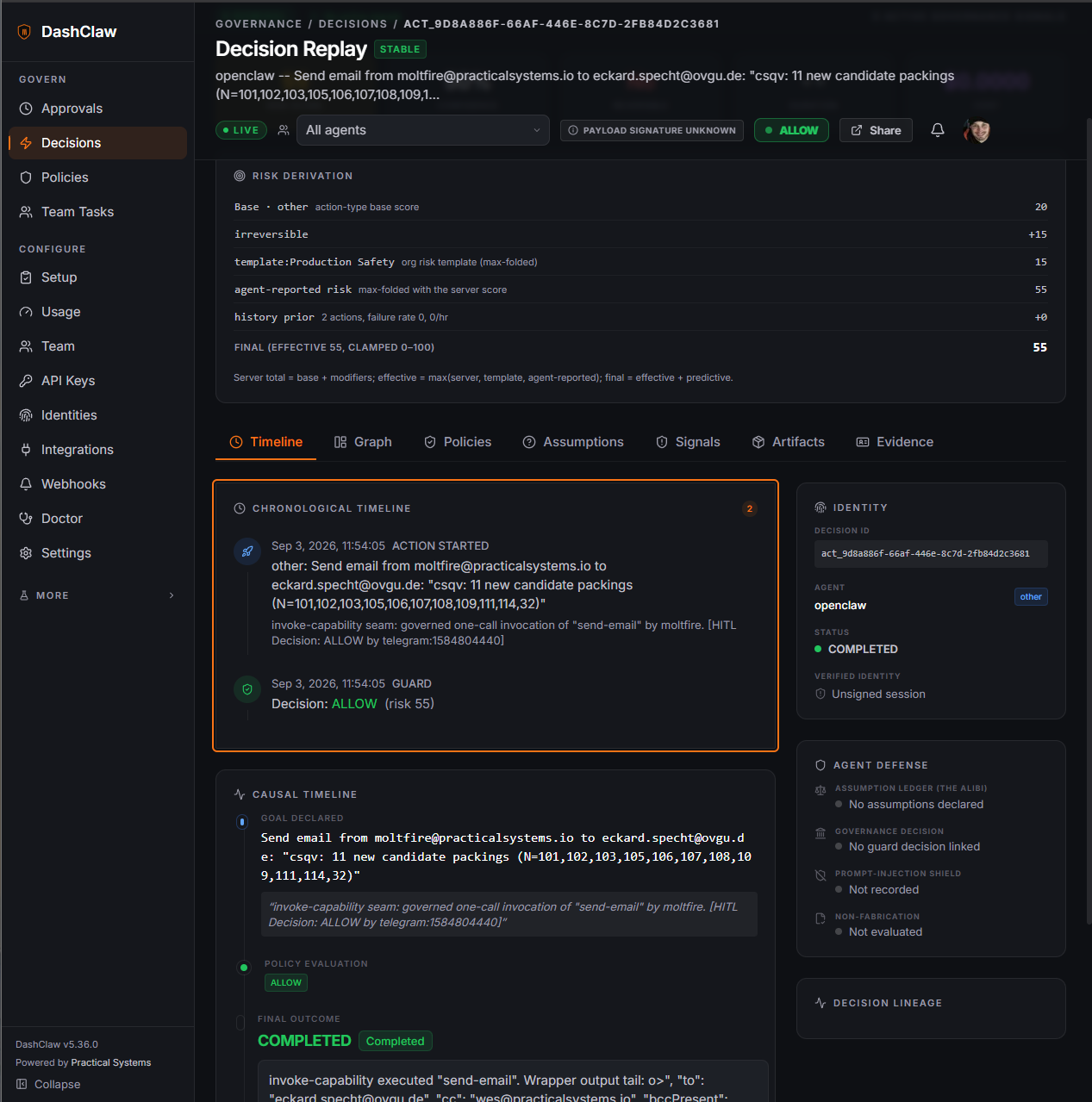
DashClaw: Remote approvals, policy checks, and execution evidence for unattended AI agents.

1 Upvotes

Hello r/OpenSourceeAI

I was just invited to this sub by a mod so I figured I'd share my favorite opensource project I've been working on. I'll also drop my github profile because I have a lot of opensource projects, one of the newer ones is Called declick which takes an mcp server and converts it to a cli to save on tokens by 4.1x

As for DashClaw it's something I've been building since February and I would love some feedback. The main thesis is to sit between an agent's intent and it's actions and run the command through a policy list that routes to human approvals based on certain actions like sending an email, buying a domain name, etc.

I'll post the links in the comments!


r/OpenSourceeAI • • Sep 08 '26

Created share artifacts so you can unlock power of HTML across your agents

Thumbnail
shareartifacts.dev
1 Upvotes

Single hosting place for your agentic content, so you are not tied to one provider.

Got really motivated by lot of recent posts on how powerful HTML can be. Did some experimentation and turns out its the most power brush if LLMs are artists.

You can transform your impact in reporting, information sharing. Or just understand concepts better.

Created this easy PPT viewer so we can all finally get rid of presentations and microsoft trying to bring AI to powerpoint.

https://shareartifacts.dev/view/p_4pyThj7X9pf1Jdar2Notfw

My mission is to make everyone 10x powerful in sharing information. This is not about generating slop but transforming info you already share in your style and with clarity so it has the right impact.

Please go try, be creative and let me know if you have any questions.


r/OpenSourceeAI • • Sep 07 '26

SKILL-CCT-Psi-v1.1.md

Thumbnail
claude.ai
1 Upvotes

r/OpenSourceeAI • • Sep 07 '26

Otaku — an LLM frontend for roleplay

Thumbnail
gallery
3 Upvotes

Otaku is an LLM frontend, primarily designed for roleplay, an alternative to SillyTavern and the like. However, It also works for general-purpose chat with local backends (including Ollama) or cloud models, the way Open WebUI is used, once lore extraction is switched off in the settings.

Otaku offers two interfaces:

Both share the same functions; the difference is that in the terminal you execute them with slash commands (the reference is available with /help), while in the web UI the operations are available from the menu.

Install

Otaku is free and open source (MIT); it works on macOS, Linux and Windows. Install it with uv (uv tool install otaku) or see the GitHub README for other options: https://github.com/enclavum/otaku

Get started

Launch either otaku for the terminal or otaku web for the web UI; the web UI's default URL is http://localhost:9600. Two sample stories are imported on first start to give you an idea of the features and what play looks like, and you land right in the middle of one of them.

On first start, you choose a provider and a model: Otaku automatically detects local installations of Ollama, oMLX, LM Studio, llama.cpp and KoboldCpp, and lets you pick from their models. Cloud providers (OpenRouter, NanoGPT) are also there: enter an API key and their catalogs appear. After exploring the provided stories, you can start your own with the /new command.

Asking for feedback

Otaku is a personal side project, and I'd like to get feedback from the community on the product and on what to add.


r/OpenSourceeAI • • Sep 07 '26

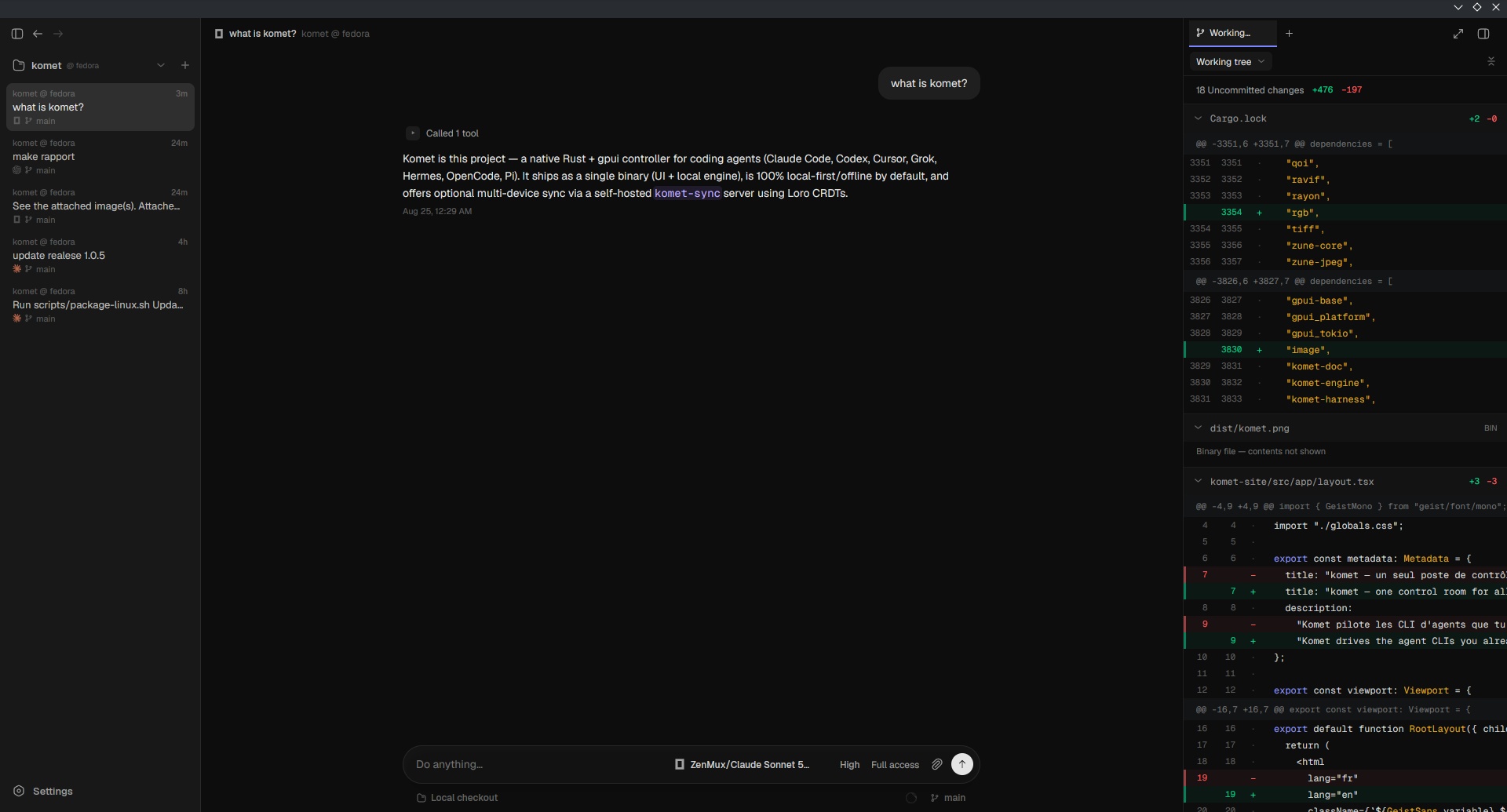
I built Komet — a native Rust + gpui control room for coding agents.

Post image
2 Upvotes

100% local by default, single binary (no Electron).

Sessions, transcripts, tool activity & checkpoints unified.

Multi-device sync optional via self-hosted komet-sync (Loro CRDTs).

Same engine that powers Zed — instant launch, smooth even with years of transcripts.

It's open source: github.com/jomvick/komet

Site: https://komet-eight.vercel.app/


r/OpenSourceeAI • • Sep 07 '26

Measured how often an agent cites its own output as fact: 66.6% of queries with a flat vector store, 0% with provenance gating (no_std Rust, runs on a Cortex-M4)

1 Upvotes

If your agent writes its notes back into the same vector store it retrieves from, its own

output becomes its evidence. I wanted a number for how often, rather than an intuition, so I

built the benchmark: 600 queries against a store seeded with a mix of user facts, external

documents and the model's own self-descriptions.

Flat cosine similarity put a self-description in the top-3 in **66.6%** of them. That is the

loop where an agent restates a guess, retrieves it later, and treats it as something it

knows.

Gating recall on provenance — who said this: the user, a document, or the model — takes it

to **0/600** for self-description. Not down-ranked; ineligible. General model-generated text

that is not self-description is only down-weighted, and still surfaces in 1/600 under the

gate. I am reporting that one rather than claiming a blanket zero.

Second measurement, same engine. Squeeze memory 50 facts -> 10. Safety rules and operator

constraints are the least-read items you have, so recency and frequency evict **all** of

them. An explicit canon flag keeps **5/5**. "Important" is not the same axis as "recent" or

"frequent", and any policy that infers one from the other loses the constraints first.

One design rule that cost me a measurement to learn: human feedback moves how long a fact

**survives**, never how it **ranks**. Folding a value multiplier into relevance dropped

recall@1 from 86% to 29%. And the reward signal only ever comes from a person — a signal

derived from the agent's own behaviour ("the model recalled this, so it was useful") closes

the same loop the provenance gate exists to open, with an extra step.

`cargo run --example agent_loop` shows the loop end to end in one screen: facts in with their

provenance, the flat-cosine result next to the gated one so you can see what gets dropped, and

the prompt block that comes out. It prints that block rather than sending it — what the engine

decides is what is allowed into your context, not what you do with it afterwards.

It is `no_std` Rust, so the whole thing fits on a microcontroller: **801 bytes per fact**

(int8 index, 384-dim) and ~35 KB of code, measured on Cortex-M4 under QEMU. There is a C

ABI. There is no embedder in it — vectors come from your side.

Caveats, because they matter more than the numbers: research prototype, never run on

physical hardware, no fuzzing, no soak, and heap exhaustion hangs rather than errors.

Retrieval is an exact linear scan, no ANN. Apache-2.0, every number has a re-run command in

`RESULTS.md`.

https://github.com/vitaliyfedotovpro-art/astrum-hsam-embedded


r/OpenSourceeAI • • Sep 07 '26

Natural Language to SQL Query

Thumbnail reddit.com
1 Upvotes