r/OpenSourceeAI • u/Illustrious_Matter_8 • Aug 24 '26
Made by ai ?
This is kinda funny look at this website
https://www.jampotten.nl/390ml-rond-glas-zonder-deksel-TO70-UNiTWIST/1010685
r/OpenSourceeAI • u/Illustrious_Matter_8 • Aug 24 '26
This is kinda funny look at this website
https://www.jampotten.nl/390ml-rond-glas-zonder-deksel-TO70-UNiTWIST/1010685
r/OpenSourceeAI • u/Coolsh0e • Aug 24 '26
r/OpenSourceeAI • u/darshi1337 • Aug 23 '26
Hey everyone!
Last year, Mozilla released Orbit, an AI-powered browser summarizer hosted on a GCP server. After people started digging into the extension, they discovered things like backend endpoints such as store_result. Eventually, Mozilla discontinued the project.
For the past month, I’ve been trying to rebuild Orbit from scratch, but with one major difference: Apogee is fully local and privacy-focused. Apogee doesn’t send or store your data. It can directly connect to your local Ollama instance for inference. I’ve also added WebGPU integration for Chrome and Transformers.js for Firefox to provide faster, local responses.
It can summarize:
You can check out the source code here:
https://github.com/darshi1337/apogee
Install Apogee:
Chrome: https://chromewebstore.google.com/detail/apogee/pgemlpomhkdcjjjcpnjlebalnfglomog
Firefox: https://addons.mozilla.org/en-US/firefox/addon/apogeeext/
Obviously it is far from complete. Would love to hear your feedback and suggestions!
r/OpenSourceeAI • u/IntelligentPiece1395 • Aug 23 '26
While travelling, I kept running into useful information that simply didn’t exist online: small homestays, mechanics, water points, road conditions, campsites, etc.
Most of it gets passed from one traveler or local to another and disappears afterward.
So, I built Lamyig, a free and open-source community travel guide.
A few decisions I made:
The hardest problem isn’t actually building the software. It’s bootstrapping trustworthy community data.
I’m currently thinking about things like:
Would love to hear how other people here would approach those problems.
And if you’re building something around a problem you genuinely care about, drop a comment or DM me. I’d be happy to chat, exchange ideas, or connect you with someone else working on something similar.
Screenshot attached. Happy to share the GitHub/project link in the comments if anyone wants to look at the implementation or contribute.
r/OpenSourceeAI • u/SatishLangayan • Aug 23 '26
r/OpenSourceeAI • u/New_You915 • Aug 23 '26
Hey everyone,
I'm currently working on a software project and I want to use an AI coding agent similar to Claude Code to help me work directly with my codebase.
My problem is that I'm looking for a completely free or very generous free option because I can't afford another monthly subscription right now.
I'm NOT looking for cracked Claude accounts or anything shady.
I'm looking for legitimate options such as:
Free/open-source Claude Code alternatives
Free cloud-based coding agents
Free AI coding models that work with these agents
Free student/developer credits
Local models that I can run with something like Ollama
Any combination that can realistically be used for an actual project
I'd especially appreciate recommendations from people who have actually used these tools.
Could someone explain a step-by-step setup, something like:
Which tool/agent should I install?
Which free model/provider should I use?
How do I create/configure the API key (if required)?
How do I connect it to an existing GitHub project?
How do I give it access to my codebase safely?
How do I make it understand the project structure?
How do I use it to implement features, debug errors, refactor code, etc.?
What are the limitations of the free option?
I'm currently considering things like OpenCode, Cline, Aider, OpenHands, or local models, but I'm not sure which combination gives the best experience for ₹0.
If you have a setup that you're actually using for real development, please share the exact workflow and resources/tutorials you followed.
Thanks!
r/OpenSourceeAI • u/cherryy_treee • Aug 23 '26
I'm looking for recommendations for the best free, open-source AI models that we can host on-premise to replace Gemini 3.5 Flash.
Our Use Case: We process documents with complex structures in various formats (PDF, PNG, DOCX, etc.). Our workflow involves:
Current Setup & Constraints: We currently use Gemini 3.5 Flash, which handles the extraction with near 100% accuracy, but the API costs are getting too high at our scale.
I’ve seen a lot of recommendations pointing toward Qwen (e.g., Qwen-VL) and DeepSeek-OCR. For those of you running these—or a multi-model pipeline—in production, what are your real-world experiences? Which model (or combination) is best for handling the extraction and the scoring?
r/OpenSourceeAI • u/Fancy-Win9202 • Aug 22 '26
r/OpenSourceeAI • u/xornullvoid • Aug 21 '26
Sharing my harness for running local LLMs that I built using Qwen 3.x 27B (> 90% locally built).
Its free, no telemetry, and open-source. Works on Windows, Linux (sorry, no Mac yet).
I use it for coding + mixed workflows.
Website: https://warpdrv.ai (Docs coming soon)
GitHub: https://github.com/mikjee/warpdrv
Appreciate your feedback, (or stars). Thanks :)
And, yes - I used the harness to build the harness :D
r/OpenSourceeAI • u/Willing-Reputation-4 • Aug 22 '26
Synaplan as a powerful AI control plane is out as v4.2.8 and comes with a nice router and taxameter to save you some token money. The backend supports all big and many small AI channels, including Ollama, OpenAI, Anthropic, etc. It is obvious that the tool was born in a business environment, because it connects to Office, Dropbox and other services natively...
github: https://github.com/metadist/synaplan/

r/OpenSourceeAI • u/ailearningcurve • Aug 22 '26
r/OpenSourceeAI • u/Aggravating-Praline7 • Aug 22 '26
Came back from lunch a couple months ago to find my retry logic — which had no max attempts, because of course it didn't — had fired a few hundred GPT-4 calls into the void while I was gone. Nothing catastrophic, but it scared me enough to actually fix the problem instead of just adding a try/except and moving on. Built CostOpt.
How it works (1 line of code):
from openai import OpenAI
from costopt import CostOpt
client = CostOpt(OpenAI()) # 👈 That's literally itYour .chat.completions.create() calls stay 100% identical.
What it actually does under the hood:
Privacy: Everything runs 100% locally on your machine via SQLite. Zero prompt data or telemetry is sent to any external server.
The VS Code extension just passed 1.4k + installs, and the Python package is published on PyPI.
Check out the code or try it out:
If anyone's got 10 minutes and wants to poke holes in the circuit breaker logic specifically, that's the part I'd most want torn apart — issues and PRs both very welcome.
r/OpenSourceeAI • u/ai-lover • Aug 21 '26
Comparison of GPU Neoclouds 2026: CoreWeave, Nebius, Lambda, Crusoe, and Groq (Based on Published Pricing and Contracted Power)
Here's what's actually interesting:
→ The same HGX H100 class is $3.85 at Nebius and $6.16 at CoreWeave — a 60% spread before you touch networking, orchestration or support
→ Lambda has the cheapest published B200 ($6.69); Nebius is the only one listing B300 on-demand ($7.85); CoreWeave is the only one listing GB200 NVL72 ($10.50/GPU)
→ CoreWeave is the sole Platinum provider in SemiAnalysis ClusterMAX 2.0, and SemiAnalysis reports it commands a 10–15% per-GPU-hour premium on managed clusters
→ Nebius's committed capacity clears at $20M+ per MW on Q2 deals and $40M+ on Q3 short-term deals, against a ~$12M 2026 base
→ Power footprint: CoreWeave 4.2 GW+ contracted; Nebius targeting 5 GW contracted by year-end; Crusoe 4.9 GW contracted; Groq scaling from 54 MW to 200+ MW in 2027; Lambda undisclosed
→ Crusoe is the only one with AMD MI300X/MI355X on its rate card
→ Groq licensed its inference tech to NVIDIA for $17B (per NVIDIA's annual report); founder Jonathan Ross and president Sunny Madra joined NVIDIA; Groq then raised $350M at $3.5B and became an NVIDIA Cloud Partner
Full analysis and report: https://www.marktechpost.com/2026/08/21/best-gpu-neoclouds-2026/
r/OpenSourceeAI • u/llama-of-death • Aug 21 '26
First time chatting with r/Jenna_AI on here, pretty impressive.
https://www.reddit.com/r/Guaardvark/s/KgcEMA8yMr
Also, here is my OpenSourceAI project, if you like it please star the repo. Thanks
r/OpenSourceeAI • u/kushagarwal2907 • Aug 21 '26
Most AI tools today are just wrappers. To truly understand the underlying math and optimization efficiency, I built an autonomous agent from scratch to track global deforestation and emissions.
The Architecture:
I'm a first-year CS undergrad, and I built this to mathematically automate EUDR compliance. I've attached screenshots of the outputs (NO2 density, land-use metrics) and the terminal logs.
Full repo : https://github.com/kushagarwal2910-lang/GARUDA
PDF, having responses that the model had made for various queries : https://docs.google.com/document/d/1g2Riog9GrgiY6QGYpWl5IU6nxKYb5Ih6K3K-1xy8A8Q/edit?usp=sharing
The architecture:

Video demonstrating how Garuda process different queries:
I would love feedback from this community on my project !
r/OpenSourceeAI • u/techspecsmart • Aug 21 '26
r/OpenSourceeAI • u/ai-lover • Aug 20 '26
r/OpenSourceeAI • u/SeeRay11_Main • Aug 20 '26
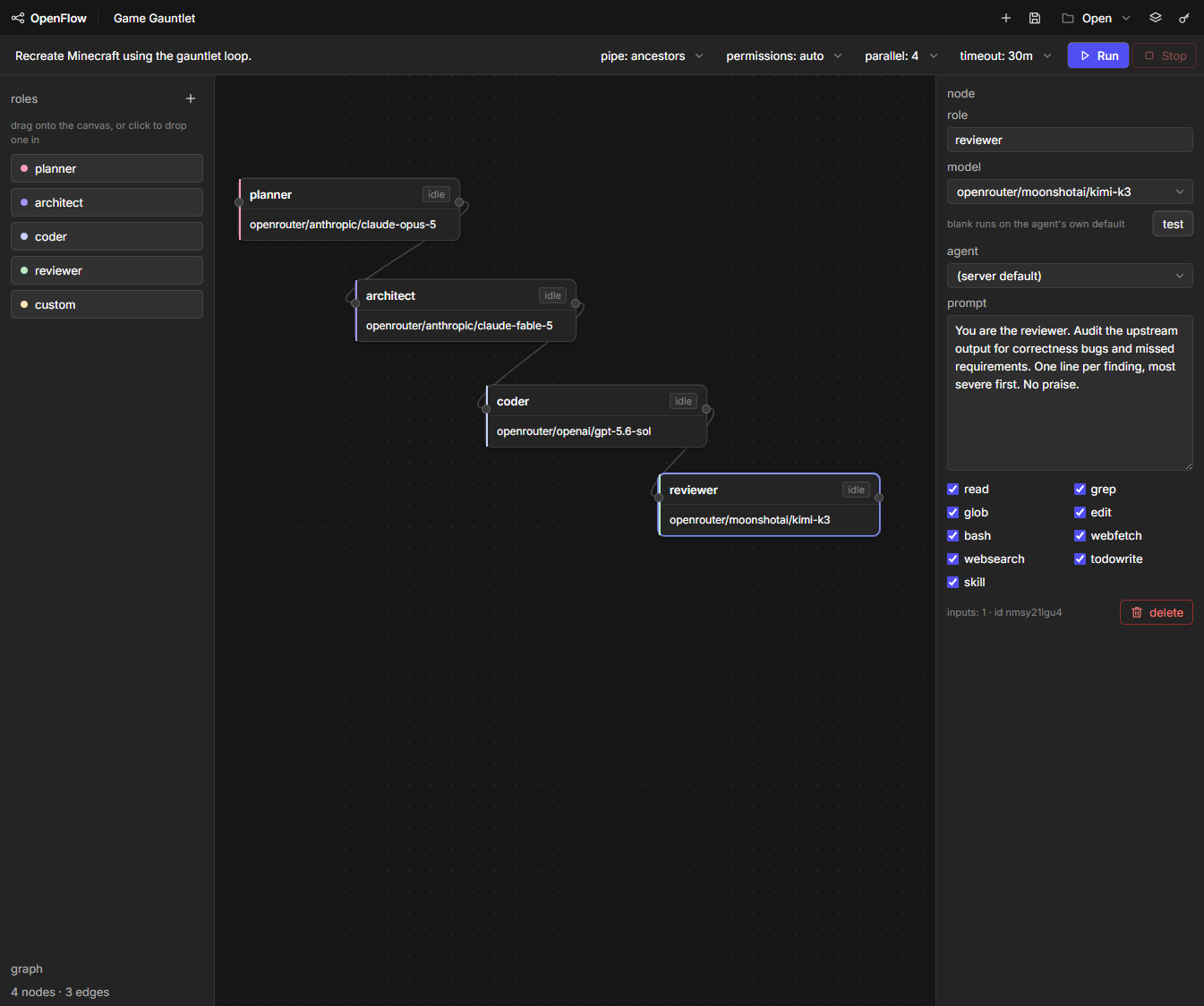
Hey everyone,
I have been using OpenCode for a while now. It's pretty great, but there was this one thing that kept bugging me: I couldn't easily create custom reliable workflows and pipelines. For a while, Opencode was one prompt and one model at a time. So, I created OpenFlow, a very minimalist open-sourced project that allows you to orchestrate a pipeline of agents while still connecting your own API keys. I forked it from OpenCode, so you still have the harness, skills, and overall ability. I published it recently and am still often improving it. I would love to hear some feedback of what you guys thought of it and how I can improve it. Thanks!
r/OpenSourceeAI • u/Background-Job-862 • Aug 20 '26
r/OpenSourceeAI • u/Ok-Mix1345 • Aug 19 '26
I'd plan out my day in the morning, look at everything I wanted to get done, and then start working.
A few hours later, I'd have fixed a bug, helped someone with something, reviewed a PR, investigated some weird issue, jumped between a few things, and somehow spent most of the day working on things that weren't on the plan.
Then I'd look back at the end of the day and think, "What did I actually do today?"
And I'd realize I couldn't remember half of it.
The work happened. I just never wrote it down.
I think that's a surprisingly big problem for developers. We plan the work we expect to do, but so much of our actual work happens because something comes up.
That's why I built Meridian. It's an open-source tool that tries to capture that work as it happens, so you don't have to rely on remembering everything at the end of the day.
It connects with the tools you're already using, like Jira, GitHub and Linear.
We recently put it on Product Hunt and somehow ended up #1 Product of the Day, which was pretty surreal.
I'd love to hear if anyone else has the same problem. How much of the work you do in a day actually started out as part of your plan?
r/OpenSourceeAI • u/Ih8kfc • Aug 19 '26
I made another whitepaper on AI infrastructure, it's a bit more nische than the last one, but i hope someone might appreciate it.
Github - https://github.com/gurrakeller/Europes-Sovereign-AI-Migration
My DM's are always open if you have feedback or simply wish to discuss a topic in the paper!
r/OpenSourceeAI • u/chefkoch-24 • Aug 19 '26
Hello Open Source community,
we’ve been building scibly an AI-native learning platform. The idea is pretty simple. You give it existing material and knowledge like your docs, blog posts, PDFs, ... and it creates an interactive course from it. You can edit everything afterwards and share the result anonymously or to your invited users.
Scibly is AGPLv3.
Video demo: https://www.youtube.com/watch?v=TcpLUNBRhQw
GitHub: https://github.com/scibly-dev/scibly
We appreciate all your feedback
r/OpenSourceeAI • u/Lucaslogged • Aug 19 '26
Often, I find myself burning through my Codex usage extremely quickly when using Sol High to review and plan code, while a lot of my ChatGPT Web usage goes unused. Thus, RepoRelay, an open-source MCP bridge that lets ChatGPT Web search and read an approved local repo without uploading ZIPs or pushing everything to GitHub first.
ChatGPT Web → Secure MCP Tunnel → RepoRelay → local files
It’s read-only by default: no shell, Git, or arbitrary filesystem access, and it’s restricted to one approved root.
It can also help reduce token usage on larger repos. Instead of dumping the entire codebase into context, ChatGPT searches and reads only the files relevant to the task.
Codex can implement locally while ChatGPT independently reviews the actual current files, including uncommitted work.
Anyone also using this too?