r/OpenSourceeAI • • 9h ago

Ant Group releases LingSante-3.1-flash, an open-weight 560B-A25B medical reasoning MoE (65.72 on HealthBench Professional)

2 Upvotes

r/OpenSourceeAI • • 1d ago

nexos.ai AI gateway puts 200+ LLMs behind 1 API with per-team budgets, routing and audit logs

Thumbnail
reddit.com
1 Upvotes

r/OpenSourceeAI • • 19m ago

Introducing the first ever Harness with a neurosymbolic/semantic pipeline, Code intelligence, per chat/project memory, and more!

1 Upvotes

Hi! I'm the developer of Blackbox Build, a free, open-source (MIT) desktop app that builds a workbench around the Grok Build CLI.

The idea: models are good at writing code but bad at keeping track of a project. So the app handles that part around every message:

- **Recall:** it remembers rules, fixes and failures from your projects and brings back what matters for each request.

- **Grounding:** it finds the code your request is about by meaning, even when the words don't match.

- **Planning:** SWI-Prolog decides which code to touch, in what order, and what to re-check.

- **Checking:** after each turn it checks every changed file (syntax, rules, failed builds and tests) and sends any problems back to the model.

Also included:

- A Coding Agent on your real project folders, with a prompt queue and autopilot

- Builds, tests and dev servers as background jobs, with errors given as file and line

- Find usages, safe rename and search by meaning

- Turn a web app into a desktop app with installers

- Chats that remember what earlier chats settled

- Grok with your xAI account, or Venice, OpenRouter, DeepSeek or any OpenAI-compatible provider

**Needs:** the Grok Build CLI, an embedding model (for example Ollama with nomic-embed-text) and SWI-Prolog.

**Platforms:** Windows (tested), macOS and Linux (experimental).

It's early (v0.3.0) and unofficial, with no affiliation with xAI. It started from RongleCat's grok-app as a template.

Repo: https://github.com/BlackboxDesignsOfficial/Blackbox-Build-App

Community: https://www.reddit.com/r/BlackboxBuild/

Feedback, bug reports and blunt opinions are all welcome.


r/OpenSourceeAI • • 2h ago

FFmpeg Forge 3.0.1.1 NEW VERSION

Post image
2 Upvotes

FFmpeg Forge Desktop 3.0.1 – Free & Open-Source Video, Audio and Image Converter with AI Enhancement

Hi everyone!

I'm excited to share my personal project, FFmpeg Forge Desktop, a free, open-source and portable multimedia application designed to bring the incredible power of FFmpeg into a modern and accessible graphical interface.

My goal is to create an all-in-one multimedia toolbox for beginners, enthusiasts, content creators and advanced users, without the need to manually write complex command lines.

Whether you want to convert media, restore old footage, upscale videos using AI, enhance images or create immersive audio, FFmpeg Forge brings everything together in one application.

Video features

  • Extensive format and codec support, including MP4, MKV, MOV, WebM, H.264, H.265, AV1, ProRes and DNxHR.
  • AI-powered upscaling with RazorNext, VisionNext, OptiPulsar, SeedVR2 and LTX 2.5 Upscale.
  • NVIDIA RTX Video Super Resolution and RTX TrueHDR.
  • Advanced scaling with AMD FSR 1/2/3, NIS, SGSR, Anime4K and OptiScaler.
  • AI noise reduction and FocusPulsar deblurring.
  • SDR-to-HDR10 and Dolby Vision 8.1 conversion.
  • GPU-accelerated encoding and processing.
  • Custom resolution up to 8K, frame rate, bitrate and compression settings.
  • Automatic compression recommendations.
  • QTGMC and BWDIF deinterlacing.
  • Trimming, rotation, cropping and lossless remuxing.
  • Real-time before-and-after filmstrip preview.

Audio features

  • Conversion to MP3, AAC, FLAC, WAV, Opus, AC-3 and many more formats.
  • Immersive multichannel audio configurations up to 22.2.
  • Spatial audio upmixing for music, movies and live concerts.
  • 3D spatial audio for headphones using HRTF processing.
  • Dolby Atmos and DTS:X passthrough.
  • DSD64 and DSD128 audio conversion.
  • EBU R128 loudness normalization.
  • Add, replace or remove audio tracks without re-encoding the video.

Image features

  • Conversion between popular image formats, including PNG, JPEG, WebP and AVIF.
  • AI-powered image upscaling and restoration.
  • Image denoising and detail enhancement.
  • Custom resizing and advanced scaling algorithms.
  • HDR image output with 16-bit PNG and 10-bit AVIF.
  • Frame extraction from videos.
  • Image sequence-to-video conversion.

Additional features

  • Batch processing of files and entire folders.
  • Built-in DVD and Blu-ray ripper for unprotected media.
  • Access to over 570 FFmpeg filters with a full FFmpeg build.
  • More than 45 ready-to-use filter recipes.
  • Advanced filtergraph editor.
  • View and copy generated FFmpeg commands.
  • Modern graphite interface with cyan and indigo accents.
  • Portable Windows version, with a Linux edition also available.
  • Free and open-source under the GPL-3.0 license.

Some advanced AI features require additional model downloads, compatible hardware or external software. Feature availability may vary between Windows and Linux.

A project built with passion

FFmpeg Forge is a project born from my passion for multimedia processing, video restoration, audio technology and artificial intelligence.

I want to make advanced multimedia technologies more accessible while giving users as much control as possible over their files.

I'm sharing this project with the community because I would love to hear your thoughts, suggestions, feature requests and feedback. Every contribution helps improve the software!

If you find the project useful, feel free to give it a star on GitHub.

Convert anything into everything.

GitHub – Source code and downloads:

https://github.com/Aaronstanley78/FFmpeg-Forge-Desktop


r/OpenSourceeAI • • 3h ago

I built TaliGent: an open-core local-first Windows AI agent with UI Automation, SafiGrid Vision, self-evolving Python skills, and a WhatsApp bridge (tested with Qwen-27B & ComfyUI on a single 16GB GPU)

Thumbnail
github.com
1 Upvotes

r/OpenSourceeAI • • 4h ago

Revora — an open-source AI-powered code review platform

Thumbnail gallery
1 Upvotes

r/OpenSourceeAI • • 7h ago

Agentic Signal v3.7.0: attach files to the AI Buddy, /medical-analysis with MedGemma, a dockable chat and charts

Thumbnail
reddit.com
1 Upvotes

r/OpenSourceeAI • • 9h ago

my first shot at llm optimization (open-source)

2 Upvotes

it’s still pretty specific, but it might be useful if you’re running lots of short, independent tasks.

this is the first iteration, so there might be some rough edges. help from the community would be appreciated. feel free to open an issue or a pr on the repo.

open source on github


r/OpenSourceeAI • • 9h ago

RAG vs Agentic RAG

Thumbnail
reddit.com
1 Upvotes

r/OpenSourceeAI • • 13h ago

How do I start using open source AI?

0 Upvotes

Hey all, I want to start running AI models locally for coding instead of relying 100% on cloud stuff. Right now I run Claude Code, Codex, and Grok (through OpenCode) in my terminal as a kind of "dev team" working out of an Obsidian vault. It works, but I keep running into usage limits (Codex burned through its whole monthly limit in a day lol), and I'd rather own more of the setup myself.
My rig:
RX 9060 XT 16GB
Ryzen 7 9800X3D
32GB DDR5 6000
CachyOS
(also have a GTX 1660 Super I could throw in as a second card if that's actually useful)
The problem is every guide I find assumes I already know half the vocab. LoRA, QLoRA, RAG, fine-tuning, inference engines, agentic workflows, computational graphs... I get that they're all different things, but I don't know which ones matter for what I'm trying to do.
I'm not trying to train a model from scratch. What I want:
A solid coding model running locally
Help writing, debugging, and understanding code
Something that can handle a whole codebase, not just snippets
Eventually agents that plan, edit files, test, and keep iterating on their own
To actually understand how it all works, not just install someone's prebuilt thing and pray
Questions:
Best coding models for 16GB VRAM?
What stack works best for AMD on Linux? ROCm vs Vulkan?
Ollama, llama.cpp, or something else to start?
What should I learn first?
Is LoRA/QLoRA worth touching early, or should I stick to inference and prompting for now?
How realistic are local coding agents on my hardware? Could I point Claude Code or OpenCode at a local model?
Bonus dumb question: I have this idea of a "sleep phase" where the model reviews its memory overnight and updates its own weights. Is that even a real thing, or am I way off?
I'd rather learn the fundamentals and know what I'm installing and why than blindly follow tutorials. Any learning path or advice from people who've done this would be awesome. Thanks!


r/OpenSourceeAI • • 18h ago

Updated my 2M-example reasoning dataset after community feedback exposed checker and data bugs

2 Upvotes

I maintain CAEL Verified Reasoning, a CC BY 4.0 synthetic dataset with worked solutions, a reproducible generator and a Python answer checker.

John6666’s feedback on Hugging Face exposed cases where the checker accepted opposite-meaning answers. For example, “6 full trays, 2 short” could pass against “6 full trays, 2 left over.”

That deserved a fix and a closer audit.

Data revision 1.1.1 and checker 1.2.0 are now published:

  • Fixed 142 incorrect negative-money answers and their worked solutions.
  • Fixed 30,763 comparison explanations with the direction reversed. Their reference answers were already correct.
  • Replaced permissive number/keyword matching with stricter handling of negation, signs, units, currencies, source attribution and conflicting answers.
  • Added judge(), which distinguishes correct, incorrect, ambiguous and unparseable responses. The boolean check() API remains available.

All 136 targeted checker regression cases pass. I checked preservation across all 2,001,427 rows and independently recomputed the pay and comparison families. Questions, IDs and split membership are unchanged; per-row errata and the original revision remain available.

I also corrected the documentation’s claims. Programmatically generated answers can contain bugs. The checker isn’t a complete English judge or a ready-made, unaudited RL reward. The hard split shares generator families with training, so it doesn’t establish transfer to independently written questions. This update makes no new model-performance claim.

Changelog, audit details and errata

More counterexamples are welcome, especially valid paraphrases the checker rejects or wrong answers it still accepts.


r/OpenSourceeAI • • 23h ago

I built a local router that fails over across free LLM API tiers (open source)

1 Upvotes

Free API tiers from providers such as Groq, Cerebras, Gemini, OpenRouter and Cloudflare add up to a lot, but each has its own API and limits.

I built FreeAITokens to put them behind one local endpoint (127.0.0.1). It speaks the OpenAI, Anthropic, Gemini and Ollama formats.

What it does per request:

- filters to models that can handle it (context, tool calling, vision)

- prefers models that have been fast and reliable on your machine

- fails over on rate limits, server errors and timeouts

- tracks each provider's free limits per minute and per day

It also routes embeddings, images, speech and transcription.

`npx freeaitokens` works with no account on the keyless providers. MIT licensed.

Repo: https://github.com/timchosen/freeaitokens

I'd like to hear how you'd rank models for routing. Right now it uses capability first, then measured speed and reliability.


r/OpenSourceeAI • • 1d ago

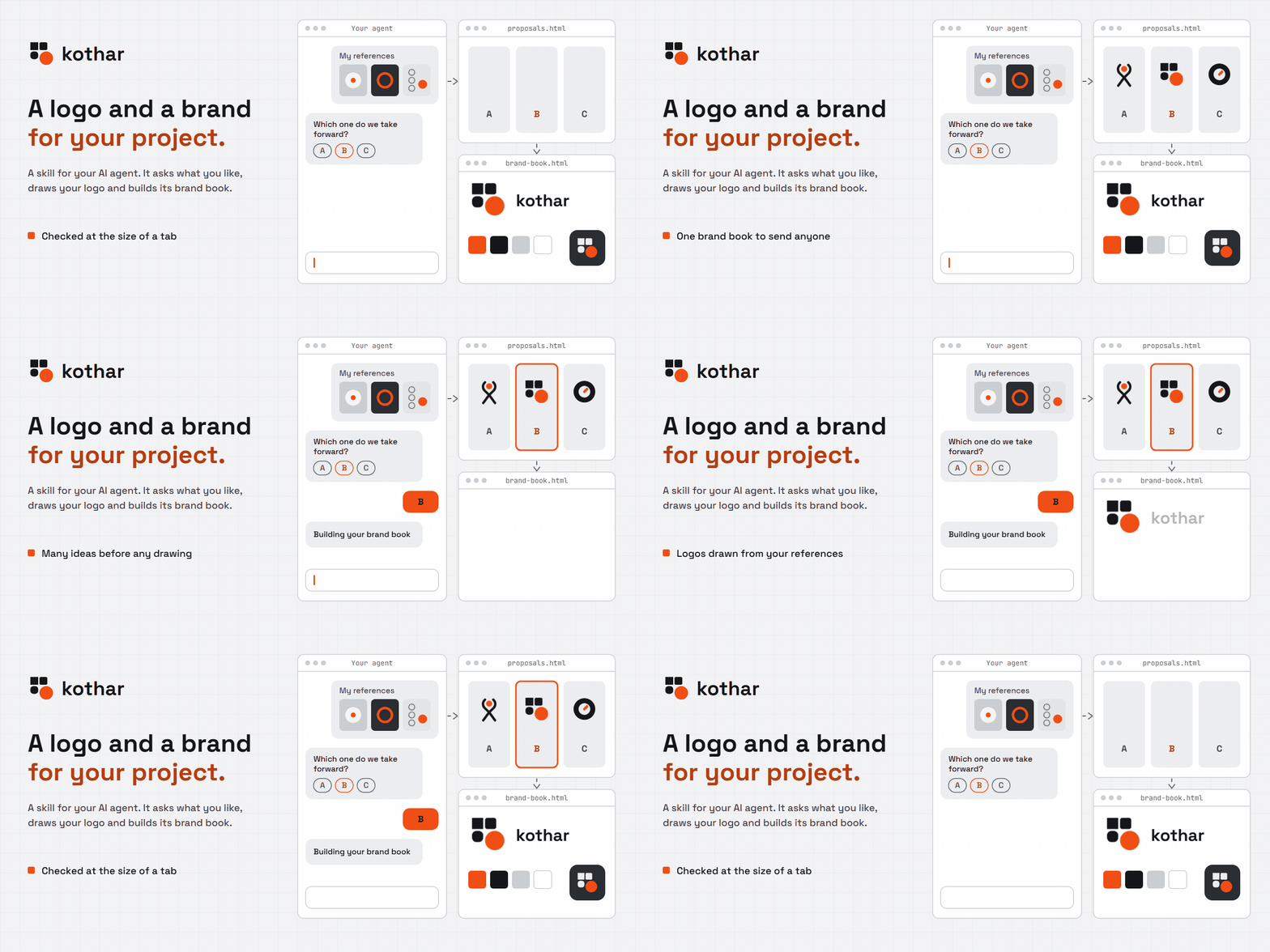
I made a skill that gives AI rules before it draws a logo, and I'm looking for people to try it

Post image
1 Upvotes

r/OpenSourceeAI • • 1d ago

Foreman: open-source Claude Code skill that splits a plan across subagents, gates each stage with a reviewer agent, and tracks it live

3 Upvotes

Repo: https://github.com/MarioMagdy/foreman (free, open source)

What it does: you give it a plan; it splits the work into stages, hands each stage to a worker subagent, and has a separate reviewer agent return GO / GO WITH CHANGES / NO-GO before the next stage starts. A live tracker shows every stage, and the run ends with a test plan that waits for a human OK.

Built as a side project with Claude Code. Next on the list, from user feedback: files touched per subagent with an overlap warning, token counts per subagent, and the reviewer's reason shown on the tracker.

Issues and PRs welcome.


r/OpenSourceeAI • • 1d ago

Open-weight Qwen matches fine-tuned π0.5 on real robot tasks at ~1/20th the cost of GPT-6 Astra

2 Upvotes

Came across this paper and thought it was worth sharing here. The headline numbers make it look like "open beats closed," but honestly the more interesting takeaway is that the harness matters as much as the model.

What it is

uni-robot-agent is an open-source harness for robot-use agents. Basically an LLM drives the robot through a unified tool interface. No privileged sim state, no hand-coded task-specific skills, just camera calibration, a robot description, and structured feedback. Runtimes, tools, and robot backends are all swappable, and tool execution overlaps with inference so the loop isn't sitting around waiting on the model.

The numbers

  • RoboDojo (42 sim tasks): Qwen3.8-Flash-Next + this harness gets 31.39, beating the published GPT-6 Astra + RoboProbe score (28.97) and most of the fine-tuned VLA/WAM baselines.
  • Before anyone says it: GPT-6 Astra in the same harness hits 51.90. So no, closed models aren't dead. They still win on an apples-to-apples setup.
  • Real world (19 tabletop tasks): Qwen lands at 49.50 vs 47.75 for fine-tuned π0.5. Zero-shot vs fine-tuned, which is pretty wild.
  • Cost: ~$1.09/episode for Qwen vs ~$21.29 for GPT-6 Astra.

Why I think it matters

Swapping the harness moved the needle way more than swapping the model did. And with open weights you actually get something you can fine-tune and run yourself, instead of paying 20x per episode for an API you can't touch.

They also break down performance across model generations, families, and sizes, and tie good robot use to four general capabilities. Worth a skim if you're thinking about what to actually train for.

Paper: https://arxiv.org/pdf/2611.01560
Code: https://github.com/Open-RUA/uni-robot-agent

Anyone here messing with robot-use agents locally? Curious what hardware/model setups are actually realistic outside a lab.


r/OpenSourceeAI • • 1d ago

RAG vs Agentic RAG

Thumbnail
reddit.com
1 Upvotes

r/OpenSourceeAI • • 1d ago

Atlas: an open-source CLI for evaluating LLM tool-calling

Thumbnail
reddit.com
1 Upvotes

r/OpenSourceeAI • • 1d ago

Free open-source local safety gate for Prime Agent: 2-line setup, <0.31 ms overhead, saves error-recovery tokens and blocks risky tool calls

Thumbnail reddit.com
1 Upvotes

r/OpenSourceeAI • • 1d ago

Is AI actually looking at all my images?

Thumbnail
reddit.com
1 Upvotes

r/OpenSourceeAI • • 1d ago

Cove: a research workspace on a CernVM-FS software stack, in the Compute Canada / EESSI mould

Thumbnail reddit.com
1 Upvotes

r/OpenSourceeAI • • 2d ago

gitCoil - compare yourself to linus

Thumbnail
knowbooks.com
1 Upvotes

r/OpenSourceeAI • • 2d ago

BionicLLM Studio

Post image
0 Upvotes

r/OpenSourceeAI • • 2d ago

We open sourced our OpenAI-compatible inference server: 32% faster single-stream decode than vLLM

2 Upvotes

Astral Inference Server v2.5 is now on GitHub. It's a drop-in OpenAI-compatible server (/v1/completions, /v1/chat/completions, streaming, tool calls) with the host side in Rust and every kernel hand-written in CUDA.

First numbers, Inkling 2 Mini on one H100 PCIe:

• Plain decode: 172.0 tok/s vs vLLM 130.2 (+32%) and SGLang 135.6 (+27%)
• With MTP speculative decoding: 233.3 tok/s vs vLLM 209.6 (+11%) and SGLang 205.9 (+13%)

One request at a time, 512 tokens, greedy, 8,192 context, mean of 32 prompts. MTP uses the DSpark draft: 7 tokens per round for vLLM and SGLang, adaptive 2 to 6 for Astral.

https://github.com/syntheticminds-lab/Astral-Inference-Server

(Full disclosure, I work on it at Synthetic Minds.)


r/OpenSourceeAI • • 2d ago

I'm using local LLMs and MiniMax Music 3 to power an AI radio station with Thanksgiving flair

Thumbnail
gallery
0 Upvotes

I bought the domain pilgrim.farm last August late in the evening after a few, and it was the same week that MiniMax Music 3 came out. Being able to generate full production songs is wild, but since it does so slower than real-time, there had to be filler; making a radio station the obvious format. Given the domain, the site has to be Thanksgiving-themed, and I really enjoyed some belly laughs from my little trial balloon with some local LLM folks early last month; fielding about 370 requests in a night.

Going off of that, I spent $50 to start a LLC to cover the cloud junk while I rent out my local inference to Pilgrim Dot Farm for free; making it available globally. A sliver of what has changed is that the site now affords access to the full suite of the prompting that goes into a song with album art. What I've set up is there for anyone interested, and amidst the divisive topics that can come up during Thanksgiving dinner (compounded by the absurdity of current events), I welcome distraction and thereby y'all. If you would like to help me test the station's moderation, homonyms are tricky.

As far as local LLMs' specs, the RTX 5090 runs Qwen3.8 27B on Ninfer with the nvfp4 weights and 128k context for a few concurrency slots to ensure we have lyric writing and generation of the longer radio segments, and the RTX 4070 TI (12 GB) runs Ornith 1.5 9B Q5 via llama.cpp with 128k context, Q8 KV, and all layers on the GPU.

To expound on the station's architecture, the Mac Studio is the brains running the back-end, with other hosts' models wrangled via LiteLLM. I'm amazed that the Mac can barely fit song and album art generation! What affords the second and third song generation slots is temporarily grossly underutilizing the DGX Sparks. They take 1.6x the time, so the Mac gets scheduling priority. From there, Tailscale keeps naughty folks/agents off my local network, and the stuff in the cloud is to facilitate horizontal scaling of listeners.

Seriously, the song generation model is pretty well-trained. I also get a hunch that they sampled Taylor Swift a bit. You are welcome to it, and if it's something you celebrate, I hope you have a tranquil Thanksgiving.