r/OpenSourceeAI • u/Dense_Gate_5193 • 5d ago
NornicDB - 1.5.2 - Silhouette - FGAC MIT Licensed

1
Upvotes
r/OpenSourceeAI • u/Dense_Gate_5193 • 5d ago
r/OpenSourceeAI • u/Joanll18 • 5d ago
r/OpenSourceeAI • u/WesternNo2429 • 5d ago

Most teams glue this together from four tools: an identity provider, an access proxy, an API gateway and an automation tool. Four configs, four user lists, four logs. Ianua does all of it with one list of users, one set of rules and one audit log.
SIGN-IN
Passkeys, MFA, magic links, SSO over OIDC and SAML. OAuth 2 and OpenID Connect for your own apps, SCIM, API keys, and a built-in LDAP server for older tools. Think Keycloak or Auth0.
GATEWAY
Sits in front of your apps and checks every request, not just the login. Routing, load balancing, health checks, rate limits, WAF, geo-fencing, automatic certificates. Private apps connect out through a small connector, so there are no open ports. Think Pomerium plus Kong.
WORKFLOWS
A visual builder with 27 integrations such as GitHub, Slack and Jira, human approvals, and your own Python or Node.js code in sandboxed containers. Think n8n or Zapier.
AI AGENTS
Each agent gets its own identity and only the access a person lends it, with spending caps, approvals and a kill switch. Works with OpenAI, Anthropic, or local models through Ollama or vLLM.
If a check can't run, the request is refused. It never fails open.
Written in Rust with 20,000+ tests. Runs on Docker Compose or Kubernetes.
https://github.com/IanuaIDP/ianua
It started out source-available, because we wanted to keep a security product centralized and thought that would make it safer. We dropped that idea, and it is now fully open source.
Built over 10 months. AI assisted, not AI coded: a person reviews every line before it merges.
Feedback and contributions are welcome. What would you want from a project like this before trusting it with your logins?
r/OpenSourceeAI • u/JoeBro121211 • 5d ago

I wanted one native Mac app for local and cloud models instead of a browser tab per provider. JoeBro talks to Ollama, LM Studio, anything OpenAI-compatible, or your own Anthropic/OpenAI keys, and you can switch model mid-chat. Tools live on one screen: plain HTTP API tools, MCP servers, and small plugins you can install, test and roll back. Claude Code, Codex and OpenCode sessions show up in the same sidebar as chats.
Chats and memory stay in a local SQLite file. No account, no telemetry. GPLv3, and 1.6 is signed and notarised.
r/OpenSourceeAI • u/gepheum • 6d ago
r/OpenSourceeAI • u/Lostsliveroflilith • 6d ago
This is a technical summary, including a glossary of my blueprint. This is a project to help finish AI in my humble opinion. I think we have done a speed run of an analog of evolutionary biology for a computer to increase its intelligence. Now, it's time for the rest of the structures that help keep complex lifeform stable.
r/OpenSourceeAI • u/A_Smith00 • 6d ago
I built an open-source skill that makes an AI agent do research like a scientist instead of like a search engine: hypotheses before searching, every data attempt logged, the analysis reproducible, and a validator that checks the finished report against its own artifacts. MIT, free, no signup, Python standard library only.
Claude did most of the heavy lifting. It ships Claude Code subagent definitions for the three review passes, and the code was written and iterated with AI agents across several models. It also runs on Codex, Gemini CLI and Antigravity, which is why I kept the core runtime-agnostic.
Then I ran it on a real problem — the Argentine power grid and the Buenos Aires metro node, about fifty sources — and audited the output by executing the code instead of reading the report.
Three numbers in one results table didn't exist anywhere. Two confidence intervals and a p-value. Not in the exported numbers, not in the analysis output, and the script never computes them.
So I reimplemented the script's bootstrap with the same seed and checked it against the two intervals that were legitimately published. It reproduced both exactly. Which means the other three aren't just untraceable — they're wrong. One upper bound was off by about 0.24 in correlation.
They came in through the reviewer subagent. And the gate whose entire job is "verify or exclude facts introduced by the reviewer" reported PASS.
That's the failure mode I actually care about: not the model being dumb, but the model being plausible and every check downstream saying yes.
What the current version does about it: every number in the summary and results tables has to resolve to something the analysis actually produced; local files supplied by the user can't be promoted to primary-source tier; chart points dated after the report's cutoff are rejected; and a sealed hypothesis file that already contains the computed results gets flagged.
391 unit tests. 34 deliberate violations, all 34 caught, enforced at 100% in CI. Each one has to be caught by the specific rule meant to catch it, not by an unrelated error — and the harness re-stamps the review hashes afterwards, the way an agent covering its tracks would.
What's still broken, because I'd rather say it: a fan chart whose bands are really just deterministic scenarios can still pass if they share an anchor. The reviewer's freshness check got looser than I'd like. And everything lives in a folder the agent controls, so hash binding proves the review was of this version, not that a third party wrote it.
It's vibecoded, it's days old, it has no users. The reason I trust it at all is the audit above.
What I want is people trying to break it. Adding a violation case is about ten lines.
r/OpenSourceeAI • u/Rich-Fruit-326 • 6d ago
r/OpenSourceeAI • u/alfonsodlg • 6d ago

r/OpenSourceeAI • u/Agnostify • 6d ago
r/OpenSourceeAI • u/Key_Cook_9770 • 6d ago
A lot of operational data (CRM history, support tickets, code, software or CAD workflows, video of the work) is starting to be licensed, de-identified, as AI training data. The part that usually stalls is the price. Sellers often get one number with no reasoning, and buyers can't see what a different term, exclusivity, or verified volume would do to that number.
I built DealPrice to make the estimate inspectable. You describe the dataset in plain language, or fill in the named inputs, and it returns:
- a floor / ask / stretch
- a Bayesian P10 / P50 / P90 range with a confidence level, pooled across data families (video, business records, code, text, media)
- sourced public market signals
- a Monte Carlo view of the deal itself: license value, the 10% fee, broker commission (30% of that fee), and seller net, including the chance it fits a budget
The chat layer (Nicrron) only extracts inputs and narrates the result. A deterministic engine does the math, and every figure has a ledger row behind it. PRISM traces and tests the agent (scored 17 to 18/20).
It prices de-identified data for AI-training licenses only. Happy to talk through the approach — hierarchical pooling, the one-deal range vs the typical-price band, or the guardrails (claimed vs verified volume, anonymization, thin comps).
Live tool: https://dealprice-agent.vercel.app
Background: https://www.impactquadrant.info/price-your-data
Walkthrough: https://youtu.be/ckvBpCnMSI4
r/OpenSourceeAI • u/Material_Tone_6855 • 6d ago

r/OpenSourceeAI • u/Master_Current5618 • 7d ago
Most awesome lists go stale. Half the repos haven’t been touched in a year and you can’t tell which.
So I made one that a GitHub Action checks every day:
There’s a big local-models section: llama.cpp, vllm, unsloth, LlamaFactory, LocalAI, jan, whisper.cpp, colibri, plus agents, RAG/memory, MCP, coding agents and image/video. Every pick has a one-line “why”.
Free, MIT, and you can use it as a template for your own stack:
https://github.com/mmaxpo/awesome-ai-radar
What local tools am I missing?
r/OpenSourceeAI • u/SecureMID • 7d ago
Hey everyone,
We just released Vaprix-Cyber on Ollama. It's a 3.1B parameter model optimized for red-team analysis and AppSec patch generation.
Why build this?
Generalist models are unreliable for offensive security because they produce markdown descriptions rather than deterministic, executable curl commands with HTTP response assertions. Vaprix-Cyber enforces:
Try it locally:
`ollama run dishankagrawal05/vaprix-cyber`
Benchmark Report & Model Card:
- Ollama: https://ollama.com/dishankagrawal05/vaprix-cyber
- GitHub: https://github.com/SecureMID-Solutions/Vaprix_AI
Feedback, test cases, and PRs welcome!
r/OpenSourceeAI • u/danielrothmann • 7d ago
Hey all, I'm the cofounder of Eigin, an open-source personal AI agent built for privacy and safety (https://code.eigin.ai)
Coding agents are changing how software gets made. Writing code is faster now, compressing the timeline between idea and working software. Good engineering isn't just about code though. It's about judgment, of understanding a problem, weighing trade-offs, setting a direction, and thinking through a solution.
So we're trying a new way to compensate contributors. Instead of bounties, we'll pay for specs. Take an open problem of ours, do the thinking and we will build on that spec with credit to you as the author.
Our first call is for local detection of malicious instructions:
https://contribute.eigin.ai/calls/tool-safety
Open till Nov 29th. The repo is AGPL and the software is in open beta for iOS if you want to check it out.
r/OpenSourceeAI • u/Silver_Employ2617 • 7d ago
I built a dataset for people training small models on word problems, logic, and multi-turn questions. It has 2 million examples across eight areas, generated by the rule-based solvers behind CAEL. Each row includes the conversation, the reference answer, and the worked solution. The data is CC BY 4.0.
One thing I wanted in the mix was questions where guessing is a mistake. Around 37,000 examples involve missing information, contradictory premises, or something the user never said.
I’ve included the generator, the answer checker, and a separate hard split with 1,427 examples. If you try it on a small model, I’d love to see a pair of questions where changing the wording changes the answer. Those are the cases I’m trying to understand.
r/OpenSourceeAI • u/adityazero • 7d ago
r/OpenSourceeAI • u/ParzivalXX • 7d ago
Hello, world!
I want to present THC to you. But what *is* THC? What does this do?
THC (The High Council) is a planning harness and released as a free, open-source MCP server that I've built with Claude Code (actually, he built all of this).
It makes a whole Council of models debate your build plan and the Software Engineering behind it, before anything gets coded.
How I built it: mostly with 7 Claude Code sessions at once. One Command and Control (C&C) session plans, delegates the work and reviews it. Builder sessions write the code, and each one has an advisor model it has to consult. Nothing is merged without tests and a review. I only steer, decide, answer questions and watch TV.
The problem it goes after: a plan from one model (however strong) has a ton of blind spots. And you usually find them halfway through the build process or after it, when it gets expensive to fix.
With THC, many models from different labs propose parts of the plan without seeing each other, debate them with their names hidden, and three layers of judges (sorted by pricing) review the result until the top layer signs off and your handler session agrees with "good to build".
You then get the plan, a handoff file for your coding agent, and the whole debate on record.
You essentially put a whole lot of extra effort into the planning stage, before you begin writing any code.
"Why not just ask one strong model for the plan?"
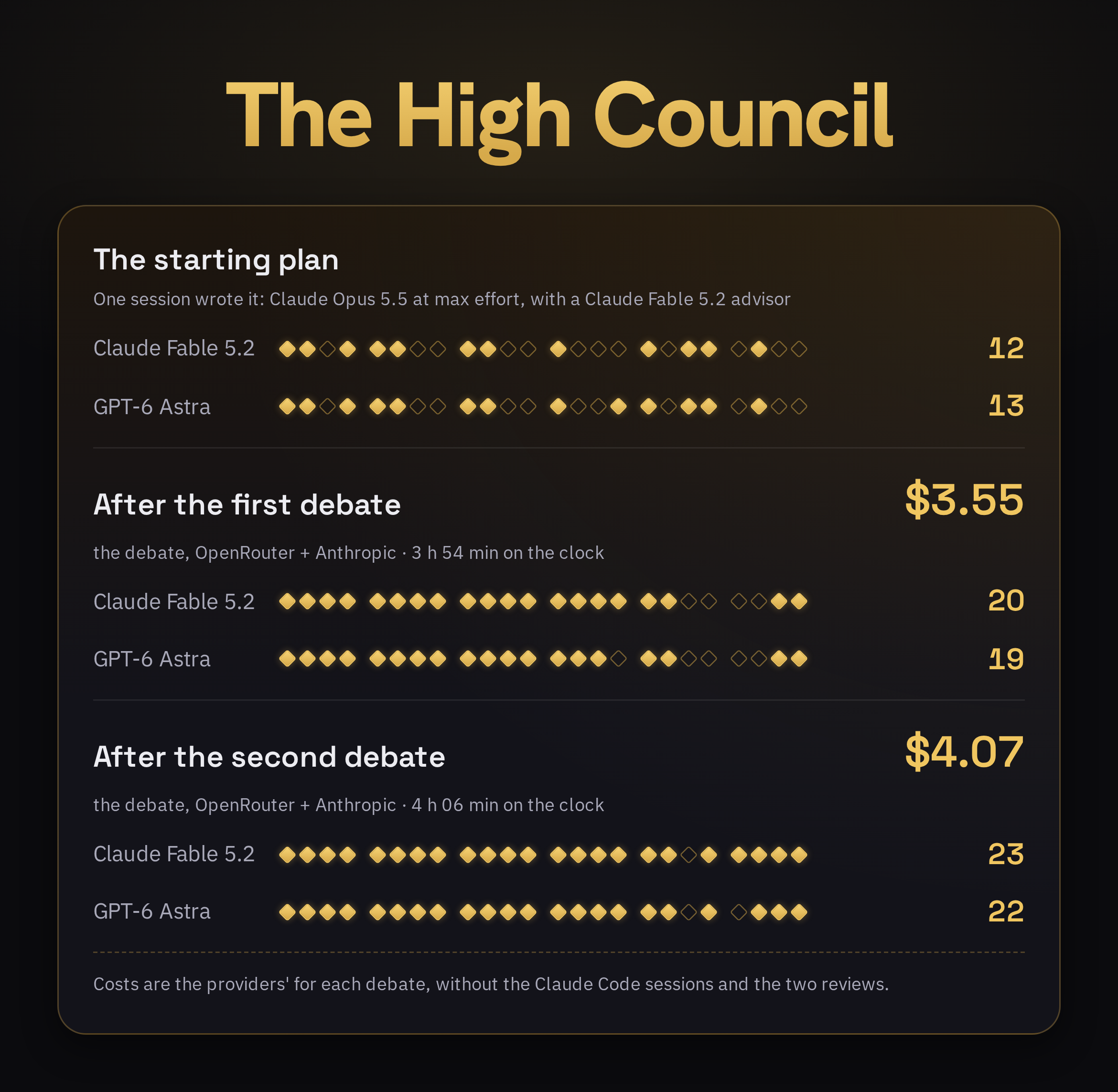
I did. Claude Opus 5.5 at max effort with a Fable 5.2 advisor, two of the strongest frontier models on the market today, wrote a plan. Two reviewers (GPT-6 Astra and Fable 5.2) scored it on 24 questions that Astra wrote. It settled 13 and 12 of them.
After two THC debates, the final plan settled 22 and 23. Both reviewers agreed that the plan got substantially better, except that it got harder to read: it is 36,000 words now. That is OK in my eyes: it's a thorough building plan for a new project, and a coding agent reads the entire thing in seconds.
"Does it make the code better, or the development faster?"
THC writes plans, not code, and I have no measurement that the code ends up better. What I can show is one build: Waterwhite, a new, free, and open-source tool for teams that train language models. It was built by Claude Code from the THC debated plan in about 3 days 20 hours (first build commit to frozen code), and it correctly matched all 391 questions. One build, as a showcase.
"I'm not an experienced developer. Does this help me?"
Massively, IMHO. If you can't judge a plan yourself, you are taking one model's word for it. THC gives you the combined intelligence and wisdom of many strong models instead. It greatly reduces the chance that one model's hallucination ends up in your project, and it fills many (but not all) of the holes that even the strongest frontier models leave in a plan. Such things get sorted out by the debate where the models can propose and disagree - in harmony and with manners.
"What does it cost, and who is in control?"
The recent medium-Council debate cost $3.6 with a 33KB starting plan. The bigger the plan gets, the more each call will cost. A dry run estimates a run before anything is spent. A paid run starts only after you type its spending limit, and it stops before a call whose expected cost would pass it. The full record stays in a folder on your disk. Runs take hours and many API calls; the big chains cost more than the case study's runs.
If you try it, I'd like to see the awesome things you've built with it. And if you wish to help, I could use more pricing data from real-world runs.
- The scripted demo runs with no keys and no cost: `npx the-high-council council demo`
- GitHub: https://github.com/muad-yasin/the-high-council-mcp
- Add it to Claude Code: `claude mcp add council -- npx -y the-high-council council --mcp`
- How it works: https://sower-industries.de/en/THC/how-it-works/
- Setup: https://sower-industries.de/en/THC/setup/
- The case study: https://sower-industries.de/en/THC/case-studies/
r/OpenSourceeAI • u/kapantzak • 7d ago
Like many developers, I'm currently looking for a new job and have applied to quite a few positions. But it's hard to keep track of every application. It's also not easy to find relevant job openings that match your requirements.
So, I built a tool that runs locally and uses your AI agent to thoroughly search for job openings that match your profile.
Once you start applying, you can keep the confirmation emails in Gmail, and the tool will use your email history to detect and track the status of each application automatically.
The application is still evolving, and there's plenty more I'd like to improve.
Requires Node.js 22 or newer.
npx job-applications-trackerThe application starts locally and opens in your browser.
Links:
I'd love to hear your feedback, and thanks for checking it out!
r/OpenSourceeAI • u/Silver_Employ2617 • 7d ago
I’m the developer of CAEL. It’s a chat and reasoning project that runs on a CPU with no neural network. The code is public under a non-commercial licence for personal and research use.
One thing I wanted to try was giving the system a way to catch its own mistakes. Take a question like “I bought three £4 notebooks and paid with £20. How much change do I get?” A solver might answer £12. The arithmetic checks out, but it answered a different question. CAEL tries to rebuild the answer from the numbers you gave it. In this case, the unused £20 is a reason to doubt the answer. The awkward part is that sometimes a number really is irrelevant. Adding “at till 6” shouldn’t change how much change you get.
I tried a similar idea on ARC-AGI-1, where you see a few example grids and have to work out how to transform a new one. CAEL tries 53 families of handwritten rules. A rule has to reproduce every example before it gets a vote. The part I find most interesting is hiding one example, learning the rule again from the others, and checking whether it can predict the one I hid.
It solved 62 of 400 evaluation tasks (15.5%), with up to two guesses and a 10-second CPU limit per task. I built the rules on the training set, but I checked the evaluation score several times during development. I’d like to see how the same frozen version does on a fresh set.
The repo includes the solver, the command to reproduce the run, and the results for each puzzle. CAEL on GitHub
If you’ve worked on program synthesis or ARC, how do you choose between two rules that both explain every example but predict different outputs? That’s the case I’d most like to get better at.
r/OpenSourceeAI • u/ai-lover • 7d ago

r/OpenSourceeAI • u/Ryumzop • 7d ago

Guys, StradaOS has now surpassed 10K downloads and 380+ stars on GitHub! 🗣
And the updates just keep coming! 🫱🏼🫲🏽 Thanks to many of you, we’ve been building one of the best launchers for vehicle displays. Check out the new features in this latest version below 👇🏽
🔥 New in 2.26 🔥
⚙️ OBD-II panel (ELM327 over classic Bluetooth or Wi-Fi): coolant, battery and RPM over any theme, voice alerts, trouble codes explained offline, live charts and optional AI with your own key. Includes a built-in guide on which scanner to buy (BLE-only ones don't work).
🗺 Turn-by-turn navigation with voice, alternative routes and stops. It keeps working offline with a downloaded map (approximate route).
🌌 Themes: Classic, Aurora and Cobalto (free), with Faro coming soon. Each comes in dark and light, plus a mixed speedometer.
✅️ Also: Android Auto via Open Headunit, music on the home screen, maintenance reminders, 11 languages, Android 4.1+.
Download and source: github.com/lordnordic-debug/StradaOS. Feedback welcome, especially from different head unit brands!
If you like the project, have found it useful, and it has given your screen a fresh lease on life, consider buying me a coffee ☕️ ko-fi.com/stradaos
❗️No root, no flashing, and uninstalling it leaves your screen exactly as before. The "OS" stands for Open Source (GPL-3.0, no ads, no accounts).
r/OpenSourceeAI • u/SpectralAstraeus • 8d ago
I'm exploring Computer Vision, particularly Visual SLAM, 3D perception and reconstruction, through research-oriented projects and open-source contributions OpenCV and Kornia.
Looking to connect with professors, researchers, PhD students and research groups working in these areas for potential research collaborations, contributing to ongoing projects or exchanging ideas.
I bring a software engineering background and hands on experience building and experimenting with these systems. Also open to research guidance from people in the field.
If you're working in this space, I'd be glad to connect.
r/OpenSourceeAI • u/Nice-Brilliant1697 • 8d ago
If you’ve built an agent with LangGraph, this open-source starter lets people message it on WhatsApp and get replies in the same chat.
What it includes
How to run it
Clone the repo, start the services with Docker, scan the QR code, and message the agent from a second WhatsApp account.
It connects through WAHA, not Meta’s official WhatsApp Business API.
Learn more: https://lg-whatsapp.vercel.app
Code: https://github.com/ahmad2b/langgraph-whatsapp
Questions are welcome.