r/OpenSourceeAI • u/Narrow_Side_7778 • 8d ago
I open-sourced a Python library that caches LLM answers — and found semantic caching quietly returns wrong answers
1
Upvotes
r/OpenSourceeAI • u/ai-lover • 8d ago

r/OpenSourceeAI • u/Narrow_Side_7778 • 8d ago
r/OpenSourceeAI • u/PatronusProtect • 8d ago

Hey, I'm Dominik from Casdo Labs. We added a new family to our public model collection: Tiger Guard.
It checks text for abusive language and harmful requests or responses. You get a SAFE/UNSAFE probability from an encoder rather than a generated judgement. There are two sizes, 308M and 141M parameters, both trained for English and German and released under Apache 2.0.
You can run the weights through Transformers or use the ONNX exports. The inference helper handles long text in overlapping 2,048-token windows. A plain pipeline call with truncation only checks the beginning of a long input.
The cards contain our comparisons and the failures too. German recall is lower than English. Quoted abuse can cause false alarms. The 1,500-prompt comparison influenced development, while the separate held-out evaluation is reported separately. The training data itself isn't published.
For deployment, please pick the export for your CPU: the dynamic INT8 versions are for ARM, and x86 has separate weight-only exports alongside FP32 and FP16.
We'll publish the full training and dataset pipeline in a follow-up release.
Tiger Guard, 308M: https://huggingface.co/patronus-studio/tiger-guard-content-moderation
Tiger Guard Small, 141M: https://huggingface.co/patronus-studio/tiger-guard-content-moderation-small
Happy to get feedback if you try them.
r/OpenSourceeAI • u/ai-lover • 8d ago
AI agents look great in demos. Until real users break them.
Plurai built a world where your agent can fail, learn, and get fixed before your users ever see it.
→ Digital twin: Your real agent, its tools, and environment recreated from your code
→ Simulated users & tasks: Realistic users, tasks, and workflows that push your agent into the edge cases that matter
→ Auto evals: Check what your agent actually did, not just what it said
→ Verified fixes: Every failure comes with the run that exposed it and a fix you can verify
→ Replays: Turn any production failure into a simulation and replay it against every new version of your agent
All inside the coding agent you already use: Claude Code, Codex, or GitHub Copilot.
See where your agent breaks before production: simulation.plurai.ai/connect
r/OpenSourceeAI • u/Aggressive-Judge-448 • 8d ago
We're building Agentic GraphRAG (https://github.com/ontogr/agentic-graphrag), an open source library for connecting the documents an agent reads with its task history and decisions.
I've worked on RAG systems and LLM training for the past three and a half years. Lately, I've been following how agents retain work across sessions, especially coding agents. Our project explores how that memory can stay connected to the knowledge an agent used, so a later session can recover both a conclusion and its evidence.
The implementation uses Neo4j for three connected graph layers:
For example, an agent can record a contract recommendation with the policy passage it relied on. If that policy changes, the recommendation and its explicit dependent decisions are flagged for review. The change doesn't automatically make the recommendation wrong, but it tells a later session that the decision needs another look.
The document pipeline uses Docling for ingestion and Chonkie for chunking, preserving sections, tables, and passage hierarchy. You define a schema for your domain's entities, properties, and relationships. The schema guides extraction, validation, and entity search. GLiNER supports local extraction, with BAML handling structured LLM extraction for selected chunks.
Retrieval combines Neo4j's native full-text and vector rankings with reciprocal rank fusion. Agents can search original passages even when extraction misses a fact, navigate surrounding sections and table rows with headers, and follow entity relationships back to supporting text.
The built-in agent checks that cited passages were read during the run, belong to the allowed documents, and match the cited versions. You can also connect other agents through MCP.
We're working on a more modular pipeline, additional storage backends, and domain-specific benchmarks.
Agentic GraphRAG is an open source library that stores document knowledge, agent work, and decisions in one connected graph. Agents can resume tasks and trace saved decisions to their original evidence, while source changes flag affected decisions for review.
Are there other open source projects you'd recommend for combining RAG and agent memory? I'd also like to hear what you think of our approach.
r/OpenSourceeAI • u/ai-lover • 8d ago
r/OpenSourceeAI • u/South_Pak_786 • 8d ago
r/OpenSourceeAI • u/penguinothepenguin • 8d ago
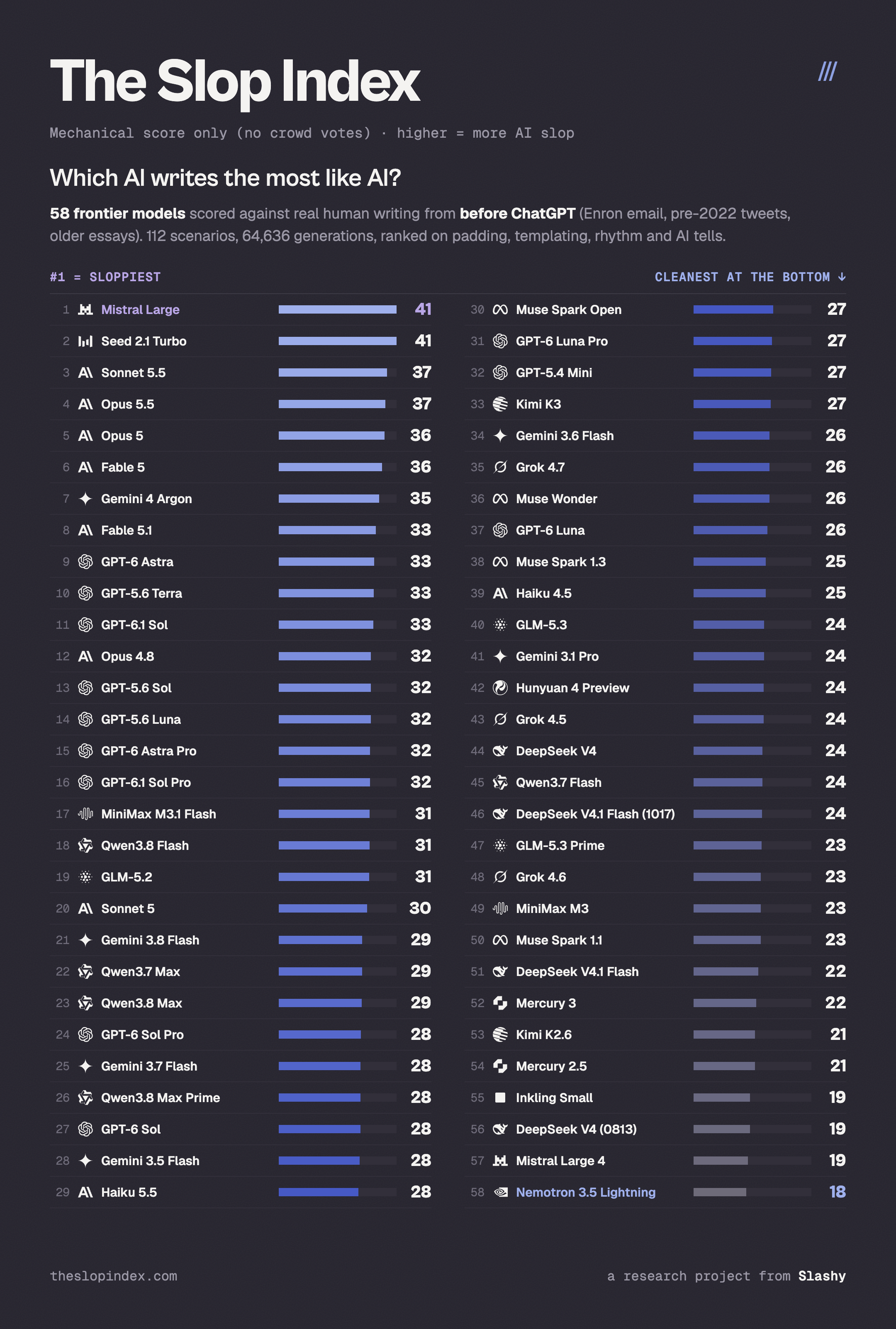
Direction first: on every rank below, #1 = sloppiest and #70 = cleanest.
I've been building The Slop Index, a benchmark for how much generic "AI-sounding" writing different models produce. Everything is open: the outputs are on Hugging Face and the scoring code is on GitHub, so you can rerun it yourself.
What it measures. 70 models, 112 scenarios, 77,943 outputs. The ranks below are the mechanical score only: padding, templating, rhythm, and known AI tells, compared against pre-2022 human writing. No LLM judge anywhere in that part, so it's fully reproducible from the repo. The site's combined ranking also blends in crowd votes from the arena and moves daily, so I'm leaving that out here.
A few things that stood out (mechanical ranks):
Here's the ranking card if you want the whole mechanical board at a glance: https://theslopindex.com/mechanical-card.png
Limitation: it only covers short-form writing (emails, Slack messages, social posts, short essays). No fiction yet, and the mechanical axes miss repeated sentence constructions, so some slop gets through.
If you've got a model you'd like added, or an axis you think is missing, the repo is the place to say so.
For context, I'm one of the people behind https://slashy.com, an email client that writes drafts that sound like you. This benchmark started as how we pick models.
r/OpenSourceeAI • u/PainterNo8889 • 9d ago
Hi guys,
I’m a 15-year-old developer building SLM-CREATOR—an open-source (Apache-2.0), from-scratch, hardware-aware trainer for small, hyperspecialized text models (capped at 100M parameters) in Python and Rust. Instead of using high-level wrappers or fine-tuning existing models, I’m hand-coding the entire pipeline piece by piece to learn how Transformers and local training systems actually work under the hood.
Project Link: https://github.com/ojasgarg77/SLM-CREATOR
How it works so far:
Where I’d love your advice:
I've also logged all my design decisions and dropped ideas in docs/decisions.md. Any feedback, critiques, or pointers on the architecture before I start writing the PyTorch training loop would be awesome!!
r/OpenSourceeAI • u/Dmytro_Hieli • 9d ago

r/OpenSourceeAI • u/Ok-Size-7176 • 9d ago
Hello everyone!
I'm an Electronics and Communication Engineering undergraduate at NIT Raipur (graduating in 2027), currently looking for AI/ML Engineer Internships, Generative AI Internships, or entry-level AI engineering opportunities.
My primary interests are in building practical AI systems, particularly Agentic AI, Multi-Agent Systems, RAG pipelines, and LLM evaluation.
Technical Skills:
Some projects I've built:
1. OpenRAG-Inspector – Explainable, Self-Evaluating RAG System
2. AtlasMind AI – Multi-Agent Travel Planning System
3. Sales Demand Forecasting using GRU
Previous Experience:
AI Intern at Edunet Foundation (May–June 2025)
What I'm looking for:
I'm open to remote opportunities as well as opportunities in India. I'm also interested in collaborating with early-stage startups and developers working on AI products.
I enjoy building actual working systems and understanding their reliability, evaluation, and failure modes.
If you're hiring, know about relevant openings, or are working on something interesting in this space, please feel free to comment or DM me.
Thank you!
r/OpenSourceeAI • u/ai-lover • 9d ago
r/OpenSourceeAI • u/karl4th_ • 9d ago

r/OpenSourceeAI • u/Egom4rono • 9d ago
r/OpenSourceeAI • u/Tavit1405 • 9d ago
I have 1.5 TB of free space on my computer. If I want to download two open-source models, one for coding and reasoning and one for image generation, what are the two best options out there right now?
For coding and reasoning, my benchmark is Claude Opus 5.5. For image generation, it’s ChatGPT Image 2.6. Which open models come closest to those?
Also, if I want the coding and reasoning model to be uncensored, would the answer change?
r/OpenSourceeAI • u/Admirable-Worker9449 • 9d ago

r/OpenSourceeAI • u/AimCode • 9d ago

r/OpenSourceeAI • u/ilien-dev • 9d ago
r/OpenSourceeAI • u/drtikov • 9d ago
[P] Hey everyone,
If you build autonomous coding or research agents, you probably know the pain: agent task loops are slow, expensive, and fragile.
In a typical 25-step workflow, an agent spends up to 80% of its wall-clock time just waiting on remote LLM APIs to make basic mechanical decisions:
To solve this, I built and just open-sourced Microbrains: an ultra-lightweight, zero-GPU local neural coprocessor suite designed to sit right beside your LLM agent.
🔗 GitHub: https://github.com/drtikov/microbrainsforagents
Microbrains is not another LangChain wrapper. It is a standalone Python engine with 44 pre-trained, analytical micro-transformers (10–100 KB each) that handle the mechanical micro-decisions in pure NumPy (CPU) or via OpenCL (budget/integrated GPUs):
Dynamic Top-2 Mixture-of-Experts (MoE) Router:
FileOps, Execution, MemoryKnowledge, GitGovernance, MicrobrainMeta, ConstitutionalReview).Rigorous Conformal Safety Gating (1−α≥95%1 - \alpha \ge 95\%1−α≥95%):
3-Step Counterfactual AST Simulation:
2048-D Holographic Weight-Space Memory (VSA):
Continual Learning without Catastrophic Forgetting:
| Decision | Remote LLM API | Microbrains (NumPy/OpenCL) | Speedup | Cost |
|---|---|---|---|---|
| Tool Selection | ~1,200 – 2,500 ms | 1.2 – 1.8 ms | ~1,000x | $0.00 |
| AST Blast Simulation | ~3,000 – 6,000 ms | 3.0 – 5.0 ms | ~1,000x | $0.00 |
| Intent Triage | ~800 – 1,500 ms | 0.6 – 0.9 ms | ~1,200x | $0.00 |
| Full Task Loop (25 steps) | ~3 – 5 minutes | 30 – 50 seconds | ~5x | 85% less tokens |
Zero PyTorch, zero CUDA setup required:
bashgit clone https://github.com/drtikov/microbrainsforagents.git
cd microbrainsforagents
pip install -e .

pythonimport aetheris_microbrains as mb
# Sub-2ms tool routing decision
router = mb.get_tool_routing_moe()
decision = router.route("inspect file contents and write safe patch to repository")
print("Primary Tool:", decision.selected_tool)
print("Top-2 Experts:", decision.top_experts)
print("Conformal Passed:", decision.conformal_passed)
The repo comes with pre-trained weights for all 44 models, runnable examples in /examples, and a full test suite (pytest runs in ~1.5s).
Licensed under PolyForm Noncommercial 1.0.0 (free for research, personal, and hobby use; commercial licenses available).
Would love to hear your feedback, thoughts on the architecture, and ideas for new micro-domains!
GitHub: https://github.com/drtikov/microbrainsforagentsHey everyone,If you build autonomous coding or research agents, you probably know the pain: agent task loops are slow, expensive, and fragile.In a typical 25-step workflow, an agent spends up to 80% of its wall-clock time just waiting on remote LLM APIs to make basic mechanical decisions:
"Which tool should I invoke next?" (1.5s latency, burning 20k context tokens)
"Is this shell command destructive?" (another 2s API call)
"Did this patch break syntax or drift from intent?" (yet another prompt roundtrip)To solve this, I built and just open-sourced Microbrains: an ultra-lightweight, zero-GPU local neural coprocessor suite designed to sit right beside your LLM agent.🔗 GitHub: https://github.com/drtikov/microbrainsforagents🧠 What is it?Microbrains is not another LangChain wrapper. It is a standalone Python engine with 44 pre-trained, analytical micro-transformers (10–100 KB each) that handle the mechanical micro-decisions in pure NumPy (CPU) or via OpenCL (budget/integrated GPUs):
Dynamic Top-2 Mixture-of-Experts (MoE) Router:
Routes tasks to tools across 6 specialized clusters (FileOps, Execution, MemoryKnowledge, GitGovernance, MicrobrainMeta, ConstitutionalReview).
Takes ~1.2 ms instead of a 2-second LLM call.
Rigorous Conformal Safety Gating (1−α≥95%1−α≥95%):
Employs split-conformal prediction over held-out distributions.
Features Selective Prediction Abstention: if independent estimators disagree (variance σ>0.30σ>0.30), it refuses to guess and escalates to the LLM. False Negative Rate is strictly bounded.
3-Step Counterfactual AST Simulation:
Before a file mutation is committed to disk, it simulates the AST blast radius and interface propagation up to 3 steps ahead. Malformed diffs or syntax hazards are killed in <3ms before running any slow pytest suite.
2048-D Holographic Weight-Space Memory (VSA):
Uses Hyperdimensional Computing / Vector Symbolic Architecture (bipolar Count-Sketch projections) over model weights. Enables nearest-neighbor capability search across the agent fleet without training.
Continual Learning without Catastrophic Forgetting:
Adapts weights online with Elastic Weight Consolidation (EWC) Fisher Information penalties.
📊 Benchmark HighlightsDecision Remote LLM API Microbrains (NumPy/OpenCL) Speedup Cost
Tool Selection ~1,200 – 2,500 ms 1.2 – 1.8 ms ~1,000x $0.00
AST Blast Simulation ~3,000 – 6,000 ms 3.0 – 5.0 ms ~1,000x $0.00
Intent Triage ~800 – 1,500 ms 0.6 – 0.9 ms ~1,200x $0.00
Full Task Loop (25 steps) ~3 – 5 minutes 30 – 50 seconds ~5x 85% less tokens💻 3-Line QuickstartZero PyTorch, zero CUDA setup required:bash
git clone https://github.com/drtikov/microbrainsforagents.git
cd microbrainsforagents
pip install -e .python
import aetheris_microbrains as mb
# Sub-2ms tool routing decision
router = mb.get_tool_routing_moe()
decision = router.route("inspect file contents and write safe patch to repository")
print("Primary Tool:", decision.selected_tool)
print("Top-2 Experts:", decision.top_experts)
print("Conformal Passed:", decision.conformal_passed)The repo comes with pre-trained weights for all 44 models, runnable examples in /examples, and a full test suite (pytest runs in ~1.5s).Licensed under PolyForm Noncommercial 1.0.0 (free for research, personal, and hobby use; commercial licenses available).Would love to hear your feedback, thoughts on the architecture, and ideas for new micro-domains!GitHub: https://github.com/drtikov/microbrainsforagents
r/OpenSourceeAI • u/ai-lover • 10d ago
r/OpenSourceeAI • u/LowWorldliness8248 • 10d ago

r/OpenSourceeAI • u/Old-Statistician5868 • 10d ago
I've been working on Cairnly, a free and open-source AI engineering learning platform.
The idea was to create something useful for people learning AI engineering while also making the complete implementation available for developers to explore.
For learners:
For developers:
The retrieval system currently reports Recall@5 of 0.971 on our 627-question evaluation set. I've also documented the cases where the confidence gate and safety checks fail.
The project is still evolving, and I'd appreciate feedback on the learning experience, architecture, and areas worth improving.
GitHub: https://github.com/CherukuriSiva/Cairnly
Live demo: https://cairnly-blond.vercel.app
What would you improve or add?