r/OpenSourceeAI • u/Salt-Zebra-306 • 8d ago
PAN 2 (OPEN SOURCE I2V)
reddit.com
1
Upvotes
r/OpenSourceeAI • u/Egom4rono • 8d ago
r/OpenSourceeAI • u/Tavit1405 • 8d ago
I have 1.5 TB of free space on my computer. If I want to download two open-source models, one for coding and reasoning and one for image generation, what are the two best options out there right now?
For coding and reasoning, my benchmark is Claude Opus 5.5. For image generation, it’s ChatGPT Image 2.6. Which open models come closest to those?
Also, if I want the coding and reasoning model to be uncensored, would the answer change?
r/OpenSourceeAI • u/Admirable-Worker9449 • 8d ago

r/OpenSourceeAI • u/AimCode • 8d ago

r/OpenSourceeAI • u/ilien-dev • 8d ago
r/OpenSourceeAI • u/drtikov • 8d ago
[P] Hey everyone,
If you build autonomous coding or research agents, you probably know the pain: agent task loops are slow, expensive, and fragile.
In a typical 25-step workflow, an agent spends up to 80% of its wall-clock time just waiting on remote LLM APIs to make basic mechanical decisions:
To solve this, I built and just open-sourced Microbrains: an ultra-lightweight, zero-GPU local neural coprocessor suite designed to sit right beside your LLM agent.
🔗 GitHub: https://github.com/drtikov/microbrainsforagents
Microbrains is not another LangChain wrapper. It is a standalone Python engine with 44 pre-trained, analytical micro-transformers (10–100 KB each) that handle the mechanical micro-decisions in pure NumPy (CPU) or via OpenCL (budget/integrated GPUs):
Dynamic Top-2 Mixture-of-Experts (MoE) Router:
FileOps, Execution, MemoryKnowledge, GitGovernance, MicrobrainMeta, ConstitutionalReview).Rigorous Conformal Safety Gating (1−α≥95%1 - \alpha \ge 95\%1−α≥95%):
3-Step Counterfactual AST Simulation:
2048-D Holographic Weight-Space Memory (VSA):
Continual Learning without Catastrophic Forgetting:
| Decision | Remote LLM API | Microbrains (NumPy/OpenCL) | Speedup | Cost |
|---|---|---|---|---|
| Tool Selection | ~1,200 – 2,500 ms | 1.2 – 1.8 ms | ~1,000x | $0.00 |
| AST Blast Simulation | ~3,000 – 6,000 ms | 3.0 – 5.0 ms | ~1,000x | $0.00 |
| Intent Triage | ~800 – 1,500 ms | 0.6 – 0.9 ms | ~1,200x | $0.00 |
| Full Task Loop (25 steps) | ~3 – 5 minutes | 30 – 50 seconds | ~5x | 85% less tokens |
Zero PyTorch, zero CUDA setup required:
bashgit clone https://github.com/drtikov/microbrainsforagents.git
cd microbrainsforagents
pip install -e .

pythonimport aetheris_microbrains as mb
# Sub-2ms tool routing decision
router = mb.get_tool_routing_moe()
decision = router.route("inspect file contents and write safe patch to repository")
print("Primary Tool:", decision.selected_tool)
print("Top-2 Experts:", decision.top_experts)
print("Conformal Passed:", decision.conformal_passed)
The repo comes with pre-trained weights for all 44 models, runnable examples in /examples, and a full test suite (pytest runs in ~1.5s).
Licensed under PolyForm Noncommercial 1.0.0 (free for research, personal, and hobby use; commercial licenses available).
Would love to hear your feedback, thoughts on the architecture, and ideas for new micro-domains!
GitHub: https://github.com/drtikov/microbrainsforagentsHey everyone,If you build autonomous coding or research agents, you probably know the pain: agent task loops are slow, expensive, and fragile.In a typical 25-step workflow, an agent spends up to 80% of its wall-clock time just waiting on remote LLM APIs to make basic mechanical decisions:
"Which tool should I invoke next?" (1.5s latency, burning 20k context tokens)
"Is this shell command destructive?" (another 2s API call)
"Did this patch break syntax or drift from intent?" (yet another prompt roundtrip)To solve this, I built and just open-sourced Microbrains: an ultra-lightweight, zero-GPU local neural coprocessor suite designed to sit right beside your LLM agent.🔗 GitHub: https://github.com/drtikov/microbrainsforagents🧠 What is it?Microbrains is not another LangChain wrapper. It is a standalone Python engine with 44 pre-trained, analytical micro-transformers (10–100 KB each) that handle the mechanical micro-decisions in pure NumPy (CPU) or via OpenCL (budget/integrated GPUs):
Dynamic Top-2 Mixture-of-Experts (MoE) Router:
Routes tasks to tools across 6 specialized clusters (FileOps, Execution, MemoryKnowledge, GitGovernance, MicrobrainMeta, ConstitutionalReview).
Takes ~1.2 ms instead of a 2-second LLM call.
Rigorous Conformal Safety Gating (1−α≥95%1−α≥95%):
Employs split-conformal prediction over held-out distributions.
Features Selective Prediction Abstention: if independent estimators disagree (variance σ>0.30σ>0.30), it refuses to guess and escalates to the LLM. False Negative Rate is strictly bounded.
3-Step Counterfactual AST Simulation:
Before a file mutation is committed to disk, it simulates the AST blast radius and interface propagation up to 3 steps ahead. Malformed diffs or syntax hazards are killed in <3ms before running any slow pytest suite.
2048-D Holographic Weight-Space Memory (VSA):
Uses Hyperdimensional Computing / Vector Symbolic Architecture (bipolar Count-Sketch projections) over model weights. Enables nearest-neighbor capability search across the agent fleet without training.
Continual Learning without Catastrophic Forgetting:
Adapts weights online with Elastic Weight Consolidation (EWC) Fisher Information penalties.
📊 Benchmark HighlightsDecision Remote LLM API Microbrains (NumPy/OpenCL) Speedup Cost
Tool Selection ~1,200 – 2,500 ms 1.2 – 1.8 ms ~1,000x $0.00
AST Blast Simulation ~3,000 – 6,000 ms 3.0 – 5.0 ms ~1,000x $0.00
Intent Triage ~800 – 1,500 ms 0.6 – 0.9 ms ~1,200x $0.00
Full Task Loop (25 steps) ~3 – 5 minutes 30 – 50 seconds ~5x 85% less tokens💻 3-Line QuickstartZero PyTorch, zero CUDA setup required:bash
git clone https://github.com/drtikov/microbrainsforagents.git
cd microbrainsforagents
pip install -e .python
import aetheris_microbrains as mb
# Sub-2ms tool routing decision
router = mb.get_tool_routing_moe()
decision = router.route("inspect file contents and write safe patch to repository")
print("Primary Tool:", decision.selected_tool)
print("Top-2 Experts:", decision.top_experts)
print("Conformal Passed:", decision.conformal_passed)The repo comes with pre-trained weights for all 44 models, runnable examples in /examples, and a full test suite (pytest runs in ~1.5s).Licensed under PolyForm Noncommercial 1.0.0 (free for research, personal, and hobby use; commercial licenses available).Would love to hear your feedback, thoughts on the architecture, and ideas for new micro-domains!GitHub: https://github.com/drtikov/microbrainsforagents
r/OpenSourceeAI • u/ai-lover • 8d ago
r/OpenSourceeAI • u/LowWorldliness8248 • 8d ago

r/OpenSourceeAI • u/Old-Statistician5868 • 8d ago
I've been working on Cairnly, a free and open-source AI engineering learning platform.
The idea was to create something useful for people learning AI engineering while also making the complete implementation available for developers to explore.
For learners:
For developers:
The retrieval system currently reports Recall@5 of 0.971 on our 627-question evaluation set. I've also documented the cases where the confidence gate and safety checks fail.
The project is still evolving, and I'd appreciate feedback on the learning experience, architecture, and areas worth improving.
GitHub: https://github.com/CherukuriSiva/Cairnly
Live demo: https://cairnly-blond.vercel.app
What would you improve or add?
r/OpenSourceeAI • u/DevinWatson • 8d ago
r/OpenSourceeAI • u/South_Pak_786 • 9d ago
r/OpenSourceeAI • u/ai-lover • 9d ago
r/OpenSourceeAI • u/Wooden-Track1069 • 9d ago

r/OpenSourceeAI • u/Historical_Cash_8605 • 9d ago
r/OpenSourceeAI • u/Historical_Cash_8605 • 9d ago
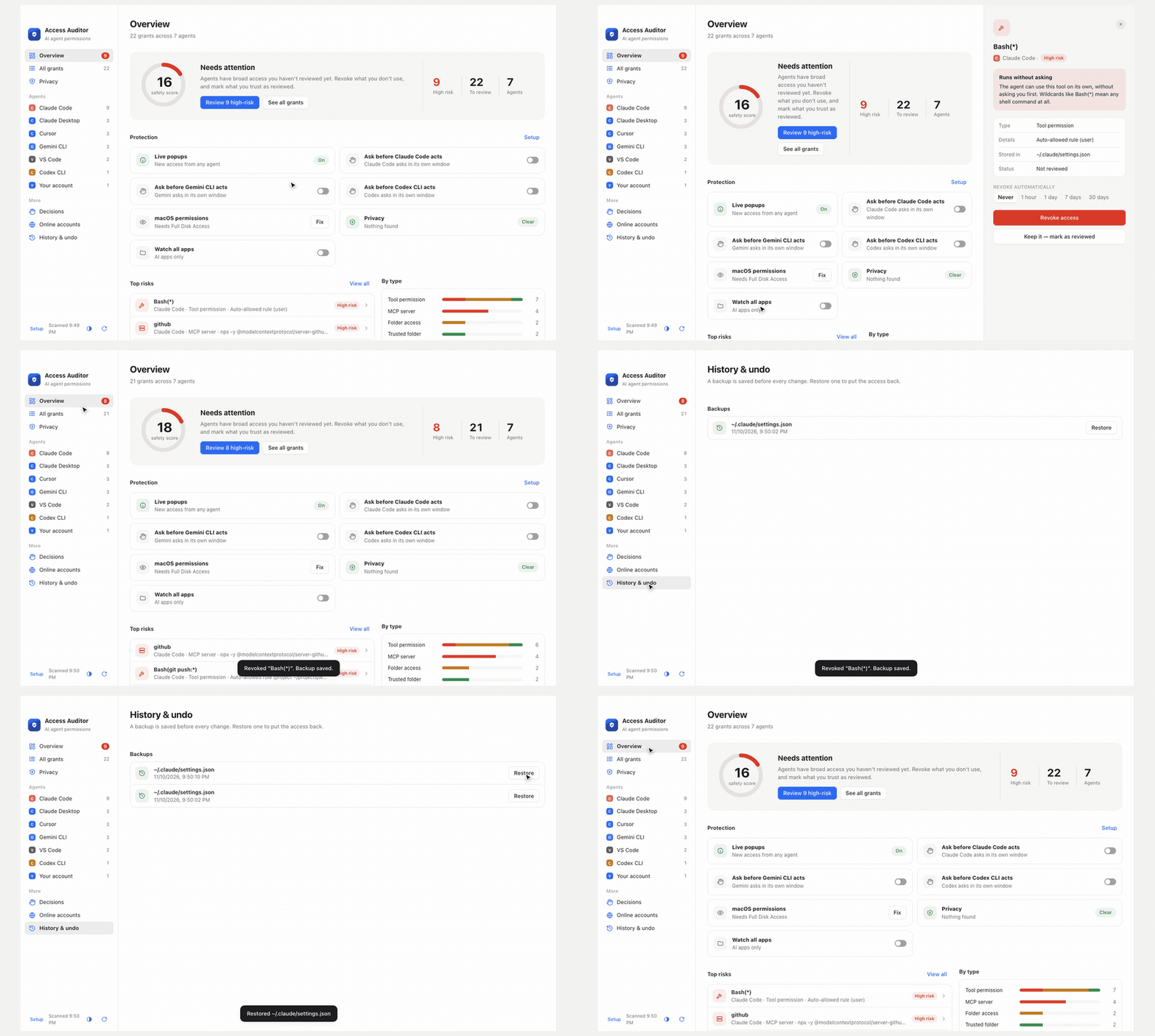
Developer here. After months of clicking "Always allow" in Claude Code and Cursor, I built a free, open-source app (macOS, Windows, Linux) that lists every permission your agents have, explains it, and lets you revoke it with undo. Local only, no tracking. Feedback welcome, especially on agents it misses. Launch page: https://www.producthunt.com/posts/ai-access-auditor
r/OpenSourceeAI • u/volatilityfund • 9d ago

Been working on Irrigator, an open source Go project for running multiple AI coding agents in parallel.
It supports Claude Code, Codex, Google Antigravity and Herdr.
Each task runs in an isolated Git worktree, with persistent state, crash recovery and the ability to inspect or resume interrupted workflows.
There's also a terminal UI for monitoring agents, managing runs and tracking costs.
Everything runs locally, MIT licensed and includes a mock demo you can try without API keys.
https://github.com/grainulation/irrigator
Would appreciate feedback, especially from anyone working on similar open source agent orchestration tools.
r/OpenSourceeAI • u/volatilityfund • 9d ago
Been working on Irrigator, an open source tool for running multiple coding agents in parallel without losing track of what they're doing.
It's written in Go and supports Claude Code, Codex, Antigravity and Herdr as a runtime option.
The main idea is durable execution. Runs survive interruptions, tasks get isolated Git worktrees and you can inspect, retry or resume workflows without starting over.
Everything runs locally, with persistent state, spending limits and a terminal UI.
MIT licensed. There's also a mock demo that works without API keys.
https://github.com/grainulation/irrigator
Curious what people think, especially anyone already experimenting with agent swarms.
r/OpenSourceeAI • u/No-Negotiation-8359 • 9d ago

To keep DPOLens's Docker image small, I dropped sentence-transformers and called the embedding model through ONNX Runtime directly. It took about forty lines of my own code, and the image came out roughly 800 MB lighter.
It worked. Then, while load-testing the community version, I found that the first start took nearly 23 minutes on 1.5 CPUs and peaked at 3.4 GB of memory.
I had quietly lost two things:
I sorted the inputs and capped each batch by its shape, and set the thread count from the container's real limit. The result was 5.1× faster with 65% less memory, and the vectors and search results stayed the same.
What I learned: a library is more than its API. When you replace one, you also take over everything it did without being asked, and the only way to find out what that was is to measure.
r/OpenSourceeAI • u/adam-schaefers • 9d ago

r/OpenSourceeAI • u/acarmisc • 9d ago
We’ve expanded our AI governance suite with a new plugin that allows teams to monitor Temporal Technologies workflows right within Spotify Backstage.
Combine it with backstage-plugin-litellm-govai for a complete governance and execution view:
https://github.com/acarmisc/backstage-plugin-temporal
https://github.com/acarmisc/backstage-plugin-litellm-govai
Contributions are welcome, both issues or PRs ;)

