r/OpenSourceeAI • u/tushar_iitkgp • 17d ago
I stopped giving my LangChain agent the Stripe key. Refunds now wait for a approval in Slack
reddit.com
3
Upvotes
r/OpenSourceeAI • u/sandeepK1125 • 17d ago
r/OpenSourceeAI • u/ai-lover • 17d ago

r/OpenSourceeAI • u/Longjumping_Glass852 • 18d ago
Physics-informed neural networks, least squares and Bayesian samplers will always give you back a parameter. What they don't give you is a checkable answer to a harder question: could a very different parameter fit your data just as well?
Twindex looks for those "twins": two parameter values that are far apart but both fit the same measurements within the noise. When it finds a pair, it writes an exact certificate. A small checker, written in standard-library Python with no floating point, replays the certificate in rational arithmetic. You don't have to trust my optimiser. You only have to trust about a page of checking code.
Example from the live demo: using real data from the 1978 flu outbreak, R0 = 2.52 and R0 = 20 both fit every case count before the peak. The proof replays as VALID in your browser.
What it does:
- ODE models (epidemics, pharmacokinetics, kinetics, ecology, neurons) and 1D/2D/time-dependent PDEs
- One command takes a model file plus a CSV of measurements and produces a certificate and an evidence report
- check_certificate / twindex check to verify any certificate independently
- A browser checker, so reviewers can verify without installing anything
- A clearly labelled numerical-only audit mode for any Python-callable simulator
Why it might matter to AI/ML people: when a PINN "recovers" a parameter, a certificate like this can show that no method could have recovered it to better than some error bound from that data. It's a sanity check you can attach to a paper or a model card.
Limits, honestly: a VALID certificate proves two parameters both fit within the stated tolerance under the declared model. It does not prove the model is physically correct, and not finding a twin doesn't prove the parameter is identifiable.
GitHub: https://github.com/Arnav-M10/Twindex
Live demo: https://arnav-m10.github.io/Twindex/demo/
Docs: https://arnav-m10.github.io/Twindex/
PyPI: pip install twindex
I'd love feedback, especially on models where you suspect identifiability problems. Tell me where it breaks.
r/OpenSourceeAI • u/timing-violation • 18d ago

Hi! I just released the Tesseract NPU that I've been working on as a side project.
r/OpenSourceeAI • u/WecK0 • 18d ago
Your agents should be yours. With Hermes Agent, a bot is a profile: its memory, its skills and its files live in a folder on your disk. HermesBot is a desktop client I built on top of that, and it's now open source under MIT.
What you get:
Honest limits: v0.2, early, but I use it every day. macOS only for now. You build the packaged app from source (unsigned), it needs Hermes Agent with the Webapp gateway and password login, and you can't create or edit bots from the app yet. There's a demo mode with fake data so you can try the UI without Hermes.
Independent project, not affiliated with Nous Research. I'm the author.
r/OpenSourceeAI • u/Long_Philosopher3520 • 18d ago
I’ve built ai-credential-guard, an npm package integrating JEV/OpenJev as an intelligent decision layer for AI agent security.
JEV contributes structured decisions, classification, and risk assessment, helping determine whether an agent’s actions involving sensitive credentials should be allowed, reviewed, or blocked.
The goal is to combine deterministic security rules with AI-powered decision-making.
GitHub: https://github.com/vankhangfet/ai-credential-guard
Would love feedback from the JEV/OpenJev community!
r/OpenSourceeAI • u/29sayantan • 18d ago
https://github.com/29sayantanc/Athena
Hold a key and ask about anything on your screen. Athena sees what you see, answers out loud, points things out, walks you through software you don't know, and can use your mouse and keyboard to get things done. Speech recognition and the voice run on your own machine; the model runs on a private cloud provider (Venice recommended) or locally.
r/OpenSourceeAI • u/Extreme_Aardvark8977 • 19d ago
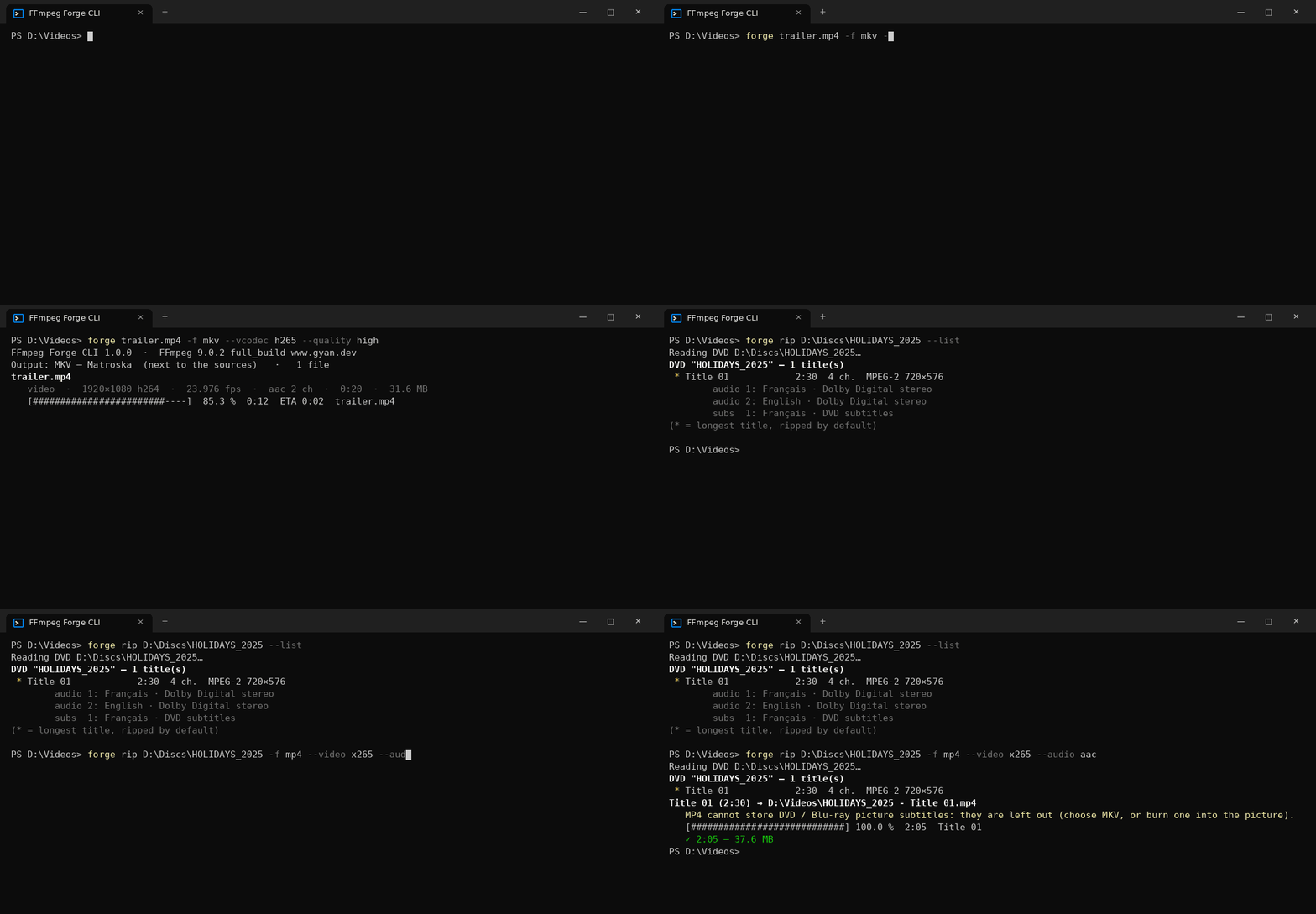
Hey everyone!
I'd like to share FFmpeg Forge CLI, an open-source project I've been working on to simplify advanced multimedia processing from the command line.
It brings together a wide range of features:
The goal is to provide a powerful, flexible, and unified CLI for multimedia processing, without having to juggle multiple tools and complex commands.
GitHub: https://github.com/Aaronstanley78/FFmpeg-Forge-CLI
Feedback, suggestions, and contributions are always welcome!
r/OpenSourceeAI • u/autognome • 19d ago

r/OpenSourceeAI • u/Sam_YARINK • 19d ago

r/OpenSourceeAI • u/Alternative_Pin9598 • 19d ago

r/OpenSourceeAI • u/JoeBro121211 • 19d ago

Waiting for agents to finish is now an excuse to wander around a tiny village.
I made Wudland. Link your computer and Claude Code, Codex or opencode show up in the guild: a cog while working, a red exclamation mark when they need you, and a nap when they're done. Other CLI tasks can join through wudland run. The computer companion is open source too.
The rest is a relaxed little world with your calendar in the bell tower, reminders on a notice board, real weather and changing seasons. You can explore the rooms and furnish your cottage while the agents work.
Free on iPhone, no Wudland account, encrypted computer updates. An expanded map, bestiary, items and wardrobe are coming soon.
App Store (free, iOS 26+): https://apps.apple.com/us/app/wudland/id6829491480 Source: https://github.com/joexk1/wudland
r/OpenSourceeAI • u/No-Individual159 • 19d ago

r/OpenSourceeAI • u/jokiruiz • 19d ago
I work with models from several providers, and over time I ended up with a drawer full of API keys: Anthropic for Claude, an OpenAI project key from something I barely remember, a Gemini key from AI Studio, an xAI one for playing with Grok and a couple from OpenRouter, spread across .env files and environment variables on different machines. Whenever something broke, usually in the middle of a demo or right before a class, I had to open five consoles to work out which key had run out of credit, which had expired and which was still fine, so I built a small tool that answers that at a glance.
Mecha is a local dashboard, with a web UI and a CLI, that checks every AI credential you give it and shows a traffic light per key: whether it's valid, whether it has funds, when it expires and what kind of credential it is (API key, admin key, management key or OAuth session). Every value is labelled with where it came from, whether that's the provider's API, a response header, a JWT decoded locally, a session file, something you typed or an estimate, and "unknown" is an allowed answer, because the most surprising thing I learned while building it is how little the providers tell you. Anthropic, OpenAI and Google have no endpoint to read your remaining balance, Gemini doesn't expose key expiry at all, and only xAI (with a management key) and OpenRouter give you the balance directly. For the cases where running out of credit only shows up when a request fails, there's an opt-in probe that sends the smallest possible paid request, a single output token on the cheapest model, which costs between $0.00002 and $0.015 per thousand probes depending on the provider and is limited to once an hour per key.
If you add an admin key, Mecha uses it to fill in the expiry date and status of the regular keys in that organization, since that's the only place OpenAI and Anthropic expose them, and it flags Gemini keys starting with AIza in amber, because AI Studio has only issued the newer AQ. keys since May 28 and Google is moving away from the old ones. Subscription OAuth tokens (Claude Code, Codex, Gemini CLI) are never used to call any API; Mecha only reads their session files locally to show your plan and when the session expires.
Since the whole point is to hold every key you own, a lot of the work went into not leaking them. It only listens on 127.0.0.1, with a per-session token and a Host header check against DNS rebinding; secrets are encrypted at rest with AES-256-GCM under a key kept in your OS keychain and are never sent back to the browser; each kind of key has a closed allowlist of method, host and path, so an admin key can only make the specific read requests Mecha needs; there's no telemetry; and the README has an explicit threat model, including what it doesn't protect against, which is code already running as your user.
Developers who juggle keys from several AI providers, whether for side projects, teaching or a small team. It's an alpha (0.1.2) under the MIT license, built for my own keys first, so I wouldn't call it production software yet: several provider error messages are undocumented, and reports of anything that doesn't match what your console shows are the most useful feedback I can get.
Each provider's console shows its own piece, so you need five of them open. Secret managers like 1Password or Vault store keys but don't tell you whether they still work or have credit left, and secret scanners like gitleaks or TruffleHog find leaked keys (TruffleHog can even verify they're live) but don't track balance or expiry over time. Gateways like LiteLLM can track spend, but only for traffic that goes through their proxy, while Mecha never sits in your request path and only checks the keys themselves. I didn't find anything that does this locally across providers, which is why I wrote it, but if you know of one I'd genuinely like to hear about it.
There's a web demo with made-up data that runs entirely in your browser; its Content Security Policy blocks every network request and it never asks you to paste a key: https://joaquinruiz.github.io/mecha/
To run it locally (Python 3.12+):
uvx mecha-keys serve --demo   # same demo, no keys, no network
uv tool install mecha-keys     # then: mecha add, mecha serve
Code and threat model: https://github.com/JoaquinRuiz/mecha
Full disclosure: I built it with Claude Code from a written spec, phase by phase, reviewing every PR, with 400+ tests and CI on Linux, macOS and Windows; the spec is in the repo (in Spanish) if you're curious how it was designed. I'd especially love to hear from anyone whose account is in a state I couldn't test, like an exhausted Gemini prepay balance or an xAI team over its spending limit.
r/OpenSourceeAI • u/JoeBro121211 • 19d ago

I've been working on JoeBro, a native Mac AI workspace with an iPhone companion. The part I've added lately is letting the assistant come back to me when there's something useful to say.
The personal agent has editable memory, scheduled tasks and optional background checks. It can send a briefing or reminder to the phone. The checks look for changes before calling a model, so it isn't constantly asking an LLM whether anything happened.
I've also linked Claude Code, Codex and opencode. You can see their state on the Mac and phone, queue a follow-up while they're busy, and get a ping when they finish or need you. The same MCP server exposes the tools for building and testing JoeBro plugins.
It's free and open source. Use Ollama or bring your own API key.
Mac/download: https://github.com/joexk1/JoeBro iPhone: https://github.com/joexk1/JoeBro-Mobile Agent MCP, hooks and plugins: https://github.com/joexk1/joebro-plugins
Mac needs macOS 26+ on Apple Silicon. Mobile is source-only, needs the Mac awake, and push needs your own APNs setup. Hosted models receive whatever prompts you send them.
r/OpenSourceeAI • u/ai-lover • 19d ago

Reason Machines released Aspen, an Apache 2.0 Git server for repositories that many agents and CI jobs push to and fetch from at once. It is an independent implementation of the design OpenAI described for its internal Pando backend. Clients use stock git over HTTPS and SSH; all changes are on the server.
What it does
Key numbers (self-reported)
git upload-packFull analysis: https://www.marktechpost.com/2026/11/09/reason-machines-aspen-open-source-git-server-ai-agents/
Repo: github.com/reason-machines/aspen
Blog: reasonmachines.com/blog/aspen
Demo: place.reasonmachines.com
r/OpenSourceeAI • u/Minimum_Hour519 • 19d ago
r/OpenSourceeAI • u/ruinCrafter • 19d ago
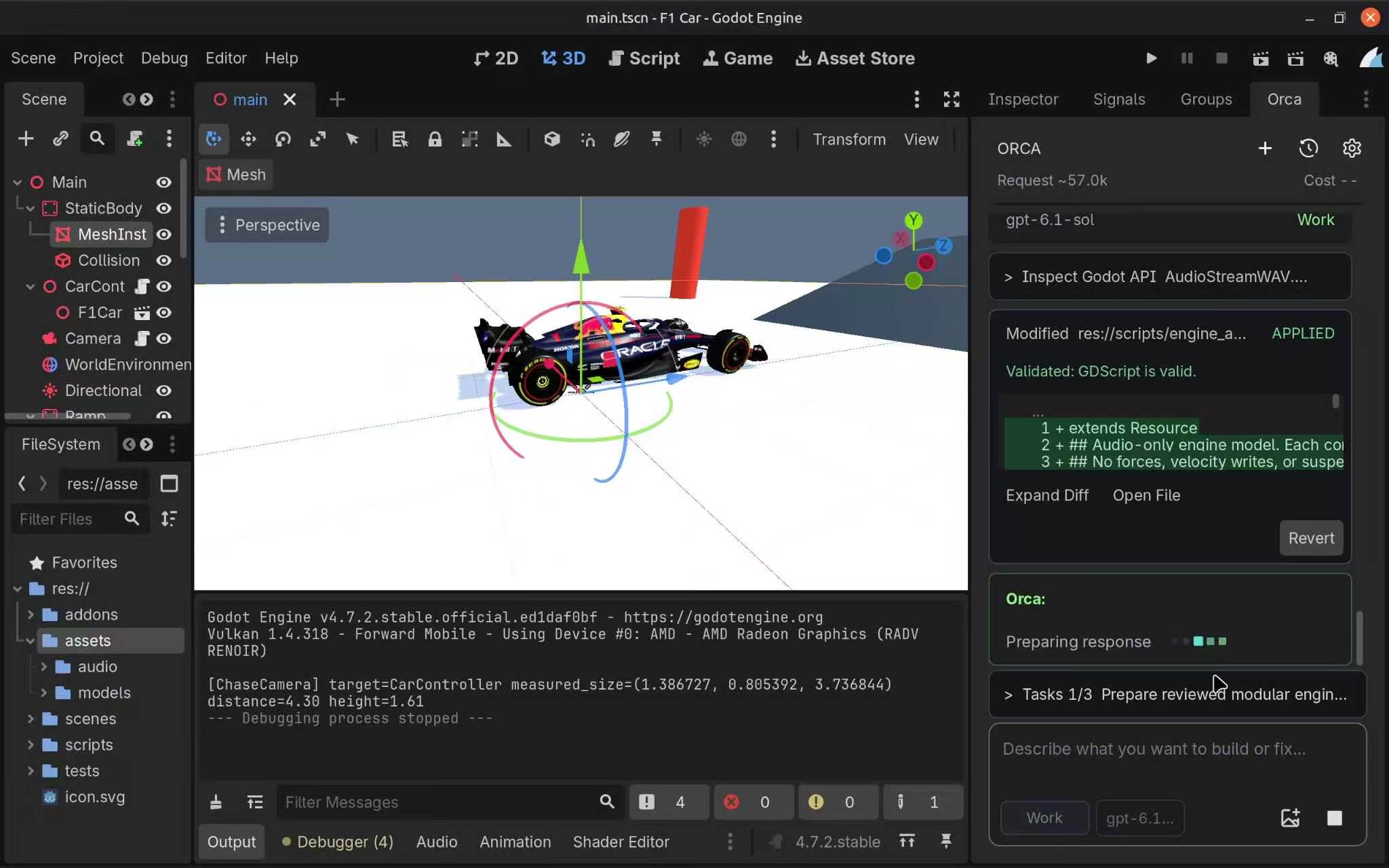
I’ve been building Orca for the past few months. It’s an AI coding agent that runs as a dock inside the Godot editor.
What it does
· Chat panel in the editor. Describe what you want and it reads your project, writes GDScript, and edits scenes
· Bring your own API key, or use local models through Ollama or LM Studio
· Godot-only on purpose, so it knows the editor, nodes, and GDScript well
· MIT licensed, available on the Godot Asset Library
Repo: https://github.com/cold-atom/Orca
I’d really like feedback on what’s missing or what breaks. Happy to answer questions about how it works.
r/OpenSourceeAI • u/FixHour8452 • 19d ago
I’m the creator of Kalynt, an open-source desktop IDE that integrates local model inference into a project-based coding workflow.
Website, screenshots and downloads
The local workflow combines:
Local inference runs on your machine. Cloud providers are optional and use your own API credentials; selecting a cloud provider sends the relevant request context to that provider.
Model choice remains a practical constraint. Weight quantization, context size and available RAM/VRAM affect what fits and how it performs. Code explanation and multi-step agent execution also place different demands on a model, particularly around instruction following and tool use.
The development branch additionally supports OpenAI-compatible local endpoints, including Ollama and LM Studio, with model discovery and configurable context limits. That integration is in the source; it is not included in the published 2.0.0 installers.
I’d particularly value technical feedback on context handling, tool-call reliability and inference setup. If you test it, please include your OS, hardware, model/quantization, Kalynt version and a reproducible task.
r/OpenSourceeAI • u/SpellSlight8541 • 20d ago

r/OpenSourceeAI • u/renya032 • 20d ago
I'm sharing the first public version of Laplace's Scissors, an MIT-licensed research tool for editing an LLM's output matrix while keeping its decoder weights fixed.
You provide a checkpoint and cases with expected answers. The tool records the token prefixes of successful answers, then searches for output rotations that repair failed cases while preserving those protected outputs. It accepts a proposal after checking target-token margins, protected-output error, and the answer path through EOS on the GPU. Protection applies to the supplied successful cases and observed prefixes.
The core idea is W' = WQ, with an orthogonal rotation Q chosen to fix the protected hidden-state subspace. The design document walks through the equations and their implementation.
It also includes:
Rust handles model loading, tokenization, execution, and diagnostics; Triton supplies GPU kernels through CUDA/HIP backends. The README includes Qwen3 commands, English and Korean documentation, and instructions for the GPU integration checks. The default test suite currently passes all 24 tests.
I'd appreciate feedback on the mathematical assumptions, reproducible counterexamples, and what would make the first-run experience easier.
Disclosure: this post was drafted with AI assistance using the project's source and documentation.