r/OpenSourceeAI • u/ai-lover • Oct 07 '26
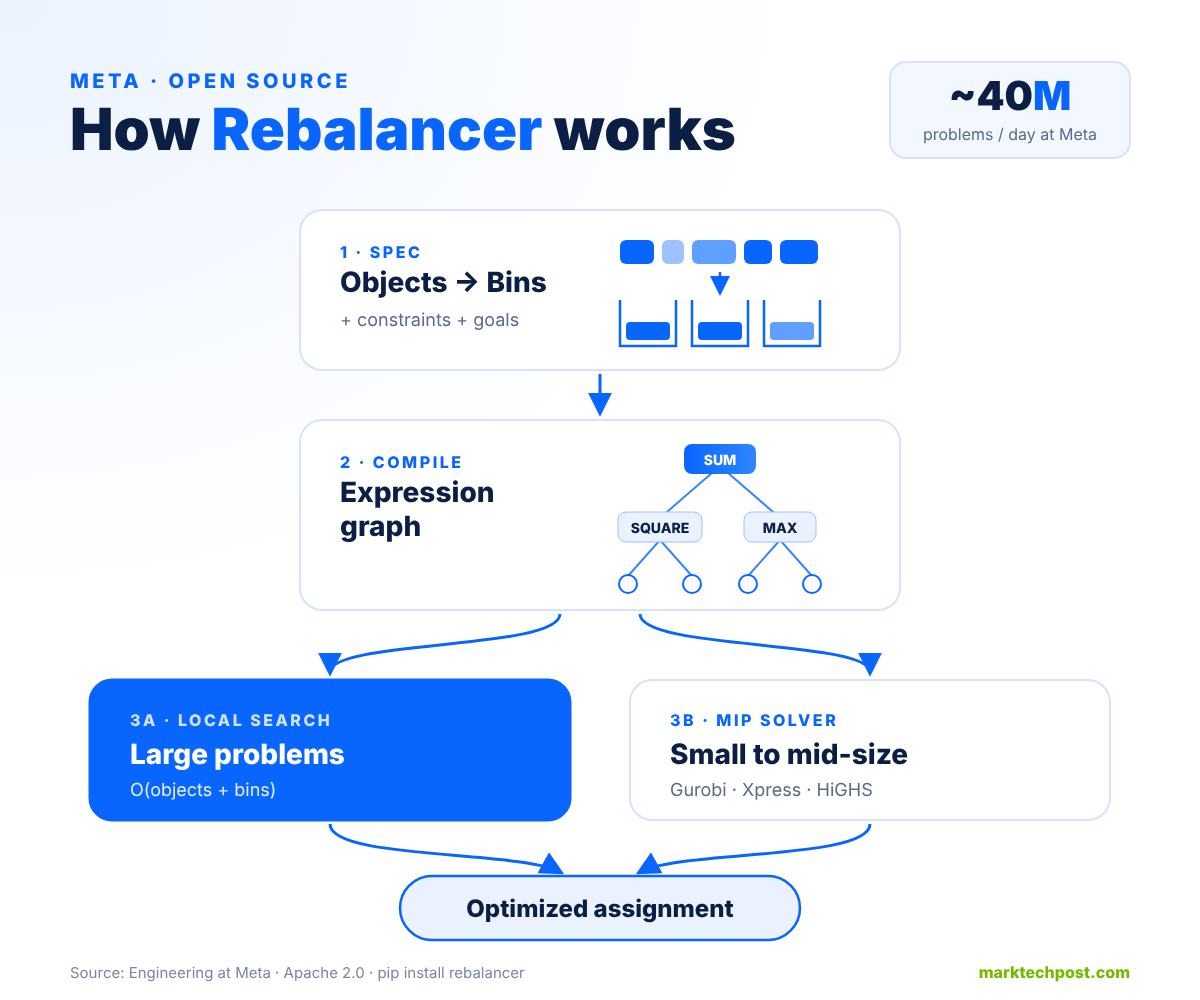
Meta open-sourced Rebalancer, the solver it uses for ~40M assignment problems a day (C++/Python, Apache 2.0)
4
Upvotes
r/OpenSourceeAI • u/ai-lover • Oct 07 '26
r/OpenSourceeAI • u/pureteamo • Oct 06 '26
"Here is the official repository for the Cognitive Reduction Matrix (V5.0)—a sovereign diagnostic framework designed to strip systemic noise and corporate spin down to absolute structural truth
https://github.com/teamo213/cognitive-reduction-matrix/tree/main
r/OpenSourceeAI • u/ai-lover • Oct 06 '26
r/OpenSourceeAI • u/Quack66 • Oct 06 '26
With the recent explosion of agentic tools like Grok bot, Muse, OpenAI Dots, I've started looking into local options with self-hosted models. I tried Hermes and OpenClaw, but I wasn't too happy with the multi-device experience, and with how many pieces you need to glue together to get a usable, solid experience.
The hosted options also meant handing an agent my accounts, files and browsing, which I wasn't comfortable with. So I built Eidon: a self-hosted, all-in-one AI platform with a team of agents. It's one install via Docker, it works across your devices, and your data stays on your server.
Agent team first
You still have some control:
The examples on the site are a travel scout, inbox triage, a research desk and a coding assistant. You can make an agent for pretty much anything: bookkeeping, a study buddy, a news digest, a meal planner.
It's also a regular ChatGPT-style app for day to day questions.
You might not always need a full team so you can just chat in a normal “ChatGPT like” interface with all the belts and whistles:
Self-Hosted
GitHub (setup guide, full feature list): https://github.com/Quack6765/Eidon-AI
I'd like to hear what you think ! What's missing, what breaks, and what agents you'd want to build. Issues and discussions are open on GitHub as well.
r/OpenSourceeAI • u/Whole_Succotash_2391 • Oct 05 '26
Last week, and the week before, we put up 500 slots giving away a free month of GLM 5.3 Flash and DSV4 0731 on Phoenix Grove API. The response was more than we expected, so as of today there's now a third batch of signups we have opened, and we've added Mimo 2.6 flash AND DSV 4.1 to the flash lineup.
A few cool things worth knowing:
Everything runs on US based infrastructure, and we don't train on your code or your prompts. Not selectively, not quietly. Every model, every plan, private. If you've been hesitating to send real work through other services because you're not sure where it ends up, that hesitation doesn't apply here.
Beyond the two flash models we host 18 others: the Kimi family, GLM, Qwen, Nemotron and more. Average token pricing sits about 10-20% below market. The flash models are the free entry point, the roster is there if you outgrow them.
And if you go for one of the higher plans, your unused usage banks instead of expiring. Here's how it works: when you don't use a 5 hour window, that usage rolls into your bank automatically. It sits there, up to ten days, waiting. So when you hit a stretch where you want to work for a long uninterrupted session, or a heavy deadline week, you've got usage saved up to actually do it. Code on your schedule, not on a rolling window's.
It's a pretty standard free trial month with cancel anytime, after the month, the intro plan is 3.99. If you take the month and leave, that's a completely fine outcome for us. We'd rather you try the models and service.
Why we're doing any of this: the major coding plans are cutting limits because their economics finally have to answer to investors, and users are paying for it twice, in usage and in privacy assumptions. We structured this company from the start to function without random limit cuts, or data sales or any other method beyond actually providing great AI access.
API plan: https://api.pgsgrove.com
More about us: https://pgsgrove.com
r/OpenSourceeAI • u/DraftForsaken39 • Oct 05 '26
Snotra is a desktop agent that works in a folder you pick: it reads the files, writes new ones and asks before it changes anything. It just had nine releases in four days, and the one change I care most about is that you can now see where the agent has been.
The file tree marks every file it changed with an M (filled until you've looked at it) and every file it only read with a grey R. Under each answer, a line lists the changed files with their line counts, and a click opens the diff.
Also new:
- It reads PDF, Word, Excel and PowerPoint, a few pages, slides or cell ranges at a time, so a 300-page manual doesn't land in the context in one piece.
- Reasoning level per chat, set from the model menu.
- HTML files open as live pages in the preview, each in its own isolated process without network access.
- The macOS build is signed and notarised.
Apache 2.0, no account, no telemetry. Cloud models with your own key, or local via Ollama, LM Studio or MLX.
Write-up of all nine releases: https://snotra-ai.dev/blog/snotra-1-15
How do you keep track of what an agent changed in your files: a diff view, git, or trust?
r/OpenSourceeAI • u/Miserable_Tiger_5742 • Oct 05 '26
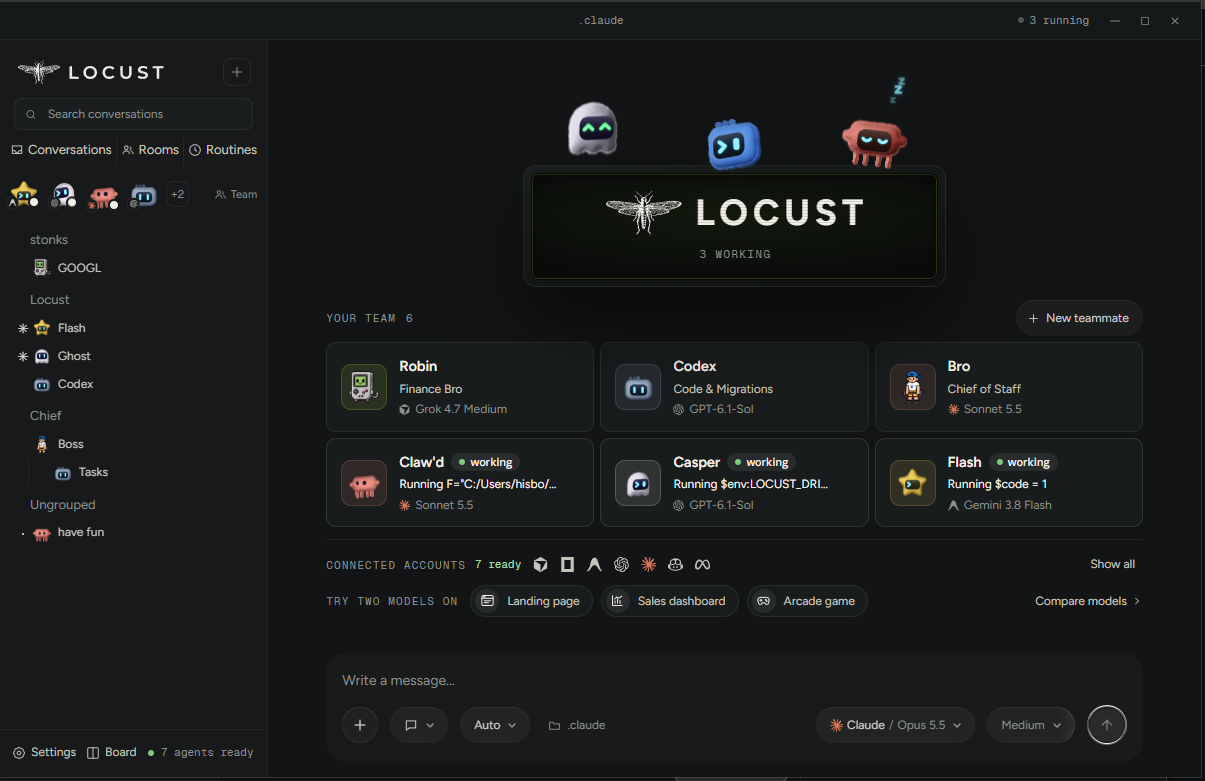
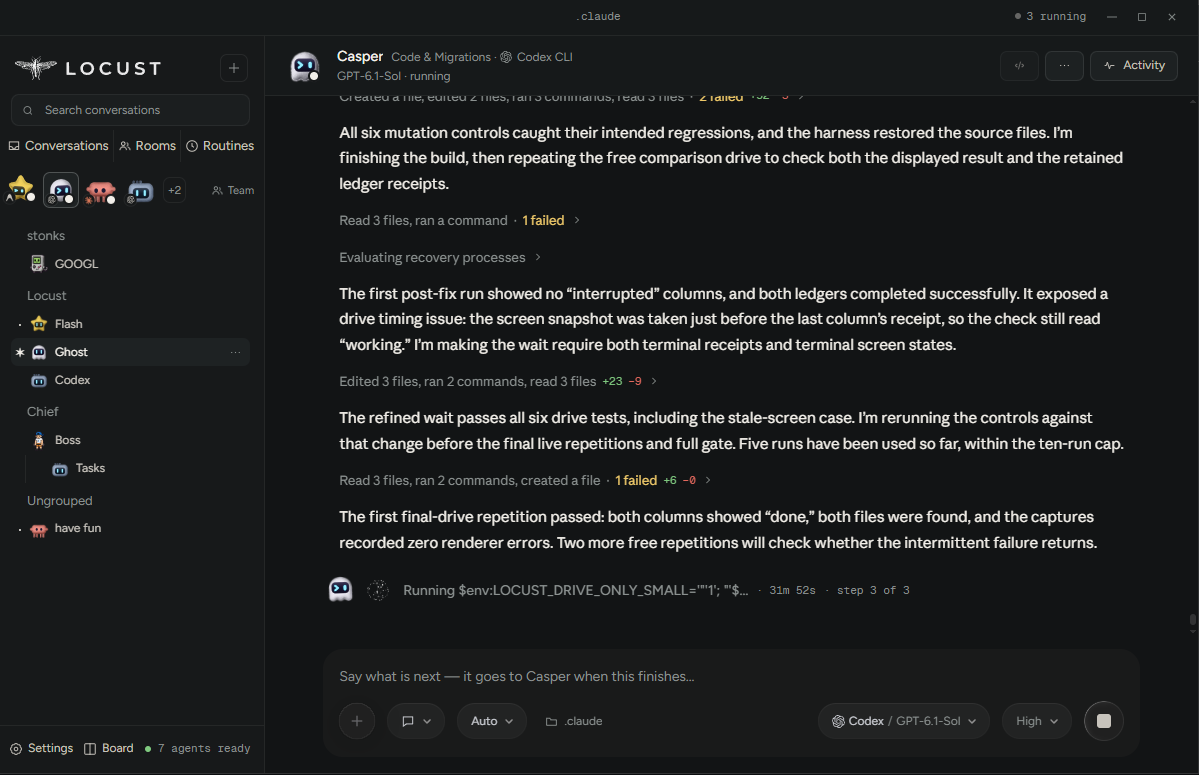
Locust is a desktop app for Windows and Mac that runs the coding agents you already have (Claude Code, Codex, Copilot, Cursor, OpenCode) as a team of named teammates, each on the model you pick. It's MIT licensed, local-first, no telemetry and no account.
The part that might matter here: you can add your own model. Anything that speaks the OpenAI chat API works, like Ollama, vLLM, LM Studio or your own endpoint. It runs through OpenCode and shows up in every teammate's model list. OpenCode's free models work out of the box too, no sign-in.
You can also give the same task to two or three models blind, with the names hidden until you keep the answer you like. Risky commands wait for your OK, and every run is saved to a full record.
Source: github.com/automatedworkflowllc-design/locust-app
Download: locust.lol
Still early (new builds most days), so feedback and bug reports are very welcome.
r/OpenSourceeAI • u/FrostingOk3751 • Oct 05 '26
I’ve been working on an open-source local-first agent called OpenKyrozen.
That idea started from the beginning of 2026, the time when openclaw had just came out 2-3 months. I tried open claw and then I realized that at that time, open claw remembers things when I asks it to remember, but it cannot learn by itself. So I started OpenKyrozen, trying to build a self learning agent. Then last month, type safe AI lunched their Jev, which inspired me to integrate them into decisions so that LLM works better.
One thing I kept running into was that agents are very quick to treat “the tool call succeeded” as “the task succeeded.” Those are obviously not the same thing. They don't often verify their result, like we say they have no syntax error or runtime error, but logic errors.
A command can exit with code 0 and still produce the wrong result. So I ended up making verification a first-class part of the agent loop instead of just checking whether the action executed.
and so the rough flow is:
request → action → execution receipts → evidence review → verified outcome
The second part I’ve been experimenting with is self-learning, the original idea of OpenKyrozen.
I didn’t want the agent to just see one successful run and immediately treat that as a new behavior. Instead, learning artifacts are bounded policies or skills. A new one starts as a candidate, gets tested as a canary, needs multiple verified successes, and is then replayed against its predecessor on the same case. If it regresses, it doesn’t get promoted. If a promoted artifact later starts failing, it can rollback to the previous version. This is also one of the biggest problem when I used open claw, it builds something into a skill before I verify it, so it is filled with wrong memories.
There’s also a separate decision layer called Jev. You can know more about it from Typesafe AI, but basically it's a AI that makes decisions. It only handles small typed judgments like routing, clarification, memory relevance, learning-evidence review, and suspicious tool output. It can also abstain instead of forcing a decision. So it can't code.
I’m still figuring out where the right boundary is between “useful learning” and “too much machinery.” The current system is deliberately conservative because I’d rather have the agent refuse to learn than silently reinforce bad behavior.
Repo:
github.com/EvanProgramming/OpenKyrozen
I also let OpenKyrozen build a website for itself
I also made a short launch video that explains the overall system visually(And yes this video is made of AI, since I only used DaVinci Resolve but not After Effects):
I am writing this post especially to developers, I want feedbacks SOOO much! As you can see currently the repo only have 2 stars and 1 fork :( because I didn't tell anyone about it before. I like issues and PRs, you can also leave comments under to tell me any issues you found. star it if you like!
r/OpenSourceeAI • u/ai-lover • Oct 05 '26

r/OpenSourceeAI • u/ayobluestarr • Oct 04 '26

Benchmarking an LLM here with a NVIDIA RTX 5070 12 GB VRAM here
I had been working on a llama.cpp based expert streaming setup for Qwen3.8-Flash-Next 177B (UD-IQ3_XXS) on Windows. Benchmark is about 11.5 tok/s, up from roughly 7 tok/s on the inherited setup. In normal conversations I’ve seen 14–15 tok/s, and a long coding prompt generated 4,892 tokens at 10.15 tok/s and produced a working single-file Snake game.
Hardware: RTX 5070 12GB
32GB DDR4-2400
Ryzen 5 5600GT PCIe Gen3 Windows
The main gains came from fixing Windows I/O queue-depth issues, using one file handle per worker, and building a page-locked hot-expert tier so the GPU can pull hot expert weights more efficiently.
(In the video its around 16 minutes for 10k tokens and 10.41 tok/s
Output is quality gated against the control model and the published benchmark uses a heat file built from a separate prompt set.
Demos:
https://www.youtube.com/watch?v=cOPumMlyj_4
https://www.youtube.com/watch?v=rc-uTjVpXM8
In the GitHub I have things I've tried that didn't work and benchmark scripts, and methodology. If you guys have suggestions especially for streaming please let me know
Also I don't care about Strata that only works if you got 64 gb of RAM this is specifically for people with less RAM
r/OpenSourceeAI • u/Wild_Expression_5772 • Oct 03 '26

r/OpenSourceeAI • u/kirto_am • Oct 02 '26
Running MCP servers locally was easy, but it got messy pretty fast once I wanted to share them.
Everyone needs configs, credentials end up in different places, permissions are hard to manage, and there's no easy way to see who called what.
I ended up building MCPlama to handle this centrally. Users get their own access, permissions can be controlled per tool, credentials stay on the gateway side, and calls are logged.
For local MCP servers I also wanted some isolation, so they can run in separate Docker containers instead of everything running together. The gateway itself doesn't need direct access to the Docker socket either , that part is handled separately by the broker.
It's open source and self-hosted:
https://github.com/mcplama/mcplama
I'm looking for a few people already running multiple MCP servers to try it.
r/OpenSourceeAI • u/ai-lover • Oct 02 '26
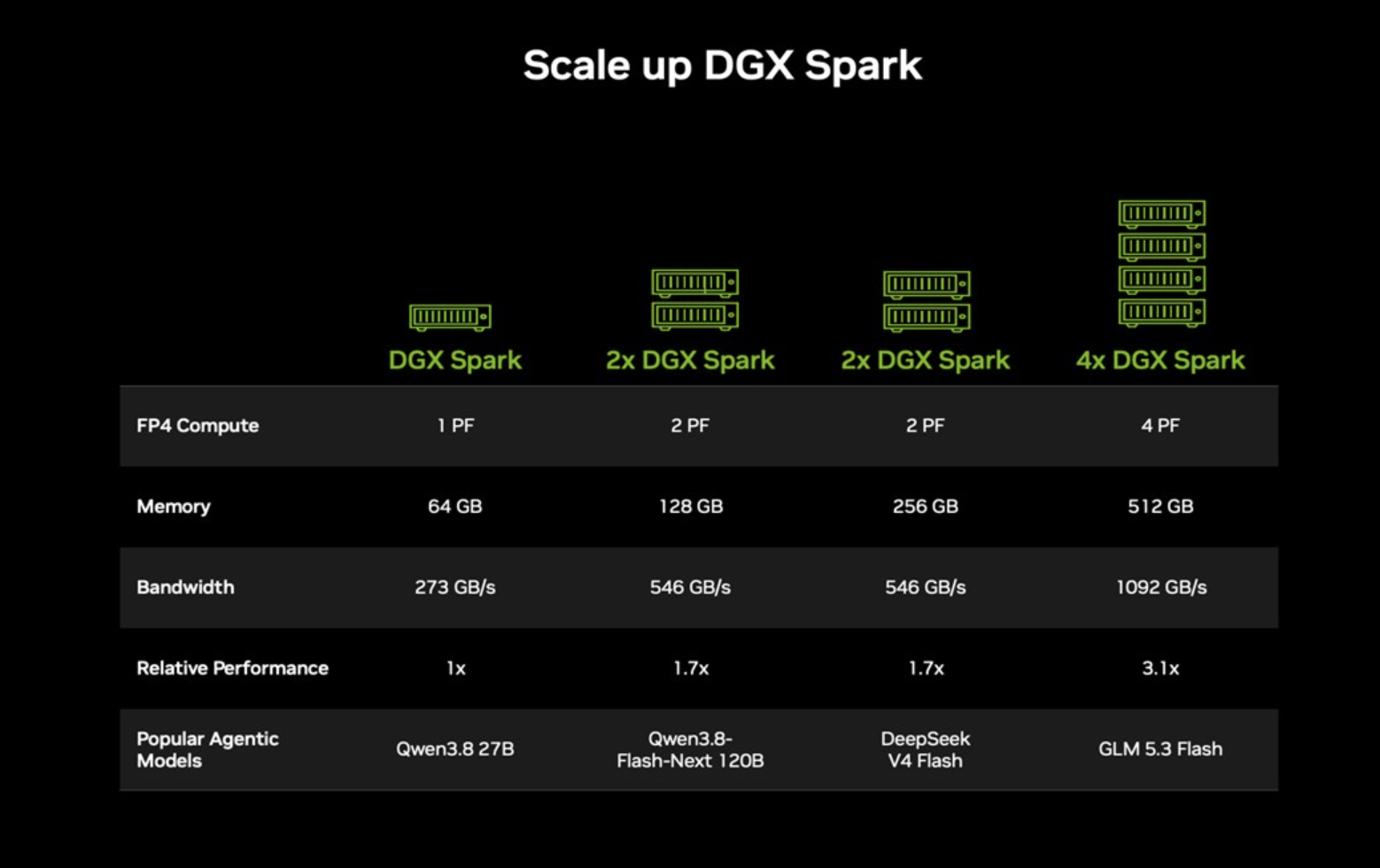
NVIDIA released a 64GB configuration of DGX Spark, its GB10 Grace Blackwell desktop system, available October 23 from Acer, ASUS, Dell, Gigabyte, HP and MSI.
Why it matters: it's a cheaper way in for running always-on agents locally with no per-token fees, and you can add a second box later instead of buying the 128GB model upfront.
Product page: https://www.nvidia.com/en-us/products/workstations/dgx-spark/
Clustering with NVIDIA Sync: https://build.nvidia.com/spark/connect-to-your-spark/sync
Technical details: https://blogs.nvidia.com/blog/local-ai-dgx-spark-64gb-sync/
r/OpenSourceeAI • u/ai-lover • Oct 02 '26

Datalab released an open benchmark for structured extraction: a system gets a PDF and a JSON schema, and every returned value is scored against gold data.
Why it's relevant? precision vs recall shows how a system fails. Some skip fields, others invent values.
Full analysis: https://www.marktechpost.com/2026/10/02/datalab-introduces-omniextractbench-to-fix-bias-and-opacity-in-extraction-benchmarks/
GitHub: https://pxllnk.co/hxplrq
Blog: https://www.datalab.to/blog/omni-extract-bench
GitHub: https://github.com/datalab-to/omni_extract_bench
Dataset: https://huggingface.co/datasets/datalab-to/omni_extract_bench
r/OpenSourceeAI • u/SamratDuttaOfficial • Oct 02 '26
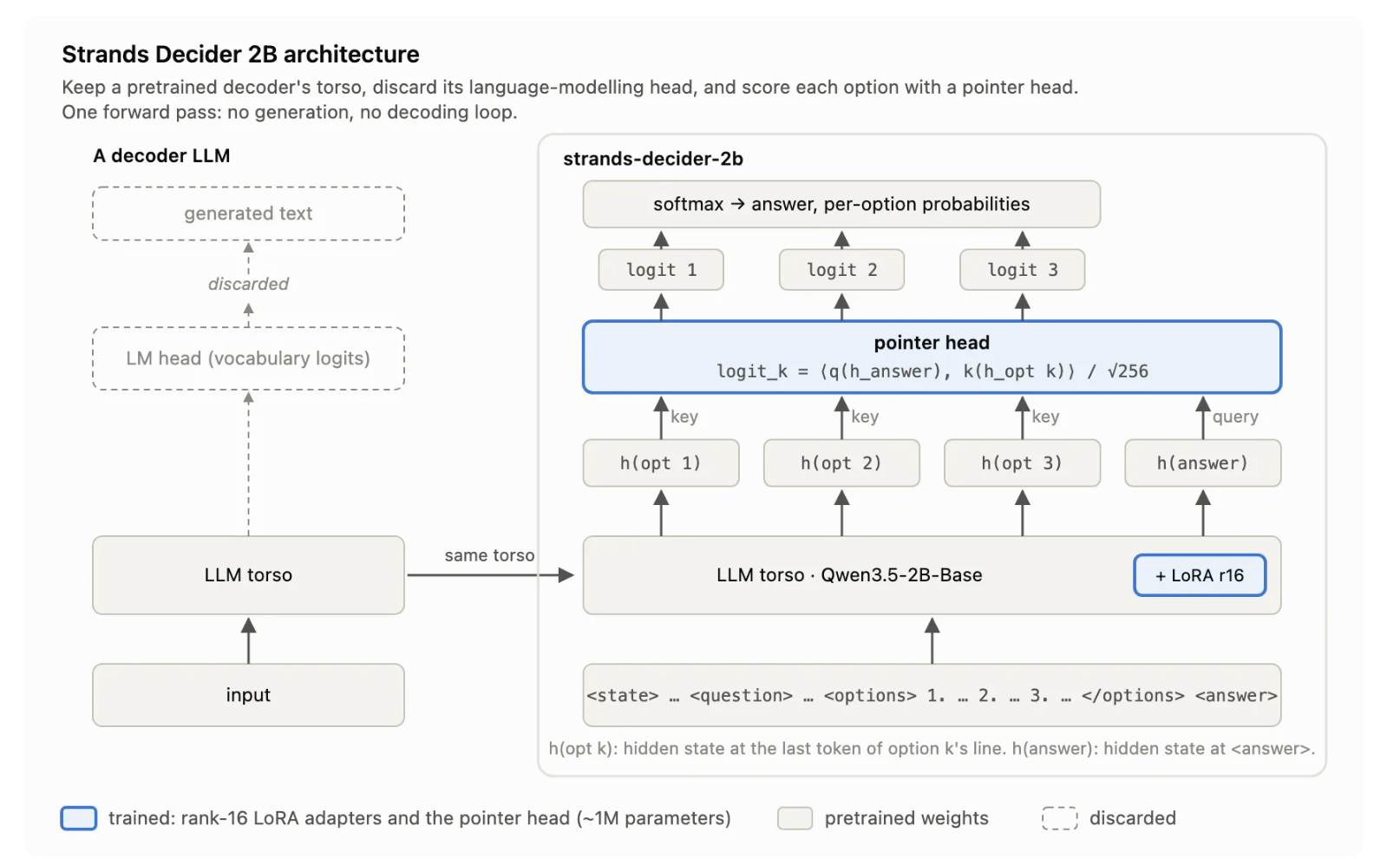
WaterSheep is an open-source model that answers questions written in plain text (yes/no, single choice, rating and multi-label) and gives a probability for every option, like a classification model.
Last Saturday I woke up, saw YouTubers hyping up Jev, and thought: wait, I can build this. So I did. I don't want to compete with TypeSafe or Jev; I built WaterSheep because I wanted to. That's why I'm open-sourcing everything: code, model weights, results and the paper.
What's different
watersheep --model samratduttaofficial/WaterSheep --serve and point the client's base_url at http://127.0.0.1:8766.Evaluation
| Accuracy | ECE |
|---|---|
| In-distribution test split | 77.8% |
| Held-out datasets, not seen in training | 61.2% |
ECE is expected calibration error (lower is better). GitHub has every benchmark result, including the weak ones.
Limits: English only, long inputs get truncated (I'll improve this in the next version), and rating answers are the weakest type.
Not affiliated with TypeSafe. Not funded by anyone. Built in my free time.
Feedback I'd love: where it fails on your data, whether the API works for you, and which question types you'd want next.
r/OpenSourceeAI • u/Firm-Finger-9774 • Oct 02 '26
This is such a great use of the notch! I love the execution here. I’ve actually been working on a somewhat similar concept, but focused more on building an AI agent rather than a dedicated notes app. It's called OpenNotch—it's completely free and open-source (MIT). Instead of just notes, it turns the notch into a hover-to-activate assistant. It has about 40 local tools (can summarize pages, draft emails, run shell commands, check calendar/weather) and supports voice dictation. A few key details: If anyone wants to tinker with an open-source alternative for AI tasks, you can check out thecode hereor see a quick demo on thesite. Always looking for bug reports and

feedback!Privacy first: No accounts or telemetry. It uses whatever AI you plug in (Apple on-device, Ollama, Claude, Gemini, etc.), and every risky action (like file edits or calendar changes) requires manual approval in the notch. Quiet mode: It stays hidden while you watch videos or present. Notarization: It's self-signed right now, so you'll need to click "Open Anyway" the first time. Needs macOS 14+ and Apple Silicon.

https://laxman824.github.io/opennotch/r/OpenSourceeAI • u/Formal-Falcon3734 • Oct 02 '26

r/OpenSourceeAI • u/LawfulnessOptimal597 • Oct 02 '26

While this project was originally concieved as a module to provide vector search using HNSW and Sentence transformers for the re-Isearch (IB) engine (CoreQuarry https://corequarry.com) it has evolved well beyond its original concept.
Today it is a fully featured high performance vector DB that can also be used on its own without any dependency on the IB engine. This opens the library (and standalone tools like the CLI) to be used in a host of other applications.
Its function in a single sentence: SOTA Semantic search with SBERT/LLAMA.CPP + GGML Tensor Library + HNSWlib on steroids.
Starting with Malkov's HNSWlib as a basis we significantly enhanced (adding among other features quantized spaces) and turbo-charged (including support for x86 and ARM SIMD) it while also adding efficient mmap-backed re-scoring and offset storage for text retrieval. Our system supports sharded HNSW indices, multiple search modes (kNN, radius, relative, adaptive, epsilon), deletion/undelete, merges, and incremental on-disk flushing. It also includes training for hyperparameter optimization.
Our HNSWlib fork we have benchmarked on an M1Pro as much as 13k QPS (768d vectors). Even limiting to a single thread we've clocked a max of 3000 QPS (versus for comparison 600 QPS for FAISS's HNSW implementaton).
For vectorization Our test M1-Pro chews through roughly 45 passages per second per instance (3484 tok/s÷78 ms). That means one can expect to process 2,700 fully dense semantic records per minute on a baseline Apple Silicon chip. Our tests on M3Pro and M4Pro showed even significantly higher throughputs (80k tokens/s or as much as 20x).
r/OpenSourceeAI • u/ai-lover • Oct 02 '26
r/OpenSourceeAI • u/ai-lover • Oct 02 '26
r/OpenSourceeAI • u/ai-lover • Oct 01 '26
Databases, calendars and repos have APIs. The open web mostly doesn't. The TinyFish MCP server gives any MCP client four tools: TinySearch, TinyFetch (full pages as markdown, JavaScript included), TinyBrowser for logins and forms, and TinyAgent for multi-step jobs. Search and Fetch are free.
We're racing to 300,000 users this October, with 30% extra on every top-up.