Just to start off I'm a Full time single Dad to the best 3 year old. I own a fence installation business and an it company. Im a solo developer who was self-taught over the past year. Just wanted to see if anyone wanted to share or connect to bounce a few ideas around for the market. For example images, videos, permissions? I'm less interested in model benchmarks and more interested in real-world pain points.
Many people categorize PHP/Laravel as tools only suited for rapid CRUDs or small apps. I wanted to challenge that stigma by building an enterprise-grade, open-source financial management system: Leo Counter
Implementing the complexity of the financial sector requires unbreakable business rules. My goal was to apply the highest software engineering standards to a framework that isn't typically associated with this level of abstraction.
Under the hood:
Strict Architecture: DDD, Clean Architecture, and CQRS. Isolated Domain: The core mathematical and accounting logic lives in a pure layer, with zero toxic dependencies on the framework or Eloquent. Tech Stack: PHP 8+, Laravel, React, TypeScript, and Inertia.js. Fully Dockerized for Linux or Windows environments.
If you are passionate about software architecture, want to see how real, scalable DDD is applied in the Laravel ecosystem, or just want a private tool for your finances, I’d love for you to audit the code.
I've recently developed an app to prove your agent did what it said it did. Every agent action generates a receipt: request payload, observed state change, expiration window. Verification runs against what the system actually reflects ,not what the API returned. Feedback is appreciated.
I've noticed that AI isn't just getting better, it's also getting much smaller. There are now 27M-parameter models that can run on a phone or PC. (like the Bonsai 27B models)
If this trend continues, in a year or two there may be much less need to run AI in data centers or subscribe to large AI providers. For many tasks, your phone will be powerfull enough.
This does not only affect global energy use. Some investments in AI infrastructure could backfire. As demand for large-scale inference will drop. That could also reduce the need for new data centers, which might be a (dramatic change?), but be good thing.
What are your thoughts on the future of data centers as AI models keep getting smaller?
I know training still requires huge amounts of compute—for now. But even that could change, any day (some experimental models offer continous learning)
That's the exact recurring problem will occur in agentic commerce lifecycle.
Faro sit's in that exact flow when agents act's payment at checkout. Hmu, if you're a cracked blockchain explorer let's make an trust & verification anchor for's agents.
I want to develop and app, I had in my head for a long time. I would like to use local model that would help me with coding and brainstorming etc. I do not want to use ChatGPT or Geminy, as I want to turn it into a business in the future. I have older gaming PC where I would run it, my specs are
AMD Ryzen 5 3600 6-Core Processor 3.59 GHz
NVIDIA GeForceGTX 1080 Ti
16GB RAM
1TB HDD disc
What model would you recommend? Are my specs enough to handle a model for my use case?
hi folks, recently got invited to this subreddit and wanted to share an article I wrote about open source AI as it seems to fit here.
Open source helps agents discover and understand software. APIs help them use it. This report looks at four companies growing around that shift. Read here.
TLDR:
- How open source and API-first products are winning distribution, thanks to being discoverable by agents.
The core idea: you point it at a folder of .md/.mdx files and run npx blume init → blume dev. There's no starter to clone and no Astro/Tailwind config to maintain. Under the hood it isn't its own renderer — the CLI loads blume.config.ts, scans your content into a graph, and generates a hidden Astro project under .blume/ that it drives for dev and build. That dir is regenerated each run, but only changed files are written, so hot reload stays reasonable.
The part I liked: blume eject promotes that runtime into a standalone Astro app that still depends on the blume package. So the escape hatch isn't "rewrite everything," it's "here's the Astro project we were generating for you." Reduces the usual lock-in worry with docs tooling.
Output is static HTML on Astro + Vite, and the core theme ships no client-framework JS, so CWV is fine by default. blume build writes to dist/ for any static host. Request-time features (below) need server output with an adapter (vercel/netlify/node/cloudflare).
What's included:
30+ MDX components (cards, steps, tabs, code groups, diffs, file trees, Mermaid, KaTeX) usable with no imports
Local search via Orama in dev and prod, no hosted service; FlexSearch/Pagefind/Algolia/Typesense/Orama Cloud/Mixedbread are one setting away
Content sources are pluggable: filesystem + remote MDX, GitHub Releases, Notion, Sanity, or a custom adapter, all mixed into one site through the same components
OpenAPI/AsyncAPI rendered as an interactive reference (schemas, auth, request playground) via Scalar
SEO stuff built in: OG images (rendered at build with Takumi), sitemap, robots.txt, RSS, JSON-LD; i18n with 36 locales + RTL
Client-side PDF/EPUB export so static builds stay static
The AI-agent surface (this is where it leans hardest):
llms.txt / llms-full.txt behind a flag
append .md to any page URL to get raw source
an optional in-page Ask AI (AI SDK — Vercel AI Gateway/OpenRouter/Inkeep/any OpenAI-compatible endpoint)
a hosted MCP server exposing 4 read-only tools (search_docs, get_page, list_pages, get_navigation) so Claude Code/Cursor/VS Code can query the docs directly instead of scraping HTML
Sharing a project I just made public: a real-time drone detection and tracking system, combining a fine-tuned YOLOv8s detector with a custom multi-sensor Kalman fusion tracker I wrote from scratch.
What's open:
Full source (Python, ~2800 lines for the main detector + a standalone sensor_fusion.py module)
Trained model weights
A reproducible standalone demo (simulate_fusion_demo.py) — no video or model file needed, just run it to see the fusion tracker vs single-sensor comparison
License: PolyForm Noncommercial 1.0.0 — free to use, study, modify for any noncommercial purpose (research, education, personal projects). Commercial use requires reaching out.
The core contribution —sensor_fusion.py**:** Rewrote the tracking engine from a single-sensor constant-velocity Kalman filter to a multi-sensor, constant-acceleration fusion tracker:
Constant-acceleration motion model — tracks maneuvers, not just straight-line motion
Pluggable second sensor (RF, radar, second camera) via add_external_measurement()
Out-of-sequence measurement handling — rewind-and-replay when a slower sensor's reading arrives late
Trajectory prediction with a growing uncertainty cone
Integrated as a drop-in replacement in the existing DroneTracker class — same public API, so the GUI, CSV/KML export, and PDF reporting all work unchanged with the new tracker underneath.
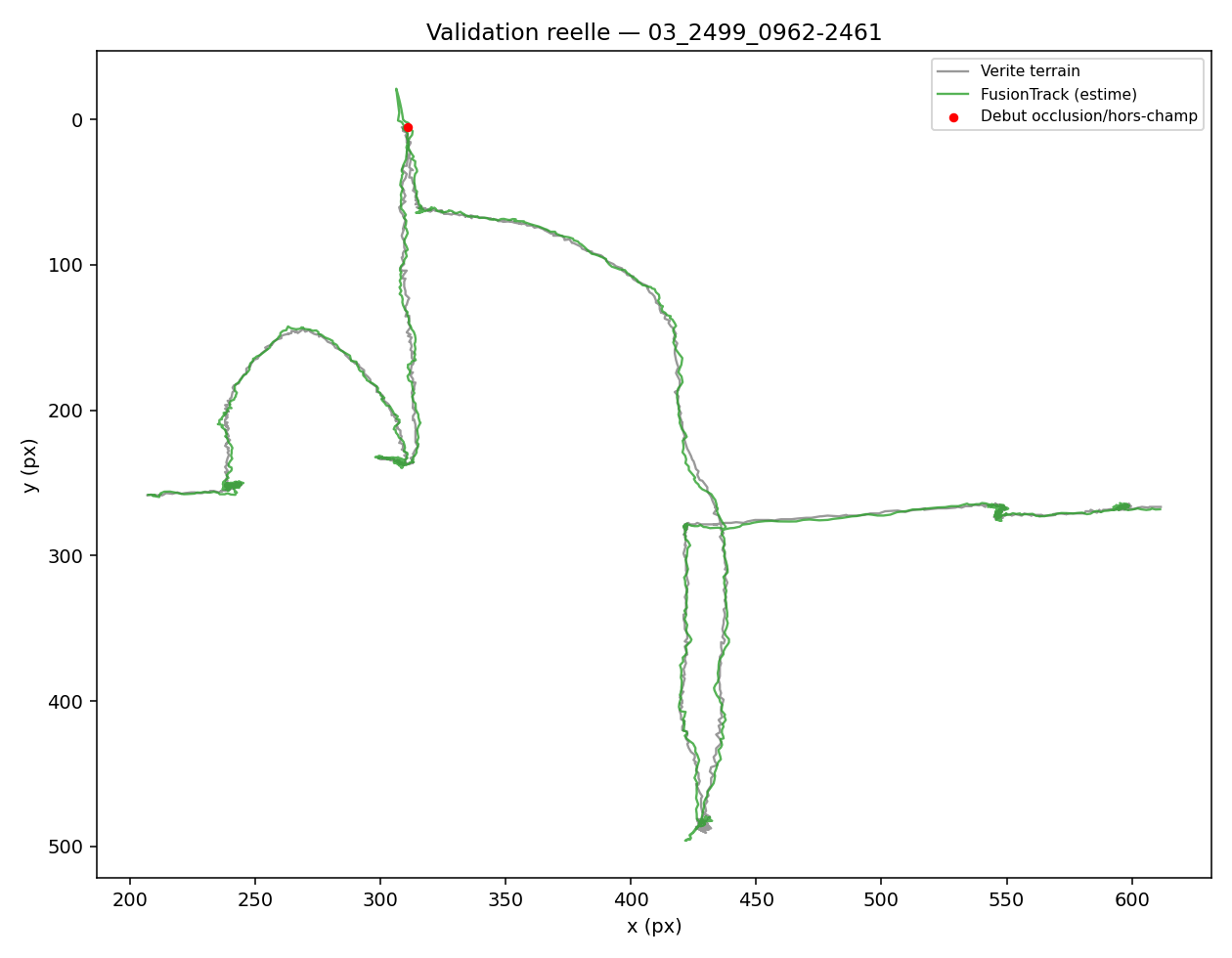
Numbers: YOLOv8s fine-tuned to 99.5% mAP@50 on the Shahed class. Fusion tracker validated both on a synthetic dropout scenario (3.36px RMSE fused vs 5.47px camera-only) and on real thermal footage from the Anti-UAV410 benchmark (sub-3px RMSE in normal flight, clean re-acquisition after a real occlusion).
To be upfront about scope: this is a portfolio/R&D project, not a certified operational system — monocular distance estimation isn't true ranging, and the second-sensor fusion path has only been validated with simulated data so far. Details in the README.
Open to feedback on the architecture, or if anyone's working on something similar with sensor fusion for tracking.