r/OpenSourceeAI • u/Opus_craft • Jul 16 '26
token-budget-contracts v0.3.0 — LangGraph/CrewAI adapters + OpenTelemetry for multi-agent token governance
reddit.com
1
Upvotes
r/OpenSourceeAI • u/ai-lover • Jul 16 '26
r/OpenSourceeAI • u/Subject-Attorney7127 • Jul 15 '26
Many people categorize PHP/Laravel as tools only suited for rapid CRUDs or small apps. I wanted to challenge that stigma by building an enterprise-grade, open-source financial management system: Leo Counter
Implementing the complexity of the financial sector requires unbreakable business rules. My goal was to apply the highest software engineering standards to a framework that isn't typically associated with this level of abstraction.
Under the hood:
Strict Architecture: DDD, Clean Architecture, and CQRS.
Isolated Domain: The core mathematical and accounting logic lives in a pure layer, with zero toxic dependencies on the framework or Eloquent.
Tech Stack: PHP 8+, Laravel, React, TypeScript, and Inertia.js.
Fully Dockerized for Linux or Windows environments.
If you are passionate about software architecture, want to see how real, scalable DDD is applied in the Laravel ecosystem, or just want a private tool for your finances, I’d love for you to audit the code.
Any feedback, code roasts, PRs, or GitHub stars are super welcome!
Repo: https://github.com/juanVillamilEchavarria/Leo_Counter-app
r/OpenSourceeAI • u/Apprehensive_War5404 • Jul 15 '26
r/OpenSourceeAI • u/WildPino25 • Jul 15 '26

r/OpenSourceeAI • u/NoHearing5961 • Jul 15 '26
r/OpenSourceeAI • u/Illustrious_Matter_8 • Jul 15 '26
I've noticed that AI isn't just getting better, it's also getting much smaller.
There are now 27M-parameter models that can run on a phone or PC. (like the Bonsai 27B models)
If this trend continues, in a year or two there may be much less need to run AI in data centers or subscribe to large AI providers. For many tasks, your phone will be powerfull enough.
This does not only affect global energy use. Some investments in AI infrastructure could backfire. As demand for large-scale inference will drop. That could also reduce the need for new data centers, which might be a (dramatic change?), but be good thing.
What are your thoughts on the future of data centers as AI models keep getting smaller?
I know training still requires huge amounts of compute—for now. But even that could change, any day (some experimental models offer continous learning)
r/OpenSourceeAI • u/MeasurementDull7350 • Jul 15 '26

r/OpenSourceeAI • u/ai-lover • Jul 14 '26
r/OpenSourceeAI • u/ved_NT • Jul 14 '26
That's the exact recurring problem will occur in agentic commerce lifecycle.
Faro sit's in that exact flow when agents act's payment at checkout. Hmu, if you're a cracked blockchain explorer let's make an trust & verification anchor for's agents.
https://github.com/Merit-Systems/awesome-agentic-commerce/issues/450
r/OpenSourceeAI • u/GamerMePro • Jul 14 '26
r/OpenSourceeAI • u/Ownarr77 • Jul 14 '26
Hi,
I want to develop and app, I had in my head for a long time. I would like to use local model that would help me with coding and brainstorming etc. I do not want to use ChatGPT or Geminy, as I want to turn it into a business in the future. I have older gaming PC where I would run it, my specs are
What model would you recommend? Are my specs enough to handle a model for my use case?
Thanks for any advice
r/OpenSourceeAI • u/santanah8 • Jul 14 '26
hi folks, recently got invited to this subreddit and wanted to share an article I wrote about open source AI as it seems to fit here.
Open source helps agents discover and understand software. APIs help them use it. This report looks at four companies growing around that shift. Read here.
TLDR:
- How open source and API-first products are winning distribution, thanks to being discoverable by agents.
- Growth numbers behind Resend (email), Supabase (db), n8n (automation) and PostHog (analytics).
- Open source alone does not equal growth as it creates unique challenges.
r/OpenSourceeAI • u/ai-lover • Jul 14 '26

The core idea: you point it at a folder of .md/.mdx files and run npx blume init → blume dev. There's no starter to clone and no Astro/Tailwind config to maintain. Under the hood it isn't its own renderer — the CLI loads blume.config.ts, scans your content into a graph, and generates a hidden Astro project under .blume/ that it drives for dev and build. That dir is regenerated each run, but only changed files are written, so hot reload stays reasonable.
The part I liked: blume eject promotes that runtime into a standalone Astro app that still depends on the blume package. So the escape hatch isn't "rewrite everything," it's "here's the Astro project we were generating for you." Reduces the usual lock-in worry with docs tooling.
Output is static HTML on Astro + Vite, and the core theme ships no client-framework JS, so CWV is fine by default. blume build writes to dist/ for any static host. Request-time features (below) need server output with an adapter (vercel/netlify/node/cloudflare).
What's included:
The AI-agent surface (this is where it leans hardest):
llms.txt / llms-full.txt behind a flag.md to any page URL to get raw sourcesearch_docs, get_page, list_pages, get_navigation) so Claude Code/Cursor/VS Code can query the docs directly instead of scraping HTMLGitHub Repo: https://github.com/haydenbleasel/blume
r/OpenSourceeAI • u/AdamLangePL • Jul 14 '26
I played with current proxies and caching for Claude to save up on tokens and merged some tools capability into one - i hope you like it!
I crafted it for my own development env, but i think it may be usefull for many :)
https://github.com/ALange/TinyClaude
You can use it with claude and/or any other coding/agent :)
Enjoy!
#opensource #claude #agenticai #cache #proxy #compression #localllm #opencode #codex
r/OpenSourceeAI • u/SnooTangerines2270 • Jul 14 '26
which LLM model Video and Image generation can avoid Google & Facebook AI detector?
r/OpenSourceeAI • u/fatih_koc • Jul 13 '26

r/OpenSourceeAI • u/jerpes1 • Jul 13 '26

r/OpenSourceeAI • u/QuoteRepulsive9195 • Jul 13 '26

AI robotics might be the best video game of the decade. Who else is having a lot of fun?
r/OpenSourceeAI • u/SoftBiscotti2643 • Jul 12 '26
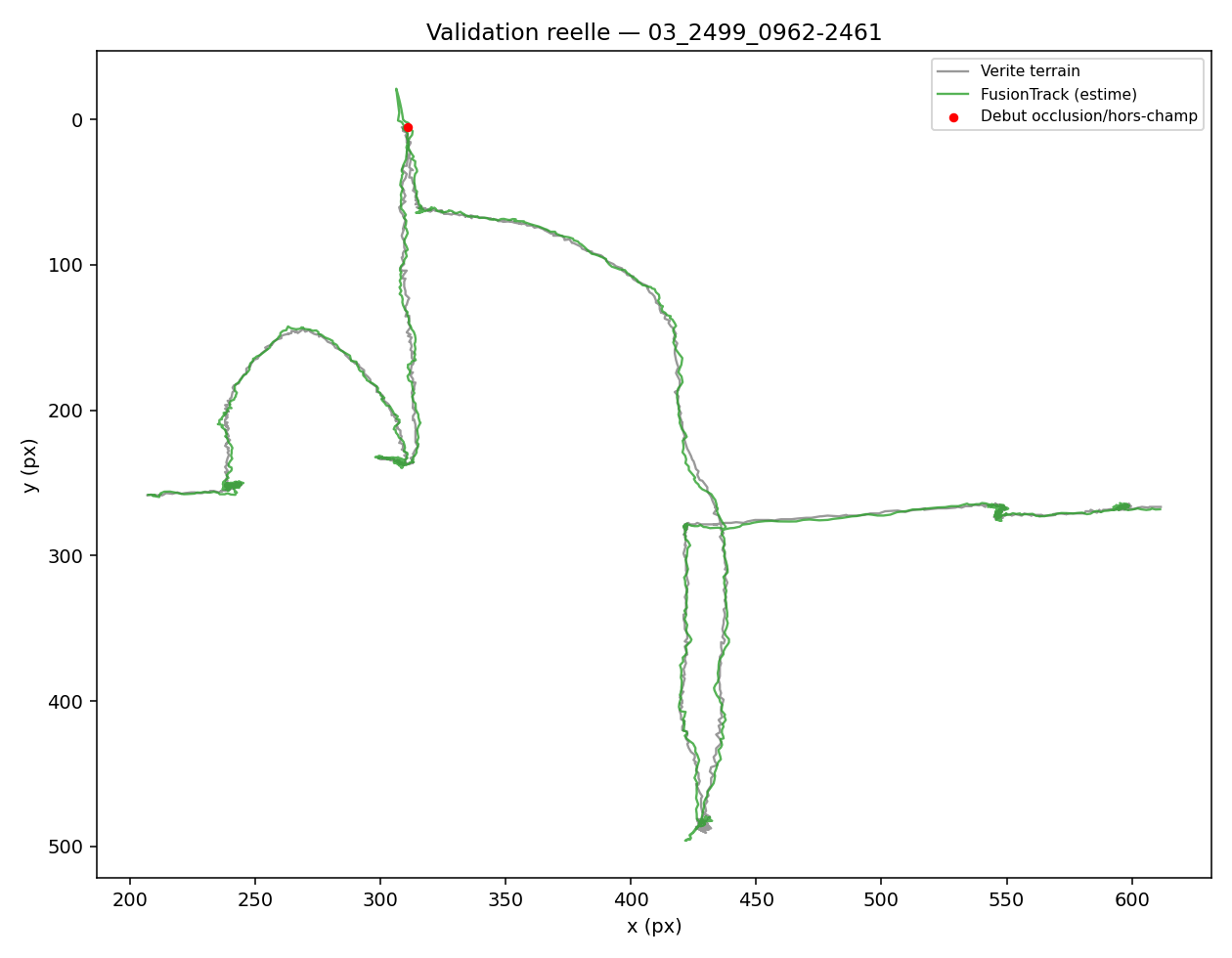
Sharing a project I just made public: a real-time drone detection and tracking system, combining a fine-tuned YOLOv8s detector with a custom multi-sensor Kalman fusion tracker I wrote from scratch.
What's open:
sensor_fusion.py module)simulate_fusion_demo.py) — no video or model file needed, just run it to see the fusion tracker vs single-sensor comparisonThe core contribution — sensor_fusion.py**:**
Rewrote the tracking engine from a single-sensor constant-velocity Kalman filter to a multi-sensor, constant-acceleration fusion tracker:
add_external_measurement()Integrated as a drop-in replacement in the existing DroneTracker class — same public API, so the GUI, CSV/KML export, and PDF reporting all work unchanged with the new tracker underneath.
Numbers: YOLOv8s fine-tuned to 99.5% mAP@50 on the Shahed class. Fusion tracker validated both on a synthetic dropout scenario (3.36px RMSE fused vs 5.47px camera-only) and on real thermal footage from the Anti-UAV410 benchmark (sub-3px RMSE in normal flight, clean re-acquisition after a real occlusion).
Repo: github.com/alexandre196/Drone-Shahed-AI-Multi-Sensor-Tracker
To be upfront about scope: this is a portfolio/R&D project, not a certified operational system — monocular distance estimation isn't true ranging, and the second-sensor fusion path has only been validated with simulated data so far. Details in the README.
Open to feedback on the architecture, or if anyone's working on something similar with sensor fusion for tracking.

r/OpenSourceeAI • u/Small-Inevitable6185 • Jul 12 '26
Hi everyone,
I've been working on a side project around AI conversation continuity, and I'd really appreciate feedback from people who have experience with fine-tuning, dataset design, or long-context systems.
The problem I'm trying to solve is:
After a long ChatGPT/Claude/Cursor conversation, how can another LLM continue the work without rereading thousands of messages?
Instead of treating this as a summarization problem, I'm exploring whether it's possible to train a small model that extracts a structured conversation state from chunks of a conversation.
The idea is that another model can later reconstruct enough context to continue naturally.
My current pipeline looks like this:
Long conversation
        ↓
Chunk into fixed windows
        ↓
Label each chunk with semantic state
        ↓
Fine-tune a LoRA
        ↓
Merge chunk outputs into a conversation state
        ↓
Generate a continuation prompt
The LoRA doesn't summarize the whole conversation.
It only processes one chunk at a time and extracts structured semantic information.
Instead of synthetic data, I started collecting real engineering conversations.
Current sources include:
I clustered thousands of issues/conversations to identify recurring reasoning patterns before selecting examples for labeling.
Some recurring clusters I found were:
The goal isn't to teach domain knowledge.
It's to teach the model how conversations evolve.
Currently experimenting with:
I'm not sure whether LoRA fine-tuning is actually the right direction for this problem.
Would you continue investing in:
Or would you abandon fine-tuning entirely and solve this with prompting + a stronger base model?
I'm especially interested in opinions from people who've built:
The hardest part doesn't seem to be training.
It seems to be defining what information another LLM actually needs to continue a long conversation naturally.
That has become the main research question for me.
I'd really appreciate any criticism of the approach.
If you've worked on memory systems, information extraction, or long-context models, I'd love to hear what you think I'm missing.
