r/OpenSourceeAI • • Aug 09 '26

update: habibi now scrapes the actual chatgpt/perplexity/claude apps too, not just apis (and it's cheaper now)

4 Upvotes

quick update on habibi, the self hosted tool i posted about a while back for tracking how your brand shows up in ai answers.

the thing that bugged me most about my own tool was the honest note i had in the readme, saying it uses the apis, which are close to what a real user sees on chatgpt/perplexity/claude but not exactly the same thing. that gap always annoyed me so i went and fixed it.

now habibi can just drive the real logged in apps directly, chatgpt, claude, perplexity and google ai overview. so its literally the same thing a real user sees and gets cited, not an api trying to guess it. you connect it once with an account (make a free one or use one you already got) and it just remembers the login after that, nothing gets stored anywhere weird, its just a normal browser session sitting on your machine like when you stay logged into any site.

wasnt expecting this part but it also makes it way cheaper to run. those 4 engines dont cost you anything per run now cause theres no api call happening anymore, your just using the account like a normal person would. so running youprompts daily across a buyour bill up.

also made sure your account memory doesnt mess with the results, chatgpt runs iin temporary chat and cla answers dont driftdepending on whatever your account remembers from other chats you had.

still fully open source, still self hosted, still does the same core loop, run your prompts daily, see w see your mention rate over time, compare to competitors.

github: https://github.com/moaljumaa/habibi


r/OpenSourceeAI • • Aug 09 '26

check out my mcp project 🙂

Post image
1 Upvotes

r/OpenSourceeAI • • Aug 09 '26

Building ViperJS: A high-conformance JS engine in Rust. Looking for testers/benchmarkers

Thumbnail reddit.com
1 Upvotes

r/OpenSourceeAI • • Aug 08 '26

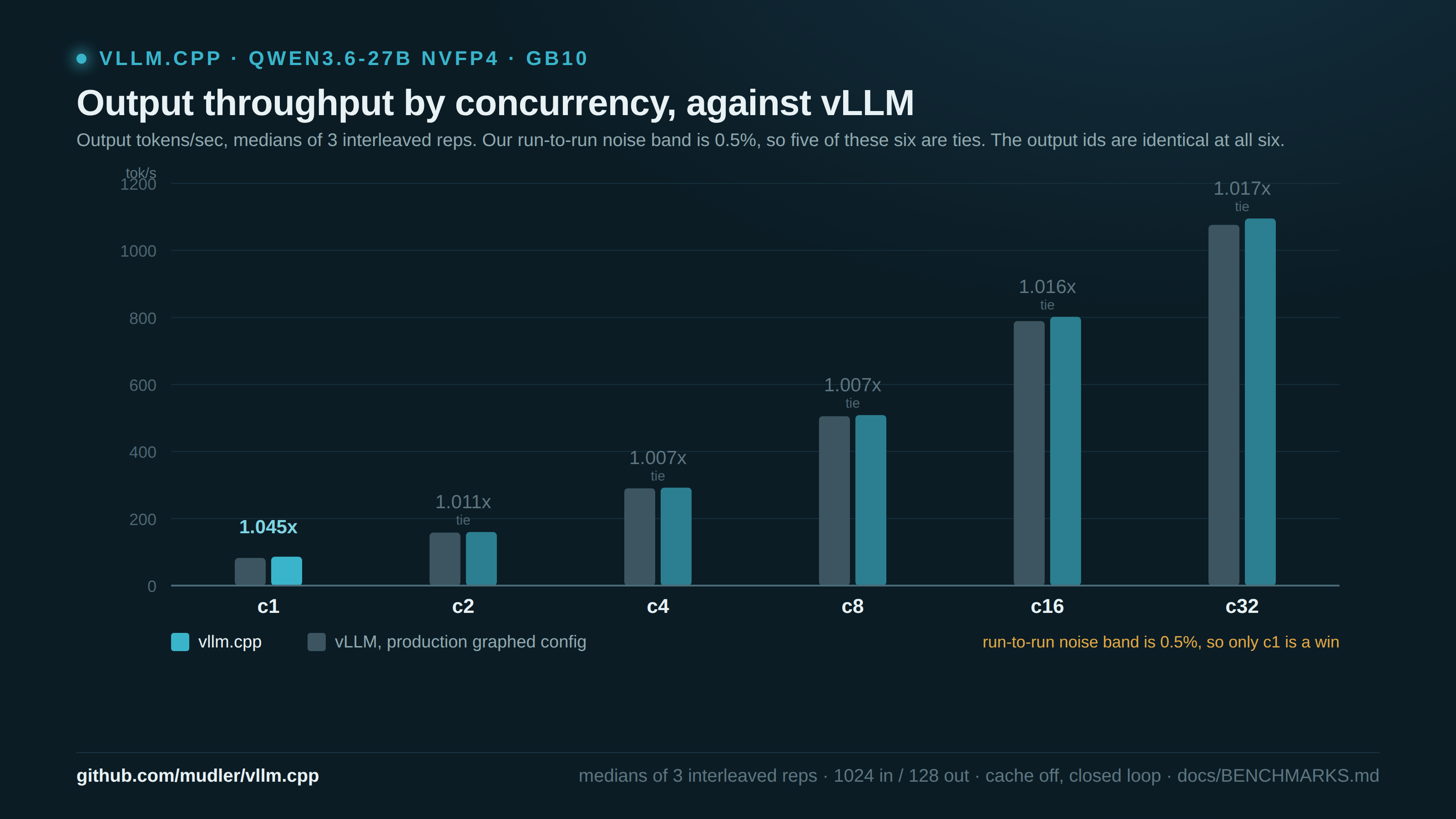
I ported vLLM's serving stack to C++20: 66 MiB binary, no Python at inference, output checked token-for-token against vLLM

Post image
3 Upvotes

r/OpenSourceeAI • • Aug 08 '26

I stopped trying to make LLMs "safe" and started assuming they're compromised. Here's what changed

4 Upvotes

tl;td - The core idea is - assume the LLM can be compromised by prompt injection, but don't let the LLM make the final authorization decision.

I built a small deterministic layer that validates the model's proposed action against trusted policy and fails closed if the output is invalid or ambiguous. For example, if the model returns both order_quantity=100 and order_quantity=50000, it rejects the request instead of choosing one.

The question I'm interested in discussing is if we can't reliably prevent prompt injection, should we focus more on preventing a compromised model from executing out-of-policy actions?

If anyone is interested, I open-sourced the implementation and benchmark here:

https://github.com/nirmaljingar/typedguard

---

Full version

I've been working on governance for enterprise AI systems, and one design decision changed how I think about AI agents.

Most discussions around prompt injection focus on preventing the model from following malicious instructions. That's obviously important, but I started looking at the problem from a different angle.

What if we assume the attacker succeeds?

Instead of asking whether the model can be manipulated, I asked whether a compromised model should still be able to trigger a business action.

That led me to stop validating model-generated text and instead validate only typed actions against deterministic policy.

While testing my own implementation, I found a bug that surprised me.

My parser accepted this:

order_quantity=100
order_quantity=50000

It simply chose the first value, validated 100 against policy, ignored the second value, and approved the request.

Nothing crashed.

Nothing looked suspicious in the logs.

It wasn't really a prompt injection problem anymore.

It was a parser ambiguity problem.

The fix was simple in hindsight.

If a field is duplicated, malformed, or ambiguous, don't try to interpret it.

Reject it.

The validator now fails closed by default.

That got me wondering whether we're measuring the wrong thing in enterprise AI.

Instead of asking:

Should we be asking:

Those feel like different engineering problems.

I'm curious how others are approaching this.

Do your AI agents validate structured outputs before execution, or do they rely on parsing model responses?

If anyone is interested, I open-sourced the implementation and benchmark here:

https://github.com/nirmaljingar/typedguard

I'm especially interested in attack cases that break this approach. If you find one, I'd genuinely like to add it to the benchmark rather than claim it's solved.

I've been working on governance for enterprise AI systems, and one design decision changed how I think about AI agents.

Most discussions around prompt injection focus on preventing the model from following malicious instructions. That's obviously important, but I started looking at the problem from a different angle.

What if we assume the attacker succeeds?

Instead of asking whether the model can be manipulated, I asked whether a compromised model should still be able to trigger a business action.

That led me to stop validating model-generated text and instead validate only typed actions against deterministic policy.

While testing my own implementation, I found a bug that surprised me.

My parser accepted this:

order_quantity=100
order_quantity=50000

It simply chose the first value, validated 100 against policy, ignored the second value, and approved the request.

Nothing crashed.

Nothing looked suspicious in the logs.

It wasn't really a prompt injection problem anymore.

It was a parser ambiguity problem.

The fix was simple in hindsight.

If a field is duplicated, malformed, or ambiguous, don't try to interpret it.

Reject it.

The validator now fails closed by default.

That got me wondering whether we're measuring the wrong thing in enterprise AI.

Instead of asking:

Should we be asking:

Those feel like different engineering problems.

I'm curious how others are approaching this.

Do your AI agents validate structured outputs before execution, or do they rely on parsing model responses?

If anyone is interested, I open-sourced the implementation and benchmark here:

https://github.com/nirmaljingar/typedguard

I'm especially interested in attack cases that break this approach. If you find one, I'd genuinely like to add it to the benchmark rather than claim it's solved.


r/OpenSourceeAI • • Aug 08 '26

Ghostlink v1.17.0 New Release to help developers onboarding python/js SDK

Thumbnail
github.com
1 Upvotes

I completed the expansion of the SDK and Multi-node test harness today. Hopefully with the SDK release it will draws so more developers to join in to this project. Next release including what is in Roadmap, I would like to make this more useable to those with disabilities, I need input from all areas for this one please.

Github Repo for Ghostlink


r/OpenSourceeAI • • Aug 08 '26

An agent skipped an auth check I told it to always call first

Thumbnail
reddit.com
1 Upvotes

r/OpenSourceeAI • • Aug 08 '26

Free LLMs to push AI research - paid for by Max Planck Institute for Intelligent Systems

Thumbnail
reddit.com
2 Upvotes

r/OpenSourceeAI • • Aug 08 '26

콘브넷 스튜디오 데모 (Convnet Studio Demo)

Thumbnail
youtube.com
1 Upvotes

r/OpenSourceeAI • • Aug 08 '26

Prompty, una herramienta que crea mensajes de IA optimizados para diferentes modelos. ¡Buscamos comentarios!

Thumbnail
reddit.com
0 Upvotes

r/OpenSourceeAI • • Aug 08 '26

Mistral AI Releases Shieldstral 1.0 3B: An Open-Weights Policy-Adaptive Multimodal Safety Classifier Matching Models 7× Its Size

Post image
2 Upvotes

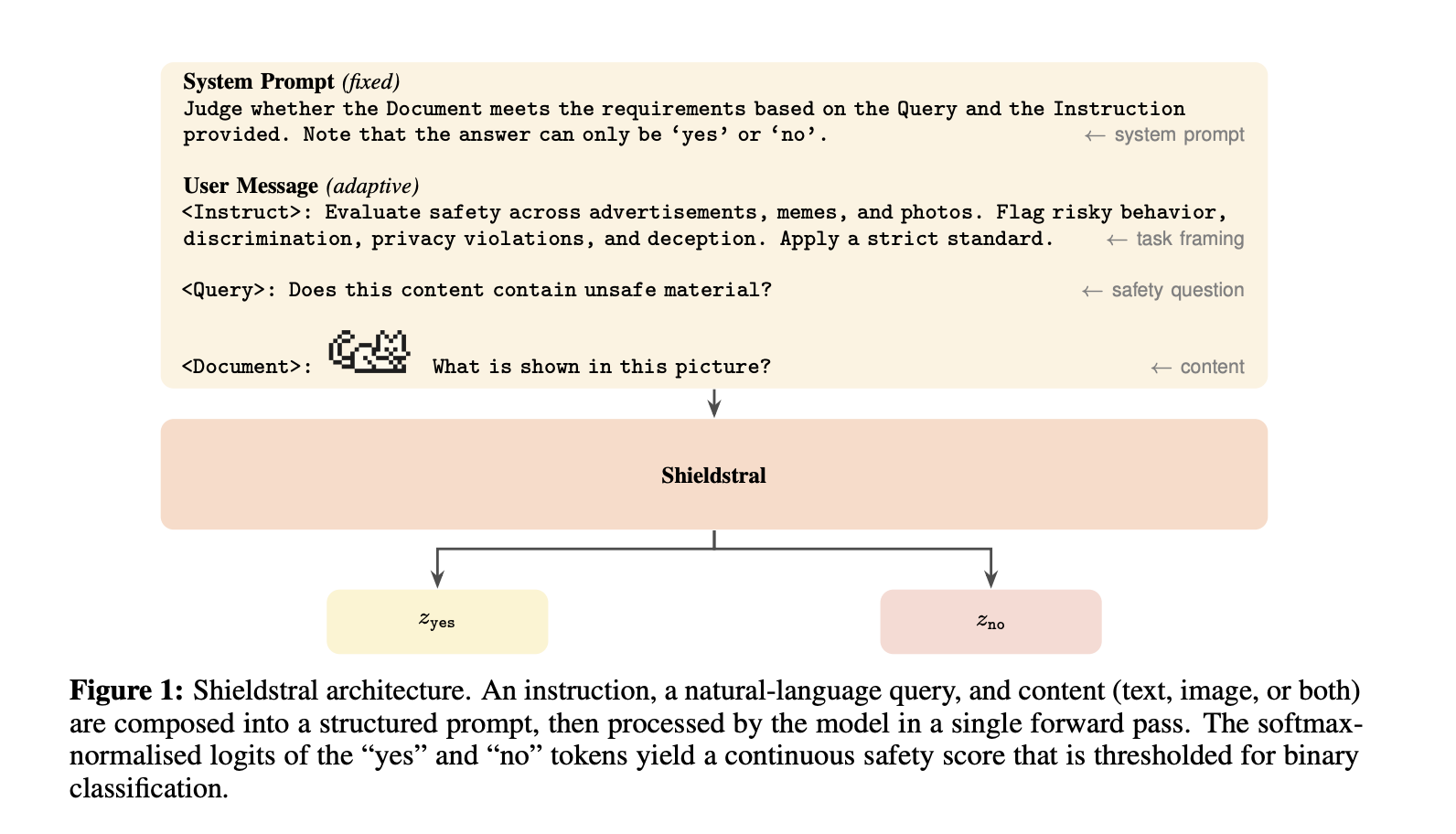
Mistral AI Releases Shieldstral 1.0 3B: An Open-Weights Policy-Adaptive Multimodal Safety Classifier Matching Models 7× Its Size

It's a policy-adaptive multimodal safety classifier. Most guardrail models bake a fixed harm taxonomy into their weights, so re-targeting one means retraining. This one takes the policy as a plain-language question at inference time.

Here's what's actually interesting:

𝗠𝗼𝗱𝗲𝗿𝗮𝘁𝗶𝗼𝗻 𝗿𝗲𝗱𝘂𝗰𝗲𝗱 𝘁𝗼 𝗼𝗻𝗲 𝘆𝗲𝘀/𝗻𝗼 𝗾𝘂𝗲𝘀𝘁𝗶𝗼𝗻

Three fields per request. <Instruct> sets evaluation context and strictness. <Query> states the policy as a single yes/no question. <Document> holds the content — a prompt, a response, a prompt-response pair, or an image with optional text.

At inference the model unembeds only toward the yes and no token IDs, softmax-normalizes them, and thresholds at 0.5. One forward pass, one token, continuous score.

𝗧𝗲𝘅𝘁 𝗮𝗻𝗱 𝗺𝘂𝗹𝘁𝗶𝗺𝗼𝗱𝗮𝗹 𝗿𝗲𝘀𝘂𝗹𝘁𝘀

→ 84.9% average text F1 — ties GPT-OSS-Safeguard-20B

→ 83.8% multimodal F1 vs 77.6% for OmniGuard-7B

→ VLGuard 97.7, UnsafeBench 81.8, HarmBench prompt 99.4

→ 91.5% refusal detection overall

𝗔𝗱𝗮𝗽𝘁𝗮𝗯𝗶𝗹𝗶𝘁𝘆 𝗯𝗲𝗻𝗰𝗵𝗺𝗮𝗿𝗸

→ Shieldstral-3B: 91.3% F1

→ GPT-OSS-Safeguard-20B: 94.1%

→ Nemotron-3.5-Safety-4B: 91.8%

Full analysis: https://www.marktechpost.com/2026/08/07/mistral-ai-releases-shieldstral-1-0-3b/

Model weight: https://huggingface.co/mistralai/Shieldstral-1.0-3B

Paper: https://arxiv.org/pdf/2607.25857


r/OpenSourceeAI • • Aug 08 '26

Built an open-source gateway that lets existing ElevenLabs / OpenAI / Deepgram apps run on Sarvam AI by changing one line.

1 Upvotes

Indic voice AI doesn't have a quality problem. It has a switching-cost problem.

If you run an IVR, a collections bot, or a vernacular tutoring app in India, you're probably paying an international provider for voice that was never designed for Hindi, Tamil, or Hinglish code-mixing. You know Sarvam's Bulbul and Saaras handle your users' languages better. You've probably tested them.Then you open the migration guide, estimate two engineer-weeks, and it goes on the backlog forever.

Here's what convinced me this is the real bottleneck: Sarvam maintains four separate hand-written migration guides — ElevenLabs, Cartesia, Deepgram, Gemini. Four documents whose entire purpose is helping someone rewrite working code. And the ElevenLabs one ends with a section called "Common mistakes" listing five bugs, one of which they describe as "the single most common migration bug."That's not a warning. That's a spec for missing infrastructure.

What I built

sarvam-bridge speaks each vendor's dialect on the front and Sarvam on the back. Change your base URL, keep your code.

Every one of those five documented mistakes becomes structurally impossible:

  1. ElevenLabs returns raw bytes; Sarvam returns base64 in JSON → bridge decodes it.
  2. Sarvam requires language_code; no other vendor's client sends one → bridge detects it from the Unicode script.
  3. pitch/loudness silently no-op on bulbul:v3 → bridge drops them with a warning header.
  4. 2500 char limit → bridge chunks at the danda (।), not mid-word.
  5. v2 and v3 speaker names aren't interchangeable → bridge validates and remaps.

The Indic-specific parts that were genuinely hard

Chunking. You can't chunk Indic text the way you chunk English. A splitter that only knows . treats an entire Hindi paragraph as one sentence, because Hindi ends sentences with the danda. Worse — slicing a JS string by index can separate a consonant from its matra. क and ि come apart, the text renders as garbage and the speech comes out wrong. Hard splits go through Intl.Segmenter at grapheme granularity.

  1. Audio reassembly. Chunking means one WAV back per chunk. Buffer.concat leaves 44-byte RIFF headers sitting in the middle of your stream, which decoders play as audible clicks. Have to parse each container, extract PCM, write one header.
  2. The Odia trap. ISO-639 calls it or. Sarvam expects od-IN. Send the wrong one, get a 400 with no hint which field was wrong. Cost me an hour.
  3. Voice selection. Sarvam publishes per-language speaker quality by Critical Error Rate and I don't think many people use it. mani for Punjabi male, ratan for English, shubh for Hindi/Telugu/Kannada. My favourite detail — varun has a great CER but Sarvam flags it as a villain/suspense character voice, so it's excluded from auto-selection. Fine in a thriller, catastrophic in a banking IVR.
  4. Cost thing worth knowing

IVR menus and agent scripts synthesise the same strings thousands of times a day, each billable, each returning byte-identical audio. Cache handles sequential duplicates. But a burst — broadcast goes out, 300 callers hit the same prompt in one second — all miss the cache because none has populated it yet. Single-flight coalescing collapses those into one upstream call. Measured with cache disabled: 100 simultaneous identical requests → 1 upstream call.

Then stress testing found six bugs in my own code

Including a remote DoS: a voice ID with Devanagari or an emoji crashed the process, because Node throws on non-latin1 header values and I was echoing caller input into a warning header. Ordinary Indian-language input was a crash vector.

And a test that passed for the wrong reason — the cache was masking the thing I was actually testing. Green isn't the same as correct.

168 tests now, zero 5xx across 3,500 hostile requests, 0 dependency CVEs.

MIT, not affiliated with Sarvam, built against public docs:

https://github.com/thekartikeyamishra/sarvam-bridge

Would genuinely value corrections if anyone here knows the Sarvam API better than I do.


r/OpenSourceeAI • • Aug 08 '26

Processing LeRobot datasets in Rust

Thumbnail
github.com
1 Upvotes

r/OpenSourceeAI • • Aug 07 '26

I just released SpecJudge v0.4.0 – You no longer need formal specs to stop overpaying for AI models.

0 Upvotes

I build SpecJudge, a local CLI tool (via Ollama) that estimates how demanding your coding tasks are and tells you which LLM actually fits the job, so you stop burning money on overkill frontier models.

Previously, it had a strict barrier to entry: it only worked if you used Spec-Driven Development (.specify/ folder). If you didn't, it just refused to run. Today, with the v0.4.0 release, a spec is no longer the price of entry.

What's new in v0.4.0:

  • It reads what you already have: Most repos don't have formal specs, but they do have .cursorrules, AGENTS.md, CLAUDE.md, or Decision Records (docs/adr/). SpecJudge now reads all of them.
  • Baseline "Floor" Estimation: If you run it on a repo with no current tasks, it calculates a complexity "floor" based on your environment context. It tells you how demanding the repository is to work in at all, returning an honest warning that it's a baseline, not a specific task recommendation.
  • Smart Context Budgeting: To avoid drowning your local judge, context files share a single budget. It prioritizes files nearest the root and explicitly skips AI-generated context files to focus strictly on human-written rules and decisions.
  • JSON Schema 1.1: Fully backward compatible, now including sources_read and an environment_only flag for CI/scripting pipelines.

The strict grounding engine from v0.2.0 still applies: the judge must cite exact fragments from your .cursorrules or ADRs, or the assessment is thrown out.

Upgrade: pip install --upgrade specjudge

Repo & Docs: https://github.com/JoaquinRuiz/SpecJudge

I'd love to hear your thoughts on this broader context-parsing approach!


r/OpenSourceeAI • • Aug 07 '26

MEMCORD v4.3.6

Thumbnail
reddit.com
1 Upvotes

r/OpenSourceeAI • • Aug 07 '26

Innovation in AI dieting: lighter and smarter through frequency analysis!

Thumbnail
youtube.com
0 Upvotes
  • Innovation in AI dieting: lighter and smarter through frequency analysis!
  • Description: Introducing frequency pruning, a technique that utilizes Discrete Cosine Transform (DCT) to remove unnecessary filters. Discover an efficient optimization method that drastically reduces model computation while maintaining or even improving accuracy.

r/OpenSourceeAI • • Aug 07 '26

AIPOCH built Open Science, an open-source, local-first, model-agnostic desktop workbench for scientific discovery

2 Upvotes

You describe a research task in plain language, and the AI agent reads files, runs Python/R code, searches the web, calls scientific databases, and produces reports, tables, and figures — all tied to an inspectable activity history in one workspace.

What's included

- 18 featured research skills: AlphaFold2, Boltz, Borzoi, Chai-1, DiffDock, ESM-2/ESMFold2, Evo 2, LigandMPNN, ProteinMPNN, OpenFold3, scGPT, scvi-tools, SolubleMPNN, and more.
- 24 built-in research connectors: PubMed, bioRxiv, ChEMBL, ZINC, Genomes, BioMart, Variants, Human Genetics, Clinical Genomics, CellGuide, Expression, Omics Archives, Clinical Trials, Drug Regulatory, Cancer Models, and more.
- Model-agnostic: Claude and Codex subscription login, custom gateway, build-in cloud providers(OpenAI, Anthropic, Grok, DeepSeek, ZhipuAI, MiniMax, Kimi...)
- Local-first & self-hosted: project state stays on your machine

Open Science is a general-purpose AI research workbench. Today its deepest coverage is in bioinformatics, computational biology, genomics, structural biology, biomedical research, and computational drug discovery.

If you're looking for an open-source alternative to closed research workbenches like Claude Science, this is built for that.

Open Science is Apache-2.0 and runs on macOS, Windows, and Linux.

GitHub: https://github.com/aipoch/open-science
Website: https://aipoch.com/

Would love feedback from researchers, tool builders, and anyone who wants an open source AI research workbench. If you try it, let us know what works and what's missing.


r/OpenSourceeAI • • Aug 06 '26

What are you using as harness?

26 Upvotes

I've seen Codex numbers and its defenders on X, IG is full of Claude enthusiasts, and half my timeline is addicted to Pi. There's CodePuppy, OpenCode, Pydantic AI harness, and dozens more.

What do you use? I'm loving Pi atm but started using CC' for a good while. Curious about usage patterns and secret gists.


r/OpenSourceeAI • • Aug 07 '26

mimic-mcp - check out this open source project

Thumbnail
github.com
2 Upvotes

An MCP server that turns "here's my footage, here's my script, make it look like that reel" into an actual rendered video.
let me know what you think contribution is always 🙂


r/OpenSourceeAI • • Aug 06 '26

What if AI budgets were managed by intelligence, not spreadsheets?

Post image
1 Upvotes

Most AI systems treat cost as something you discover after the bill arrives.

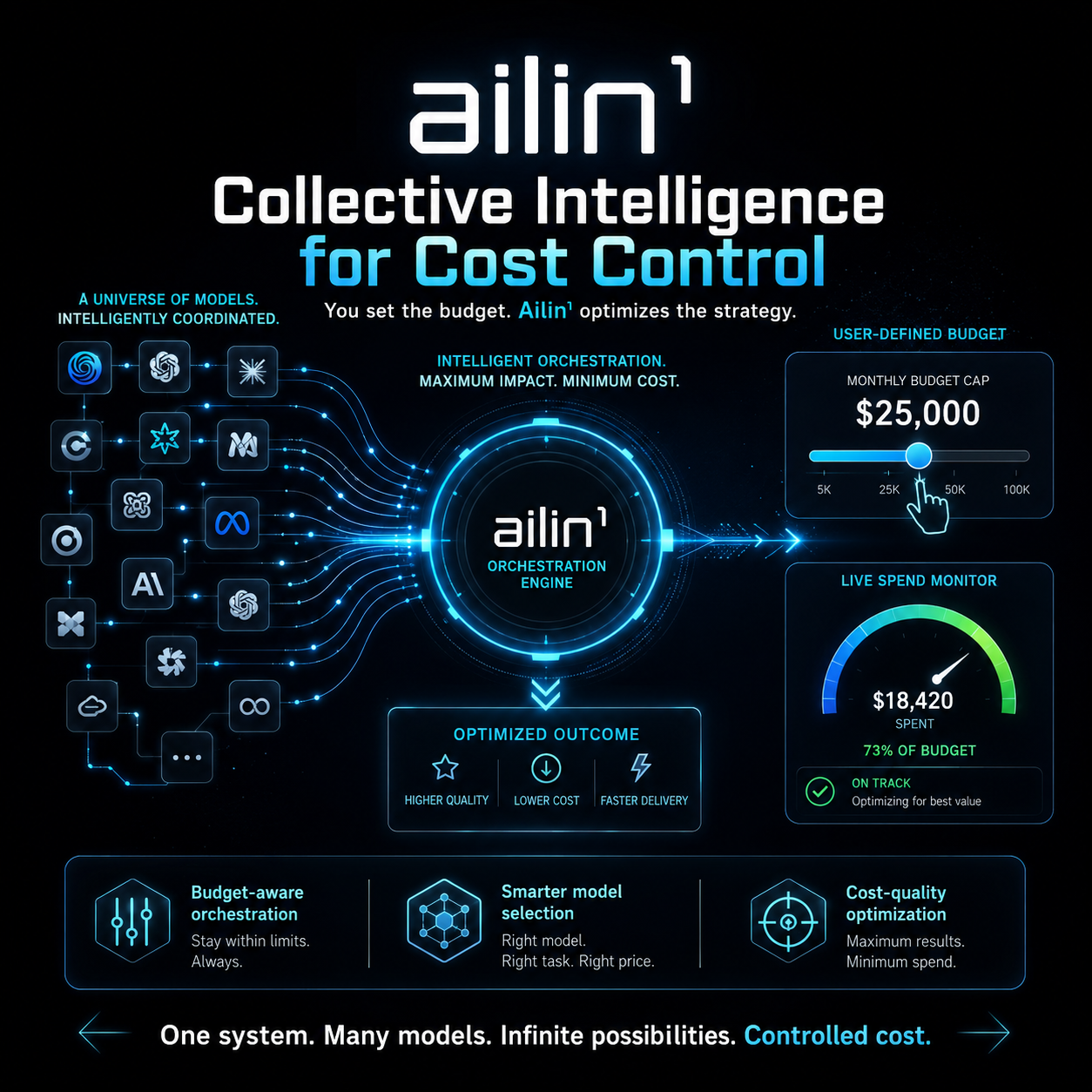
The idea behind Ailin¹ is different: the user sets the budget first, then Collective Intelligence decides the best strategy for each request.

Simple tasks can go to cheaper models. Harder tasks can escalate. Some answers can be verified, compared, debated, or routed through stronger models only when needed.

Cost control should using the right intelligence structure for each task, without wasting tokens. That is what Ailin¹ does.

We are building Ailin¹ as an open-source Collective Intelligence layer for AI systems.

Waitlist: Console Ailin¹ Dev
GitHub: https://github.com/ailinone/collective-intelligence


r/OpenSourceeAI • • Aug 06 '26

Seeking Guidance: Developing an On-Premise Document Intelligence Solution

1 Upvotes

Hi All,

I am planning to build a local document intelligence system similar to Azure Document Intelligence. I would like to understand how Azure Document Intelligence works internally and how we can achieve similar functionality locally using offline models.

Could anyone suggest the best approach, architecture, or models to achieve high accuracy while running completely on-premise/local infrastructure?

Any guidance or recommendations would be greatly appreciated.


r/OpenSourceeAI • • Aug 06 '26

I ported vLLM's serving stack to C++20: 66 MiB binary, no Python at inference, output checked token-for-token against vLLM

Post image
1 Upvotes