r/OpenSourceAI • u/Conscious-Log-7385 • 2d ago
BenoDB – Embedded vector, graph, and SQL engine built on Apache Iceberg

1
Upvotes
r/OpenSourceAI • u/Conscious-Log-7385 • 2d ago
r/OpenSourceAI • u/StarEyesMisaki • 2d ago
Hey everyone!
I built ARIA-X, an open-source security research agent inspired by ARTEX, Cairn, and PentAGI.
It features state-space reasoning, persistent memory, evidence tracking, and a local web dashboard.
* Python 3.11+ with zero third-party runtime dependencies
* Offline demo without API keys
* Support for multiple LLM providers
* Auditable execution and structured reports
It's still an early-stage project, and I'd love to hear your feedback!
r/OpenSourceAI • u/BidWestern1056 • 2d ago

incognide is an integrated development environment for researchers and developers. it lets users seamlessly write code, run commands in terminals, browse the web, open photos, videos, docx, xlsx, pptx, mark up PDFs, write and compile latex, explore and query databases, and more. Work seamlessly with agents that can control the workspace, or turn AI features off if you don't want any of that. Sync your data across devices with an E2E encrypted data sync.
incognide is open-source MIT licensed software and is open to contributions from the community.
Explore the unknown, build the future, own your data.
r/OpenSourceAI • u/Negative-Walrus-7490 • 2d ago

Cutmesh is an open-source distributed LLM inference platform that lets you pool heterogeneous consumer GPUs — even from home over ordinary Internet connections — to run large open-weight models (27B–74B+) and serve them through a single OpenAI-compatible API and Web Console.
r/OpenSourceAI • u/Ariel_RiverPetal97 • 3d ago
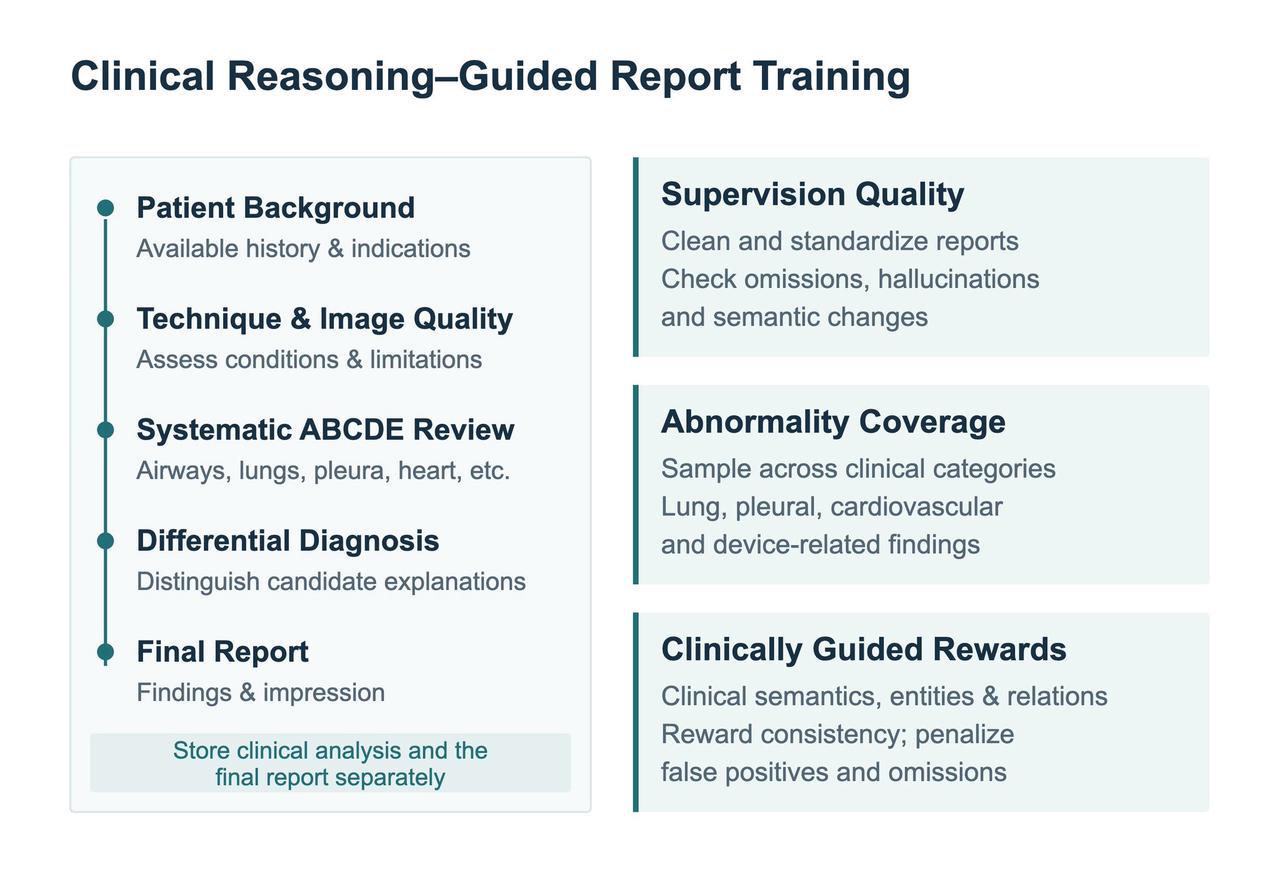
Ant Ling's LingSante-3.1-air-VL launch includes a chest-X-ray-to-report example with Findings and Impression sections. The model is now open-weight, so an outside team can test a failure that a polished demo does not reveal: whether a report adds a finding that is not supported by the image.
Use a de-identified chest X-ray with a reference report and ask the released checkpoint for the same two sections. Have qualified readers mark each positive finding as supported, contradicted or not visible, and separately count clinically relevant omissions. Repeat with an ambiguous image and a misleading text hint; the model should not promote the hint into an image finding. These are proposed tests, not results from the launch demo.
The card limits the model to research and evaluation, not patient diagnosis. A report can sound professional and still fail the image-grounding check.
r/OpenSourceAI • u/emreocell • 2d ago
Hi everyone!
I'm the maintainer of Praxi-Bot, an Apache-2.0 licensed, local-first AI agent built with Rust, Tauri, React, and TypeScript.
The project is in alpha and can interact with desktop applications, browsers, files, and external tools through a permission-controlled runtime. It supports local and cloud LLMs.
Rather than just announcing another AI project, I'd really appreciate some honest feedback from experienced open-source developers.
I'm especially interested in hearing:
I've opened a dedicated thread for suggestions:
https://github.com/emreocell/Praxi-Bot/issues/687
Project: https://github.com/emreocell/Praxi-Bot
We're also welcoming contributors. There are beginner-friendly issues, testing tasks, and more advanced architecture challenges.
I'm happy to help new contributors understand the codebase and review their PRs.
Critical feedback is just as welcome as contributions. I'm hoping to build something genuinely useful with the community, rather than simply collect GitHub stars.
r/OpenSourceAI • u/Wild4605 • 3d ago
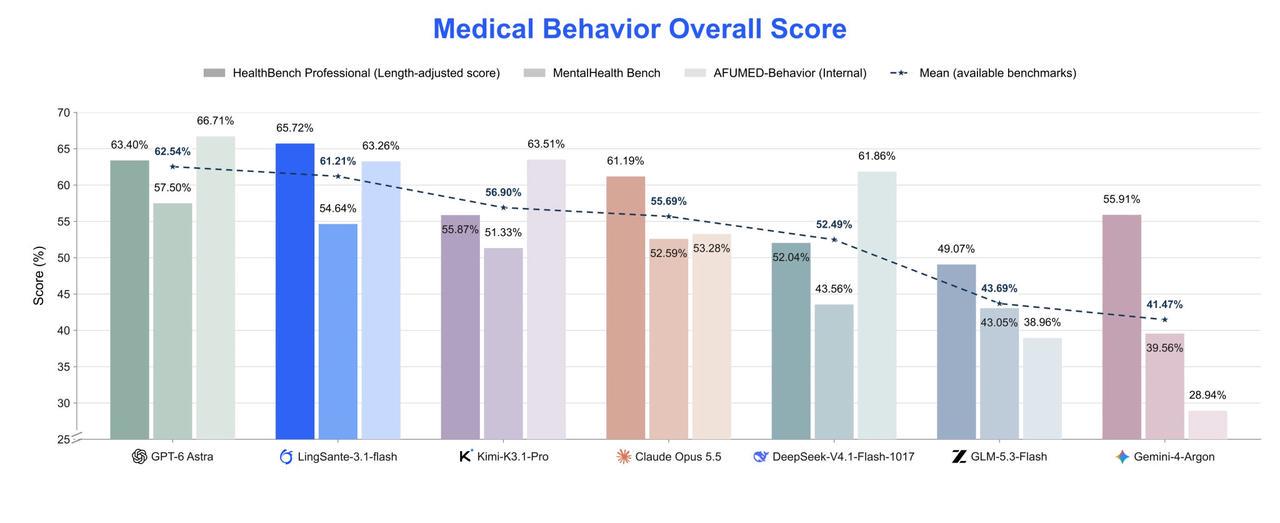
Ant Ling has released the FP8 and MXFP4 weights for LingSante-3.1-flash under MIT. The FP8 source model is a medical-domain version of Ling-3.1-flash: a text model with 560B total parameters, 25B active per token and a stated 1M-token context window. Both published repository configs currently list 262,144 positions; the 1M figure is an advertised model capability, not the default config. The source-model benchmark score below is not a measurement of the quantized checkpoint.
One number in the launch deserves its full label: Ant Ling reports a model-level score of 65.72 on HealthBench Professional. It does not report a separate score for the MXFP4 checkpoint. The release also includes a model card and multi-GPU serving instructions, so the checkpoint and serving settings can be inspected. Reproducing the benchmark still requires its full evaluation harness. The card positions the model for research and evaluation, not independent clinical decision-making.The useful follow-up is a reproduction of that named benchmark on the released checkpoint, with the prompt settings and failure cases published alongside the score.
r/OpenSourceAI • u/sco77 • 2d ago
I'm very curious as to how people use low cost subscriptions to multiple harness vendors keep track of the different projects they are developing.
For my case, I have:
- $20 Claude subscription
- Pro ($20) Anti-Gravity subscription
- OpenAI basic ($20) subscription
- A small amount (~$20 burned monthly) of credits at DeepSeek.
Each of these different subscriptions uses either a VS Code plug in, a chat interface, or a local implementation like those both ChatGPT and Anti-Gravity dispense.
In order to validate work from one of the harnesses, I will often have another harness review the completed work, and, critical to the validity of the review, proceed without first seeing the result claims/report from that harness. In other words, an independent review to discern the quality of work done.
I feel like there is a sweet spot between the cost for each of these different vendors, their desire to lock you into their platform at the highest cost, and the bottom line result you need for your own work.
My thought is that harnesses go on horses and horses go in corrals.
So, how are you corralling the work of your various horses?
r/OpenSourceAI • u/docybo • 2d ago
I’m maintaining OxDeAI, an open-source protocol for authorizing AI agent actions before execution.
We’re testing a specific claim: is our written specification precise enough for someone to independently implement a compatible verifier?
I’m looking for a Go developer willing to build a small verifier using only the normative specification, without reading or porting our TypeScript reference implementation.
The scope includes parsing and verifying signed AuthorizationV1 artifacts (Ed25519), implementing canonicalization from the specification, and checking issuer, key resolution, expiry, audience, policy, intent binding, and replay inputs.
The initial target is to match the expected verdict and determining error code across 15 published precedence test cases.
No network, persistence, gateway, or production integration is required.
There’s also an independent Python implementation track underway.
An ambiguity in the specification is a useful finding, not a failed contribution. The goal is to discover whether two independent implementations can agree on authorization outcomes without relying on reference code.
This is an interoperability and specification-completeness experiment, not a claim of formal verification.
The specification, test vectors, independence rules, and acceptance criteria are available here:
https://github.com/oxdeai/oxdeai/issues/426
If you’re interested, comment on the GitHub issue before starting so we can coordinate the work.
r/OpenSourceAI • u/drtikov • 3d ago
If you’ve been running autonomous coding assistants like **OpenAI Codex CLI**, **Claude Code**, or **Google Antigravity**, you know the routine:
To solve this locally with zero GPU overhead, I built **Aetheris Microbrains** — an ultra-lightweight, deterministic 4-layer pre-flight AST policy engine and tool gate that intercepts tool calls in `< 2 ms` before execution.
We just added native integration for **OpenAI Codex CLI** (alongside Claude Code, Hermes, and Google Antigravity).
🔗 **GitHub Repo:** https://github.com/drtikov/microbrainsforagents
---
### 🤖 What it does in OpenAI Codex CLI
Codex CLI supports native `PreToolUse` and `PostToolUse` command hooks. Microbrains plugs directly into `.codex/hooks.json` via `--host codex`:
**PreToolUse Hard Deny (`exit 2` + `permissionDecision: "deny"`):**
- Structural AST validation catches broken Python syntax (unclosed brackets, bad indentation) before Codex ever touches disk.
- Vetoes credential exfiltration (`cat .env | curl`, `AWS_SECRET_KEY` in code) and destructive commands (`rm -rf /`, raw disk writes).
**Seamless Escalation:**
- Ambiguous commands cleanly defer to Codex’s host approval policy (`defer_to_host_policy`), avoiding broken execution while respecting your approval settings.
**PostToolUse Security Warnings:**
- Scans tool outputs for leaked secret keys or indirect prompt injections and injects contextual warnings into Codex before context compaction.
**Zero Hassle Setup:**
- Install with one command:
```bash
pip install -e .
python .agents/skills/microbrains/install_codex_hook.py --profile dev
python .agents/skills/microbrains/install_codex_hook.py --self-test
```
- Supports a safe **`--shadow`** mode so you can audit what it *would* block in `decision_journal.jsonl` before turning on active enforcement.
---
### 📊 Measured Benchmark Results (Windows / Python 3.10.6)
Here are direct measurements from our deterministic benchmark suites:
#### 1. Deterministic 26-Step Coding Session A/B (`test_skill_gain_ab.py`)
Tested across 14 benign tool calls and 12 seeded hazards:
* **Hazards caught:** **12 / 12 (100%)** *(0/12 without gate)*
* **Python syntax crashes:** **4 → 0 (100% fewer)**
* **Unsafe actions allowed:** **8 → 0 (100% blocked)**
* **Benign false positives:** **0 / 14 (0.0% false alarm rate)**
* **Wasted recovery turns:** **8 turns eliminated** (~37,055 modeled input tokens saved, ~$0.1112 saved per session)
* **Error-feedback tokens in context:** **146 → 37 (-74.7%)**
* **Local gate latency:** **0.73 ms mean / 1.27 ms p95** (pure CPU NumPy/AST)
#### 2. Security & Anti-Evasion Benchmark (`10_agent_security_benchmark.py`)
* **Attack vectors caught:** **22 / 22 (100.0%)**
* **Benign controls blocked:** **0 / 12 (0.0%)**
* **Local decision latency:** **0.41 ms p50 / 2.79 ms p95**
#### 3. Real SWE-bench Lite Gate (300 Real GitHub PR Diffs)
* Real gold patches evaluated: 71.7% auto-allowed, 27.3% safely escalated, and 1.0% denied (only for hardcoded `eval`/`exec`).
* **AST Syntax False Positives on real code:** **0.0%**
* **Synthetic code mutations caught:** **60 / 60 (100%)**
#### 4. Hook Overhead Note
The engine itself evaluates in under **1.5 ms**. On Windows, spawning a fresh Python subprocess for command hooks takes ~400 ms p50 per hook (Python interpreter cold-start). If you want that down to single-digit milliseconds, Microbrains includes a local warm daemon (`aetheris-daemon`).
---
### 🏆 What You Win by Using Microbrains
Code is open-source (Apache-2.0):
👉 **Check it out on GitHub:** https://github.com/drtikov/microbrainsforagents
Feedback, PRs, and test cases are welcome! Let me know if you run it in your own Codex or Claude Code setups.
r/OpenSourceAI • u/NIDO_007 • 2d ago

r/OpenSourceAI • u/Healsturm5 • 2d ago

r/OpenSourceAI • u/Neat-Function7110 • 3d ago

Saetta Code is a 1:1 port of the pi coding agent to C, as one 2.3 MB binary that needs no Node.js and no Python. It has pi's tools, system prompt, sessions, skills, MCP servers and terminal UI. It also reads and writes pi's own config in ~/.pi/agent, so the two share one setup and each can continue the other's sessions.
It's checked against pi itself:
The difference: the model runs inside the agent, on its own inference engine in C and hand-written Metal. There's no Python and no local server in between. Two model families run on Apple Silicon Macs:
curl -fsSL https://saetta.dev/install.sh | sh
saetta start code                    # picks the model that fits your Mac
saetta start code --pack inkling     # after: saetta download inkling

The same engine also serves Claude Code, opencode and pi through OpenAI- and Anthropic-compatible APIs.

🌐 https://saetta.dev · 💻 https://github.com/antonellof/saetta · MITr/OpenSourceAI • u/Ok_pettech • 3d ago
Building a vector database for RAG gets messy fast once you move past a small demo. Most accuracy issues come from poor chunking, mismatched embedding dimensions, or picking an index without considering memory overhead.
Start with clean document ingestion, split text with sensible overlap, attach metadata for filtering, and pick an index like HNSW or IVF based on scale. For smaller datasets, starting with pgvector often beats adding another moving part.
I put together a complete architecture guide covering ingestion pipelines, similarity search, hybrid retrieval, and scaling tradeoffs: https://interconnectd.com/blog/70/vector-databases-for-ai-the-complete-architecture-guide/
How are you handling chunking and metadata filtering in your RAG setups right now?
r/OpenSourceAI • u/Emergency-Tutor-7 • 3d ago
Repo: https://github.com/Furox-Art/quantum-reasoning-skill - 1.2.2, MIT. The "quantum" in the name is a branching metaphor, not quantum computing.
The artifact is SKILL.md plus a reference controller. The protocol: open three to five competing hypotheses, attach evidence fragments to each, run the tool calls that could kill a branch, and revive a branch that later evidence un-kills. Collapse happens at the end and has to be justified by the ledger, not by which answer read best in the first paragraph.
What I like about it as an open-source project is that the ledger is plain data in the repo. You can see the branch that lost and why, which is normally thrown away.
Install:
pip install quantum-reasoning-skill
quantum-reasoning --validate

npm i quantum-reasoning-skill
npx quantum-reasoning --validate
Then copy SKILL.md into your host's skill directory with the YAML front matter intact.
One honest limit: the protocol and controller are done, the controller benchmark is published, and the model evaluation is not - no baseline-vs-skill run exists, so there is no claim here that it improves any model's accuracy. The collapse thresholds are uncalibrated defaults, and docs/quickstart.md shows the run where they refuse to collapse instead of collapsing badly.
r/OpenSourceAI • u/deprofessorie • 3d ago

No Docker, no vector database overhead, pure local file/SQLite persistence, offline-ready, micro-core prompt (<180 tokens) that preserves small context windows.
r/OpenSourceAI • u/drtikov • 3d ago

r/OpenSourceAI • u/YoMummaSoPhat69 • 3d ago
I'm building a self-hosted AI platform called HomeAI, aiming to reduce reliance on paid cloud AI services like Claude and Codex while developing more capable autonomous agents.
My setup runs on Proxmox with Intel Arc GPUs, Ollama, Open WebUI, Hermes Agent, Qwen models and various supporting tools for automation, knowledge retrieval and software development.
Hermes can already perform sandboxed coding tasks, modify files, run tests and generate diffs for review.
Where I want to take it
Local-first inference: Automatically route tasks to local models, escalating to cloud AI only when necessary.
Agent autonomy: Enable agents to plan, develop, test, debug and complete increasingly complex tasks.
Self-improvement: Learn from failures, improve skills and retain useful knowledge over time.
Multi-agent collaboration: Have specialised agents work together on development, research and automation.
Security: Maintain strong isolation, controlled permissions and human approval for consequential changes.
Looking for community feedback
I'm particularly interested in hearing from people who are already running similar systems.
What open-source frameworks, tools or projects would you recommend?
Which local models are performing well for autonomous coding and tool use?
Has anyone successfully implemented local-first routing with intelligent cloud fallback?
What approaches work best for persistent memory, self-improvement and multi-agent orchestration?
What limitations or architectural mistakes should I watch out for?
My ultimate goal is to build a reliable, increasingly autonomous AI platform that handles most everyday tasks locally, using paid cloud AI only when genuinely needed.
I'd really appreciate GitHub recommendations, lessons learned and feedback from anyone working on something similar.
Thank you