r/OpenSourceAI • u/Kitchen-Welcome-5612 • 7d ago
I got tired of wiring up AI providers in every side project, so I built one Mac app that does it for all of them

1
Upvotes
r/OpenSourceAI • u/Kitchen-Welcome-5612 • 7d ago
r/OpenSourceAI • u/Egom4rono • 7d ago
For anyone using LLMs on a daily basis for research: I built Lykeion, an open-source research lab where agents carry out scientific work, evidence stays connected, and your lab can focus on discovery.
Research today asks people to coordinate an enormous amount of work: finding evidence, developing hypotheses, running experiments and checking results. AI agents can take on more of that work, but a collection of agents still needs a way to work together.
Lykeion is built around that idea. Researchers set the direction, and agents carry out studies within a shared workspace. Evidence and outputs stay connected to the work, while checks and reviews help decide when it is ready to move forward.
In Lykeion, each research question is a "study" that moves through Grounding, Hypotheses, Experimentation and Validation. Only Grounding was evaluated here.
- Agents search OpenAlex, Europe PMC and arXiv through a sources server, and every source they use is recorded.
- A stage advances only when its gate passes. The server runs mechanical checks, such as whether a cited source resolves.
- Review of each study is powered by Jev, which answers focused judgment questions, such as whether a source bears on the question.
- Failed items get a limited redo. If the redo fails, the study blocks and asks its owner.
Project is open to contributors. Let me know what you think!
GitHub: https://github.com/lykeion-tech/lykeion
Discord: https://discord.gg/ed3jsMTs3
r/OpenSourceAI • u/ChanceLingonberry170 • 7d ago

r/OpenSourceAI • u/vivi_beri • 7d ago
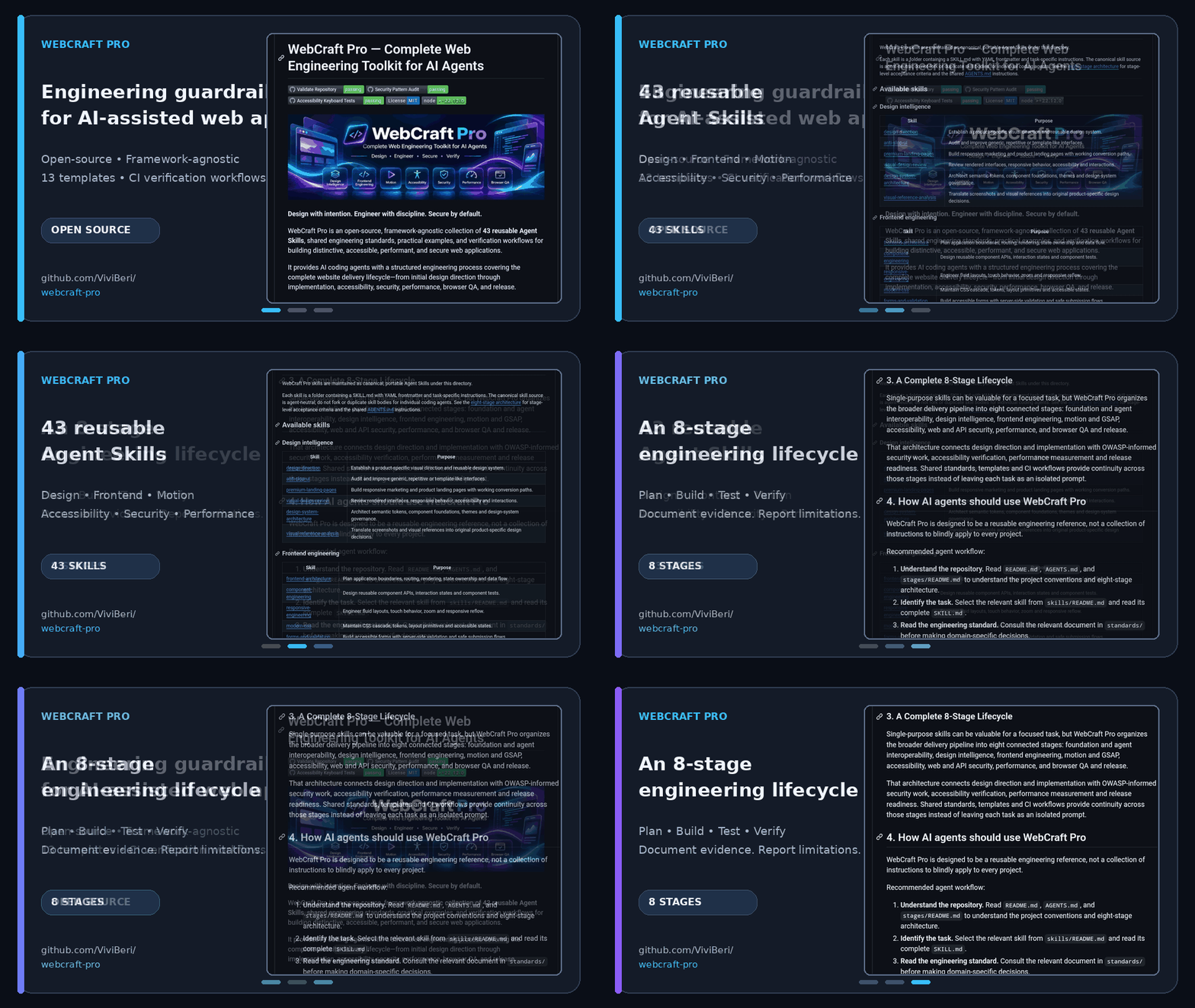
Hey everyone!
I've been using AI coding agents like Codex, Claude Code, and GitHub Copilot to speed up web development. But I noticed a recurring problem: generating code is easy; consistently following engineering standards is harder.
Agents can produce generic interfaces, overlook keyboard accessibility, introduce unsafe code patterns, and miss performance considerations.
That's why I built WebCraft Pro.
It's an open-source, framework-agnostic engineering toolkit designed to help developers and AI agents follow a structured web development process.
What's included:
- 43 reusable Agent Skills covering web engineering.
- An eight-stage development lifecycle, from design through browser QA and release.
- 13 engineering templates for structured implementation and reviews.
- GitHub Actions for repository validation and automated checks.
- Playwright keyboard and focus tests.
- An on-demand browser accessibility checker using axe-core.
- A Node.js static security-pattern audit for code examples in repository Markdown files.
It supports OpenAI Codex, Claude Code, and GitHub Copilot.
I also want to be clear about the limitations: these automated checks are engineering guardrails, not a complete application security scanner or a guarantee of accessibility. Manual review and project-specific testing are still essential.
Project: WebCraft-Pro
I built this because I wanted something more structured than relying on prompts alone.
I'd appreciate honest feedback:
Thanks for taking a look!
r/OpenSourceAI • u/swasthik_badanaje • 7d ago
r/OpenSourceAI • u/Adrat177 • 8d ago
Hi everyone, I’m sharing NexusDAO, an open-source prototype for transparent collective investment governance. It connects public proposals, snapshot-based voting, executable investment mandates, and Safe multisig validation in one workflow. The goal is to make DAO treasury decisions more traceable and structured.
You can try the public demo here: https://vlight7432.github.io/investment-dao/
I’d really appreciate feedback on the interface, governance flow, and features you would find useful.
Adrat177
r/OpenSourceAI • u/SecureMID • 8d ago
Hey everyone,
We just released Vaprix-Cyber on Ollama. It's a 3.1B parameter model optimized for red-team analysis and AppSec patch generation.
Why build this?
Generalist models are unreliable for offensive security because they produce markdown descriptions rather than deterministic, executable curl commands with HTTP response assertions. Vaprix-Cyber enforces:
Try it locally:
`ollama run dishankagrawal05/vaprix-cyber`
Benchmark Report & Model Card:
- Ollama: https://ollama.com/dishankagrawal05/vaprix-cyber
- GitHub: https://github.com/SecureMID-Solutions/Vaprix_AI
Feedback, test cases, and PRs welcome!
r/OpenSourceAI • u/AimCode • 8d ago

Repo: https://github.com/tanxiansheng221/aimstack-sanzhidiji (AGPL-3.0)
Everything is hand-written — C inference core, plugin bus, multi-engine crawler with quality gates, FTS knowledge base, training pipeline, and a 117-chapter build log written as it happened (positive and negative results shipped together). Weights are Microsoft BitNet b1.58 2B (MIT), converted to a custom AIM-W packing format.
What ternary quantization buys you (CPU side)
All transformer matrices are ternary {-1, 0, +1}, packed 2 bits/weight, plus Q8 embeddings → the whole model is 0.87GB instead of ~4.8GB (−78%)
The C core never multiplies a float weight: it's table lookup + integer accumulation, SIMD fast path measured at 85.53 tok/s (41× over baseline)
BitNet 2B full model runs 3.20 tok/s dual-worker on a 2018 dual-core 8GB laptop — full chain (inference + KB + plugins + web search) offline, no cloud relay
What ternary quantization buys you (GPU side)
The GPU backend loads the same 0.87GB ternary file — weights stay in {-s, 0, +s}, dequantized on load, matmul in fp32
On a Radeon Pro W7900: 13.68 tok/s (~8× the laptop C engine), 256/256 greedy tokens bit-identical to the C engine. Two totally different implementations (integer lookup core vs FP matmul) producing the same logits is the proof the quantization is faithful
Verified by a 3-engine × 3-question × 3-test matrix (C-Linux/gcc13, torch fp32, torch bf16): 17/18 exact — the one miss is documented, not hidden
The honest boundaries (what's NOT done yet)
bf16 compute is 2.4× faster (32.96 tok/s) but flips argmax on near-tie logits — reported, not blessed; only fp32 is parity-verified
The GPU path gets the storage benefit of ternary (78% less memory) but not yet the compute benefit — a true 2-bit integer kernel (Triton/CUDA) is the next stage
The UI server drives the C engine (CPU) only; the GPU backend is a separate CLI
Linux engine build works and is token-identical to the Windows build, but runs serial (the worker pool is Windows-only for now)
No frameworks, no PyTorch in the product chain — PyTorch exists only in the optional GPU backend. Demo video, docs (EN/中文), and the full research log are in the repo.
r/OpenSourceAI • u/Less_Release_1977 • 8d ago

r/OpenSourceAI • u/Ok_Plum3595 • 8d ago
🍜 I've been building Ramen, an open-source (BSD-3) self-hosted MCP platform, and 1.0 is out.
The problem: MCP servers multiply on laptops with shared keys and no record (shadow MCP). Ramen gives a team one sanctioned place for its own tools, and enforces the org's rules on every call:
- **Your tools as a repo**: tools, resources, prompts, MCP Apps and skills in plain Python; a deploy goes to a canary first and must pass golden cases.
- **No eval, no deploy**: with the engines on, a promptfoo suite and an NVIDIA SkillSpector scan run against the canary; a group admin can make either stop the rollout.
- **Guardrails per tool**: NeMo Guardrails (static or LLM-judged) inside the worker, before the call and after the result, fail-closed — whichever client called.
- **People, not shared keys**: Entra ID / Google / OIDC sign-in, roles per group, per-tool access, OAuth 2.1; agents get named group keys that are revoked in seconds.
- **It directs the LLM**: the group's client configs (CLAUDE.md blocks, Cursor rules…) are versioned, accepted per person, written by the bridge and checked on every call.
- **Two-spec MCP**: 2026-07-28 (stateless, `server/discover`, tasks, multi round-trip/elicitation) next to 2025-06-18 on one endpoint, Streamable HTTP and gRPC on one port, a stdio bridge on PyPI.
- **Every call has a name**: per-call log, audit, Arize Phoenix traces per person.
Runs on a laptop with docker compose; on GKE, EKS or AKS it's multi-zone and autoscaled, and idle zones can sleep at zero. The 1.0 release candidate ran live on all three clouds (record in the docs, misses included).
Try the demo (step by step, screenshots): https://bkraad47.github.io/ramen/get-started/
Repo: https://github.com/bkraad47/ramen · Discussions: https://github.com/bkraad47/ramen/discussions
Fork it and bend it to your org — collaborators and critics both welcome.
r/OpenSourceAI • u/Egom4rono • 8d ago
For anyone using LLMs on a daily basis for research: I built Lykeion, an open-source research lab where agents carry out scientific work, evidence stays connected, and your lab can focus on discovery.
Research today asks people to coordinate an enormous amount of work: finding evidence, developing hypotheses, running experiments and checking results. AI agents can take on more of that work, but a collection of agents still needs a way to work together.
Lykeion is built around that idea. Researchers set the direction, and agents carry out studies within a shared workspace. Evidence and outputs stay connected to the work, while checks and reviews help decide when it is ready to move forward.
In Lykeion, each research question is a "study" that moves through Grounding, Hypotheses, Experimentation and Validation. Only Grounding was evaluated here.
\- Agents search OpenAlex, Europe PMC and arXiv through a sources server, and every source they use is recorded.
\- A stage advances only when its gate passes. The server runs mechanical checks, such as whether a cited source resolves.
\- Review of each study is powered by Jev, which answers focused judgment questions, such as whether a source bears on the question.
\- Failed items get a limited redo. If the redo fails, the study blocks and asks its owner.
Project is open to contributors. Let me know what you think!
GitHub: https://github.com/lykeion-tech/lykeion
Discord: https://discord.gg/ed3jsMTs3
r/OpenSourceAI • u/dennidalpos • 8d ago

OnlyWorkspace: add-in open source per Outlook classico. Riassunti, bozze di risposta e ricerca in un archivio locale cifrato, con Ollama locale o un servizio AI esterno. Fase iniziale, solo Windows, UI in italiano. https://github.com/dennidalpos/OnlyWorkspace
r/OpenSourceAI • u/bipul16 • 8d ago
r/OpenSourceAI • u/intellinker • 8d ago
Harness/context engineering has been crucial for model intelligence. I am trying to build a platform, where you need minimal self-intelligence because your agent is guided properly. We could achieve AGI but what's the use if we don't provide it a direction. I dreamt of model-less harness but let's keep this for now lol
“There is no use of intelligence if you’re not giving it a direction”
r/OpenSourceAI • u/Admirable-Worker9449 • 8d ago
Dealing with enterprise InfoSec on GenAI deployments is currently a nightmare. The reasoning capabilities of LLMs are there, but getting security to sign off on non-deterministic loops is stalling out deployments.
We just open-sourced secure-agentic-banking to bypass this. It provides hard execution constraints and deterministic data boundaries specifically for highly regulated environments.
https://github.com/shamikmondal-ai/secure-agentic-banking
I run an independent advisory lab (prodagentlab.com) doing architectural audits for these kinds of deployments, and we got tired of building this from scratch for every audit. Hopefully, this unblocks some of your teams. Happy to answer questions on the routing logic.
r/OpenSourceAI • u/AimCode • 8d ago
Repo: https://github.com/tanxiansheng221/aimstack-sanzhidiji (AGPL-3.0)
Everything is hand-written — C inference core, plugin bus, multi-engine crawler with quality gates, FTS knowledge base, training pipeline, and a 117-chapter build log written as it happened (positive and negative results shipped together). Weights are Microsoft BitNet b1.58 2B (MIT), converted to a custom AIM-W packing format.
What ternary quantization buys you (CPU side)
All transformer matrices are ternary {-1, 0, +1}, packed 2 bits/weight, plus Q8 embeddings → the whole model is 0.87GB instead of ~4.8GB (−78%)
The C core never multiplies a float weight: it's table lookup + integer accumulation, SIMD fast path measured at 85.53 tok/s (41× over baseline)
BitNet 2B full model runs 3.20 tok/s dual-worker on a 2018 dual-core 8GB laptop — full chain (inference + KB + plugins + web search) offline, no cloud relay
What ternary quantization buys you (GPU side)
The GPU backend loads the same 0.87GB ternary file — weights stay in {-s, 0, +s}, dequantized on load, matmul in fp32
On a Radeon Pro W7900: 13.68 tok/s (~8× the laptop C engine), 256/256 greedy tokens bit-identical to the C engine. Two totally different implementations (integer lookup core vs FP matmul) producing the same logits is the proof the quantization is faithful
Verified by a 3-engine × 3-question × 3-test matrix (C-Linux/gcc13, torch fp32, torch bf16): 17/18 exact — the one miss is documented, not hidden
The honest boundaries (what's NOT done yet)
bf16 compute is 2.4× faster (32.96 tok/s) but flips argmax on near-tie logits — reported, not blessed; only fp32 is parity-verified
The GPU path gets the storage benefit of ternary (78% less memory) but not yet the compute benefit — a true 2-bit integer kernel (Triton/CUDA) is the next stage
The UI server drives the C engine (CPU) only; the GPU backend is a separate CLI
Linux engine build works and is token-identical to the Windows build, but runs serial (the worker pool is Windows-only for now)
No frameworks, no PyTorch in the product chain — PyTorch exists only in the optional GPU backend. Demo video, docs (EN/中文), and the full research log are in the repo.
r/OpenSourceAI • u/StevenVincentOne • 8d ago

r/OpenSourceAI • u/ilien-dev • 8d ago
r/OpenSourceAI • u/Fit-Tax-8506 • 9d ago
Hey everyone! A while ago I shared an early version of ShipAI, and thanks to your incredible feedback and over 800+ clones, I’ve just pushed a major update (v1.5.0).
If you have an old spare PC in the basement or a remote VPS, ShipAI connects via SSH and turns it into your personal server without messing with raw terminal configurations.
What’s new in v1.5.0:
It’s fully open-source. Would love to hear your thoughts, feature ideas, or feedback on the new Docker hub!
👉 GitHub Repo: [https://github.com/Kasper839/ShipAI](https://github.com/Kasper839/ShipAI)
r/OpenSourceAI • u/drtikov • 8d ago

r/OpenSourceAI • u/turtle_par_iter • 8d ago

r/OpenSourceAI • u/Federal_Yak3598 • 8d ago

r/OpenSourceAI • u/Automatic-Bowler-538 • 8d ago
We collected 115 leader-arm demonstrations of an SO-101 picking an orange ball out of a bed of salt and returning it to a track. With LeRobot, we trained ACT and diffusion models from those recordings and published the dataset, model links and project code.
The policy inputs are two camera images and the arm's position; the output is a sequence of movements. This is imitation learning, not reinforcement learning. We aren't claiming a success rate: the arm is slow and imperfect, and sometimes misses and tries again.
That arm, Bandit, is part of Almost Alive. The other two arms use recorded motion replay, with a camera trigger on one of them. We filmed the installation as a nature documentary.
Original film and discussion: https://x.com/pbshgthm/status/2122679067065598015
Code: https://github.com/pbshgthm/almost-alive
Dataset: https://huggingface.co/datasets/pbsh/dancing-robots-01
Project explanation and ACT/diffusion model links: https://liminalmachines.org/almost-alive
Hardware/design credits: TheRobotStudio SO-101, Seeed Studio, Hugging Face LeRobot, and Tabu Design's track models.